United Kingdom (UK) Dental Sterilization Market Size, Share & Growth Rate
The United Kingdom (UK) Dental Sterilization Market was estimated at USD 493 Million in 2025 and is projected to reach USD 612 Million by 2032, growing at a CAGR of 3.1% from 2026 to 2032. This upward trajectory is fueled by a heightened focus on infection control protocols among dental practitioners, alongside an increasing incidence of dental ailments that necessitate rigorous sterilization processes. Furthermore, the stringent regulatory framework governing sterilization practices in healthcare settings propels the adoption of advanced sterilization technologies, reinforcing the commitment to patient safety.
United Kingdom (UK) Dental Sterilization Market Year-wise Growth Rate and Key Drivers
This graph highlights how the United Kingdom (UK) Dental Sterilization Market has steadily grown over the years, supported by major growth factors.
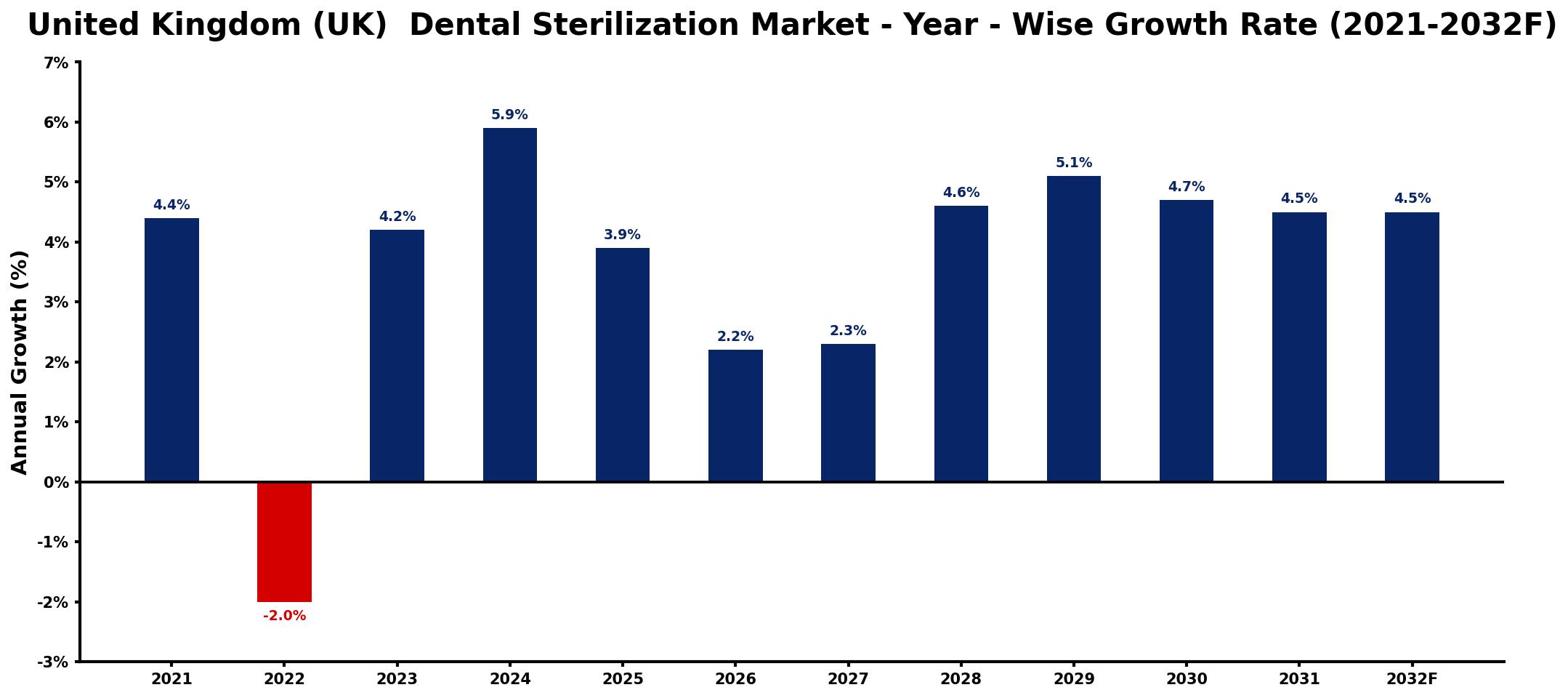
The table below presents the year‑wise growth rates along with the key drivers influencing the market
| Year | Growth Rate | Major Drivers |
| 2021 | 4.4% | Rising healthcare investment levels |
| 2022 | -2.0% | Supply chain disruptions affecting operations |
| 2023 | 4.2% | Increased focus on hygiene standards |
| 2024 | 5.9% | Growing awareness of infection control |
| 2025 | 3.9% | Expansion of healthcare facilities nationwide |
| 2026 | 2.2% | Technological advancements in healthcare |
| 2027 | 2.3% | Surge in preventive care practices |
| 2028 | 4.6% | Regulatory changes enhancing safety protocols |
| 2029 | 5.1% | Boost in patient safety initiatives |
| 2030 | 4.7% | Growing demand for advanced technologies |
| 2031 | 4.5% | Increased funding for healthcare innovations |
| 2032 | 4.5% | Rising public health awareness campaigns |
Note: Market size estimations and growth projections presented in this report are based on 6Wresearch's proprietary forecasting methodology, utilizing the latest available industry data, government publications, and primary research inputs.
United Kingdom (UK) Dental Sterilization Market Synopsis
The UK Dental Sterilization Market has witnessed significant momentum in recent years, driven largely by technological advancements and a growing emphasis on hygiene in dental practices. As awareness of infection control measures rises, dental professionals are increasingly investing in advanced sterilization solutions to meet compliance standards.
However, the market is also on the cusp of transformative changes. The growing demand for single-use sterilization products and sustainable practices is expected to reshape how dental sterilization is approached. Innovations in sterilization equipment and methods will play a crucial role in this evolution.
United Kingdom (UK) Dental Sterilization Market Key Takeaways
- The market is driven by the increasing prevalence of dental diseases and a heightened focus on infection control.
- Advanced sterilization technologies are gaining traction, with a notable shift towards automation and digital monitoring systems.
- Regulatory compliance remains a pivotal concern, influencing the purchasing decisions of dental professionals.
- There is a growing trend towards disposable sterilization products aimed at reducing cross-contamination risks.
- Investment opportunities exist in manufacturing innovative sterilization solutions that enhance operational efficiency.
Evaluation of Restraints in United Kingdom (UK) Dental Sterilization Market
The UK Dental Sterilization Market faces several significant restraints that could impede its growth trajectory. Stringent regulatory requirements pose a challenge for dental practices, as compliance necessitates continuous investment in updated technologies and staff training. Moreover, the pressure to balance cost reduction with stringent infection control standards continues to complicate decision-making for dental professionals. Furthermore, as the healthcare landscape evolves, the need to address emerging pathogens and the environmental impact of sterilization processes highlights the urgency for innovative, sustainable solutions within the market.
United Kingdom (UK) Dental Sterilization Market Trends
Several key trends are currently shaping the UK Dental Sterilization Market. Notably, there is a marked shift towards the adoption of sophisticated sterilization technologies, including autoclaves and chemical sterilants, driven by the demand for effective disinfection in dental clinics. Additionally, the preference for single-use disposable instruments is rapidly increasing as practitioners aim to minimize the risk of cross-contamination.
Moreover, the integration of digital monitoring systems within sterilization processes enhances the reliability of practices, ensuring adherence to safety protocols. As the market continues to evolve, these trends are indicative of a broader commitment to patient safety and quality assurance in dental care.
United Kingdom (UK) Dental Sterilization Market Opportunities
The UK Dental Sterilization Market presents numerous investment opportunities, particularly for those interested in advanced sterilization technologies. As dental clinics increasingly prioritize infection control, there is a growing demand for autoclaves, ultrasonic cleaners, and sterilization packaging solutions. Investors should also focus on research and development aimed at creating innovative sterilization processes that improve efficiency and reduce sterilization times. Furthermore, the exploration of sustainable practices and materials in sterilization can open new avenues for growth in this dynamic market.
Government Initiatives in the United Kingdom (UK) Dental Sterilization Market
The UK government enforces strict regulations to ensure high standards of infection control within dental practices. The Care Quality Commission (CQC) is instrumental in setting comprehensive standards for dental sterilization processes. Moreover, the Health and Safety Executive (HSE) issues guidelines on the safe handling of medical waste and sharps, promoting a safe environment for both patients and practitioners. Alongside this, the Medicines and Healthcare products Regulatory Agency (MHRA) oversees the regulation of sterilization equipment, ensuring that dental professionals comply with established safety protocols.
Future Insights of the United Kingdom (UK) Dental Sterilization Market
Looking ahead to the period from 2026 to 2032, the United Kingdom Dental Sterilization Market is expected to thrive as the focus on patient safety and infection prevention continues to intensify. With the rise in dental procedures and the adoption of cutting-edge sterilization technologies, the market is poised for sustained growth. Additionally, evolving regulatory requirements and increased awareness around infection control will further compel dental professionals to invest in advanced sterilization solutions, ensuring high standards of care in dental practices across the UK.
United Kingdom (UK) Dental Sterilization Market Latest Developments (2025 - 2026)
In recent months, the UK Dental Sterilization Market has seen notable developments, including the introduction of next-generation sterilization equipment that emphasizes automation and efficiency. Increased research initiatives targeting the effectiveness of new sterilization agents have been on the rise, driven by the need for improved disinfection solutions. Additionally, dental clinics are increasingly collaborating with manufacturers to tailor sterilization products that meet specific clinical needs, reflecting a shift towards customized solutions in the market.
United Kingdom (UK) Dental Sterilization Market - Key Attractiveness of the Report
- 10 Years of Market Numbers
- Historical Data Starting from 2022 to 2025
- Base Year: 2025
- Forecast Data until 2032
- Key Performance Indicators Impacting the Market
- Major Upcoming Developments and Projects
Key Highlights of the Report:
- United Kingdom (UK) Dental Sterilization Market Outlook
- Market Size of United Kingdom (UK) Dental Sterilization Market, 2025
- Forecast of United Kingdom (UK) Dental Sterilization Market, 2032
- Historical Data and Forecast of United Kingdom (UK) Dental Sterilization Revenues & Volume for the Period 2022-2032F
- United Kingdom (UK) Dental Sterilization Market Trend Evolution
- United Kingdom (UK) Dental Sterilization Market Drivers and Challenges
- United Kingdom (UK) Dental Sterilization Price Trends
- United Kingdom (UK) Dental Sterilization Porter's Five Forces
- United Kingdom (UK) Dental Sterilization Industry Life Cycle
- Historical Data and Forecast of United Kingdom (UK) Dental Sterilization Market Revenues & Volume By Product for the Period 2022-2032F
- Historical Data and Forecast of United Kingdom (UK) Dental Sterilization Market Revenues & Volume By Instruments for the Period 2022-2032F
- Historical Data and Forecast of United Kingdom (UK) Dental Sterilization Market Revenues & Volume By Consumables and Accessories for the Period 2022-2032F
- Historical Data and Forecast of United Kingdom (UK) Dental Sterilization Market Revenues & Volume By End-use for the Period 2022-2032F
- Historical Data and Forecast of United Kingdom (UK) Dental Sterilization Market Revenues & Volume By Hospital for the Period 2022-2032F
- Historical Data and Forecast of United Kingdom (UK) Dental Sterilization Market Revenues & Volume By Dental Clinics for the Period 2022-2032F
- Historical Data and Forecast of United Kingdom (UK) Dental Sterilization Market Revenues & Volume By Dental Laboratories for the Period 2022-2032F
- United Kingdom (UK) Dental Sterilization Import Export Trade Statistics
- Market Opportunity Assessment By Product
- Market Opportunity Assessment By End-use
- United Kingdom (UK) Dental Sterilization Top Companies Market Share
- United Kingdom (UK) Dental Sterilization Competitive Benchmarking By Technical and Operational Parameters
- United Kingdom (UK) Dental Sterilization Company Profiles
- United Kingdom (UK) Dental Sterilization Key Strategic Recommendations






































