United Kingdom (UK) Metal & Metallurgy Machinery Market Summary
The united kingdom (uk) metal & metallurgy machinery market was estimated at USD 279 Million in 2025 and is projected to reach USD 345 Million by 2032, growing at a CAGR of 2.7% from 2026 to 2032.
United Kingdom (UK) Metal & Metallurgy Machinery Market Year-wise Growth Rate and Key Drivers
This graph highlights how the United Kingdom (UK) Metal & Metallurgy Machinery Market has steadily grown over the past five years, supported by major growth factors.
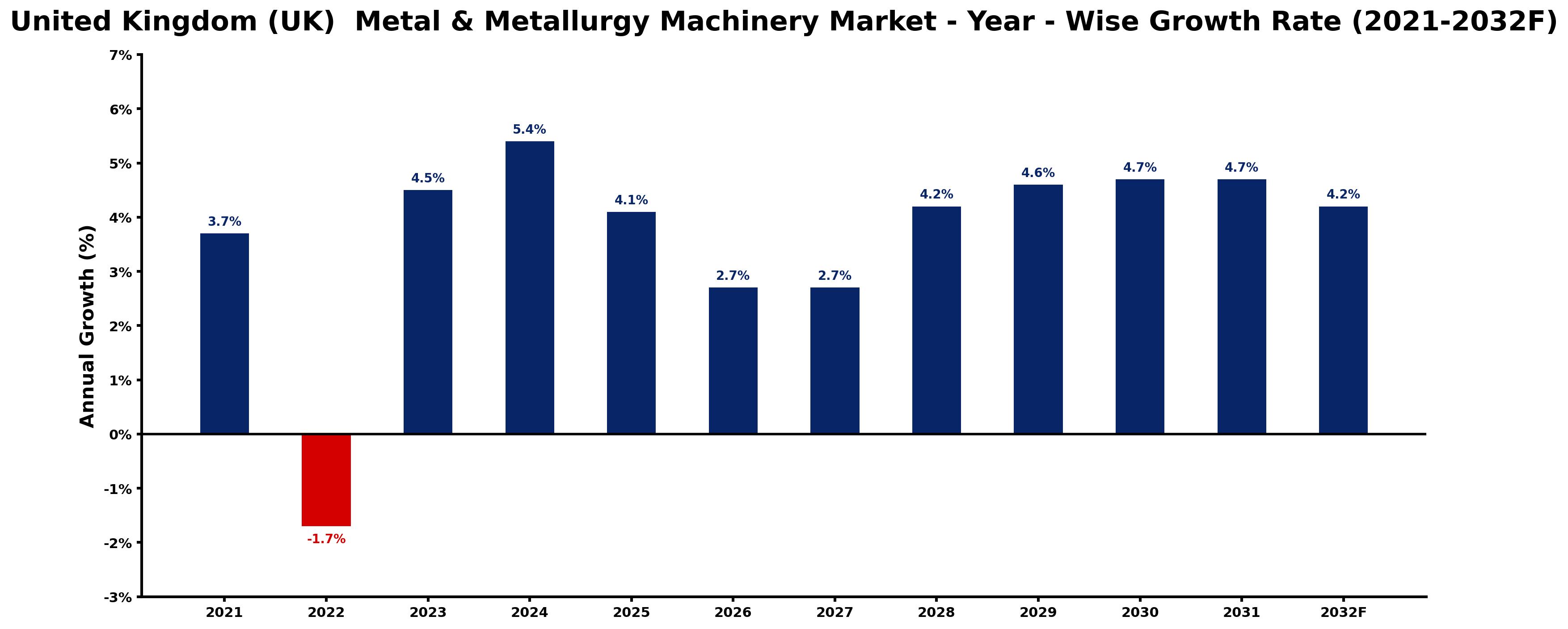
The table below presents the year wise growth rates along with the key drivers influencing the market
| Year | Growth Rate | Major Drivers |
| 2021 | 3.7% | Post-lockdown retail projects prompted machinery upgrades in diverse sectors across the UK. |
| 2022 | -1.7% | Supply chain disruptions severely impacted machinery availability, leading to delays and reduced investment in the industry. |
| 2023 | 4.5% | Sustainability mandates pushed firms to adopt eco-friendly metallurgy solutions and machinery. |
| 2024 | 5.4% | Innovation in automation led companies to enhance efficiency in metal processing operations. |
| 2025 | 4.1% | International trade agreements facilitated increased imports and exports of metal machinery. |
| 2026 | 2.7% | Construction sector expansion stimulated demand for advanced metal and metallurgy solutions. |
| 2027 | 2.7% | Technological breakthroughs in 3D printing reshaped metal fabrication processes in the market. |
| 2028 | 4.2% | Workforce development initiatives concentrated on upskilling technicians in advanced metallurgy techniques. |
| 2029 | 4.6% | Market consolidation among machinery producers resulted in optimized operational frameworks and offerings. |
| 2030 | 4.7% | Industry collaborations fostered knowledge sharing, enhancing overall technological maturity in metallurgy. |
| 2031 | 4.7% | The shift towards modular design in machinery supported increased customization for clients. |
| 2032 | 4.2% | Global supply chain dynamics necessitated agile production strategies in the metallurgy sector. |
Note - Market size estimations and growth projections presented in this report are based on 6Wresearch's advanced forecasting approach, validated with industry datasets as of June 2026.
United Kingdom (UK) Metal & Metallurgy Machinery Market Synopsis
The United Kingdom (UK) Metal Metallurgy Machinery Market is projected to reach 2.7% and witness significant growth during the forecast period (2026-2032). This growth is primarily driven by the increasing demand for advanced machinery in key sectors such as automotive, construction, and aerospace. A notable aspect of this market is the rapid pace of technological advancements, which, coupled with a shift towards increased automation, is propelling the development of metal and metallurgy machinery. Additionally, government initiatives aimed at encouraging investments in machine tools are expected to provide attractive opportunities for stakeholders in this sector.
United Kingdom (UK) Metal & Metallurgy Machinery Market Growth Drivers
The growth trajectory of the United Kingdom (UK) Metal & Metallurgy Machinery Market is influenced by several key drivers which include:
- The rising demand for sophisticated machinery in the automotive sector, where precision and efficiency are paramount in manufacturing processes.
- Increased investments in construction projects that rely on robust and high-performance machinery for the fabrication of metal components.
- The ongoing expansion in the aerospace industry, which necessitates advanced metalworking machinery capable of meeting stringent safety and performance standards.
- Technological innovations, such as the integration of Industry 4.0 principles, which enhance production efficiency and reduce operational costs.
- The growing trend of automation across industries, leading to a higher requirement for advanced metal processing tools to maintain competitive edge.
United Kingdom (UK) Metal & Metallurgy Machinery Market Challenges and Restraints
While the prospects for the United Kingdom (UK) Metal & Metallurgy Machinery Market appear positive, certain challenges and restraints may impede growth. These include:
- The high initial investment costs associated with advanced machinery, which can deter smaller enterprises from upgrading their equipment.
- Supply chain disruptions that have been exacerbated by global events, impacting the availability of raw materials essential for manufacturing machinery.
- The need for skilled labor to operate and maintain advanced machinery, which can be a constraint given the current industry-wide skills gap.
- Economic fluctuations that could lead to uncertainties in investment and spending on machinery, particularly in sectors such as construction.
- Environmental regulations requiring compliance that may increase operational costs for manufacturers and impact future investments.
United Kingdom (UK) Metal & Metallurgy Machinery Market Trends and Opportunities
The United Kingdom (UK) Metal & Metallurgy Machinery Market is witnessing several trends that present opportunities for growth. Key trends include:
- The shift towards green technology, as manufacturers increasingly seek energy-efficient and sustainable machinery to meet regulatory demands.
- Customized solutions tailored to specific industry needs, allowing for greater flexibility and efficiency in manufacturing processes.
- The adoption of artificial intelligence and machine learning technologies to optimize production and predictive maintenance of machinery.
- Growing collaborations between technology firms and machinery manufacturers aiming to integrate digital solutions into traditional manufacturing processes.
- Expansion into emerging markets, where there is an increasing demand for modern metallurgy equipment due to rapid industrialization.
United Kingdom (UK) Metal & Metallurgy Machinery Market Government Investment and Initiatives
The government of the United Kingdom has implemented various initiatives aimed at fostering growth within the Metal & Metallurgy Machinery Market. These initiatives include:
- Increased public spending on infrastructure projects, which directly correlates to a heightened demand for metal machinery in the construction sector.
- Grants and funding programs designed to support innovation and development in manufacturing technologies, particularly focusing on advanced machinery.
- Policies promoting the adoption of automation and digital technologies in manufacturing to enhance productivity and competitiveness.
- Collaborations with industry stakeholders to establish training programs that address the labor skills shortage in the metalworking sector.
- Development of strategic plans aimed at improving the supply chain resilience of metal machinery manufacturers through enhanced logistics and resource allocation.
United Kingdom (UK) Metal & Metallurgy Machinery Market Latest Developments (May 2025 - June 2026)
The period from May 2025 to June 2026 has seen notable developments in the United Kingdom (UK) Metal & Metallurgy Machinery Market, reflecting a dynamic and evolving industry landscape. Key developments include:
- Increased focus on research and development activities by companies aiming to introduce more efficient and technologically advanced machinery into the market.
- Growing partnerships between manufacturers and research institutions to accelerate innovation and introduce cutting-edge solutions tailored to market needs.
- The implementation of pilot programs aimed at promoting the use of sustainable practices and technologies in manufacturing operations.
- Emergence of new players in the market as startups leverage innovation to bring fresh perspectives and solutions to the metalworking industry.
- Continued emphasis on training and upskilling initiatives as a response to the challenges posed by the skills gap in the sector.
United Kingdom (UK) Metal & Metallurgy Machinery Market - Key Attractiveness of the Report
- 10 Years of Market Numbers
- Historical Data Starting from 2022 to 2025
- Base Year: 2025
- Forecast Data until 2032
- Key Performance Indicators Impacting the Market
- Major Upcoming Developments and Projects
Key Highlights of the Report:
- United Kingdom (UK) Metal & Metallurgy Machinery Market Outlook
- Market Size of United Kingdom (UK) Metal & Metallurgy Machinery Market, 2025
- Forecast of United Kingdom (UK) Metal & Metallurgy Machinery Market, 2032F
- Historical Data and Forecast of United Kingdom (UK) Metal & Metallurgy Machinery Revenues & Volume for the Period 2022-2032F
- United Kingdom (UK) Metal & Metallurgy Machinery Market Trend Evolution
- United Kingdom (UK) Metal & Metallurgy Machinery Market Drivers and Challenges
- United Kingdom (UK) Metal & Metallurgy Machinery Price Trends
- United Kingdom (UK) Metal & Metallurgy Machinery Porter's Five Forces
- United Kingdom (UK) Metal & Metallurgy Machinery Industry Life Cycle
- Historical Data and Forecast of United Kingdom (UK) Metal & Metallurgy Machinery Market Revenues & Volume By Product Types for the Period 2022-2032F
- Historical Data and Forecast of United Kingdom (UK) Metal & Metallurgy Machinery Market Revenues & Volume By Metal Rolling Machinery for the Period 2022-2032F
- Historical Data and Forecast of United Kingdom (UK) Metal & Metallurgy Machinery Market Revenues & Volume By Steelmaking Equipment for the Period 2022-2032F
- Historical Data and Forecast of United Kingdom (UK) Metal & Metallurgy Machinery Market Revenues & Volume By Ironmaking Equipment for the Period 2022-2032F
- Historical Data and Forecast of United Kingdom (UK) Metal & Metallurgy Machinery Market Revenues & Volume By Applications for the Period 2022-2032F
- Historical Data and Forecast of United Kingdom (UK) Metal & Metallurgy Machinery Market Revenues & Volume By Cutting for the Period 2022-2032F
- Historical Data and Forecast of United Kingdom (UK) Metal & Metallurgy Machinery Market Revenues & Volume By Welding for the Period 2022-2032F
- Historical Data and Forecast of United Kingdom (UK) Metal & Metallurgy Machinery Market Revenues & Volume By Non-Metal Processing for the Period 2022-2032F
- Historical Data and Forecast of United Kingdom (UK) Metal & Metallurgy Machinery Market Revenues & Volume By Additive Manufacturing for the Period 2022-2032F
- Historical Data and Forecast of United Kingdom (UK) Metal & Metallurgy Machinery Market Revenues & Volume By Others for the Period 2022-2032F
- United Kingdom (UK) Metal & Metallurgy Machinery Import Export Trade Statistics
- Market Opportunity Assessment By Product Types
- Market Opportunity Assessment By Applications
- United Kingdom (UK) Metal & Metallurgy Machinery Top Companies Market Share
- United Kingdom (UK) Metal & Metallurgy Machinery Competitive Benchmarking By Technical and Operational Parameters
- United Kingdom (UK) Metal & Metallurgy Machinery Company Profiles
- United Kingdom (UK) Metal & Metallurgy Machinery Key Strategic Recommendations






































