United States (US) Knitwear Market Top 5 Importing Countries and Market Competition (HHI) Analysis
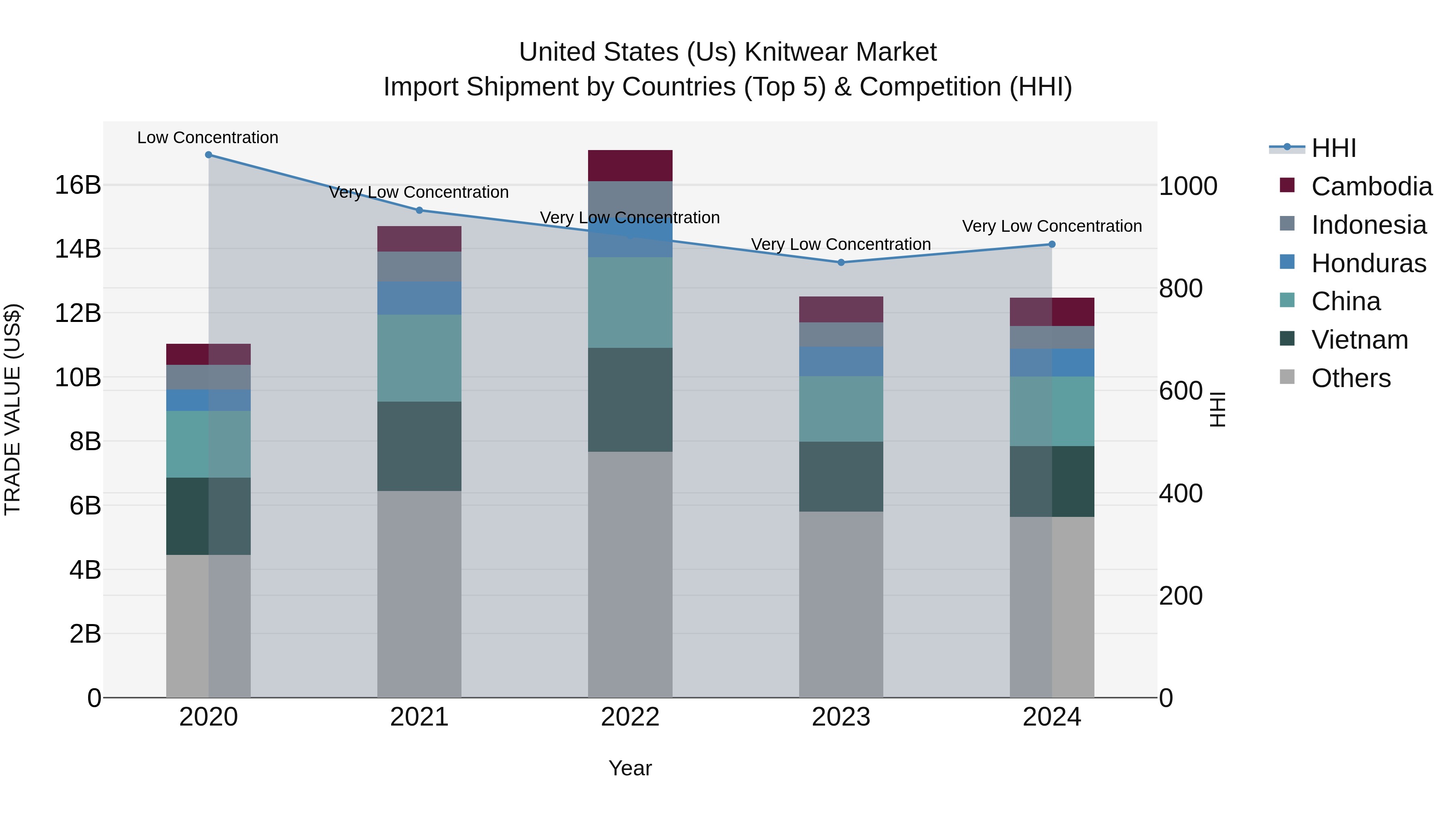
In 2024, the United States saw a steady CAGR of 3.11% in knitwear import shipments, with Vietnam, China, Cambodia, Honduras, and Indonesia emerging as the top exporting countries. Despite a marginal decline in growth rate from 2023 to 2024 (-0.3%), the market remained highly diversified with a very low Herfindahl-Hirschman Index (HHI) concentration. This indicates a healthy level of competition and opportunities for sourcing knitwear products from a variety of nations, ensuring a robust supply chain for the US market.
US Knitwear Market Highlights
| Report Name | US Knitwear Market |
| Forecast period | 2025-2031 |
| CAGR | 7.8% |
| Growing Sector | Apparel |
Topics Covered in the US Knitwear Market Report
The US Knitwear market report thoroughly covers the market by product type, by material type, by application, by consumer group, by distribution channel and competitive Landscape. The report provides an unbiased and detailed analysis of the on-going market trends, opportunities/high growth areas, and market drivers which would help the stakeholders to devise and align their market strategies according to the current and future market dynamics.
US Knitwear Market Synopsis
The US knitwear market has shown remarkable resilience and adaptability in the face of changing fashion trends and economic downturns. Industry analysts attribute this durability to several key factors, including the versatility of knitwear in both casual and formal settings, the comfort and durability of knitted fabrics, and the continuous innovation in design and material use. Furthermore, the rise of e-commerce has significantly widened the market reach for US knitwear brands, making it easier for consumers nationwide, and even globally, to access a wide variety of knitwear styles. Additionally, recent trends in the US knitwear market underscore a growing preference for eco-friendly and sustainable products. Consumers are increasingly aware of the environmental impact of their purchases, leading to a surge in demand for knitwear made from organic, recycled, or biodegradable materials. Additionally, the trend towards personalization and customization has taken a firm hold, with many consumers seeking unique, made-to-order knitwear that reflects their personal style and values. These trends not only influence consumer buying behavior but also drive innovation and creativity within the industry.
According to 6Wresearch, US Knitwear market size is projected to grow at a CAGR of 7.8% during 2025-2031. Among the primary drivers propelling growth in the US knitwear market is the burgeoning influence of social media and online influencers. Platforms such as Instagram, Pinterest, and TikTok have become pivotal in shaping fashion trends and purchasing decisions, especially among younger demographics. Influencers and fashion bloggers frequently spotlight knitwear items, from cozy, oversized sweaters to intricately patterned scarves, promoting both classic styles and innovative designs. This visibility not only drives immediate consumer interest and sales but also elevates the overall profile of knitwear in the fashion industry. Additionally, technological advancements in knitting machinery and techniques have enabled manufacturers to produce knitwear more efficiently and in greater variety, further stimulating market growth by appealing to a wider audience with high-quality, innovative products.
Government Initiatives Introduced in the US Knitwear Market
Government initiatives play a pivotal role in supporting the growth of the eco-friendly segment of the US knitwear market. Recognizing the importance of sustainability in fashion, federal and state governments have introduced various grants, subsidies, and policies geared towards encouraging the use of organic and recycled materials in the textile industry. These initiatives not only aim to reduce the environmental footprint of fashion manufacturing but also to foster innovation in sustainable textile production. Programs such as the Sustainable Fashion Alliance and public awareness campaigns highlight the significance of choosing eco-friendly apparel, further driving consumer demand for sustainable knitwear. Congruently, these initiatives have enhanced the US Knitwear Market Share. Further, through these efforts, the government actively contributes to shaping a more environmentally conscious market and supports the industry's shift towards greener practices.
Key Players in the US Knitwear Market
Key companies in the knitwear market, such as V.F. Corporation, Ralph Lauren, and H&M Group, have significantly contributed to shaping the industry's landscape. These companies continuously innovate in design, sustainability, and manufacturing practices, setting industry standards and responding to the increasing consumer demand for both fashion-forward and eco-friendly products. Their efforts in leveraging social media influence and adopting advanced technologies have played crucial roles in expanding their market reach and enhancing their brand value globally. In addition, the corporations’ grasp massive US Knitwear Market Revenues. Additionally, their active participation in sustainability initiatives and collaboration with government programs reflect a commitment to environmental stewardship and ethical fashion, further cementing their position as leaders in the knitwear industry.
Future Insights of the United States (US) Knitwear Market
Looking ahead, the knitwear industry is poised for a transformation, driven by a blend of technological advancements and an unyielding commitment to sustainability. Innovations such as 3D knitting and the use of bio-based fibers are expected to redefine production processes, reducing waste and improving efficiency. Furthermore, transparency and traceability will become critical factors influencing consumer choices, as digital tools make it easier to track the environmental impact of garments from farm to wardrobe. This shift towards a more informed and conscious consumer base will compel brands to further integrate sustainability into every aspect of their business model, from sourcing materials to packaging. As we move towards a future where fashion and environmental responsibility converge, the industry will likely witness a surge in collaborations between tech companies, fashion brands, and environmental organizations, aiming to create a circular economy that benefits both the planet and its inhabitants.
Market Analysis by Product Type
According to Ravi Bhandari, Research Head, 6Wresearch, in response to the evolving landscape of sustainable fashion, the industry is also seeing a diversification in the product range that incorporates environmentally friendly and technologically advanced materials. This includes innerwear and T-shirts & shirts made from fabrics like organic cotton and bamboo, which offer comfort and breathability while minimizing environmental impact. Sweaters & jackets, along with sweatshirts & hoodies, are being produced from recycled polyester and wool, supporting warmth and sustainability. Furthermore, shorts & trousers, as well as evening dresses, are being crafted from biodegradable materials and natural dyes, reflecting an eco-conscious approach to fashion. Lastly, suits & leggings are increasingly made from stretchable, recycled materials, offering flexibility and durability for both formal occasions and athletic activities. These product categories signify a comprehensive shift towards a more sustainable wardrobe, meeting the consumer demand for fashion that not only looks good but also feels good for the planet.
Market Analysis by Application
The sustainable fashion movement encompasses a wide array of applications, ensuring that every category of apparel can contribute to a healthier planet. Outerwear pieces, including jackets and coats, are being designed with recycled and upcycled materials, setting new standards for eco-friendly fashion. Innerwear, such as underwear and bras, are increasingly made from organic cotton and bamboo fibers, offering comfort and sustainability. Sportswear items, including leggings and sports bras, are crafted from stretchable, recycled materials, providing the necessary flexibility and support for athletic activities while minimizing environmental footprints. Lastly, the Others category captures a variety of apparel including accessories like hats and bags, made from innovative, sustainable materials, ensuring that eco-consciousness extends beyond clothing to encompass every aspect of one’s wardrobe.
Key Attractiveness of the Report
- 10 Years Market Numbers.
- Historical Data Starting from 2021 to 2024.
- Base Year: 2024.
- Forecast Data until 2031.
- Key Performance Indicators Impacting the Market.
- Major Upcoming Developments and Projects.
Key Highlights of the Report:
- US Knitwear Market Market Outlook
- Market Size of US Knitwear Market Market, 2024
- Forecast of US Knitwear Market Market, 2031
- Historical Data and Forecast of US Knitwear Market Revenues & Volume for the Period 2021 - 2031
- US Knitwear Market Market Trend Evolution
- US Knitwear Market Market Drivers and Challenges
- US Knitwear Market Price Trends
- US Knitwear Market Porter's Five Forces
- US Knitwear Market Industry Life Cycle
- Historical Data and Forecast of US Knitwear Market Market Revenues & Volume By Product Type for the Period 2021 - 2031
- Historical Data and Forecast of US Knitwear Market Market Revenues & Volume By Innerwear for the Period 2021 - 2031
- Historical Data and Forecast of US Knitwear Market Market Revenues & Volume By T-Shirts & Shirts for the Period 2021 - 2031
- Historical Data and Forecast of US Knitwear Market Market Revenues & Volume By Sweaters & Jackets for the Period 2021 - 2031
- Historical Data and Forecast of US Knitwear Market Market Revenues & Volume By Sweatshirts & Hoodies for the Period 2021 - 2031
- Historical Data and Forecast of US Knitwear Market Market Revenues & Volume By Shorts & Trousers for the Period 2021 - 2031
- Historical Data and Forecast of US Knitwear Market Market Revenues & Volume By Evening Dresses, Suits, & Leggings for the Period 2021 - 2031
- Historical Data and Forecast of US Knitwear Market Market Revenues & Volume By Accessories for the Period 2021 - 2031
- Historical Data and Forecast of US Knitwear Market Market Revenues & Volume By Material Type for the Period 2021 - 2031
- Historical Data and Forecast of US Knitwear Market Market Revenues & Volume By Natural for the Period 2021 - 2031
- Historical Data and Forecast of US Knitwear Market Market Revenues & Volume By Synthetic for the Period 2021 - 2031
- Historical Data and Forecast of US Knitwear Market Market Revenues & Volume By Blended for the Period 2021 - 2031
- Historical Data and Forecast of US Knitwear Market Market Revenues & Volume By Applications for the Period 2021 - 2031
- Historical Data and Forecast of US Knitwear Market Market Revenues & Volume By Outerwear for the Period 2021 - 2031
- Historical Data and Forecast of US Knitwear Market Market Revenues & Volume By Innerwear for the Period 2021 - 2031
- Historical Data and Forecast of US Knitwear Market Market Revenues & Volume By Sportswear for the Period 2021 - 2031
- Historical Data and Forecast of US Knitwear Market Market Revenues & Volume By Others for the Period 2021 - 2031
- Historical Data and Forecast of US Knitwear Market Market Revenues & Volume By Consumer Group for the Period 2021 - 2031
- Historical Data and Forecast of US Knitwear Market Market Revenues & Volume By Men for the Period 2021 - 2031
- Historical Data and Forecast of US Knitwear Market Market Revenues & Volume By Women for the Period 2021 - 2031
- Historical Data and Forecast of US Knitwear Market Market Revenues & Volume By Kids for the Period 2021 - 2031
- Historical Data and Forecast of US Knitwear Market Market Revenues & Volume By Distribution Channel for the Period 2021 - 2031
- Historical Data and Forecast of US Knitwear Market Market Revenues & Volume By Online for the Period 2021 - 2031
- Historical Data and Forecast of US Knitwear Market Market Revenues & Volume By Offline for the Period 2021 - 2031
- US Knitwear Market Import Export Trade Statistics
- Market Opportunity Assessment By Product Type
- Market Opportunity Assessment By Material Type
- Market Opportunity Assessment By Applications
- Market Opportunity Assessment By Consumer Group
- Market Opportunity Assessment By Distribution Channel
- US Knitwear Market Top Companies Market Share
- US Knitwear Market Competitive Benchmarking By Technical and Operational Parameters
- US Knitwear Market Company Profiles
- US Knitwear Market Key Strategic Recommendations
Market Covered
The report offers a comprehensive study of the subsequent market segments:
By Product Type
- Innerwear
- T-Shirts & Shirts
- Sweaters & Jackets
- Sweatshirts & Hoodies
- Shorts & Trousers
- Evening Dresses
- Suits, & Leggings
- Accessories
By Material Type
- Natural
- Synthetic
- Blended
By Applications
- Outerwear
- Innerwear
- Sportswear
- Others
By Consumer Group
- Men
- Women
- Kids
By Distribution Channel
- Online
- Offline






































