United States (US) Television Broadcasting Market Size, Share & Growth Rate
The United States (US) Television Broadcasting Market was estimated at USD 174 Million in 2025 and is projected to reach USD 234 Million by 2032, growing at a CAGR of 4.3% from 2026 to 2032. This growth trajectory is driven by the increasing shift towards on-demand viewing and the rising demand for original programming from both traditional and streaming platforms. As consumer preferences evolve, broadcasters are adjusting their strategies to capture a larger share of the digital advertising market, leading to a more vibrant and competitive landscape.
United States (US) Television Broadcasting Market Year-wise Growth Rate and Key Drivers
This graph highlights how the United States (US) Television Broadcasting Market has steadily grown over the years, supported by major growth factors.
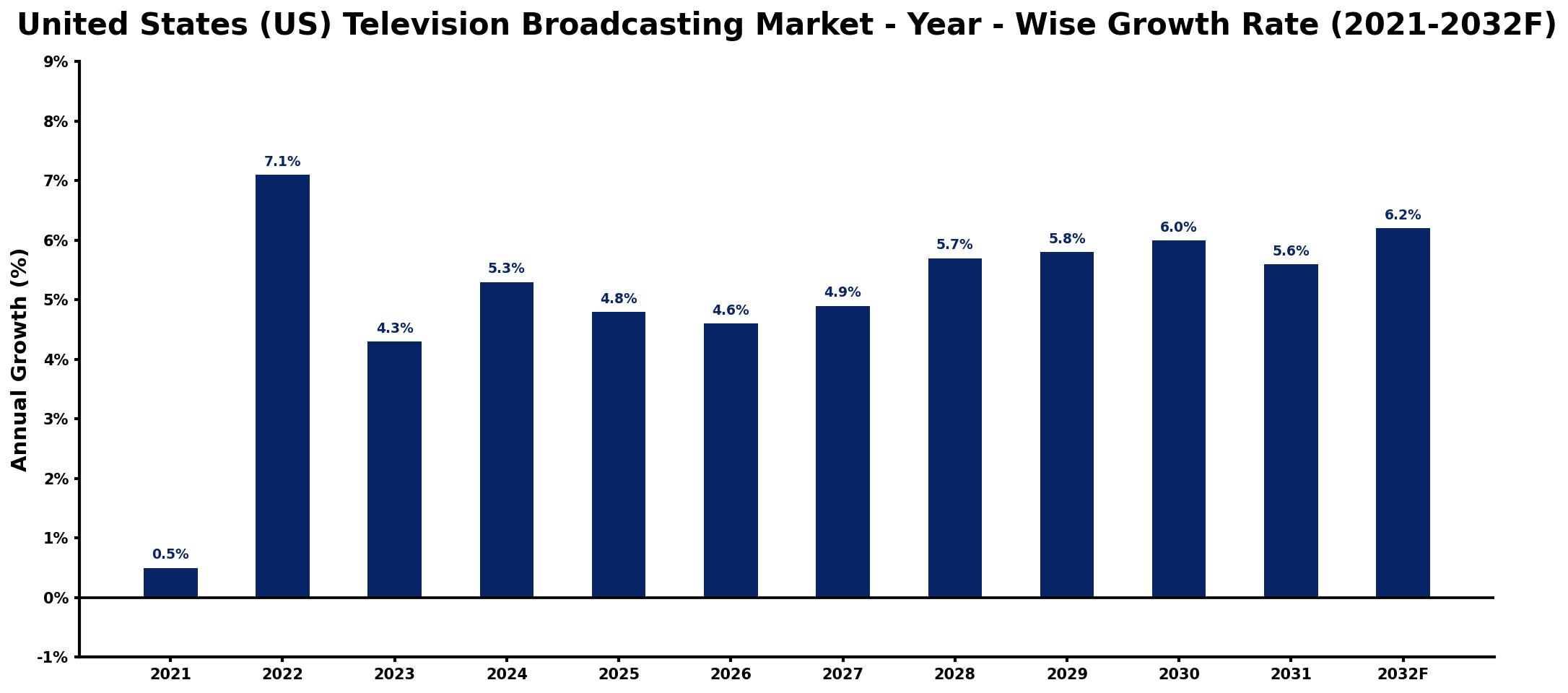
The table below presents the year‑wise growth rates along with the key drivers influencing the market
| Year | Growth Rate | Major Drivers |
| 2021 | 0.5% | Increased demand for streaming content |
| 2022 | 7.1% | Higher advertising revenue from digital |
| 2023 | 4.3% | Expansion of content production facilities |
| 2024 | 5.3% | Rise in subscription service offerings |
| 2025 | 4.8% | Growing interest in original programming |
| 2026 | 4.6% | strengthening international trade flows |
| 2027 | 4.9% | Surge in live event coverage |
| 2028 | 5.7% | Enhanced viewer engagement strategies |
| 2029 | 5.8% | Emergence of niche content platforms |
| 2030 | 6.0% | Increased partnerships with influencers |
| 2031 | 5.6% | Development of immersive viewing experiences |
| 2032 | 6.2% | growing emerging market penetration |
Note: Market size estimations and growth projections presented in this report are based on 6Wresearch's proprietary forecasting methodology, utilizing the latest available industry data, government publications, and primary research inputs.
United States (US) Television Broadcasting Market Synopsis
The most significant force currently shaping the United States Television Broadcasting Market is the rapid rise of streaming services. This trend has disrupted traditional broadcasting models and created a surge in competition, forcing established networks to innovate and diversify their content offerings. Audiences are increasingly gravitating towards platforms that provide flexible viewing options and high-quality original content, which is reshaping how broadcasters approach programming and distribution.
Additionally, the investment in technology for enhanced viewer engagement is pivotal in this market. Broadcasters are harnessing analytics and advanced broadcasting solutions to tailor content to specific demographics, thus improving viewer retention. As a result, industry stakeholders are compelled to adapt not only their content strategies but also their delivery methods to align with the evolving media consumption landscape.
United States (US) Television Broadcasting Market Key Takeaways
- The market is experiencing a paradigm shift towards digital streaming and on-demand content.
- Traditional broadcasters are launching their own streaming platforms to compete effectively.
- Advertisers are pivoting to digital marketing strategies to keep pace with changing viewer habits.
- Investment opportunities are emerging in content production and technology solutions for broadcasters.
- Regulatory frameworks continue to evolve, impacting operational strategies for television networks.
Evaluation of Restraints in United States (US) Television Broadcasting Market
Despite its robust growth, the United States Television Broadcasting Market faces real constraints. The surge in competition from streaming services has led to declining viewership for traditional cable networks, as consumers increasingly adopt cord-cutting behaviors. Additionally, the rising costs associated with producing high-quality original programming can strain budgets. Furthermore, navigating an evolving regulatory environment presents challenges that broadcasters must address to maintain compliance and competitive edge. These factors require a strategic focus on innovation and adaptability from all industry participants.
United States (US) Television Broadcasting Market Trends
Current trends indicate a strong movement towards personalized viewing experiences facilitated by advanced technology. Streaming services are increasingly investing in artificial intelligence and machine learning to analyze viewer data and deliver curated content. Moreover, the demand for live content, especially in sports and special events, continues to remain strong, compelling traditional broadcasters to adapt their offerings accordingly. Another trend is the growing collaboration between traditional broadcasters and tech companies to enhance content distribution and viewer engagement.
United States (US) Television Broadcasting Market Opportunities
Opportunities abound in the United States Television Broadcasting Market, particularly in original content production and digital advertising. As streaming platforms continue to thrive, theres a burgeoning demand for unique, quality programming that resonates with diverse audiences. Companies specializing in technology solutions that support seamless broadcasting and content analytics are also positioned for growth. Furthermore, strategic partnerships between traditional networks and emerging platforms can create synergistic advantages, paving the way for innovative content delivery methods and wider reach.
Government Initiatives in the United States (US) Television Broadcasting Market
The regulatory landscape governing the United States Television Broadcasting Market is primarily influenced by the Federal Communications Commission (FCC). The FCC's initiatives aim to ensure fair competition and access to quality programming, enforcing regulations that promote diverse media ownership and content requirements. Furthermore, the FCC plays a pivotal role in managing issues related to digital broadcasting standards and licensing, which are crucial for maintaining market integrity and fostering innovation within the industry.
Future Insights of the United States (US) Television Broadcasting Market
Looking ahead to 2026-2032, the United States Television Broadcasting Market is poised for significant transformations. The dominance of streaming platforms will likely continue, compelling traditional broadcasters to evolve their business models and distribution strategies. Technological advancements, such as the rollout of 5G, will facilitate enhanced content delivery and interactive viewer experiences. Moreover, as audience demands shift towards integrated content across various platforms, the market will see an increased focus on producing high-quality, engaging programming tailored to diverse consumer preferences.
United States (US) Television Broadcasting Market Latest Developments (2025 - 2026)
In recent months, the United States Television Broadcasting Market has witnessed a surge in collaborations between traditional broadcasters and digital platforms aimed at enhancing content accessibility. There's a notable uptick in investment towards original content production, with many networks announcing new series and specials designed to attract a broader audience. Additionally, advancements in streaming technology are being leveraged to improve viewer experiences and engagement, marking a significant direction in how content is consumed.
United States (US) Television Broadcasting Market - Key Attractiveness of the Report
- 10 Years of Market Numbers
- Historical Data Starting from 2022 to 2025
- Base Year: 2025
- Forecast Data until 2032
- Key Performance Indicators Impacting the Market
- Major Upcoming Developments and Projects
Key Highlights of the Report:
- United States (US) Television Broadcasting Market Outlook
- Market Size of United States (US) Television Broadcasting Market, 2025
- Forecast of United States (US) Television Broadcasting Market, 2032
- Historical Data and Forecast of United States (US) Television Broadcasting Revenues & Volume for the Period 2022-2032F
- United States (US) Television Broadcasting Market Trend Evolution
- United States (US) Television Broadcasting Market Drivers and Challenges
- United States (US) Television Broadcasting Price Trends
- United States (US) Television Broadcasting Porter's Five Forces
- United States (US) Television Broadcasting Industry Life Cycle
- Historical Data and Forecast of United States (US) Television Broadcasting Market Revenues & Volume By Type for the Period 2022-2032F
- Historical Data and Forecast of United States (US) Television Broadcasting Market Revenues & Volume By Television Station for the Period 2022-2032F
- Historical Data and Forecast of United States (US) Television Broadcasting Market Revenues & Volume By Television Network for the Period 2022-2032F
- Historical Data and Forecast of United States (US) Television Broadcasting Market Revenues & Volume By Broadcaster Type for the Period 2022-2032F
- Historical Data and Forecast of United States (US) Television Broadcasting Market Revenues & Volume By Public for the Period 2022-2032F
- Historical Data and Forecast of United States (US) Television Broadcasting Market Revenues & Volume By Commercial for the Period 2022-2032F
- Historical Data and Forecast of United States (US) Television Broadcasting Market Revenues & Volume By Revenue Source for the Period 2022-2032F
- Historical Data and Forecast of United States (US) Television Broadcasting Market Revenues & Volume By Subscription-based for the Period 2022-2032F
- Historical Data and Forecast of United States (US) Television Broadcasting Market Revenues & Volume By Advertisement-based for the Period 2022-2032F
- United States (US) Television Broadcasting Import Export Trade Statistics
- Market Opportunity Assessment By Type
- Market Opportunity Assessment By Broadcaster Type
- Market Opportunity Assessment By Revenue Source
- United States (US) Television Broadcasting Top Companies Market Share
- United States (US) Television Broadcasting Competitive Benchmarking By Technical and Operational Parameters
- United States (US) Television Broadcasting Company Profiles
- United States (US) Television Broadcasting Key Strategic Recommendations






































