Venezuela Advertising Market Size, Share & Growth Rate
The Venezuela Advertising Market was estimated at USD 253 Million in 2025 and is projected to reach USD 343 Million by 2032, growing at a CAGR of 4.4% from 2026 to 2032. This growth trajectory is largely driven by the rising internet penetration and a shift towards digital advertising, which offers a more cost-effective means of reaching consumers in a challenging economic climate. Brands are increasingly allocating their budgets to targeted digital campaigns, aiming to maximize their return on investment.
Venezuela Advertising Market Year-wise Growth Rate and Key Drivers
This graph highlights how the Venezuela Advertising Market has steadily grown over the years, supported by major growth factors.
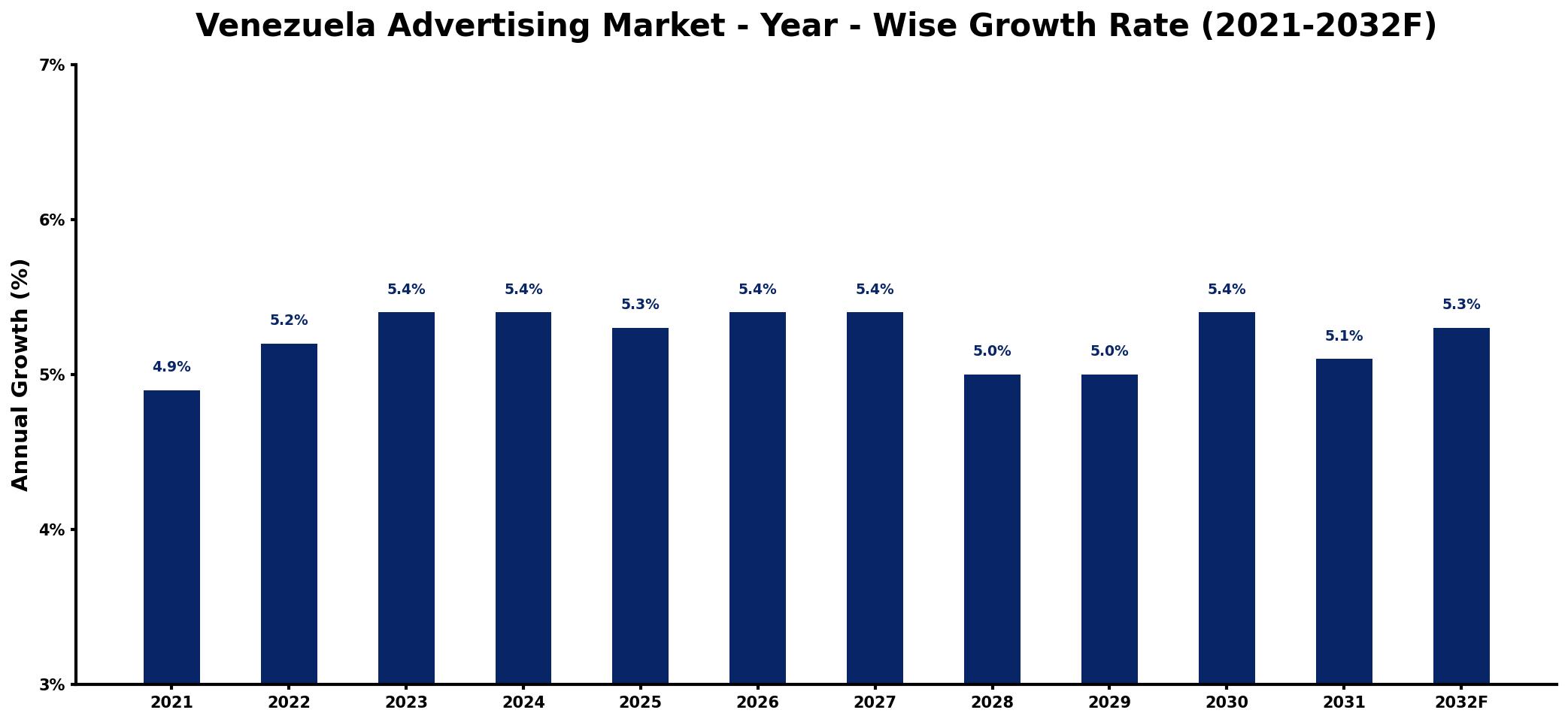
The table below presents the year‑wise growth rates along with the key drivers influencing the market
| Year | Growth Rate | Major Drivers |
| 2021 | 4.9% | increased digital media consumption |
| 2022 | 5.2% | growth in e-commerce platforms |
| 2023 | 5.4% | rising export shipment volumes |
| 2024 | 5.4% | rising demand for local content |
| 2025 | 5.3% | investment in influencer marketing |
| 2026 | 5.4% | enhanced data analytics capabilities |
| 2027 | 5.4% | growing automotive sector requirements |
| 2028 | 5.0% | emergence of new technologies |
| 2029 | 5.0% | rising procurement volume requirements |
| 2030 | 5.4% | development of immersive experiences |
| 2031 | 5.1% | growing importance of sustainability |
| 2032 | 5.3% | expansion of video marketing strategies |
Note: Market size estimations and growth projections presented in this report are based on 6Wresearch's proprietary forecasting methodology, utilizing the latest available industry data, government publications, and primary research inputs.
Venezuela Advertising Market Synopsis
The Venezuela advertising market is currently in a state of flux. Recent trends indicate a growing enthusiasm for digital platforms as traditional media faces challenges from reduced consumer spending and restrictive budgets. As brands adapt to these realities, they are exploring innovative advertising methods to engage a population that is both economically constrained and politically aware.
Moving forward, the markets dynamics are expected to continue shifting. While regulatory constraints and political uncertainties pose significant hurdles, the ongoing digital transformation presents new avenues for brands to connect with their audiences. Advertisers who embrace this duality of challenge and opportunity will be better positioned to thrive in Venezuela's unpredictable advertising landscape.
Venezuela Advertising Market Key Takeaways
- The Venezuela advertising market is experiencing a significant shift towards digital advertising as traditional channels face economic limitations.
- Targeted marketing strategies and influencer collaborations are becoming essential tools for effective audience engagement.
- Regulatory challenges remain a significant barrier, necessitating creative approaches to navigate governmental restrictions on content.
- The increasing demand for digital services highlights potential investment opportunities in local digital marketing platforms and agencies.
- Despite ongoing turmoil, there is an opportunity for growth driven by a large and connected population eager for innovative advertising solutions.
Evaluation of Restraints in Venezuela Advertising Market
The Venezuela advertising market is severely constrained by multiple factors that impact its overall viability. Economic instability, primarily characterized by hyperinflation and severe currency devaluation, has resulted in a marked decline in consumer purchasing power. This directly affects advertising budgets across the board. Moreover, the political climate adds another layer of complexity. Government regulations on advertising content not only restrict creative expression but also create an environment where advertisers must operate with caution to avoid potential backlash or censorship. As a result, businesses face significant challenges in planning and executing effective advertising strategies within these confines.
Venezuela Advertising Market Trends
The current landscape of the Venezuela advertising market is heavily influenced by the need for cost-effective solutions amidst financial hardship. Digital advertising is on the rise, spurred by the high internet penetration rates, which offer an accessible platform for brands to reach consumers. Social media marketing, particularly through influencers, is gaining traction as companies strive for authentic connections with their audience. Additionally, there is an observable trend towards hyper-targeted advertising, allowing brands to maximize their budgets and engage specific consumer segments effectively. This shift highlights an evolution in advertising strategies that prioritize efficiency and engagement over traditional approaches.
Venezuela Advertising Market Opportunities
Despite the myriad of challenges, the Venezuela advertising market reveals notable opportunities for growth. The increasing penetration of digital technology among the population suggests a fertile ground for innovative digital marketing strategies. Investing in local digital marketing agencies and platforms could prove lucrative as businesses look for ways to adapt to the market's changing dynamics. Furthermore, traditional media channels, although facing adversity, still hold value and present opportunities for targeted campaigns, especially in underserved demographics. The potential for innovative advertising solutions that address local needs is significant, paving the way for investment and growth in this complex environment.
Government Initiatives in the Venezuela Advertising Market
Government policies affecting the Venezuela advertising market are characterized by stringent regulations that dictate content and messaging strategies. These regulations are often influenced by the current political climate and are designed to control the narrative within media channels. The government has shown a preference for local advertising companies over foreign agencies, aiming to maintain control over the industry. Additionally, there are attempts to use advertising as a means of promoting government initiatives and propaganda, which further complicates the landscape for private advertisers seeking to maintain creative freedom.
Future Insights of the Venezuela Advertising Market
Looking ahead to 2026-2032, the Venezuela advertising market is expected to continue facing economic and political hurdles. However, as the digitalization of consumer interactions progresses, there could be significant openings for growth, particularly in the digital advertising sphere. Advertisers will need to remain agile, adopting innovative strategies that align with both the technological landscape and the consumer psyche. By effectively monitoring the evolving political and economic environment, brands can make informed decisions that drive success, navigating the complexities of a market ripe with both challenges and opportunities.
Venezuela Advertising Market Latest Developments (2025 - 2026)
Recent developments in the Venezuela advertising market highlight a continued shift towards digital platforms. Various brands are pivoting towards social media and influencer marketing as essential components of their advertising strategies. Additionally, the emergence of local digital marketing solutions is beginning to take root, offering businesses tailored services that resonate more closely with local consumer needs. The landscape remains dynamic, with businesses exploring innovative approaches to stay relevant amidst ongoing economic challenges.
Venezuela Advertising Market - Key Attractiveness of the Report
- 10 Years of Market Numbers
- Historical Data Starting from 2022 to 2025
- Base Year: 2025
- Forecast Data until 2032
- Key Performance Indicators Impacting the Market
- Major Upcoming Developments and Projects
Key Highlights of the Report:
- Venezuela Advertising Market Outlook
- Market Size of Venezuela Advertising Market, 2025
- Forecast of Venezuela Advertising Market, 2032
- Historical Data and Forecast of Venezuela Advertising Revenues & Volume for the Period 2022-2032F
- Venezuela Advertising Market Trend Evolution
- Venezuela Advertising Market Drivers and Challenges
- Venezuela Advertising Price Trends
- Venezuela Advertising Porter's Five Forces
- Venezuela Advertising Industry Life Cycle
- Historical Data and Forecast of Venezuela Advertising Market Revenues & Volume By Type for the Period 2022-2032F
- Historical Data and Forecast of Venezuela Advertising Market Revenues & Volume By Television for the Period 2022-2032F
- Historical Data and Forecast of Venezuela Advertising Market Revenues & Volume By Print (Newspaper and Magazine) for the Period 2022-2032F
- Historical Data and Forecast of Venezuela Advertising Market Revenues & Volume By Radio for the Period 2022-2032F
- Historical Data and Forecast of Venezuela Advertising Market Revenues & Volume By Outdoor for the Period 2022-2032F
- Historical Data and Forecast of Venezuela Advertising Market Revenues & Volume By Internet (Search, Display, Classified, Video) for the Period 2022-2032F
- Historical Data and Forecast of Venezuela Advertising Market Revenues & Volume By Mobile for the Period 2022-2032F
- Historical Data and Forecast of Venezuela Advertising Market Revenues & Volume By Cinema for the Period 2022-2032F
- Venezuela Advertising Import Export Trade Statistics
- Market Opportunity Assessment By Type
- Venezuela Advertising Top Companies Market Share
- Venezuela Advertising Competitive Benchmarking By Technical and Operational Parameters
- Venezuela Advertising Company Profiles
- Venezuela Advertising Key Strategic Recommendations






































