Venezuela Mineral Oil Market Size, Share & Growth Rate
The Venezuela Mineral Oil Market was estimated at USD 161 Million in 2025 and is projected to reach USD 214 Million by 2032, growing at a CAGR of 4.1% from 2026 to 2032. This growth is propelled by the country's substantial mineral oil reserves, alongside potential reforms aimed at stabilizing the oil sector. Furthermore, partnerships with foreign investors could enhance technology transfer and operational efficiency, creating a more robust market environment.
Venezuela Mineral Oil Market Year-wise Growth Rate and Key Drivers
This graph highlights how the Venezuela Mineral Oil Market has steadily grown over the years, supported by major growth factors.
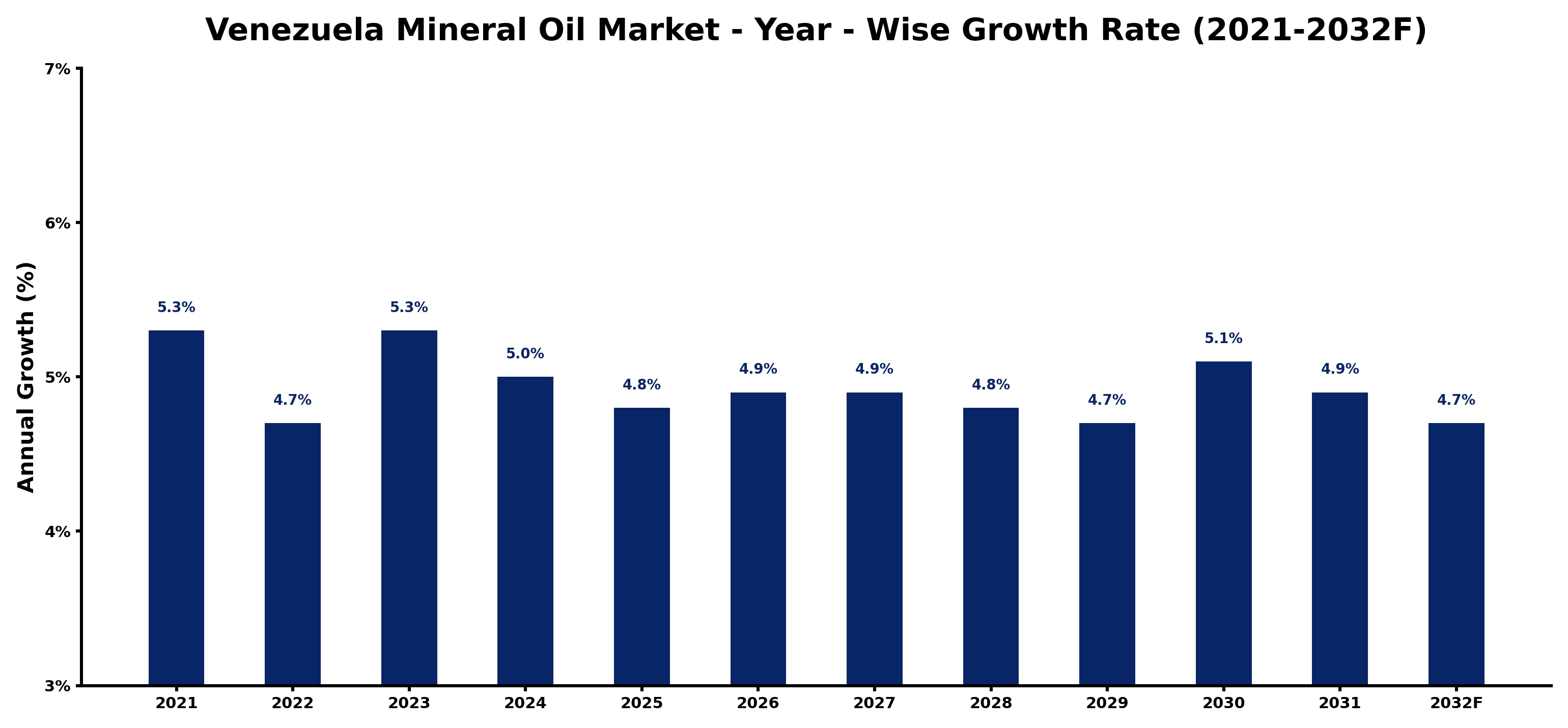
The table below presents the year‑wise growth rates along with the key drivers influencing the market
| Year | Growth Rate | Major Drivers |
| 2021 | 5.3% | Growing urbanization and commercial development |
| 2022 | 4.7% | Increasing smart city development projects |
| 2023 | 5.3% | Expansion of commercial construction activities |
| 2024 | 5.0% | Expansion of commercial construction activities |
| 2025 | 4.8% | Rapid growth in telecom and data center sectors |
| 2026 | 4.9% | Increasing industrial automation investments |
| 2027 | 4.9% | Expansion of commercial construction activities |
| 2028 | 4.8% | Rapid growth in telecom and data center sectors |
| 2029 | 4.7% | Government infrastructure modernization initiatives |
| 2030 | 5.1% | Government infrastructure modernization initiatives |
| 2031 | 4.9% | Expansion of transportation and logistics networks |
| 2032 | 4.7% | Increasing adoption of advanced technologies |
Note - Market size estimations and growth projections presented in this report are based on 6Wresearch's advanced forecasting approach, validated with industry datasets as of June 2026.
Venezuela Mineral Oil Market Synopsis
The Venezuela Mineral Oil Market is grappling with a complex landscape shaped by political turmoil and economic challenges. Although the country has significant oil reserves, the production levels are hindered by aging infrastructure and international sanctions that restrict access to essential technologies.
Current dynamics suggest that revitalizing investment and infrastructure is vital for the market's recovery. As Venezuela endeavors to re-establish its position in the global oil market, strategic reforms and enhanced partnerships are becoming increasingly necessary to attract foreign capital and expertise.
Venezuela Mineral Oil Market Key Takeaways
- The market is currently valued at USD 161 Million and projected to grow to USD 214 Million by 2032.
- Political instability and economic crises are significant barriers to production efficiency.
- Efforts to modernize infrastructure are essential for recovering production levels.
- Investment opportunities exist through potential collaborations with PDVSA and other stakeholders.
- International sanctions have severely limited market access and technological advancement.
Evaluation of Restraints in Venezuela Mineral Oil Market
The Venezuela Mineral Oil Market is significantly restrained by ongoing political instability and economic crises that have rendered the business environment volatile. The fluctuating regulations can dissuade potential investments, while rampant inflation and resource scarcity impede operational capabilities. Moreover, infrastructure deterioration and a lack of technological advancements further exacerbate production inefficiencies, making it challenging for companies to sustain profitability and growth.
Venezuela Mineral Oil Market Trends
Emerging trends within the Venezuela Mineral Oil Market indicate a shift towards seeking foreign partnerships as a strategy to overcome domestic challenges. This includes investments aimed at modernizing extraction and refining technologies to boost output. Additionally, the focus is increasingly on sustainable practices to address environmental concerns and align with global oil market trends.
Venezuela Mineral Oil Market Opportunities
There are substantial opportunities within the Venezuela Mineral Oil Market, particularly in the realms of joint ventures with international firms and upgrading aging infrastructure. Foreign investors may find value in exploring collaborative exploration projects, as well as in the development of downstream operations such as refining and distribution. The ongoing need for innovation in extraction technologies also presents a ripe avenue for research and development investments.
Government Initiatives in the Venezuela Mineral Oil Market
Government policies in Venezuela's mineral oil sector focus primarily on maintaining oversight through PDVSA, the state-owned oil company. The administration has implemented nationalization and regulatory policies aimed at ensuring that oil resources are managed for state benefit. However, these initiatives have been criticized for causing inefficiencies and stifling foreign investment. To attract international capital, reforms aimed at improving transparency and operational frameworks are vital.
Future Insights of the Venezuela Mineral Oil Market
Looking ahead to 2026-2032, the Venezuela Mineral Oil Market presents a complex yet potentially rewarding landscape. As the country navigates through its political and economic hurdles, the success of the market will hinge on effective government reforms and the ability to stabilize production. If the necessary changes are implemented, there is a chance for Venezuela to reclaim its status as a significant player in the global oil arena, capitalizing on its vast reserves.
Venezuela Mineral Oil Market Latest Developments (May 2025 - June 2026)
Recent developments in the Venezuela Mineral Oil Market have seen incremental advancements in local production capabilities, although progress remains slow due to infrastructure challenges. The government is reportedly considering new policies to attract foreign investment and promote technological partnerships. Additionally, there have been discussions regarding the revitalization of key oil fields and efforts to stabilize export routes amidst ongoing geopolitical tensions.
Venezuela Mineral Oil Market - Key Attractiveness of the Report
- 10 Years of Market Numbers
- Historical Data Starting from 2022 to 2025
- Base Year: 2025
- Forecast Data until 2032
- Key Performance Indicators Impacting the Market
- Major Upcoming Developments and Projects
Key Highlights of the Report:
- Venezuela Mineral Oil Market Outlook
- Market Size of Venezuela Mineral Oil Market, 2025
- Forecast of Venezuela Mineral Oil Market, 2032
- Historical Data and Forecast of Venezuela Mineral Oil Revenues & Volume for the Period 2022-2032F
- Venezuela Mineral Oil Market Trend Evolution
- Venezuela Mineral Oil Market Drivers and Challenges
- Venezuela Mineral Oil Price Trends
- Venezuela Mineral Oil Porter's Five Forces
- Venezuela Mineral Oil Industry Life Cycle
- Historical Data and Forecast of Venezuela Mineral Oil Market Revenues & Volume By Grade for the Period 2022-2032F
- Historical Data and Forecast of Venezuela Mineral Oil Market Revenues & Volume By Technical Oil for the Period 2022-2032F
- Historical Data and Forecast of Venezuela Mineral Oil Market Revenues & Volume By White Oil for the Period 2022-2032F
- Historical Data and Forecast of Venezuela Mineral Oil Market Revenues & Volume By Application for the Period 2022-2032F
- Historical Data and Forecast of Venezuela Mineral Oil Market Revenues & Volume By Baby Oil for the Period 2022-2032F
- Historical Data and Forecast of Venezuela Mineral Oil Market Revenues & Volume By Cosmetics for the Period 2022-2032F
- Historical Data and Forecast of Venezuela Mineral Oil Market Revenues & Volume By Skin Care Products for the Period 2022-2032F
- Historical Data and Forecast of Venezuela Mineral Oil Market Revenues & Volume By Hair Care Products for the Period 2022-2032F
- Historical Data and Forecast of Venezuela Mineral Oil Market Revenues & Volume By Consumer Goods for the Period 2022-2032F
- Historical Data and Forecast of Venezuela Mineral Oil Market Revenues & Volume By Others for the Period 2022-2032F
- Venezuela Mineral Oil Import Export Trade Statistics
- Market Opportunity Assessment By Grade
- Market Opportunity Assessment By Application
- Venezuela Mineral Oil Top Companies Market Share
- Venezuela Mineral Oil Competitive Benchmarking By Technical and Operational Parameters
- Venezuela Mineral Oil Company Profiles
- Venezuela Mineral Oil Key Strategic Recommendations






































