Venezuela Motorcycle Market Summary
The venezuela motorcycle market was estimated at USD 467 Million in 2025 and is projected to reach USD 645 Million by 2032, growing at a CAGR of 5.7% from 2026 to 2032.
Venezuela Motorcycle Market Year-wise Growth Rate and Key Drivers
This graph highlights how the Venezuela Motorcycle Market has steadily grown over the past five years, supported by major growth factors.
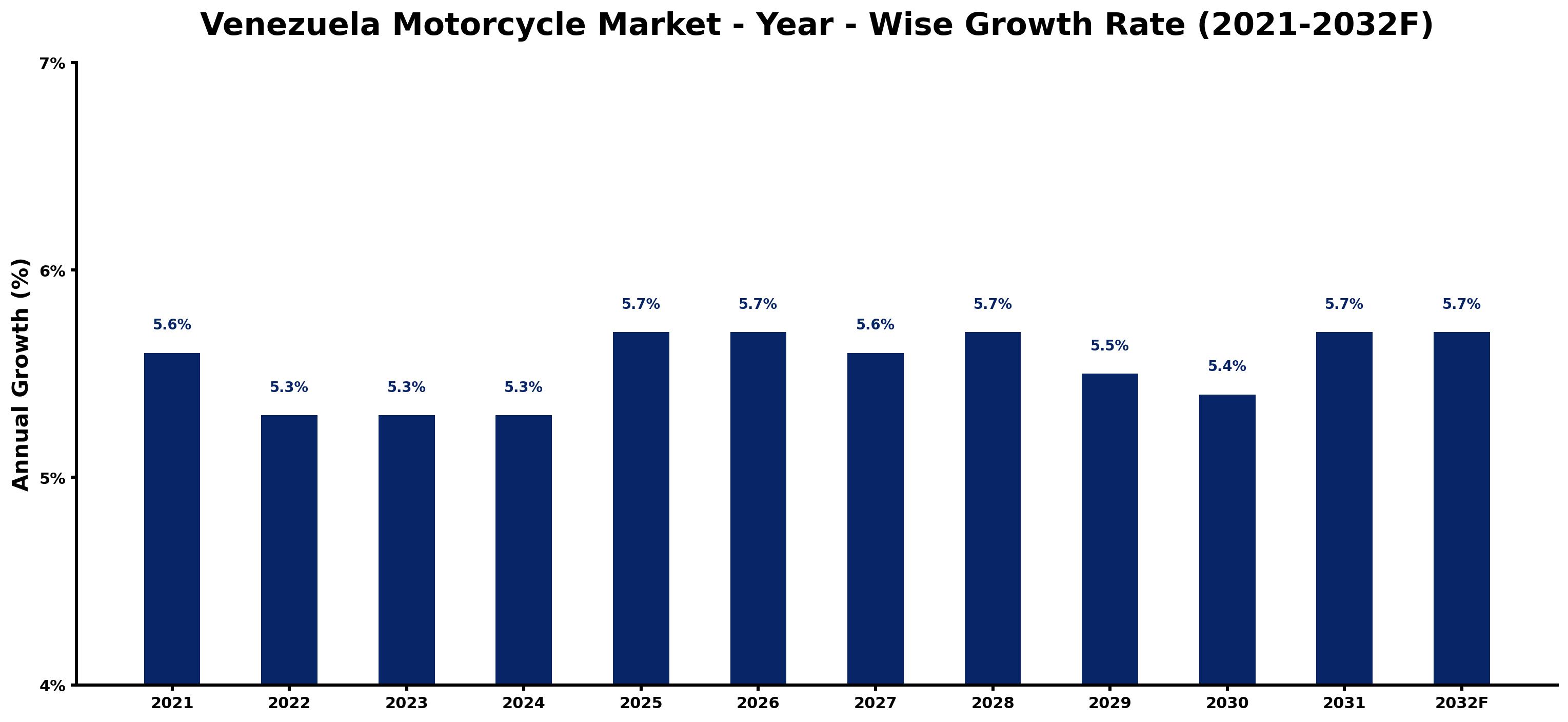
The table below presents the year wise growth rates along with the key drivers influencing the market
| Year | Growth Rate | Major Drivers |
| 2021 | 5.6% | Economic instability has led many to consider motorcycles a practical transport solution. |
| 2022 | 5.3% | Urban congestion pushes residents toward motorcycles for more efficient commuting options. |
| 2023 | 5.3% | Rising gasoline prices make motorcycles a cost-effective alternative for daily travel. |
| 2024 | 5.3% | Increased availability of affordable motorcycle models attracts a broader customer base. |
| 2025 | 5.7% | Insurance companies introduce tailored motorcycle policies, boosting market confidence among consumers. |
| 2026 | 5.7% | Improved roads and infrastructure enhance the overall riding experience for motorcycle users. |
| 2027 | 5.6% | Growing interest in recreational biking contributes to a rise in motorcycle sales. |
| 2028 | 5.7% | Technological advancements make motorcycles more appealing to younger, tech-savvy riders. |
| 2029 | 5.5% | Local manufacturing initiatives boost supply chains, decreasing costs for motorcycle production. |
| 2030 | 5.4% | Urban planning increasingly accommodates motorcycles, reinforcing their role in city transport. |
| 2031 | 5.7% | Online marketplaces grow, making motorcycles more accessible to diverse consumers. |
| 2032 | 5.7% | Sustainability awareness encourages the purchase of electric motorcycles among eco-conscious riders. |
Note - Market size estimations and growth projections presented in this report are based on 6Wresearch's advanced forecasting approach, validated with industry datasets as of June 2026.
Venezuela Motorcycle Market Synopsis
The Venezuela Motorcycle Market is projected to reach 5.7% and witness significant growth during the forecast period (2026-2032). This market is being shaped by a combination of affordability, efficiency, and the need for reliable transportation amid the challenges faced in urban areas. The ongoing economic difficulties in Venezuela have propelled the demand for two-wheeled vehicles, which are often perceived as a cost-effective solution for personal and commercial mobility. Despite the adversities, the market continues to reflect potential due to shifting consumer preferences towards motorcycles.
Venezuela Motorcycle Market Growth Drivers
Numerous factors are driving the growth of the Venezuela motorcycle market. First and foremost, the economic landscape compels consumers to seek more affordable transportation modes. Motorcycles are generally less expensive to purchase and maintain than cars, making them attractive options for daily commuting. Urban congestion further enhances the appeal, as motorcycles can maneuver through traffic more effectively than larger vehicles.
- The rising cost of gasoline relative to consumer incomes has led to increased interest in fuel-efficient two-wheelers.
- Motorcycles provide a practical solution for navigating Venezuela's often challenging urban environments, where road congestion is prevalent.
- Local demand trends indicate a preference for smaller, compact models that emphasize sustainability and economical operation.
- Chinese manufacturers have established themselves as dominant players by offering competitively priced motorcycles tailored to the local market's needs.
- Financing options are becoming more available, allowing consumers from various economic backgrounds to invest in motorcycles with relative ease.
Venezuela Motorcycle Market Trends and Opportunities
Current trends in the Venezuela motorcycle market reveal a transition towards more environmentally friendly options, specifically electric motorcycles. As consumers become increasingly aware of environmental issues, the demand for electric two-wheelers is gaining momentum. This trend aligns with global shifts towards sustainability, creating a unique opportunity for market expansion.
- The shift to electric motorcycles introduces an avenue for new entrants and investors focused on alternative transportation solutions.
- Enhanced financing options are being explored to make motorcycles, particularly electric ones, more accessible to a broader demographic.
- There is potential for business models that include after-sales services, such as maintenance and repairs, addressing the gap in consumer needs for vehicle upkeep.
- Strategically positioned businesses can capitalize on the increasing popularity of motorcycles for commercial deliveries, providing timely services in congested urban areas.
- Engagement in community awareness campaigns can elevate the acceptance and understanding of electric vehicles among potential buyers.
Venezuela Motorcycle Market Challenges and Restraints
Despite its potential, the Venezuela motorcycle market faces several significant challenges that could impede future growth. The economic environment, characterized by hyperinflation and constant political turmoil, poses a direct threat to consumer purchasing power. This, coupled with a volatile currency, complicates both consumer acquisitions and manufacturer operations.
- Ongoing political instability has created an uncertain business environment, discouraging investment and complicating operations.
- The lack of access to foreign currency hampers the ability to import raw materials necessary for motorcycle production and assembly.
- Infrastructure deficiencies, including poor road conditions and inadequate maintenance facilities, hinder the overall motorcycle ownership experience.
- High crime rates in certain regions also deter potential buyers, creating risks associated with ownership and use.
- The complex regulatory landscape and fluctuating government policies further complicate market entry and operations.
Venezuela Motorcycle Market Government Investment and Initiatives
Government involvement plays a crucial role in shaping the Venezuela motorcycle market. Policies reflect a dual approach of promoting local manufacturing while managing the broader economic crisis. Price controls and import restrictions have been implemented to safeguard local manufacturers and stave off potential market saturation from foreign brands.
- Subsidies for motorcycle purchases aim to increase accessibility and encourage the use of two-wheelers as a primary mode of transportation.
- Tax incentives for manufacturers aim to stimulate local production, reducing dependence on imports.
- The government has introduced regulatory measures to ensure motorcycle registration and licensing, targeting safety and reducing crime associated with unregistered vehicles.
- Ongoing initiatives are being evaluated to improve road infrastructure, which is critical for enhancing motorcycle usability and safety.
- New frameworks are being considered to encourage the development of electric motorcycles, aligning with global sustainability goals.
Venezuela Motorcycle Market Latest Developments (May 2025 - June 2026)
From May 2025 through June 2026, the Venezuela motorcycle market has seen notable developments that reflect its ongoing evolution. The market has been influenced by rising consumer interest in electric motorcycles, prompting discussions around potential government incentives for their adoption.
- Increased focus has been placed on enhancing the availability of financing options, catering to a broader audience amid ongoing economic challenges.
- Market participants are exploring strategic partnerships to bolster local manufacturing capabilities, focusing on sustainability and reduced import reliance.
- Consumer education campaigns have emerged, addressing the benefits of motorcycles and electric alternatives, aimed at increasing acceptance and sales.
- Regulatory changes have been initiated to streamline the licensing process for motorcycle owners, making it easier for consumers to comply with government mandates.
- Innovative maintenance solutions are being developed to support the growing motorcycle population, emphasizing accessibility and reliability.
Venezuela Motorcycle Market - Key Attractiveness of the Report
- 10 Years of Market Numbers
- Historical Data Starting from 2022 to 2025
- Base Year: 2025
- Forecast Data until 2032
- Key Performance Indicators Impacting the Market
- Major Upcoming Developments and Projects
Key Highlights of the Report:
- Venezuela Motorcycle Market Outlook
- Market Size of Venezuela Motorcycle Market, 2025
- Forecast of Venezuela Motorcycle Market, 2032F
- Historical Data and Forecast of Venezuela Motorcycle Revenues & Volume for the Period 2022-2032F
- Venezuela Motorcycle Market Trend Evolution
- Venezuela Motorcycle Market Drivers and Challenges
- Venezuela Motorcycle Price Trends
- Venezuela Motorcycle Porter's Five Forces
- Venezuela Motorcycle Industry Life Cycle
- Historical Data and Forecast of Venezuela Motorcycle Market Revenues & Volume By Type for the Period 2022-2032F
- Historical Data and Forecast of Venezuela Motorcycle Market Revenues & Volume By Adventure for the Period 2022-2032F
- Historical Data and Forecast of Venezuela Motorcycle Market Revenues & Volume By Cruiser for the Period 2022-2032F
- Historical Data and Forecast of Venezuela Motorcycle Market Revenues & Volume By Mopeds for the Period 2022-2032F
- Historical Data and Forecast of Venezuela Motorcycle Market Revenues & Volume By Sports for the Period 2022-2032F
- Historical Data and Forecast of Venezuela Motorcycle Market Revenues & Volume By Standard for the Period 2022-2032F
- Historical Data and Forecast of Venezuela Motorcycle Market Revenues & Volume By Touring for the Period 2022-2032F
- Historical Data and Forecast of Venezuela Motorcycle Market Revenues & Volume By Engine Capacity for the Period 2022-2032F
- Historical Data and Forecast of Venezuela Motorcycle Market Revenues & Volume By 151-300 CC for the Period 2022-2032F
- Historical Data and Forecast of Venezuela Motorcycle Market Revenues & Volume By 301-500 CC for the Period 2022-2032F
- Historical Data and Forecast of Venezuela Motorcycle Market Revenues & Volume By 501-800 CC for the Period 2022-2032F
- Historical Data and Forecast of Venezuela Motorcycle Market Revenues & Volume By 801-1000 CC for the Period 2022-2032F
- Historical Data and Forecast of Venezuela Motorcycle Market Revenues & Volume By 1001-1600 CC for the Period 2022-2032F
- Historical Data and Forecast of Venezuela Motorcycle Market Revenues & Volume By Above 1600 CC for the Period 2022-2032F
- Venezuela Motorcycle Import Export Trade Statistics
- Market Opportunity Assessment By Type
- Market Opportunity Assessment By Engine Capacity
- Venezuela Motorcycle Top Companies Market Share
- Venezuela Motorcycle Competitive Benchmarking By Technical and Operational Parameters
- Venezuela Motorcycle Company Profiles
- Venezuela Motorcycle Key Strategic Recommendations






































