Venezuela Personal Computers Market Size, Share & Growth Rate
The Venezuela Personal Computers Market was estimated at USD 438 Million in 2025 and is projected to reach USD 628 Million by 2032, growing at a CAGR of 5.3% from 2026 to 2032. This growth trajectory is primarily driven by the increasing need for affordable computing solutions amid economic constraints and rising demand from businesses and educational institutions. As the Venezuelan economy shows signs of recovery, investment in technology is likely to rise, fueling further demand for personal computers.
Venezuela Personal Computers Market Year-wise Growth Rate and Key Drivers
This graph highlights how the Venezuela Personal Computers Market has steadily grown over the years, supported by major growth factors.
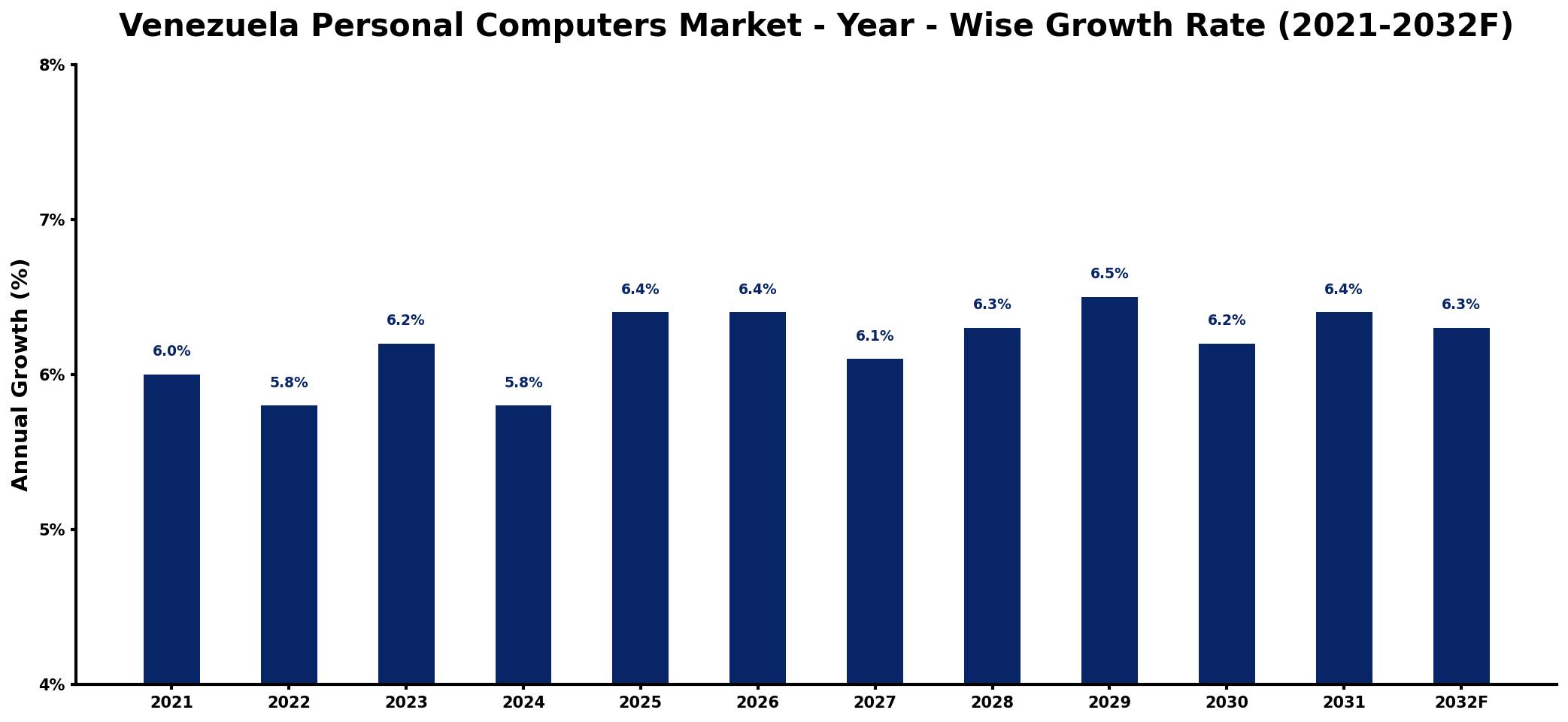
The table below presents the year‑wise growth rates along with the key drivers influencing the market
| Year | Growth Rate | Major Drivers |
| 2021 | 6.0% | Rising internet penetration rates |
| 2022 | 5.8% | Increased remote work adoption |
| 2023 | 6.2% | Growth in digital education initiatives |
| 2024 | 5.8% | Expansion of gaming industry investments |
| 2025 | 6.4% | Boost in tech startup funding |
| 2026 | 6.4% | Higher demand for cloud services |
| 2027 | 6.1% | Surge in e-commerce activities |
| 2028 | 6.3% | Advancements in fintech solutions |
| 2029 | 6.5% | Growing interest in cybersecurity |
| 2030 | 6.2% | Increased focus on digital transformation |
| 2031 | 6.4% | improved raw material availability |
| 2032 | 6.3% | Rising popularity of online content |
Note: Market size estimations and growth projections presented in this report are based on 6Wresearch's proprietary forecasting methodology, utilizing the latest available industry data, government publications, and primary research inputs.
Venezuela Personal Computers Market Synopsis
The personal computers market in Venezuela has recently faced significant declines due to ongoing economic challenges and limited access to foreign currency. Despite this downturn, there remains a steady demand, particularly from sectors such as education and business, indicating resilience amid adversity.
Looking ahead, the market is poised for gradual recovery. A potential stabilization of the economy could revitalize consumer purchasing power, shifting preferences back toward more advanced and versatile computing options. The transition towards an integrated digital economy continues to create opportunities for growth.
Venezuela Personal Computers Market Key Takeaways
- The market is dominated by a mix of international and local brands, focusing on entry-level and budget-friendly options.
- Demand for laptops, particularly lightweight models suitable for remote work and online learning, is on the rise.
- Continued economic instability and currency fluctuations pose risks for both consumers and PC manufacturers.
- Investment opportunities exist in the manufacturing and distribution of locally-tailored computing solutions.
- Government policies significantly impact market dynamics, affecting pricing, imports, and overall access to technology.
Evaluation of Restraints in Venezuela Personal Computers Market
The personal computers market in Venezuela is hindered by several fundamental constraints. Hyperinflation and political uncertainty have severely impacted consumer purchasing power, leading to a contraction in market demand. The country's heavy reliance on imports for essential components further complicates matters, as fluctuations in foreign currency rates disrupt pricing and availability. Additionally, persistent issues related to internet access and infrastructure limitations curtail the potential for widespread adoption of personal computers, resulting in a fragmented and uneven market landscape.
Venezuela Personal Computers Market Trends
Current trends within the Venezuela Personal Computers Market reflect a shift toward affordability and practicality. As consumers prioritize budget-friendly options, there is an increasing demand for basic laptops and desktops that serve essential functions like web browsing and document processing. Lightweight laptops are particularly sought after, enabling users to work remotely and engage in online education, which has gained momentum in recent years. Additionally, as digital literacy improves and more users seek technological solutions, the market is gradually adapting to these evolving preferences.
Venezuela Personal Computers Market Opportunities
The Venezuela Personal Computers Market offers several avenues for investment and growth. As the country navigates economic recovery, businesses and consumers alike will require reliable and affordable personal computing devices. Companies that can develop solutions tailored to local market needs, including devices with language support and essential features, stand to gain a competitive edge. Moreover, opportunities in after-sales support and accessories can enhance the user experience, further driving adoption and satisfaction. Such prospects are promising for stakeholders prepared to engage with the complexities of this evolving market.
Government Initiatives in the Venezuela Personal Computers Market
Government policies in Venezuela regarding the personal computers market are heavily influenced by economic imperatives and regulatory frameworks. Import restrictions and currency controls remain significant challenges, aimed at fostering domestic production while limiting foreign competition. Price regulations are also in place to manage inflation, impacting the affordability of personal computing devices. These policies create a dynamic and often complex environment, necessitating adaptability from businesses looking to operate successfully within the Venezuelan market.
Future Insights of the Venezuela Personal Computers Market
Looking toward 2026-2032, the Venezuela Personal Computers Market is expected to experience a gradual transformation. While immediate economic challenges persist, there are signs that stabilization may pave the way for increased investment in technology. As businesses and educational institutions seek to modernize their operations, the demand for personal computers is likely to rise. Companies that prioritize innovative pricing strategies and affordable, reliable products will find fertile ground for growth, positioning themselves favorably in the market as it recovers and evolves.
Venezuela Personal Computers Market Latest Developments (2025 - 2026)
In recent months, the Venezuela Personal Computers Market has seen a notable shift towards the introduction of more affordable computing options aimed at budget-conscious consumers. Industry participants are exploring innovative partnerships to enhance local manufacturing capabilities and streamline supply chains. Additionally, there is a growing focus on providing better after-sales service to improve customer satisfaction and build brand loyalty. Overall, these developments signal a commitment to addressing market demands amid ongoing economic fluctuations.
Venezuela Personal Computers Market - Key Attractiveness of the Report
- 10 Years of Market Numbers
- Historical Data Starting from 2022 to 2025
- Base Year: 2025
- Forecast Data until 2032
- Key Performance Indicators Impacting the Market
- Major Upcoming Developments and Projects
Key Highlights of the Report:
- Venezuela Personal Computers Market Outlook
- Market Size of Venezuela Personal Computers Market, 2025
- Forecast of Venezuela Personal Computers Market, 2032
- Historical Data and Forecast of Venezuela Personal Computers Revenues & Volume for the Period 2022-2032F
- Venezuela Personal Computers Market Trend Evolution
- Venezuela Personal Computers Market Drivers and Challenges
- Venezuela Personal Computers Price Trends
- Venezuela Personal Computers Porter's Five Forces
- Venezuela Personal Computers Industry Life Cycle
- Historical Data and Forecast of Venezuela Personal Computers Market Revenues & Volume By Product Type for the Period 2022-2032F
- Historical Data and Forecast of Venezuela Personal Computers Market Revenues & Volume By Desktop for the Period 2022-2032F
- Historical Data and Forecast of Venezuela Personal Computers Market Revenues & Volume By Notebook for the Period 2022-2032F
- Historical Data and Forecast of Venezuela Personal Computers Market Revenues & Volume By Workstation for the Period 2022-2032F
- Historical Data and Forecast of Venezuela Personal Computers Market Revenues & Volume By Others for the Period 2022-2032F
- Historical Data and Forecast of Venezuela Personal Computers Market Revenues & Volume By Distribution Channel for the Period 2022-2032F
- Historical Data and Forecast of Venezuela Personal Computers Market Revenues & Volume By Business-To-Business (B2B) for the Period 2022-2032F
- Historical Data and Forecast of Venezuela Personal Computers Market Revenues & Volume By Business-To-Consumer (B2C) for the Period 2022-2032F
- Historical Data and Forecast of Venezuela Personal Computers Market Revenues & Volume By Application for the Period 2022-2032F
- Historical Data and Forecast of Venezuela Personal Computers Market Revenues & Volume By Consumer for the Period 2022-2032F
- Historical Data and Forecast of Venezuela Personal Computers Market Revenues & Volume By Commercial for the Period 2022-2032F
- Historical Data and Forecast of Venezuela Personal Computers Market Revenues & Volume By Industrial for the Period 2022-2032F
- Venezuela Personal Computers Import Export Trade Statistics
- Market Opportunity Assessment By Product Type
- Market Opportunity Assessment By Distribution Channel
- Market Opportunity Assessment By Application
- Venezuela Personal Computers Top Companies Market Share
- Venezuela Personal Computers Competitive Benchmarking By Technical and Operational Parameters
- Venezuela Personal Computers Company Profiles
- Venezuela Personal Computers Key Strategic Recommendations






































