Venezuela Ploughing and Cultivating Machinery Market Size, Share & Growth Rate
The Venezuela Ploughing and Cultivating Machinery Market was estimated at USD 195 Million in 2025 and is projected to reach USD 257 Million by 2032, growing at a CAGR of 4.0% from 2026 to 2032. This projected growth is primarily driven by the gradual recovery of the agricultural sector as the government pushes for modernization and increased productivity. Additionally, the rising demand for efficient machinery that can meet the challenges of changing agricultural conditions plays a critical role in this upward trajectory.
Venezuela Ploughing and Cultivating Machinery Market Year-wise Growth Rate and Key Drivers
This graph highlights how the Venezuela Ploughing and Cultivating Machinery Market has steadily grown over the years, supported by major growth factors.
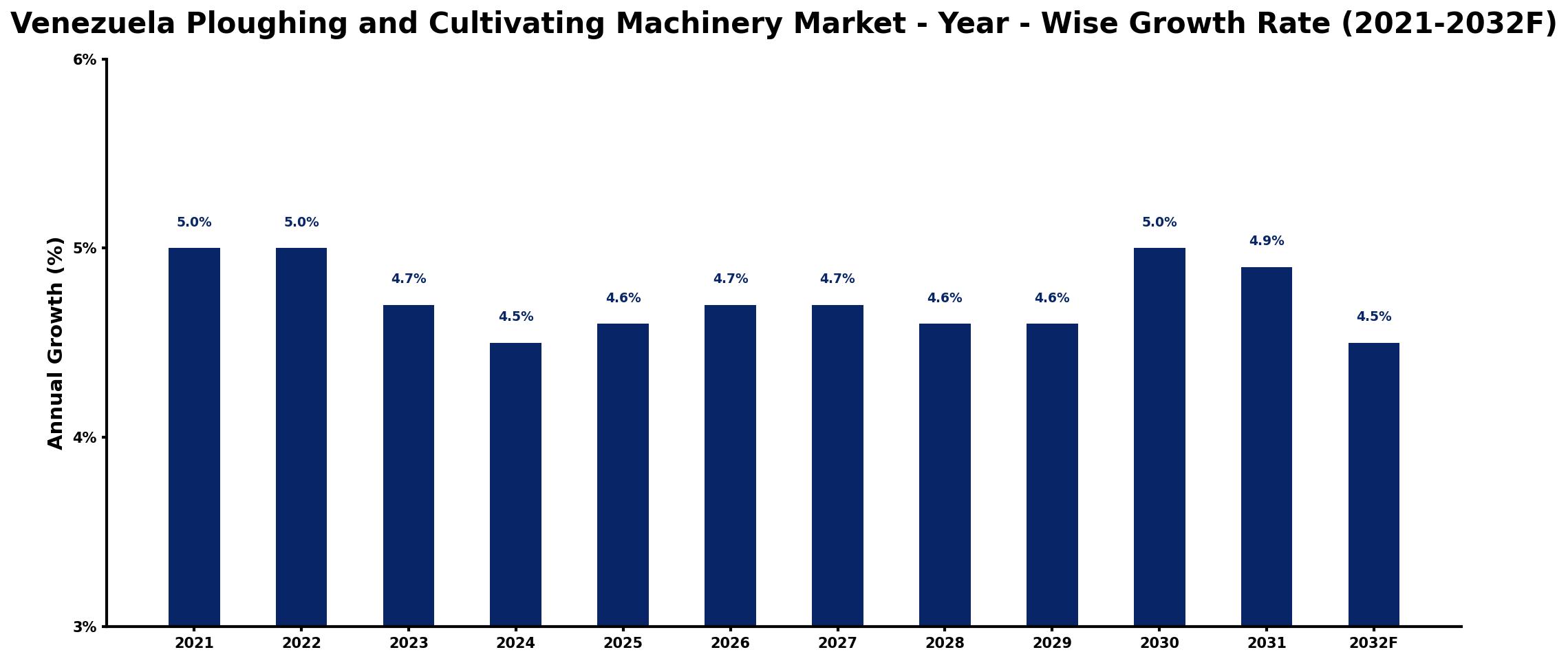
The table below presents the year‑wise growth rates along with the key drivers influencing the market
| Year | Growth Rate | Major Drivers |
| 2021 | 5.0% | Rising agricultural investment levels |
| 2022 | 5.0% | Increased demand for food security |
| 2023 | 4.7% | Expansion of export markets |
| 2024 | 4.5% | Technological advancements in agriculture |
| 2025 | 4.6% | Growing interest in sustainable practices |
| 2026 | 4.7% | Enhanced government support programs |
| 2027 | 4.7% | Increase in rural development projects |
| 2028 | 4.6% | Improvement in supply chain logistics |
| 2029 | 4.6% | Rising consumer awareness of quality |
| 2030 | 5.0% | rising procurement volume requirements |
| 2031 | 4.9% | Boost in agricultural financing options |
| 2032 | 4.5% | Growing trend of precision farming |
Note: Market size estimations and growth projections presented in this report are based on 6Wresearch's proprietary forecasting methodology, utilizing the latest available industry data, government publications, and primary research inputs.
Venezuela Ploughing and Cultivating Machinery Market Synopsis
Currently, the Venezuela Ploughing and Cultivating Machinery Market reflects a complex landscape shaped by economic instability and the pressing need for modernization. While traditional methods remain dominant in many areas, a noticeable shift towards mechanization is emerging as farmers seek to enhance productivity and cope with labor shortages.
The market is characterized by limited international competition, primarily due to stringent import restrictions and economic challenges. Local manufacturers are stepping up to fill this void, which can lead to both opportunities and constraints as they adapt to evolving agricultural demands and government policies.
Venezuela Ploughing and Cultivating Machinery Market Key Takeaways
- The market is witnessing a transition towards more efficient and precision-based machinery.
- Domestic manufacturers are increasingly competing against traditional ploughing methods.
- Government initiatives aim to bolster the agricultural sector, with potential benefits for machinery suppliers.
- Economic recovery and reforms could stimulate investment in modern agricultural technology.
- Challenges such as inflation and currency devaluation continue to affect purchasing power in the market.
Evaluation of Restraints in Venezuela Ploughing and Cultivating Machinery Market
The Venezuela Ploughing and Cultivating Machinery Market faces significant restraints stemming from the country's ongoing economic turmoil and hyperinflation. These factors have drastically reduced farmers' purchasing power, making it increasingly challenging for them to invest in new equipment. Import restrictions further exacerbate the situation, limiting access to advanced machinery that could enhance agricultural productivity. Political instability contributes additional uncertainty, creating a complex landscape that poses substantial barriers to market growth and modernization.
Venezuela Ploughing and Cultivating Machinery Market Trends
The current trends in the Venezuela Ploughing and Cultivating Machinery Market highlight a move towards advanced technology and sustainability. Farmers are increasingly interested in machinery that improves fuel efficiency and minimizes environmental impact. This shift is fueled by the need to adapt to changing weather patterns and labor shortages, compelling the adoption of modern tools like precision seeders and conservation tillage equipment. The focus on sustainable farming practices is reshaping equipment preferences, steering demand toward environmentally responsible solutions.
Venezuela Ploughing and Cultivating Machinery Market Opportunities
Investment opportunities abound within the Venezuela Ploughing and Cultivating Machinery Market as farmers strive to modernize and enhance productivity. There is a notable demand for efficient machinery, which presents avenues for companies to supply high-quality equipment tailored to local needs. Beyond just sales, offering financing solutions could help farmers overcome economic barriers to purchasing. Additionally, partnerships with local agricultural associations can pave the way for initiatives that support the modernization of farming practices, ultimately fostering a more robust agricultural sector.
Government Initiatives in the Venezuela Ploughing and Cultivating Machinery Market
The Venezuelan government has implemented various policies aimed at promoting domestic production within the Ploughing and Cultivating Machinery Market. Measures such as import tariffs and subsidies are designed to support local manufacturers, encouraging the development of homegrown agricultural machinery. Quality standards and environmental regulations are also being enforced to ensure that domestic production meets global benchmarks. However, the ongoing political and economic challenges significantly influence the effectiveness of these initiatives.
Future Insights of the Venezuela Ploughing and Cultivating Machinery Market
Looking ahead to 2026-2032, the Venezuela Ploughing and Cultivating Machinery Market is poised for a cautious recovery, contingent upon improvements in political stability and economic conditions. Innovations in technology and sustainable agricultural practices will likely drive demand for modern machinery. As the government continues to implement supportive measures for the agricultural sector, opportunities for growth may arise, allowing the market to gradually overcome its current obstacles and move towards modernization.
Venezuela Ploughing and Cultivating Machinery Market Latest Developments (2025 - 2026)
In recent months, the Venezuela Ploughing and Cultivating Machinery Market has begun to see shifts as local manufacturers adapt to changing demands. Efforts are underway to enhance the availability of spare parts and maintenance services, addressing a significant concern for farmers relying on older machinery. Additionally, discussions surrounding potential government reforms aim to create a more conducive environment for agricultural investments, promising a more robust future for the sector.
Venezuela Ploughing and Cultivating Machinery Market - Key Attractiveness of the Report
- 10 Years of Market Numbers
- Historical Data Starting from 2022 to 2025
- Base Year: 2025
- Forecast Data until 2032
- Key Performance Indicators Impacting the Market
- Major Upcoming Developments and Projects
Key Highlights of the Report:
- Venezuela Ploughing and Cultivating Machinery Market Outlook
- Market Size of Venezuela Ploughing and Cultivating Machinery Market, 2025
- Forecast of Venezuela Ploughing and Cultivating Machinery Market, 2032
- Historical Data and Forecast of Venezuela Ploughing and Cultivating Machinery Revenues & Volume for the Period 2022-2032F
- Venezuela Ploughing and Cultivating Machinery Market Trend Evolution
- Venezuela Ploughing and Cultivating Machinery Market Drivers and Challenges
- Venezuela Ploughing and Cultivating Machinery Price Trends
- Venezuela Ploughing and Cultivating Machinery Porter's Five Forces
- Venezuela Ploughing and Cultivating Machinery Industry Life Cycle
- Historical Data and Forecast of Venezuela Ploughing and Cultivating Machinery Market Revenues & Volume By Type for the Period 2022-2032F
- Historical Data and Forecast of Venezuela Ploughing and Cultivating Machinery Market Revenues & Volume By Ploughs for the Period 2022-2032F
- Historical Data and Forecast of Venezuela Ploughing and Cultivating Machinery Market Revenues & Volume By Harrows for the Period 2022-2032F
- Historical Data and Forecast of Venezuela Ploughing and Cultivating Machinery Market Revenues & Volume By Others for the Period 2022-2032F
- Historical Data and Forecast of Venezuela Ploughing and Cultivating Machinery Market Revenues & Volume By Application for the Period 2022-2032F
- Historical Data and Forecast of Venezuela Ploughing and Cultivating Machinery Market Revenues & Volume By Soil Loosening for the Period 2022-2032F
- Historical Data and Forecast of Venezuela Ploughing and Cultivating Machinery Market Revenues & Volume By Clod Size Reduction for the Period 2022-2032F
- Historical Data and Forecast of Venezuela Ploughing and Cultivating Machinery Market Revenues & Volume By Clod Sorting for the Period 2022-2032F
- Historical Data and Forecast of Venezuela Ploughing and Cultivating Machinery Market Revenues & Volume By Others for the Period 2022-2032F
- Venezuela Ploughing and Cultivating Machinery Import Export Trade Statistics
- Market Opportunity Assessment By Type
- Market Opportunity Assessment By Application
- Venezuela Ploughing and Cultivating Machinery Top Companies Market Share
- Venezuela Ploughing and Cultivating Machinery Competitive Benchmarking By Technical and Operational Parameters
- Venezuela Ploughing and Cultivating Machinery Company Profiles
- Venezuela Ploughing and Cultivating Machinery Key Strategic Recommendations






































