Venezuela Two Wheeler Market Summary
The venezuela two wheeler market was estimated at USD 1457 Million in 2025 and is projected to reach USD 2108 Million by 2032, growing at a CAGR of 6.4% from 2026 to 2032.
Venezuela Two Wheeler Market Year-wise Growth Rate and Key Drivers
This graph highlights how the Venezuela Two Wheeler Market has steadily grown over the past five years, supported by major growth factors.
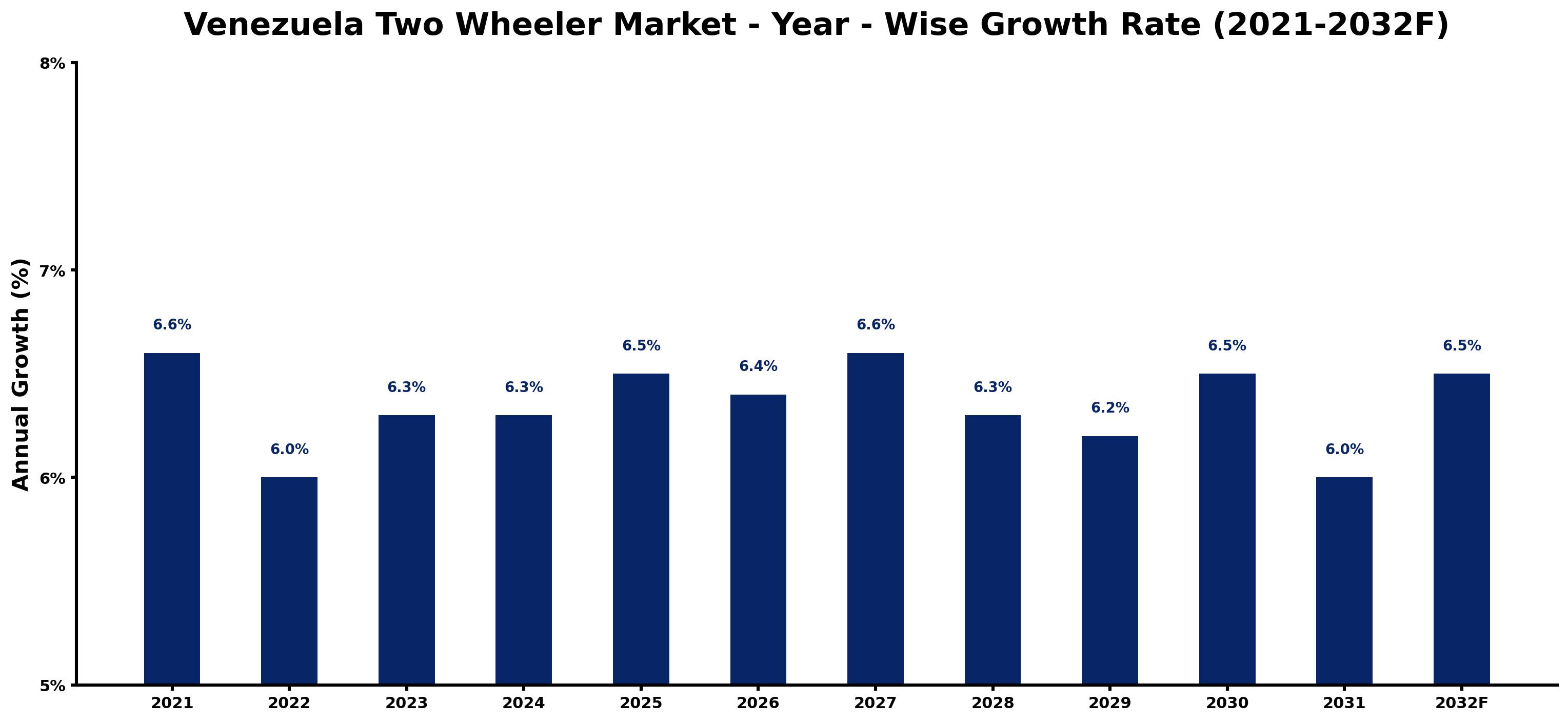
The table below presents the year wise growth rates along with the key drivers influencing the market
| Year | Growth Rate | Major Drivers |
| 2021 | 6.6% | Economic instability forces consumers to seek affordable transportation alternatives in Venezuela. |
| 2022 | 6.0% | Urban congestion drives interest in compact two-wheelers for efficient commuting solutions. |
| 2023 | 6.3% | Inflationary pressures enhance the appeal of cost-effective and fuel-efficient vehicles. |
| 2024 | 6.3% | Cultural shifts promote motorcycle use among younger demographics in urban areas. |
| 2025 | 6.5% | Local manufacturing initiatives reduce import reliance, encouraging domestic two-wheeler production. |
| 2026 | 6.4% | Rising fuel prices further emphasize the financial benefits of two-wheeler ownership. |
| 2027 | 6.6% | Increased investment in infrastructure enhances safety and accessibility for riders. |
| 2028 | 6.3% | Partnerships with local businesses create attractive financing options for consumers. |
| 2029 | 6.2% | E-commerce growth stimulates demand for delivery motorcycles in urban centers. |
| 2030 | 6.5% | Environmental awareness encourages adoption of electric two-wheelers among eco-conscious consumers. |
| 2031 | 6.0% | Diversification in product offerings caters to various consumer preferences and needs. |
| 2032 | 6.5% | Technological innovations in vehicle design improve performance and rider safety significantly. |
Note - Market size estimations and growth projections presented in this report are based on 6Wresearch's advanced forecasting approach, validated with industry datasets as of June 2026.
Venezuela Two Wheeler Market Synopsis
The Venezuela Two Wheeler Market is projected to reach 6.4% and witness significant growth during the forecast period (2026-2032). The market is benefiting from a notable increase in the demand for economy bikes and scooters, primarily driven by changing consumer preferences. In addition, government initiatives such as subsidies on motorcycles have positively influenced market dynamics. As disposable incomes improve due to rising employment opportunities, consumers are also leaning towards premium motorcycles, thereby transforming the landscape of the Venezuela two wheeler market.
Venezuela Two Wheeler Market Growth Drivers
The growth of the Venezuela Two Wheeler Market can be attributed to several key factors:
- Rising Demand for Affordable Transportation: A significant portion of the Venezuelan population is seeking economical modes of transport, making economy bikes a viable option.
- Government Support: The Venezuelan government has implemented various subsidies aimed at reducing the cost burden on consumers, further boosting the sales of two wheelers.
- Increasing Urbanization: As urban areas expand, the need for efficient and compact transportation solutions grows, leading to greater adoption of motorcycles and scooters.
- Improved Disposable Incomes: With rising employment rates and wage growth, consumers have more financial freedom to invest in higher-quality motorcycles.
- Technological Advancements: Continuous improvements in motorcycle design and performance have made premium bikes more appealing to consumers, providing an incentive to upgrade from conventional models.
Venezuela Two Wheeler Market Challenges and Restraints
While the Venezuela Two Wheeler Market is on a growth trajectory, several challenges may impede its progress:
- Economic Instability: Persistent economic fluctuations can affect consumer confidence, impacting purchasing decisions and overall market growth.
- High Maintenance Costs: The cost of maintaining two wheelers may deter consumers from investing in high-performance models.
- Supply Chain Disruptions: Challenges in the supply chain, particularly regarding raw materials and components, can hinder production and availability of two wheelers in the market.
- Competition from Alternative Transportation: The rise of public transportation and ride-sharing services may divert some potential motorcycle buyers away from purchasing a personal two-wheeler.
- Environmental Regulations: Increasing regulation around emissions may increase costs for manufacturers, affecting market pricing structures and consumer affordability.
Venezuela Two Wheeler Market Trends and Opportunities
The Venezuela Two Wheeler Market is witnessing several noteworthy trends that indicate future opportunities:
- Shift Towards Eco-Friendly Models: With rising awareness of environmental issues, there is a growing demand for electric and hybrid motorcycles in the market.
- Increasing Online Sales Channels: The shift to e-commerce is becoming prominent in the two-wheeler market, allowing consumers more convenient purchasing options.
- Focus on Customization: Consumers are seeking personalized features and design options, prompting manufacturers to offer more customizable models.
- Growth of Aftermarket Services: As ownership of two wheelers increases, so does the demand for related services, such as repairs and accessories, creating a new revenue stream for businesses.
- Strategic Partnerships: Collaboration between local manufacturers and international firms can enhance product offerings and market penetration strategies.
Venezuela Two Wheeler Market Government Investment and Initiatives
The Venezuelan government plays a crucial role in the growth of the two wheeler market through various investment and policy initiatives:
- Motorcycle Subsidy Programs: The government has introduced financial incentives to lower the cost of motorcycle purchases, encouraging consumer participation in the market.
- Infrastructure Development: There is an ongoing focus on improving road infrastructure, which directly benefits two wheeler users by enhancing travel efficiency.
- Public Awareness Campaigns: Efforts to promote the benefits of motorcycle use, including fuel efficiency and convenience, have been initiated to boost sales.
- Investment in Training Programs: The government is investing in educational programs focused on motorcycle safety and maintenance, contributing to a more informed consumer base.
- Regulatory Support for Local Manufacturing: Policies encouraging local production can reduce import dependency, fostering a robust domestic market.
Venezuela Two Wheeler Market Latest Developments (May 2025 - June 2026)
Recent developments in the Venezuela Two Wheeler Market reflect an evolving industry landscape:
- Increased Collaboration with Financial Institutions: Recent partnerships facilitate financing options for consumers looking to purchase motorcycles, thus expanding the customer base.
- Launch of Eco-Friendly Initiatives: There is a noticeable increase in companies introducing electric two wheelers, catering to the environmentally conscious consumer.
- Expansion of Distribution Networks: Businesses are improving distribution chains to ensure better availability of products across the region, thus reaching a wider audience.
- Enhanced Safety Regulations: New safety standards are being adopted, prioritizing consumer safety while riding motorcycles and ensuring compliance across the industry.
- Focus on Digital Marketing Strategies: Manufacturers are increasingly utilizing digital platforms to engage consumers and stimulate interest in their products.
Venezuela Two Wheeler Market - Key Attractiveness of the Report
- 10 Years of Market Numbers
- Historical Data Starting from 2022 to 2025
- Base Year: 2025
- Forecast Data until 2032
- Key Performance Indicators Impacting the Market
- Major Upcoming Developments and Projects
Key Highlights of the Report:
- Venezuela Two Wheeler Market Outlook
- Market Size of Venezuela Two Wheeler Market, 2025
- Forecast of Venezuela Two Wheeler Market, 2032F
- Historical Data and Forecast of Venezuela Two Wheeler Revenues & Volume for the Period 2022-2032F
- Venezuela Two Wheeler Market Trend Evolution
- Venezuela Two Wheeler Market Drivers and Challenges
- Venezuela Two Wheeler Price Trends
- Venezuela Two Wheeler Porter's Five Forces
- Venezuela Two Wheeler Industry Life Cycle
- Historical Data and Forecast of Venezuela Two Wheeler Market Revenues & Volume By Vehicle Type for the Period 2022-2032F
- Historical Data and Forecast of Venezuela Two Wheeler Market Revenues & Volume By Motorcycle for the Period 2022-2032F
- Historical Data and Forecast of Venezuela Two Wheeler Market Revenues & Volume By Scooter/Moped for the Period 2022-2032F
- Historical Data and Forecast of Venezuela Two Wheeler Market Revenues & Volume By Engine Capacity for the Period 2022-2032F
- Historical Data and Forecast of Venezuela Two Wheeler Market Revenues & Volume By Up to 125cc for the Period 2022-2032F
- Historical Data and Forecast of Venezuela Two Wheeler Market Revenues & Volume By 126-250cc for the Period 2022-2032F
- Historical Data and Forecast of Venezuela Two Wheeler Market Revenues & Volume By 251-500cc for the Period 2022-2032F
- Historical Data and Forecast of Venezuela Two Wheeler Market Revenues & Volume By Above 500cc for the Period 2022-2032F
- Venezuela Two Wheeler Import Export Trade Statistics
- Market Opportunity Assessment By Vehicle Type
- Market Opportunity Assessment By Engine Capacity
- Venezuela Two Wheeler Top Companies Market Share
- Venezuela Two Wheeler Competitive Benchmarking By Technical and Operational Parameters
- Venezuela Two Wheeler Company Profiles
- Venezuela Two Wheeler Key Strategic Recommendations






































