Vietnam 3D NAND Flash Memory Market (2026-2032) | Strategic Insights, Segments, Outlook, Competitive, Revenue, Investment Trends, Strategy, Challenges, Opportunities, Restraints, Growth, Competition, Forecast, Companies, Consumer Insights, Pricing Analysis, Industry, Drivers, Share, Trends, Demand, Analysis, Size, Segmentation, Value, Supply
Market Forecast By Type (SingleLevel Cell (SLC), MultiLevel Cell (MLC), TripleLevel Cell (TLC), Others), By Application (Smartphones, Tablets, Laptops & PCs, Digital Cameras, Others), By End user (Consumer Electronics, Automotive, Enterprise, Healthcare, Others) And Competitive Landscape
| Product Code: ETC11536436 | Publication Date: Apr 2025 | Updated Date: Jun 2026 | Product Type: Market Research Report | |
| Publisher: 6Wresearch | Author: Bhawna Singh | No. of Pages: 65 | No. of Figures: 34 | No. of Tables: 19 |
Vietnam 3D NAND Flash Memory Market Growth Rate
According to 6Wresearch internal database and industry insights, the Vietnam 3D NAND Flash Memory Market is projected to grow at a compound annual growth rate (CAGR) of 14.8% during the forecast period (2026–2032).
Vietnam 3D NAND Flash Memory Market Year-wise Growth Rate and Key Drivers
This graph highlights how the Vietnam 3D NAND Flash Memory Market has steadily grown over the past five years, supported by major growth factors.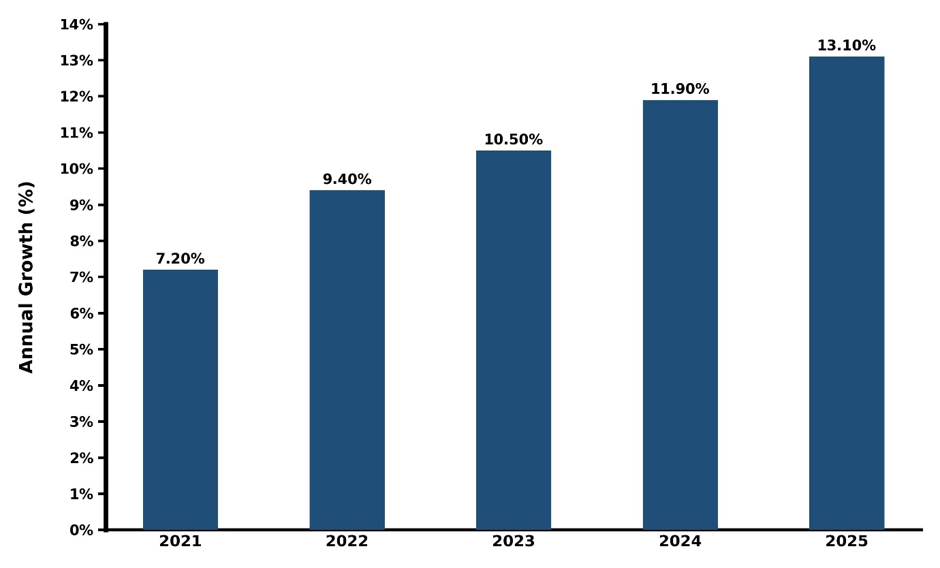
Below is an evaluation of year-wise growth rate along with growth drivers:
| Year | Est. Annual Growth (%) | Growth Drivers |
| 2021 | 7.2% | Expansion of local smartphone assembly units and rising localized consumer electronics manufacturing. |
| 2022 | 9.4% | Increasing global supply chain diversity, forcing leading OEMs to create multiple-tier electronics manufacturing centers in Vietnam. |
| 2023 | 10.5% | Faster rollout of 5G network across the nation, creating the need for increased memory bandwidth. |
| 2024 | 11.9% | Increased investments in infrastructure for regional cloud data centers and huge server farms. |
| 2025 | 13.1% | Huge surge in automotive electronics and smart factory automation systems with industrial embedded storage devices. |
Topics Covered in the Vietnam 3D NAND Flash Memory Market Report
The Vietnam 3D NAND Flash Memory Industry report covers the market by type, application, and end user. The market report provides an unbiased and detailed analysis of ongoing market trends, opportunities, and drivers, which help stakeholders devise and align their market strategies according to the current and future market dynamics.
Vietnam 3D NAND Flash Memory Market Highlights
| Report Name |
Vietnam 3D NAND Flash Memory Market |
| Forecast period | 2026-2032 |
| CAGR | 14.8% |
| Market Size |
Consumer Electronics |
Vietnam 3D NAND Flash Memory Market Synopsis
Vietnam 3D NAND Flash Memory Market is experiencing an unprecedented transition from conventional planar (2D) structures to highly dense vertical stacking architectures. This transition is heavily supported by regional industrial shifts, localized consumer electronics manufacturing setups, and nationwide hyper-scale digitization infrastructure. 3D NAND Flash Memory is a type of non-volatile storage used in SSDs, smartphones, and memory cards. It stores data even when power is turned off, and the “3D” part refers to how memory cells are stacked vertically to increase storage capacity.
Evaluation of Growth Drivers in Vietnam 3D NAND Flash Memory Market (2026–2032)
Below are some major drivers and their influence on the market dynamics:
| Drivers | Primary Segment Affected | Why It Matters (Evidence) |
| Global Semiconductor China+1 Strategy | Enterprise Storage, Consumer Electronics | Multinational chip design firms and tier-1 electronics manufacturing service (EMS) providers are expanding production setups across northern Vietnam. |
| Rapid 5G Infrastructure Proliferation | Smartphones, Connected Hardware | National telecom operators are rapidly deploying standalone 5G networks, driving consumer upgrade cycles for high-density storage mobile platforms. |
| National Digitization Directives | Data Centers, Enterprise SSDs | Government mandates requiring localized citizen data storage have catalyzed construction of enterprise data complexes requiring scalable flash arrays. |
| Automotive Assembly Modernization | Automotive, Infotainment Systems | The domestic assembly of smart electric vehicles (EVs) loaded with advanced driver-assistance systems (ADAS) requires ruggedized flash architectures. |
| Proliferation of Edge Computing Devices | Internet of Things (IoT), Smart Cities | Development of smart grids in the city and other public safety networks employ multi-layer stacked memory systems. |
Vietnam 3D NAND Flash Memory Market is poised for robust growth, exhibiting a CAGR of nearly 14.8% during the forecast period (2026–2032), owing to technological advancements and density scaling. Moreover, the entry of Vietnam in the international semiconductor supply chain in the backend assembly, testing, and packaging process of 3D NAND flash memory chips boosts the market further.
Vietnam 3D NAND flash memory market growth is also benefiting from the increasing shift toward high-layer 3D NAND architectures (128-layer and above), which significantly enhance storage efficiency, reduce cost per bit, and improve performance for data-intensive applications. As global OEMs continue relocating parts of their electronics production to Vietnam, the demand for NAND flash memory embedded in smartphones, laptops, and IoT devices is accelerating steadily.
Evaluation of Restraints in Vietnam 3D NAND Flash Memory Market
Below are some major restraints and their influence on the market dynamics:
| Restraints | Primary Segment Affected | What This Means (Evidence) |
| High Fabrication Set-Up Costs | Local Manufacturing, Domestic Foundry Investment | Setting up state-of-the-art vertical etching cleanrooms requires massive capital layouts, slowing localized semiconductor fabrication lines. |
| Skilled Semiconductor Workforce Deficit | R&D Operations, Advanced Packaging | A temporary deficit in high-tier physical-design and silicon-validation engineers limits complex structural chip troubleshooting locally. |
| Volatile Global Silicon Pricing | Import Procurement, Cost Structures | Periodic international flash component price fluctuations impact the margins of domestic electronics manufacturers relying on imported dies. |
| Complex Lithography Equipment Dependency | Supply Chain Resilience | Stringent global export controls on advanced precision multi-patterning tools limit local vendor access to quick machinery upgrades. |
| High Power Consumption Patterns | Cleanroom Management, Substation Utilities | Operating ultra-precise vertical stacking semiconductor facilities requires exceptionally stable electrical grids, putting strain on regional utilities. |
Vietnam 3D NAND Flash Memory Market Challenges
Vietnam 3D NAND Flash Memory Industry faces several structural and industry-specific challenges that go beyond general supply-demand issues, largely shaped by its position in the global semiconductor value chain and its developing domestic ecosystem. One of the most critical challenges is limited upstream semiconductor capability, particularly the absence of advanced wafer fabrication facilities for NAND flash production. Vietnam’s current role is concentrated in assembly, testing, and packaging (OSAT), which means the country remains dependent on imports from leading semiconductor manufacturing hubs such as Taiwan, South Korea, and China.
Vietnam 3D NAND Flash Memory Market Trends
Some latest trends influencing the dynamics of Vietnam 3D NAND Flash Memory Market are:
- Migration toward High-Layer Stacking (200+ Layers): Local component sourcing strategies are actively moving away from legacy 64-layer and 96-layer configurations. Assembly plants are replacing them with 176-layer and 200+ layer architectures to meet the strict physical space constraints of next-generation slim form-factor hardware.
- Widespread Integration of Charge Trap Flash (CTF) Architecture: Manufacturers are completely prioritizing CTF over conventional floating gate variants. The change in technology minimizes leakage of electrons and interference from structures across cells, leading to increased data endurance cycles in tropical conditions.
- Rapid Adoption of PCIe Gen5 NVMe Storage Formats: High-end PCs and data centers are shifting to PCIe Gen5 interface standards. These systems leverage the full multi-channel structural speeds of 3D NAND to hit data throughput rates well beyond 12,000 MB/s.
Investment Opportunities in the Vietnam 3D NAND Flash Memory Market
Some potential investment avenues present in the Vietnam 3D NAND Flash Memory Market are:
- Establishment of Specialized Semiconductor Packaging and Testing Centers (OSAT): Massive structural openings exist for setting up outsourced semiconductor assembly and test facilities. Due to its excellent geographic location, Vietnam represents the perfect location from which to harvest large quantities of backend physical chip processing flows.
- Development of Smart Logistics and Industrial Data Center Infrastructure: With localization laws taking tight effect, investing in scalable data servers loaded with multi-terabit solid-state drives offers exceptional commercial returns to enterprise hardware providers.
- Localized Production of High-Purity Processing Materials: To reduce transport costs for high-end hardware manufacturers, the provision of specialized clean room chemicals and substrates can be made locally within the country's special economic zones.
Top 5 Leading Players in Vietnam 3D NAND Flash Memory Market
Below are some of the leading companies operating in the Vietnam 3D NAND Flash Memory Industry:
1. Samsung Electronics Co., Ltd.
| Company Name | Samsung Electronics Co., Ltd. |
|---|---|
| Established Year | 1969 |
| Headquarters | Suwon, Gyeonggi Province, South Korea |
| Official Website | Click Here |
Samsung Electronics integrates its state-of-the-art V-NAND architectures directly into consumer smartphones and computing components assembled within the country, serving as a core supplier for regional consumer electronics networks.
2. Intel Corporation
| Company Name | Intel Corporation |
|---|---|
| Established Year | 1968 |
| Headquarters | Santa Clara, California, United States |
| Official Website | Click Here |
Intel plays a vital role in the processing, validation, and worldwide distribution of advanced embedded computing architectures, storage units, and next-generation systems-on-chip.
3. SK Hynix Inc.
| Company Name | SK Hynix Inc. |
|---|---|
| Established Year | 1983 |
| Headquarters | Icheon, Gyeonggi Province, South Korea |
| Official Website | Click Here |
SK Hynix is a globally renowned supplier of high-density storage configurations, prominently supplying 4D and 3D NAND configurations.
4. Micron Technology, Inc.
| Company Name | Micron Technology, Inc. |
|---|---|
| Established Year | 1978 |
| Headquarters | Boise, Idaho, United States |
| Official Website | Click Here |
Micron Technology is recognized for pioneering complex multi-layer stacked configurations, including the development of advanced 232-layer memory solutions.
5. Kioxia Corporation
| Company Name | Kioxia Corporation |
|---|---|
| Established Year | 2018 |
| Headquarters | Tokyo, Japan |
| Official Website | Click Here |
Kioxia consistently builds strategic partnerships across Vietnamese technology networks to deliver high-speed memory systems to original equipment manufacturers building laptops, and consumer appliances.
Government Initiatives being implemented in the Vietnam 3D NAND Flash Memory Market
The Vietnamese government is actively strengthening its position in the global semiconductor value chain through targeted policy frameworks aimed at attracting high-tech investments. The other strategy implemented by the country is the National Semiconductor Strategy, which aims at developing a lasting ecosystem involving chip design, packaging, testing, and ultimately partial fabrication. The strategy favors semiconductors that have anything to do with memories, with NAND flash being part of the strategy within the context of electronics manufacturing industry.
Besides, the country has developed special economic zones like the Ho Chi Minh city, which are aimed at facilitating the development of semiconductors and electronics in order to offer tax incentives and ease of licensing procedures to multinational corporations involved in OSAT and electronics manufacturing. For example, expansion efforts in the Saigon Hi-Tech Park are aimed at attracting more memory-related assembly and testing operations.
Future Insights of the Vietnam 3D NAND Flash Memory Market
Vietnam 3D NAND Flash Memory Market is expected to evolve into a strategically important backend hub within the global semiconductor ecosystem. Over the forecast period, the country is likely to strengthen its dominance in OSAT services, while gradually increasing its participation in higher-value semiconductor activities such as advanced packaging and design support for memory products.
A major future trend is the deepening integration of Vietnam into global electronics supply chain diversification strategies. As multinational companies continue to reduce dependence on single-country manufacturing bases, Vietnam is expected to capture a larger share of NAND-related assembly demand, particularly for smartphones, laptops, and IoT devices.
Market Segmentation Analysis
The report offers a comprehensive study of the following market segments and their leading categories:
By Application - Smartphones to Lead the Market
According to Mohit, Senior Research Analyst, 6Wresearch, the Smartphones application segment holds the dominant position across the market space. Modern mobile operating systems, multi-camera configurations, high-definition recording, and on-device artificial intelligence engines demand extensive internal storage capacities.
By End user - Consumer Electronics Dominates the Segment
Consumer Electronics vertical is expected to contribute the most to the Vietnam 3D NAND flash memory market share, driven by massive regional consumption of smart television setups, tablets, computing rigs, and wearable lifestyle gadgets. Continuous domestic lifestyle changes, rising middle-class disposable wages, and widespread access to digital marketplaces drive steady hardware replacement cycles, keeping consumer electronics at the absolute forefront of 3D NAND demand.
Key Attractiveness of the Report:
- 10 Years of Market Numbers
- Historical Data Starting from 2022 to 2025
- Base Year: 2025
- Forecast Data until 2032
- Key Performance Indicators Impacting the Market
- Major Upcoming Developments and Projects
Key Highlights of the Report:
- Vietnam 3D NAND Flash Memory Market Outlook
- Market Size of Vietnam 3D NAND Flash Memory Market, 2025
- Forecast of Vietnam 3D NAND Flash Memory Market, 2032
- Historical Data and Forecast of Vietnam 3D NAND Flash Memory Revenues & Volume for the Period 2022-2032
- Vietnam 3D NAND Flash Memory Market Trend Evolution
- Vietnam 3D NAND Flash Memory Market Drivers and Challenges
- Vietnam 3D NAND Flash Memory Price Trends
- Vietnam 3D NAND Flash Memory Porter's Five Forces
- Vietnam 3D NAND Flash Memory Industry Life Cycle
- Historical Data and Forecast of Vietnam 3D NAND Flash Memory Market Revenues & Volume By Type for the Period 2022-2032
- Historical Data and Forecast of Vietnam 3D NAND Flash Memory Market Revenues & Volume By SingleLevel Cell (SLC) for the Period 2022-2032
- Historical Data and Forecast of Vietnam 3D NAND Flash Memory Market Revenues & Volume By MultiLevel Cell (MLC) for the Period 2022-2032
- Historical Data and Forecast of Vietnam 3D NAND Flash Memory Market Revenues & Volume By TripleLevel Cell (TLC) for the Period 2022-2032
- Historical Data and Forecast of Vietnam 3D NAND Flash Memory Market Revenues & Volume By Others for the Period 2022-2032
- Historical Data and Forecast of Vietnam 3D NAND Flash Memory Market Revenues & Volume By Application for the Period 2022-2032
- Historical Data and Forecast of Vietnam 3D NAND Flash Memory Market Revenues & Volume By Smartphones for the Period 2022-2032
- Historical Data and Forecast of Vietnam 3D NAND Flash Memory Market Revenues & Volume By Tablets for the Period 2022-2032
- Historical Data and Forecast of Vietnam 3D NAND Flash Memory Market Revenues & Volume By Laptops & PCs for the Period 2022-2032
- Historical Data and Forecast of Vietnam 3D NAND Flash Memory Market Revenues & Volume By Digital Cameras for the Period 2022-2032
- Historical Data and Forecast of Vietnam 3D NAND Flash Memory Market Revenues & Volume By Others for the Period 2022-2032
- Historical Data and Forecast of Vietnam 3D NAND Flash Memory Market Revenues & Volume By End user for the Period 2022-2032
- Historical Data and Forecast of Vietnam 3D NAND Flash Memory Market Revenues & Volume By Consumer Electronics for the Period 2022-2032
- Historical Data and Forecast of Vietnam 3D NAND Flash Memory Market Revenues & Volume By Automotive for the Period 2022-2032
- Historical Data and Forecast of Vietnam 3D NAND Flash Memory Market Revenues & Volume By Enterprise for the Period 2022-2032
- Historical Data and Forecast of Vietnam 3D NAND Flash Memory Market Revenues & Volume By Healthcare for the Period 2022-2032
- Historical Data and Forecast of Vietnam 3D NAND Flash Memory Market Revenues & Volume By Others for the Period 2022-2032
- Vietnam 3D NAND Flash Memory Import Export Trade Statistics
- Market Opportunity Assessment By Type
- Market Opportunity Assessment By Application
- Market Opportunity Assessment By End user
- Vietnam 3D NAND Flash Memory Top Companies Market Share
- Vietnam 3D NAND Flash Memory Competitive Benchmarking By Technical and Operational Parameters
- Vietnam 3D NAND Flash Memory Company Profiles
- Vietnam 3D NAND Flash Memory Key Strategic Recommendations
Market Covered
The report offers an extensive study of the following market segments:
By Type
- SingleLevel Cell (SLC)
- MultiLevel Cell (MLC)
- TripleLevel Cell (TLC)
- Others
By Application
- Smartphones
- Tablets
- Laptops & PCs
- Digital Cameras
- Others
By End user
- Consumer Electronics
- Automotive
- Enterprise
- Healthcare
- Others
Vietnam 3D NAND Flash Memory Market (2026-2032): FAQs
Vietnam 3D NAND Flash Memory Market is anticipated to grow at a compound annual growth rate (CAGR) of 14.8% during the forecast period (2026-2032).
Growth is driven by expanding smartphone production, increasing demand for high-storage devices, and rising semiconductor assembly activities in Vietnam.
Consumer electronics is the leading end-user segment, supported by high demand for smartphones, laptops, and smart devices.
Key trends include adoption of high-layer NAND, growth in AI-enabled devices, and expansion of data-driven applications.
6Wresearch actively monitors the Vietnam 3D NAND Flash Memory Market and publishes its comprehensive annual report, highlighting emerging trends, growth drivers, revenue analysis, and forecast outlook. Our insights help businesses to make data-backed strategic decisions with ongoing market dynamics. Our analysts track relevent industries related to the Vietnam 3D NAND Flash Memory Market, allowing our clients with actionable intelligence and reliable forecasts tailored to emerging regional needs.
Yes, we provide customisation as per your requirements. To learn more, feel free to contact us on sales@6wresearch.com
Global Go To Market Strategy - 2030
Export potential enables firms to identify high-growth global markets with greater confidence by combining advanced trade intelligence with a structured quantitative methodology. The framework analyzes emerging demand trends and country-level import patterns while integrating macroeconomic and trade datasets such as GDP and population forecasts, bilateral import–export flows, tariff structures, elasticity differentials between developed and developing economies, geographic distance, and import demand projections. Using weighted trade values from 2020–2024 as the base period to project country-to-country export potential for 2030, these inputs are operationalized through calculated drivers such as gravity model parameters, tariff impact factors, and projected GDP per-capita growth. Through an analysis of hidden potentials, demand hotspots, and market conditions that are most favorable to success, this method enables firms to focus on target countries, maximize returns, and global expansion with data, backed by accuracy.
By factoring in the projected importer demand gap that is currently unmet and could be potential opportunity, it identifies the potential for the Exporter (Country) among 190 countries, against the general trade analysis, which identifies the biggest importer or exporter.
To discover high-growth global markets and optimize your business strategy:
Click Here
Pricing
- Single User License$ 1,995
- Department License$ 2,400
- Site License$ 3,120
- Global License$ 3,795

Leadership Perspectives from Industry Events
Search
Thought Leadership and Analyst Meet





Our Clients








6WResearch In News
- India Air Conditioner Market Set for Strong Rebound in 2026 After Weather-Led Correction and GST-Driven Recovery: 6Wresearch
- ADAS in India: How Automatic Emergency Braking, Blind Spot Detection & Driver Monitoring are Transforming Road Safety
- Doha a strategic location for EV manufacturing hub: IPA Qatar
- Demand for luxury TVs surging in the GCC, says Samsung
- Empowering Growth: The Thriving Journey of Bangladesh’s Cable Industry
- Demand for luxury TVs surging in the GCC, says Samsung
Latest Reports
- Poland Fire Protection Systems Market (2026-2032)
- Cape Verde Portable Hand-Thrown Extinguisher Market (2026-2032)
- Canada Portable Hand-Thrown Extinguisher Market (2026-2032)
- Cameroon Portable Hand-Thrown Extinguisher Market (2026-2032)
- Burundi Portable Hand-Thrown Extinguisher Market (2026-2032)
- Burkina Faso Portable Hand-Thrown Extinguisher Market (2026-2032)
- Bulgaria Portable Hand-Thrown Extinguisher Market (2026-2032)
- Brunei Portable Hand-Thrown Extinguisher Market (2026-2032)
- Botswana Portable Hand-Thrown Extinguisher Market (2026-2032)
- Bosnia and Herzegovina Portable Hand-Thrown Extinguisher Market (2026-2032)
Industry Events and Analyst Meet

HIMTEX 2026

India Refining Summit 2026

India EV Show 2026

EV tech India Expo 2026

Auto Tech Asia 2026
Whitepaper
- Middle East & Africa Commercial Security Market Click here to view more.
- Middle East & Africa Fire Safety Systems & Equipment Market Click here to view more.
- GCC Drone Market Click here to view more.
- Middle East Lighting Fixture Market Click here to view more.
- GCC Physical & Perimeter Security Market Click here to view more.


