Vietnam 5G Network Infrastructure Market (2026-2032) | Drivers, Challenges, Analysis, Value, Demand, Growth, Companies, Share, Investment Trends, Strategic Insights, Pricing Analysis, Segmentation, Revenue, Strategy, Forecast, Competition, Opportunities, Restraints, Supply, Size, Competitive, Segments, Trends, Industry, Consumer Insights, Outlook
Market Forecast By Component (Core Network, Small Cells, Macro Cells, Edge Computing), By Frequency (Sub-6 GHz, mmWave, 26-39 GHz, Above 39 GHz), By Deployment Model (Standalone, Non-Standalone, Hybrid, Cloud-based), By Industry (Telecom, Urban, Industrial, IT) And Competitive Landscape
| Product Code: ETC11647796 | Publication Date: Apr 2025 | Updated Date: Jul 2026 | Product Type: Market Research Report | |
| Publisher: 6Wresearch | Author: Bhawna Singh | No. of Pages: 75 | No. of Figures: 35 | No. of Tables: 5 |
Vietnam 5G Network Infrastructure Market Growth Rate
According to 6Wresearch internal database and industry insights, the Vietnam 5G Network Infrastructure Market is projected to grow at a CAGR of 21.64% during the forecast period 2026–2032.
Vietnam 5G Network Infrastructure Market Year-wise Growth Rate and Key Drivers
This graph illustrates the annual growth rates of the Vietnam 5G Network Infrastructure Market from 2021 to 2032, highlighting a steady upward trajectory and projected market expansion over the forecast period.
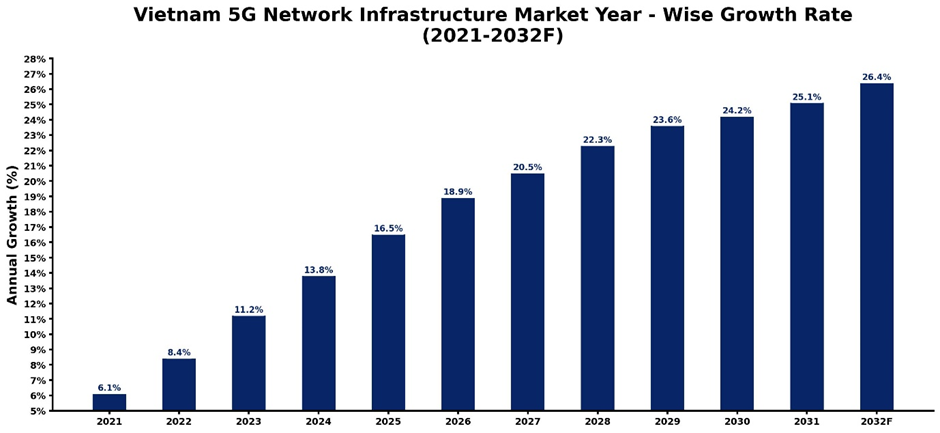
The following table summarizes the historical and forecasted growth rates of the Vietnam 5G Network Infrastructure Market, along with the rationale behind each year’s performance.
| Year | Estimated Growth (%) | Market Rationale |
| 2021 | 6.1% | Initiation of 5G pilot rollouts by major telecommunication companies |
| 2022 | 8.4% | Extension of testing areas and spectrum allocation operations |
| 2023 | 11.2% | Further government involvement in digital transformation plans |
| 2024 | 13.8% | Increase in investments in telecom towers, fiber backhaul, and core network infrastructure |
| 2025 | 16.5% | Corporate expansion of 5G commercial rollout into major metropolitan areas |
| 2026 | 18.9% | Faster deployment of macro cell sites and standalone networks |
| 2027 | 20.5% | Increasing enterprise demands for industrial connectivity services |
| 2028 | 22.3% | Greater investment in edge computing and private 5G networks |
| 2029 | 23.6% | Broadening of smart city initiatives and connected transportation systems |
| 2030 | 24.2% | Popularization of Industry 4.0 and mission critical application |
| 2031 | 25.1% | National-level modernization of telecom infrastructure |
| 2032 | 26.4% | Mature 5G ecosystem supporting advanced digital services |
Topics Covered in the Vietnam 5G Network Infrastructure Market Report
The Vietnam 5G Network Infrastructure Market report covers the market by component, frequency, deployment model, and industry. The report provides a detailed analysis of ongoing technological developments, investment trends, infrastructure expansion projects, and market opportunities shaping the future of Vietnam’s telecommunications sector.
Vietnam 5G Network Infrastructure Market Highlights
| Report Name | Vietnam 5G Network Infrastructure Market |
| Forecast period | 2026-2032 |
| CAGR | 21.64% |
| Growing Sector | Edge Computing Infrastructure |
Vietnam 5G Network Infrastructure Market Synopsis
The Vietnam 5G Network Infrastructure Market is experiencing consistently growing owing to the country’s digital transformation strategy and fast-developing next-generation communications networks. Vietnam is taking active steps to improve the telecom infrastructure in the country in order to enable the implementation of 5G technology throughout the nation. The growth in the sector is fueled by rising demand for fast Internet and mobile data usage and the need for low latency across different sectors such as manufacturing, logistics, healthcare, and smart cities.
Evaluation of Growth Drivers in Vietnam 5G Network Infrastructure Market (2026–2032)
Below are some major drivers and their influence on the market dynamics:
| Drivers | Primary Segment Affected | Why It Matters (Evidence) |
| Expansion of National 5G Coverage | Macro Cells | Operators are investing heavily in nationwide network deployment. |
| Growth of Smart Manufacturing | Industrial | Factories require ultra-reliable low-latency connectivity. |
| Increasing Data Consumption | Core Network | Growing network usage needs upgrading the infrastructure. |
| Government Digital Transformation Programs | Telecom | Various government initiatives aid in modernizing telecom projects. |
| Rising Demand for Edge Computing | Edge Computing | Real-time processing applications require localized infrastructure. |
Vietnam 5G Network Infrastructure Market is projected to grow at a CAGR of 21.64% during 2026–2032, driven by growing investments from telecommunication companies, rising number of connected devices, and emerging advanced digital services. Growth is further supported by growing development of standalone 5G networks among operators that result in demand for densification, backhaul fiber infrastructure, and edge computing. Moreover, industrial automation projects, smart cities, and digitalization projects of enterprises are creating a good demand in advanced network infrastructure solutions.
Evaluation of Restraints in Vietnam 5G Network Infrastructure Market
Below are some major restraints and their influence on the market dynamics:
| Restraints | Primary Segment Affected | What This Means (Evidence) |
| High Capital Expenditure Requirements | Telecom | Infrastructural installation demands substantial initial capital expenditure. |
| Limited Rural Connectivity Economics | Urban & Rural Expansion | Service providers can hold off on deployment in sparse regions. |
| Spectrum Allocation Constraints | Frequency Deployment | Lack of spectrum may affect expansion plans. |
| Skilled Workforce Shortages | Workforce Development | Deployment of next generation 5G network will require high skills. |
| Cybersecurity and Network Risks | Government & Commercial Users | Increased connection creates additional channels of vulnerability. |
Vietnam 5G Network Infrastructure Market Challenges
One of the major challenges facing the Vietnam 5G Network Infrastructure Industry is balancing rapid deployment with investment efficiency. Implementation of 5G network throughout the country would require significant financial investments into the spectrum procurement, infrastructure construction, fiber deployment and cloud-native network design. Moreover, operators need to provide interoperability of their existing infrastructure with new standalone 5G networks. Complexity of edge computing integration, implementation of network slicing and network security are the most important problems nowadays.
Vietnam 5G Network Infrastructure Market Trends
Latest trends influencing the Vietnam 5G Network Infrastructure Market are:
- Increased Development of Standalone 5G: There will be more investments by telecom companies on standalone 5G technology to leverage its full potentials like network slicing and low latency communication.
- Deployment of Edge Computing Nodes: Businesses will implement more edge computing solutions near the end users for increased efficiency.
- Growing Use of Open RAN Solutions: There will be increased adoption of open and interoperable RAN architecture for cost savings and improved vendor freedom.
- Use of AI in Network Operations: There will be use of artificial intelligence for maintenance, optimization, and resource allocation in networks.
Investment Opportunities in the Vietnam 5G Network Infrastructure Market
Some strategic investment opportunities in the Vietnam 5G Network Infrastructure Market are:
- Telecom Tower Expansion Projects: Growing network coverage requirements create substantial opportunities for tower infrastructure providers.
- Edge Data Center Development: Demand for low-latency services is encouraging investments in distributed computing facilities.
- Private 5G Network Solutions: Industrial enterprises increasingly seek dedicated wireless infrastructure for mission-critical applications.
- Network Optimization Platforms Using AI: Investment in intelligent networks may bring benefits to operation.
Top 5 Leading Players in Vietnam 5G Network Infrastructure Market
Here is a list of companies contributing to the Vietnam 5G network infrastructure market growth:
1. Viettel Group
| Company Name | Viettel Group |
|---|---|
| Established Year | 1989 |
| Headquarters | Hanoi, Vietnam |
| Official Website | Click Here |
Viettel develops radio access networks, core network systems, and digital infrastructure solutions that support nationwide connectivity expansion.
2. VNPT (Vietnam Posts and Telecommunications Group)
| Company Name | VNPT (Vietnam Posts and Telecommunications Group) |
|---|---|
| Established Year | 1945 |
| Headquarters | Hanoi, Vietnam |
| Official Website | Click Here |
VNPT provides extensive telecommunications infrastructure, cloud platforms, and network modernization solutions. The company plays a significant role in Vietnam’s 5G rollout and digital transformation initiatives.
3. MobiFone Corporation
| Company Name | MobiFone Corporation |
|---|---|
| Established Year | 1993 |
| Headquarters | Hanoi, Vietnam |
| Official Website | Click Here |
MobiFone is actively investing in 5G infrastructure, advanced radio networks, and digital communication technologies.
4. Ericsson Vietnam
| Company Name | Ericsson Vietnam |
|---|---|
| Established Year | 1876 |
| Headquarters | Stockholm, Sweden |
| Official Website | Click Here |
Ericsson supplies advanced 5G radio systems, core network technologies, and cloud-native telecommunications solutions that support Vietnam’s ongoing infrastructure modernization efforts.
5. Nokia Vietnam
| Company Name | Nokia Vietnam |
|---|---|
| Established Year | 1865 |
| Headquarters | Espoo, Finland |
| Official Website | Click Here |
Nokia provides end-to-end 5G infrastructure solutions, including radio access equipment, network software, edge computing platforms, and transport systems that facilitate large-scale 5G deployments.
Government Initiatives being implemented in the Vietnam 5G Network Infrastructure Market
Vietnam government is subsidizing the 5G network infrastructure market significantly to achieve 99% population coverage by 2030. Major initiatives include direct equipment subsidies, spectrum allocations, state-owned carriers (Viettel, VNPT, MobiFone) deployment of tens of thousands of base stations, and Open RAN (O-RAN) adoption.
Specific government initiatives being implemented include:
National Digital Infrastructure Strategy: This strategy for the country obliges telecommunications operators to quickly set up thick 5G coverage in areas that involve hi-tech industry, research, train stations, airports, and seaports.
Financial Subsidies & Incentives: MIC and state bodies provide telecoms a subsidy of 15% on 5G equipment investment, provided they install more than 20,000 base stations.
Domestic Manufacturing (Open RAN): The government encourages local state organizations, such as Viettel, to conduct research into the production of hardware terminals and Open RAN (O-RAN) base stations.
Future Insights of the Vietnam 5G Network Infrastructure Market
In the coming years, the Vietnam 5G network infrastructure market is likely to experience remarkable growth, fuelled by growing requirements for ultra-fast and latency-free connections and increased use of digital technologies. The future of Vietnam, which is likely to embrace a digital economy model, 5G network infrastructure will play a pivotal role in enabling advanced technologies like IoT, AI, cloud computing and automated industrial systems. Future growth will be fueled by ongoing investments to expand base station deployment, extend fibre backhaul and upgrade the core network to ensure nationwide coverage and enhanced service quality.
Market Segmentation Analysis
The report offers a comprehensive study of the following market segments and their leading categories:
By Component – Macro Cells Dominate Market Revenue, Edge Computing Emerges as Fastest-Growing Segment
According to Bhawna Singh, Assistant Manager, 6Wresearch, Macro Cells accounted for an estimated 43.8% revenue share of the Vietnam 5G Network Infrastructure Market in 2025, primarily due to large-scale nationwide 5G coverage expansion undertaken by telecom operators. Macro cell infrastructure remains the backbone of Vietnam’s 5G rollout strategy as operators prioritize broad network availability across urban and semi-urban areas. Meanwhile, Edge Computing is anticipated to register the highest CAGR of 23.4% during 2026–2032, supported by increasing demand for ultra-low latency applications, industrial automation, AI-driven analytics, and real-time processing capabilities across enterprise environments.
By Deployment Model – Non-Standalone Architecture Maintains Leadership, Standalone Networks Witness Accelerated Growth
Non-Standalone (NSA) architecture accounted for nearly 58.9% of Vietnam 5G network infrastructure market share in 2025 as telecom service providers used their existing 4G LTE networks to facilitate the commercial deployment of 5G while saving costs. NSA network architecture has provided quicker deployment and optimized costs during the initial stages of 5G deployment. However, SA infrastructure is estimated to experience strong CAGR of 22.8% from 2026 to 2032 due to rising demand for advanced capabilities such as network slicing, URLLC, and massive MTC.
Note- Market size estimations and growth projections presented in this report are based on 6Wresearch's advanced forecasting approach, validated with industry datasets as of June 2026.
Key Attractiveness of the Report
- 10 Years of Market Numbers
- Historical Data Starting from 2022 to 2025
- Base Year: 2025
- Forecast Data until 2032
- Key Performance Indicators Impacting the Market
- Major Upcoming Developments and Projects
Key Highlights of the Report:
- Vietnam 5G Network Infrastructure Market Outlook
- Market Size of Vietnam 5G Network Infrastructure Market, 2025
- Forecast of Vietnam 5G Network Infrastructure Market, 2032
- Historical Data and Forecast of Vietnam 5G Network Infrastructure Revenues & Volume for the Period 2022-2032
- Vietnam 5G Network Infrastructure Market Trend Evolution
- Vietnam 5G Network Infrastructure Market Drivers and Challenges
- Vietnam 5G Network Infrastructure Price Trends
- Vietnam 5G Network Infrastructure Porter's Five Forces
- Vietnam 5G Network Infrastructure Industry Life Cycle
- Historical Data and Forecast of Vietnam 5G Network Infrastructure Market Revenues & Volume By Component for the Period 2022-2032
- Historical Data and Forecast of Vietnam 5G Network Infrastructure Market Revenues & Volume By Core Network for the Period 2022-2032
- Historical Data and Forecast of Vietnam 5G Network Infrastructure Market Revenues & Volume By Small Cells for the Period 2022-2032
- Historical Data and Forecast of Vietnam 5G Network Infrastructure Market Revenues & Volume By Macro Cells for the Period 2022-2032
- Historical Data and Forecast of Vietnam 5G Network Infrastructure Market Revenues & Volume By Edge Computing for the Period 2022-2032
- Historical Data and Forecast of Vietnam 5G Network Infrastructure Market Revenues & Volume By Frequency for the Period 2022-2032
- Historical Data and Forecast of Vietnam 5G Network Infrastructure Market Revenues & Volume By Sub-6 GHz for the Period 2022-2032
- Historical Data and Forecast of Vietnam 5G Network Infrastructure Market Revenues & Volume By mmWave for the Period 2022-2032
- Historical Data and Forecast of Vietnam 5G Network Infrastructure Market Revenues & Volume By 26-39 GHz for the Period 2022-2032
- Historical Data and Forecast of Vietnam 5G Network Infrastructure Market Revenues & Volume By Above 39 GHz for the Period 2022-2032
- Historical Data and Forecast of Vietnam 5G Network Infrastructure Market Revenues & Volume By Deployment Model for the Period 2022-2032
- Historical Data and Forecast of Vietnam 5G Network Infrastructure Market Revenues & Volume By Standalone for the Period 2022-2032
- Historical Data and Forecast of Vietnam 5G Network Infrastructure Market Revenues & Volume By Non-Standalone for the Period 2022-2032
- Historical Data and Forecast of Vietnam 5G Network Infrastructure Market Revenues & Volume By Hybrid for the Period 2022-2032
- Historical Data and Forecast of Vietnam 5G Network Infrastructure Market Revenues & Volume By Cloud-based for the Period 2022-2032
- Historical Data and Forecast of Vietnam 5G Network Infrastructure Market Revenues & Volume By Industry for the Period 2022-2032
- Historical Data and Forecast of Vietnam 5G Network Infrastructure Market Revenues & Volume By Telecom for the Period 2022-2032
- Historical Data and Forecast of Vietnam 5G Network Infrastructure Market Revenues & Volume By Urban for the Period 2022-2032
- Historical Data and Forecast of Vietnam 5G Network Infrastructure Market Revenues & Volume By Industrial for the Period 2022-2032
- Historical Data and Forecast of Vietnam 5G Network Infrastructure Market Revenues & Volume By IT for the Period 2022-2032
- Vietnam 5G Network Infrastructure Import Export Trade Statistics
- Market Opportunity Assessment By Component
- Market Opportunity Assessment By Frequency
- Market Opportunity Assessment By Deployment Model
- Market Opportunity Assessment By Industry
- Vietnam 5G Network Infrastructure Top Companies Market Share
- Vietnam 5G Network Infrastructure Competitive Benchmarking By Technical and Operational Parameters
- Vietnam 5G Network Infrastructure Company Profiles
- Vietnam 5G Network Infrastructure Key Strategic Recommendations
Market Covered
The report offers an extensive study of the following market segments:
By Component
- Core Network
- Small Cells
- Macro Cells
- Edge Computing
By Frequency
- Sub-6 GHz
- mmWave
- 26–39 GHz
- Above 39 GHz
By Deployment Model
- Standalone
- Non-Standalone
- Hybrid
- Cloud-based
By Industry
- Telecom
- Urban
- Industrial
- IT
Vietnam 5G Network Infrastructure Market (2026-2032): FAQs
The Vietnam 5G Network Infrastructure Market is projected to grow at a CAGR of 21.64% during 2026–2032.
Key growth drivers include nationwide 5G rollout programs, increasing enterprise digitalization, smart city initiatives, industrial automation, and rising data consumption.
High capital investment requirements, spectrum availability constraints, cybersecurity concerns, and workforce shortages are key market challenges.
Vietnam 5G Network Infrastructure Market is expected to experience strong growth driven by standalone 5G deployments and Industry 4.0 transformation initiatives.
6Wresearch actively monitors the Vietnam 5G Network Infrastructure Market and publishes its comprehensive annual report, highlighting emerging trends, growth drivers, revenue analysis, and forecast outlook. Our insights help businesses to make data-backed strategic decisions with ongoing market dynamics. Our analysts track relevent industries related to the Vietnam 5G Network Infrastructure Market, allowing our clients with actionable intelligence and reliable forecasts tailored to emerging regional needs.
Yes, we provide customisation as per your requirements. To learn more, feel free to contact us on sales@6wresearch.com
| 1 Executive Summary |
| 2 Introduction |
| 2.1 Key Highlights of the Report |
| 2.2 Report Description |
| 2.3 Market Scope & Segmentation |
| 2.4 Research Methodology |
| 2.5 Assumptions |
| 3 Vietnam 5G Network Infrastructure Market Overview |
| 3.1 Vietnam Country Macro Economic Indicators |
| 3.2 Vietnam 5G Network Infrastructure Market Revenues & Volume, 2022 & 2032F |
| 3.3 Vietnam 5G Network Infrastructure Market - Industry Life Cycle |
| 3.4 Vietnam 5G Network Infrastructure Market - Porter's Five Forces |
| 3.5 Vietnam 5G Network Infrastructure Market Revenues & Volume Share, By Component, 2022 & 2032F |
| 3.6 Vietnam 5G Network Infrastructure Market Revenues & Volume Share, By Frequency, 2022 & 2032F |
| 3.7 Vietnam 5G Network Infrastructure Market Revenues & Volume Share, By Deployment Model, 2022 & 2032F |
| 3.8 Vietnam 5G Network Infrastructure Market Revenues & Volume Share, By Industry, 2022 & 2032F |
| 4 Vietnam 5G Network Infrastructure Market Dynamics |
| 4.1 Impact Analysis |
| 4.2 Market Drivers |
| 4.2.1 Government support and initiatives to develop 5G infrastructure in Vietnam |
| 4.2.2 Increasing demand for high-speed internet and data services |
| 4.2.3 Growing adoption of IoT devices and smart technologies in various industries |
| 4.3 Market Restraints |
| 4.3.1 High initial investment costs for building and upgrading 5G network infrastructure |
| 4.3.2 Limited availability of skilled workforce for implementing and maintaining 5G technology |
| 4.3.3 Regulatory challenges and spectrum allocation issues |
| 5 Vietnam 5G Network Infrastructure Market Trends |
| 6 Vietnam 5G Network Infrastructure Market, By Types |
| 6.1 Vietnam 5G Network Infrastructure Market, By Component |
| 6.1.1 Overview and Analysis |
| 6.1.2 Vietnam 5G Network Infrastructure Market Revenues & Volume, By Component, 2022-2032F |
| 6.1.3 Vietnam 5G Network Infrastructure Market Revenues & Volume, By Core Network, 2022-2032F |
| 6.1.4 Vietnam 5G Network Infrastructure Market Revenues & Volume, By Small Cells, 2022-2032F |
| 6.1.5 Vietnam 5G Network Infrastructure Market Revenues & Volume, By Macro Cells, 2022-2032F |
| 6.1.6 Vietnam 5G Network Infrastructure Market Revenues & Volume, By Edge Computing, 2022-2032F |
| 6.2 Vietnam 5G Network Infrastructure Market, By Frequency |
| 6.2.1 Overview and Analysis |
| 6.2.2 Vietnam 5G Network Infrastructure Market Revenues & Volume, By Sub-6 GHz, 2022-2032F |
| 6.2.3 Vietnam 5G Network Infrastructure Market Revenues & Volume, By mmWave, 2022-2032F |
| 6.2.4 Vietnam 5G Network Infrastructure Market Revenues & Volume, By 26-39 GHz, 2022-2032F |
| 6.2.5 Vietnam 5G Network Infrastructure Market Revenues & Volume, By Above 39 GHz, 2022-2032F |
| 6.3 Vietnam 5G Network Infrastructure Market, By Deployment Model |
| 6.3.1 Overview and Analysis |
| 6.3.2 Vietnam 5G Network Infrastructure Market Revenues & Volume, By Standalone, 2022-2032F |
| 6.3.3 Vietnam 5G Network Infrastructure Market Revenues & Volume, By Non-Standalone, 2022-2032F |
| 6.3.4 Vietnam 5G Network Infrastructure Market Revenues & Volume, By Hybrid, 2022-2032F |
| 6.3.5 Vietnam 5G Network Infrastructure Market Revenues & Volume, By Cloud-based, 2022-2032F |
| 6.4 Vietnam 5G Network Infrastructure Market, By Industry |
| 6.4.1 Overview and Analysis |
| 6.4.2 Vietnam 5G Network Infrastructure Market Revenues & Volume, By Telecom, 2022-2032F |
| 6.4.3 Vietnam 5G Network Infrastructure Market Revenues & Volume, By Urban, 2022-2032F |
| 6.4.4 Vietnam 5G Network Infrastructure Market Revenues & Volume, By Industrial, 2022-2032F |
| 6.4.5 Vietnam 5G Network Infrastructure Market Revenues & Volume, By IT, 2022-2032F |
| 7 Vietnam 5G Network Infrastructure Market Import-Export Trade Statistics |
| 7.1 Vietnam 5G Network Infrastructure Market Export to Major Countries |
| 7.2 Vietnam 5G Network Infrastructure Market Imports from Major Countries |
| 8 Vietnam 5G Network Infrastructure Market Key Performance Indicators |
| 8.1 Average data speed on 5G network |
| 8.2 Number of 5G base stations deployed |
| 8.3 Percentage increase in IoT device connections on 5G network |
| 8.4 Average latency rate on 5G network |
| 8.5 Percentage of population covered by 5G network signal |
| 9 Vietnam 5G Network Infrastructure Market - Opportunity Assessment |
| 9.1 Vietnam 5G Network Infrastructure Market Opportunity Assessment, By Component, 2022 & 2032F |
| 9.2 Vietnam 5G Network Infrastructure Market Opportunity Assessment, By Frequency, 2022 & 2032F |
| 9.3 Vietnam 5G Network Infrastructure Market Opportunity Assessment, By Deployment Model, 2022 & 2032F |
| 9.4 Vietnam 5G Network Infrastructure Market Opportunity Assessment, By Industry, 2022 & 2032F |
| 10 Vietnam 5G Network Infrastructure Market - Competitive Landscape |
| 10.1 Vietnam 5G Network Infrastructure Market Revenue Share, By Companies, 2025 |
| 10.2 Vietnam 5G Network Infrastructure Market Competitive Benchmarking, By Operating and Technical Parameters |
| 11 Company Profiles |
| 12 Recommendations |
| 13 Disclaimer |
Global Go To Market Strategy - 2030
Export potential enables firms to identify high-growth global markets with greater confidence by combining advanced trade intelligence with a structured quantitative methodology. The framework analyzes emerging demand trends and country-level import patterns while integrating macroeconomic and trade datasets such as GDP and population forecasts, bilateral import–export flows, tariff structures, elasticity differentials between developed and developing economies, geographic distance, and import demand projections. Using weighted trade values from 2020–2024 as the base period to project country-to-country export potential for 2030, these inputs are operationalized through calculated drivers such as gravity model parameters, tariff impact factors, and projected GDP per-capita growth. Through an analysis of hidden potentials, demand hotspots, and market conditions that are most favorable to success, this method enables firms to focus on target countries, maximize returns, and global expansion with data, backed by accuracy.
By factoring in the projected importer demand gap that is currently unmet and could be potential opportunity, it identifies the potential for the Exporter (Country) among 190 countries, against the general trade analysis, which identifies the biggest importer or exporter.
To discover high-growth global markets and optimize your business strategy:
Click Here
Request Primary Research & Report
- Single User License$ 1,995
- Department License$ 2,400
- Site License$ 3,120
- Global License$ 3,795

Leadership Perspectives from Industry Events
Search
6Wresearch in the News
 Forbes
Citing 6Wresearch analytics to map global infrastructure and pharmaceutical industry trajectories.
 Bloomberg Law
Direct syndication of 6Wresearch's macro data points, capturing complex supply chain shifts.
 Reuters
Tracking industrial manufacturing adjustments and electronic security ecosystem scaling.
 Mint
Mint
Utilizing deep-tech sector market sizing to analyze global automation and robotics.
 The Economic Times
Anchoring features on industrial IoT growth metrics and connected smart-grid devices.
 Business Standard
Featuring strategic evaluations of Advanced Driver Assistance Systems (ADAS) and AI road safety.
 The Hindu
Spotlighting core commercial metrics ranging from unmanned aerial vehicles (UAVs) to consumer durables.
 Financial Express
Anchoring quarterly reviews on cross-border real estate tech and structural hardware manufacturing.
 Yahoo Finance
Syndicating the tracker's $30.1 billion untapped-market findings, spotlighting Japan, the US and China as India's top new-potential importers.
 India Today
Carrying the release on smartphones leading India's export potential to $94 billion by 2031, per 6WExportGTM data.
 Dailyhunt
Distributing the tracker findings to its regional readership, framing India's export diversification into Japan and Mexico.
 PR Newswire Original release
Publishing the full India Export Attractiveness Tracker 2026, detailing new trade corridors across iron ore, LCVs and pharmaceuticals.
 The Industrial
Highlighting the tracker's read on India's semiconductor ambitions and long-term chip-assembly export potential.
 PTI News
Reporting on the $66.81 billion pharmaceuticals export opportunity flagged in the tracker, amid looming US generic-drug tariffs.
 Tribune India
Covering the tracker's tariff-versus-regulation analysis across India's mature export markets in the US, China and UAE.
 ANI News
Amplifying the report's findings on polished diamonds, refined petroleum and medicines as India's core export engines.
 International Business Magazine
Covering the report's insight into how AEB, blind spot detection, and driver monitoring are reshaping India's ADAS market.
 Focus Gaming News
Highlighting the research forecast for Egypt's gambling market, projecting steady growth through 2032.
Thought Leadership and Analyst Meet





Our Clients








Latest Reports
- Namibia Financial Asset Management Market (2026-2032)
- Mozambique Financial Asset Management Market (2026-2032)
- Montenegro Financial Asset Management Market (2026-2032)
- Mongolia Financial Asset Management Market (2026-2032)
- Monaco Financial Asset Management Market (2026-2032)
- Micronesia Financial Asset Management Market (2026-2032)
- Mauritius Financial Asset Management Market (2026-2032)
- Mauritania Financial Asset Management Market (2026-2032)
- Marshall Islands Financial Asset Management Market (2026-2032)
- Malta Financial Asset Management Market (2026-2032)
Industry Events and Analyst Meet

EV India Expo 2026

HIMTEX 2026

India Refining Summit 2026

India EV Show 2026

EV tech India Expo 2026
Whitepaper
- Middle East & Africa Commercial Security Market Click here to view more.
- Middle East & Africa Fire Safety Systems & Equipment Market Click here to view more.
- GCC Drone Market Click here to view more.
- Middle East Lighting Fixture Market Click here to view more.
- GCC Physical & Perimeter Security Market Click here to view more.


