Vietnam Twine Market Size, Share & Growth Rate
The Vietnam Twine Market was estimated at USD 939 Million in 2025 and is projected to reach USD 1334 Million by 2032, growing at a CAGR of 5.1% from 2026 to 2032. This growth trajectory is primarily fueled by the sustained demand from the agriculture sector, where twine plays a pivotal role in crop management and product bundling. Additionally, the burgeoning aquaculture industry, coupled with innovations in packaging methods, is enhancing the market's potential.
Vietnam Twine Market Year-wise Growth Rate and Key Drivers
This graph highlights how the Vietnam Twine Market has steadily grown over the years, supported by major growth factors.
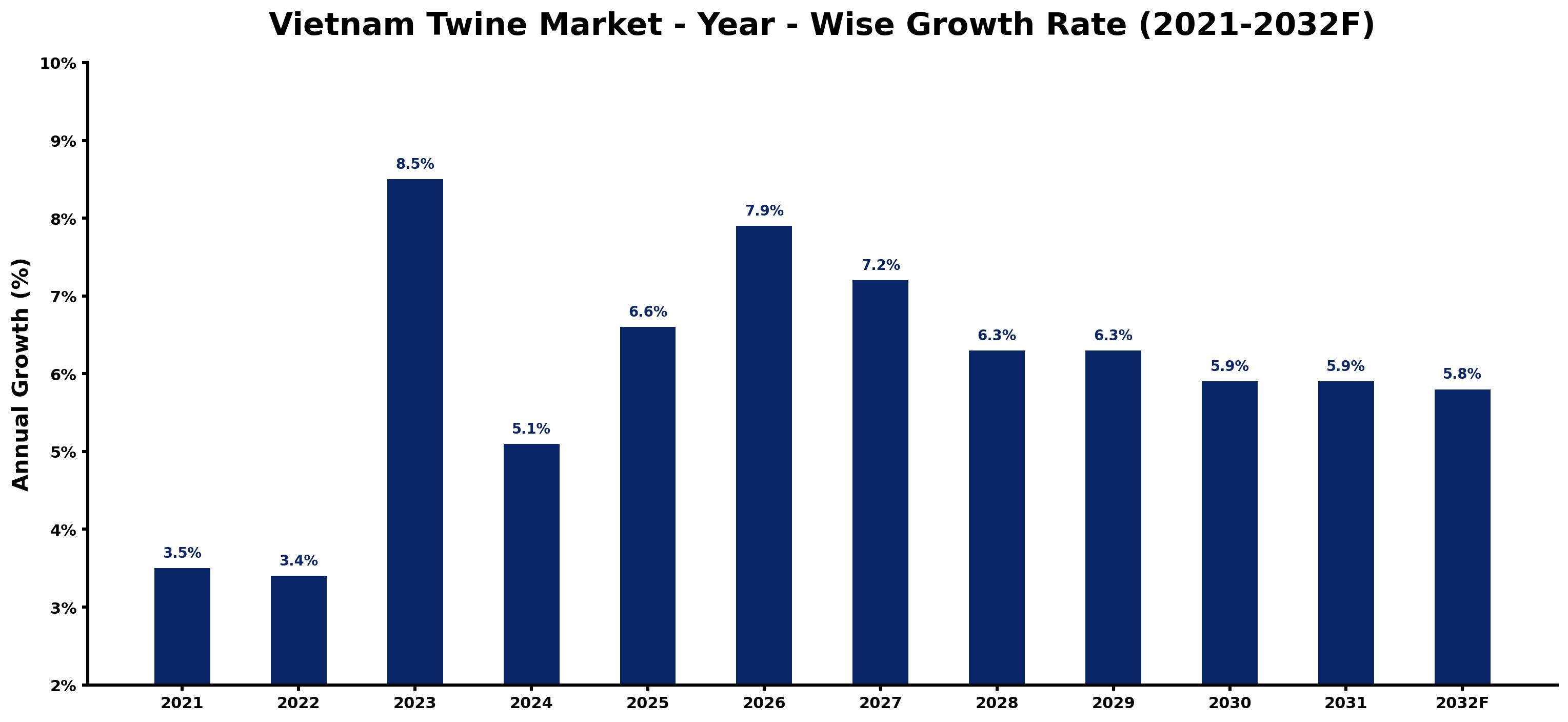
The table below presents the year‑wise growth rates along with the key drivers influencing the market
| Year | Growth Rate | Major Drivers |
| 2021 | 3.5% | Government infrastructure modernization initiatives |
| 2022 | 3.4% | Growing urbanization and commercial development |
| 2023 | 8.5% | Rapid growth in telecom and data center sectors |
| 2024 | 5.1% | Government infrastructure modernization initiatives |
| 2025 | 6.6% | Rising electricity demand across industries |
| 2026 | 7.9% | Expansion of manufacturing activities |
| 2027 | 7.2% | Expansion of transportation and logistics networks |
| 2028 | 6.3% | Rapid growth in telecom and data center sectors |
| 2029 | 6.3% | Increasing industrial infrastructure investments |
| 2030 | 5.9% | Growing urbanization and commercial development |
| 2031 | 5.9% | Increasing industrial automation investments |
| 2032 | 5.8% | Increasing adoption of advanced technologies |
Note - Market size estimations and growth projections presented in this report are based on 6Wresearch's advanced forecasting approach, validated with industry datasets as of June 2026.
Vietnam Twine Market Synopsis
The twine market in Vietnam stands as a critical component of the country's diverse industrial landscape, particularly given its vital applications in agriculture, fishing, and packaging. As the country modernizes its agricultural practices and expands its aquaculture capabilities, the reliance on twine for various functionalities has only increased.
Currently, the industry is witnessing a significant shift towards adopting modern packaging techniques across multiple sectors. This shift, driven by both consumer demand for sustainable practices and the need for efficiency in logistics, positions the twine market favorably for continued growth.
Vietnam Twine Market Key Takeaways
- The market shows strong demand driven by agriculture, aquaculture, and packaging industries.
- Key growth factors include the modernization of farming techniques and increasing aquaculture production.
- Environmental concerns and competition from alternative materials are reshaping industry dynamics.
- The market is rebounding positively post-COVID-19, with a resurgence in agricultural and packaging activities.
- Investment in eco-friendly twine options could open new avenues for market participants.
Evaluation of Restraints in Vietnam Twine Market
Despite its promising outlook, the Vietnam twine market contends with notable restraints. The volatility in raw material prices, particularly for natural fibers, continues to create uncertainty for producers, impacting cost stability. Furthermore, the increasing prevalence of synthetic alternatives presents a competitive challenge that could hinder the adoption of traditional twine solutions. This is compounded by environmental concerns associated with twine disposal, which call for a transition towards more sustainable practices.
Vietnam Twine Market Trends
The current market landscape is characterized by the integration of technology into traditional practices. Smart agriculture initiatives are driving the use of advanced twine solutions that not only enhance efficiency but also promote sustainability. Furthermore, the increasing consumer awareness regarding eco-friendly packaging is steering manufacturers towards biodegradable materials, which are poised to gain traction in the market.
Vietnam Twine Market Opportunities
Significant growth opportunities lie in the development of innovative, sustainable twine products that cater to environmentally conscious consumers. Additionally, the expansion of the aquaculture sector presents a lucrative avenue for market players, as twine is essential in the operations of fish farming. Manufacturers who can adapt their offerings to meet the evolving demands of both the agricultural and packaging sectors are likely to find substantial success.
Government Initiatives in the Vietnam Twine Market
The Vietnamese government has launched several initiatives aimed at bolstering the agricultural sector, which includes support for sustainable practices. By encouraging environmentally friendly production processes and providing incentives for adopting modern technology, policymakers are fostering a conducive environment for the twine market to flourish. These initiatives align with broader national objectives aimed at enhancing productivity and sustainability in agriculture and related industries.
Future Insights of the Vietnam Twine Market
Looking ahead to 2026-2032, the Vietnam twine market is set to experience robust growth, driven by the ongoing modernization of agriculture and increasing demand for packaging solutions. The push towards sustainability will likely catalyze innovations in twine production, positioning eco-friendly options at the forefront. As consumer preferences continue to evolve, those who can meet the dual demands of functionality and environmental responsibility will be well-positioned for success.
Vietnam Twine Market Latest Developments (May 2025 - June 2026)
Recent months have seen significant movements within the Vietnam twine market. There has been a noticeable shift towards increased collaboration between manufacturers and agricultural cooperatives, aimed at enhancing product quality and aligning with modern farming practices. Additionally, various companies have begun exploring partnerships that emphasize the development of biodegradable twine materials, reflecting a growing awareness of environmental impacts.
Vietnam Twine Market - Key Attractiveness of the Report
- 10 Years of Market Numbers
- Historical Data Starting from 2022 to 2025
- Base Year: 2025
- Forecast Data until 2032
- Key Performance Indicators Impacting the Market
- Major Upcoming Developments and Projects
Key Highlights of the Report:
- Vietnam Twine Market Outlook
- Market Size of Vietnam Twine Market, 2025
- Forecast of Vietnam Twine Market, 2032
- Historical Data and Forecast of Vietnam Twine Revenues & Volume for the Period 2022-2032F
- Vietnam Twine Market Trend Evolution
- Vietnam Twine Market Drivers and Challenges
- Vietnam Twine Price Trends
- Vietnam Twine Porter's Five Forces
- Vietnam Twine Industry Life Cycle
- Historical Data and Forecast of Vietnam Twine Market Revenues & Volume By Type for the Period 2022-2032F
- Historical Data and Forecast of Vietnam Twine Market Revenues & Volume By Polethylene Rope Twine for the Period 2022-2032F
- Historical Data and Forecast of Vietnam Twine Market Revenues & Volume By Metal Rope Twine for the Period 2022-2032F
- Historical Data and Forecast of Vietnam Twine Market Revenues & Volume By Other for the Period 2022-2032F
- Historical Data and Forecast of Vietnam Twine Market Revenues & Volume By Applications for the Period 2022-2032F
- Historical Data and Forecast of Vietnam Twine Market Revenues & Volume By Industrial for the Period 2022-2032F
- Historical Data and Forecast of Vietnam Twine Market Revenues & Volume By Counstruction for the Period 2022-2032F
- Historical Data and Forecast of Vietnam Twine Market Revenues & Volume By Oil for the Period 2022-2032F
- Historical Data and Forecast of Vietnam Twine Market Revenues & Volume By Coal mine for the Period 2022-2032F
- Historical Data and Forecast of Vietnam Twine Market Revenues & Volume By Other for the Period 2022-2032F
- Vietnam Twine Import Export Trade Statistics
- Market Opportunity Assessment By Type
- Market Opportunity Assessment By Applications
- Vietnam Twine Top Companies Market Share
- Vietnam Twine Competitive Benchmarking By Technical and Operational Parameters
- Vietnam Twine Company Profiles
- Vietnam Twine Key Strategic Recommendations






































