West and Central Africa video conferencing market report thoroughly cover the market by types, sectors, and countries. The market report provides an unbiased and detailed analysis of the ongoing market trends, opportunities/high growth areas, and market drivers which would help the stakeholders to devise and align their market strategies according to the current and future market dynamics.
West and Central Africa Video Conferencing Market Synopsis
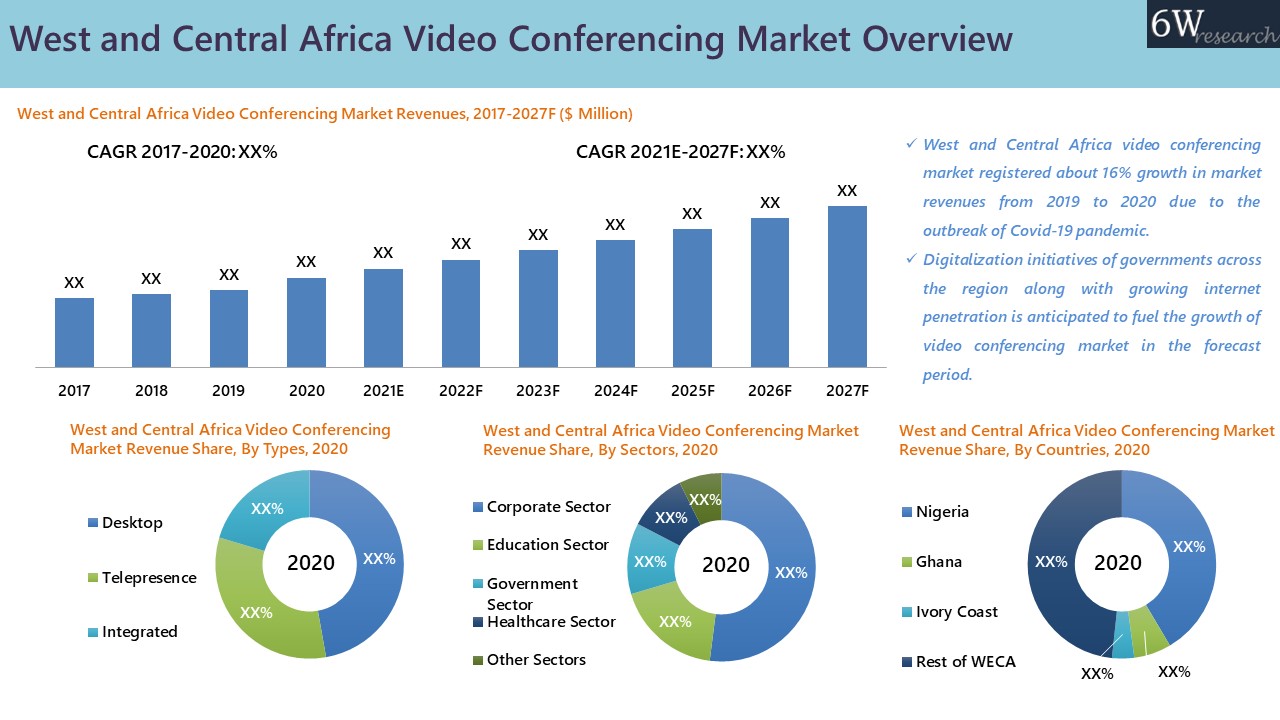
West and Central Africa video conferencing market is anticipated to grow significantly on the back of rapidly growing economies, increased foreign direct investments and rising internet penetration in the region. The outbreak of COVID-19 pandemic had a positive impact on the video conferencing market in 2020 as most of the communication was being done through virtual forms of collaboration. In addition to that, companies in many countries in the region are shifting to remote or hybrid forms of working which would further augment the growth of the market in the forecast period. Many governments across the region aim to further develop their cities by launching smart city programs. Work is being done in Lagos in Nigeria and Accra in Ghana to ensure further urbanization, better infrastructure, faster internet connectivity and surveillance which is expected to further augment market growth in the coming years.
According to 6Wresearch, West and Central Africa Video Conferencing Market size is projected to grow at CAGR of 8.5% during 2021-27. Video conferencing market of West and Central Africa region is currently at the growth stage of its industry life cycle. However, as many countries in West and Central Africa region are rapid growing economies, it is anticipated that the market would register significant growth in the coming years. Furthermore, a growing corporate sector with increased foreign investments would also augment the growth of hardware segment of the video conferencing market in the forecast period. Video conferencing market of Ivory Coast is anticipated to grow significantly in the forecast period on the back of government efforts to develop the private sector of the country along with promotion of digitalization to enable access to faster internet connectivity. The outbreak of Covid-19 pandemic acted as a catalyst for growth of video conferencing market in West and Central Africa as most organisations, schools, government institutions, healthcare services and more resorted to video conferencing for continuity of their daily activities which led to an increase in demand for video conferencing hardware. Furthermore, an increase in remote working culture increased the demand for video conferencing hardware and further drove the growth of market revenues in 2020.
Market Analysis by Type
By type, the desktop segment accounted for the highest share in 2020 and is expected to project the fastest growth in the forecast period owing to an increase in demand for portable devices for video conferencing in times where work-from-home and e-learning have become the new normal. Increasing innovation and new technologies in the segment is expected to drive the demand for the desktop segment in the forecast period. By sector, the corporate sector acquired a maximum share in 2020 on the back of a growing construction sector leading to an increase in office spaces. However, the education sector is expected to register the fastest growth due to the growing popularity of virtual education in the region.
Market Analysis by Geography
Based on countries, Nigeria Video Conferencing Market accounted for the highest share in the market for the year 2020 as it is the largest economy and one of the most populated countries in Africa. It is anticipated to register decent growth in the forecast period on the back of a fast-growing corporate sector aided with many upcoming office buildings in the country. Further, Nigeria government’s aim to drive industrialization in the country by promoting small and medium businesses along with diversifying the country’s economy would further drive the demand for video conferencing hardware in the country.
Key Attractiveness of the Report
- COVID-19 Impact on the Market.
- 10 Years Market Numbers.
- Historical Data Starting from 2017 to 2020.
- Base Year: 2020
- Forecast Data until 2027.
- Key Performance Indicators Impacting the Market.
- Major Upcoming Developments and Projects.
Key Highlights of the Report:
- West and Central Africa Video Conferencing Market Overview
- West and Central Africa Video Conferencing Market Outlook
- West and Central Africa Video Conferencing Market Forecast
- Historical Data and Forecast of West and Central Africa Video Conferencing Market Revenues for the Period 2017-2027F.
- Historical Market Data and Forecast of Revenues, By Types for the Period 2017-2027F.
- Historical Market Data and Forecasts of Revenues, By Sectors, for the Period 2017-2027F.
- Historical Market Data and Forecasts of Revenues, By Countries, for the Period 2017-2027F.
- Market Drivers and Restraints
- Market Trends
- Industry Life Cycle
- Porter’s Five Force Analysis
- Market Opportunity Assessment
- West and Central Africa Video Conferencing Market Share, By Companies
- Competitive Benchmarking
- Company Profiles
- Key Strategic Recommendations
Market Scope and Segmentation
Thereport provides a detailed analysis of the following market segments:
By Types
- Telepresence
- Integrated
- Desktop
By Sectors
- Corporate Sector
- Education Sector
- Government Sector
- Healthcare Sector
- Other Sectors
- Banking
- Financial Services
- Hospitality
- Media and Entertainment
By Countries
- Nigeria Ghana
- Ivory Coast
- Rest of West And Central Africa (Cameroon Benin Congo-Brazzaville Guinea-Bissau Liberia Kenya etc.)






































