Algeria Cyber Security Market Size, Share & Growth Rate
The Algeria Cyber Security Market was estimated at USD 419 Million in 2025 and is projected to reach USD 565 Million by 2032, growing at a CAGR of 4.4% from 2026 to 2032. This growth trajectory is fueled by an uptick in cyber threats, particularly in sectors such as finance, healthcare, and government. With increasing digitalization, organizations in Algeria are recognizing the urgent need for enhanced cybersecurity measures to protect sensitive information and digital infrastructures.
Algeria Cyber Security Market Year-wise Growth Rate and Key Drivers
This graph highlights how the Algeria Cyber Security Market has steadily grown over the years, supported by major growth factors.
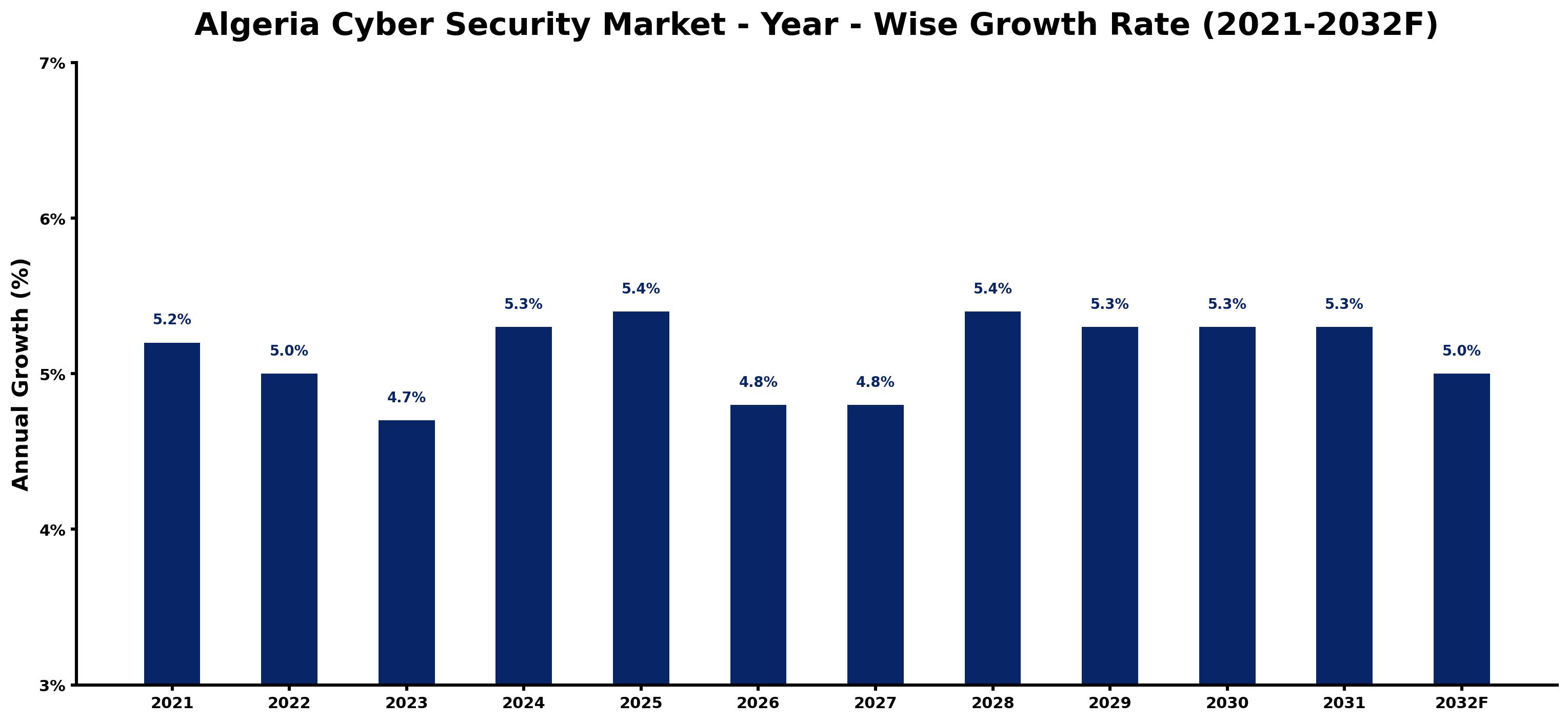
The table below presents the year‑wise growth rates along with the key drivers influencing the market
| Year | Growth Rate | Major Drivers |
| 2021 | 5.2% | Growing renewable energy integration projects |
| 2022 | 5% | Rapid growth in telecom and data center sectors |
| 2023 | 4.7% | Increasing industrial infrastructure investments |
| 2024 | 5.3% | Rising electricity demand across industries |
| 2025 | 5.4% | Increasing industrial automation investments |
| 2026 | 4.8% | Increasing industrial infrastructure investments |
| 2027 | 4.8% | Growing urbanization and commercial development |
| 2028 | 5.4% | Growing renewable energy integration projects |
| 2029 | 5.3% | Increasing smart city development projects |
| 2030 | 5.3% | Growing urbanization and commercial development |
| 2031 | 5.3% | Rising electricity demand across industries |
| 2032 | 5% | Expansion of transportation and logistics networks |
Note - Market size estimations and growth projections presented in this report are based on 6Wresearch’s advanced forecasting approach, validated with industry datasets as of June 2026.
Topics Covered in the Algeria Cyber Security Market Report
The Algeria Cyber Security Market report covers the market by product type, end-user industry, and deployment. The report provides an in-depth analysis of ongoing market trends, opportunities, and growth drivers, enabling stakeholders to align strategies with current and future market dynamics.
Algeria Cyber Security Market Highlights
| Report Name | Algeria Cyber Security Market |
| Forecast period | 2026–2032 |
| CAGR | 4.4% |
| Growing Sector | IT & Telecom |
Algeria Cyber Security Market Synopsis
The Algeria Cyber Security Industry is expected to witness steady growth during the forecast period on account of increase in cyber threats, and adoption of the cloud-based infrastructure across enterprises. The rise in digital banking, and e-governance initiatives is significantly increasing the demand for the advanced cybersecurity solutions. Additionally, the growing internet penetration, and rapid digitization are exposing the organizations to risks such data breaches. As a result, investments in the network security, and cloud security solutions are expected to rise consistently across the country.
Evaluation of Growth Drivers in Algeria Cyber Security Market (2026–2032)
Below are some major drivers and their influence on the market dynamics:
| Drivers | Primary Segment Affected | Why It Matters (Evidence) |
| Cyber Threats | BFSI, Government, Enterprises | The rise in incidents of ransomware, and data breaches are driving the security adoption. |
| Digital Transformation | IT, Telecom, Government | Expansion of the digital services requires secure IT infrastructure. |
| Growth of E-Governance | Public Sector | Government digitization increases the demand for secure platforms. |
| Cloud Adoption | Enterprises & SMEs | Migration to cloud increases the need for advanced security controls. |
| Expansion of Digital Payments | BFSI & Fintech | Growth in online transactions increases the exposure to cyber risks. |
The Algeria Cyber Security Market is projected to grow at a CAGR of 4.4% during 2026–2032 on account of increased digitization, strong regulatory focus, and rise in awareness of cybersecurity risks. The adoption of AI-based threat detection, and managed security services is expected to further strengthen the enterprise resilience. The adoption of these technologies is also expected to enhance the digital resilience, and accelerate the secure innovation across critical sectors.
Evaluation of Restraints in Algeria Cyber Security Market
Below are some major restraints and their influence on the market dynamics:
| Restraints | Primary Segment Affected | What This Means (Evidence) |
| High Implementation Cost | SMEs & Start-ups | Limited budgets restrict the adoption of advanced security tools. |
| Shortage of Skilled Professionals | IT & Security Operations | Lack of trained experts slows the deployment, and response capabilities. |
| Low Cybersecurity Awareness | SMEs & Traditional Businesses | Limited awareness delays the investment in security solutions. |
| Infrastructure Gaps | Nationwide IT Ecosystem | The uneven digital infrastructure impacts the security effectiveness of the market. |
| Regulatory Complexity | Cross-sector Organizations | Evolving compliance requirements increase the operational burden. |
Algeria Cyber Security Market Challenges
Despite strong growth potential, Algeria Cyber Security Market is facing several challenges such as shortage of cybersecurity professionals, limited awareness among small business, and budget constraints for advanced security deployment. To address these challenges, organizations must invest in the cybersecurity training programs, adopt AI-driven security solutions, and strengthen the managed security service partnerships. Government-led digital security initiatives are also likely to play a key role in improving the national cybersecurity posture.
Algeria Cyber Security Market Trends
Principal trends driving the Algeria Cyber Security Market Growth are outlined below:
- Rise of Cloud Security Adoption: Organizations are shifting towards the cloud-based infrastructure, driving the demand for cloud security tools like identity access management, and workload protection.
- Growth of Managed Security Services: SMEs, and enterprises are outsourcing the cybersecurity operations to MSS providers on account of limited in-house expertise, and cost-effective security management needs.
- Increased Use of AI & Threat Intelligence: The AI-driven security solutions are being adopted for the real-time threat detection, automated response, and advanced analytics to counter the evolving cyberattacks.
Investment Opportunities in the Algeria Cyber Security Market
Major investment opportunities in the Algeria Cyber Security Market are presented below:
- Cloud Security Solutions: The growth in the cloud adoption creates strong demand for encryption, identity management, and cloud workload protection solutions across enterprises, and government systems.
- Managed Security Services Expansion: Investment opportunities are available for the MSS providers to support SMEs lacking in-house expertise, offering affordable monitoring, and 24/7 threat management.
- AI-based Cybersecurity Platforms: Investment in the AI-driven tools for threat detection, behavioural analytics, and automated response systems is rising on account of increasing attack sophistication.
Top Players in Algeria Cyber Security Market
A comprehensive list of major companies holding majority of Algeria Cyber Security Market Share is provided below:
1. Algérie Télécom
| Company Name | Algérie Télécom |
|---|---|
| Established Year | 2003 |
| Headquarters | Algiers, Algeria |
| Official Website | - |
Algérie Télécom is a key national telecom operator driving cybersecurity adoption through secure network infrastructure, managed security services, and support for government digital transformation initiatives.
2. Cisco Systems
| Company Name | Cisco Systems |
|---|---|
| Established Year | 1984 |
| Headquarters | San Jose, California, USA |
| Official Website | Click Here |
Cisco is a leading provider of network security, and cloud security solutions used by telecom operators, enterprises, and government institutions in Algeria for securing digital infrastructure, and preventing cyber threats.
3. IBM (International Business Machines Corporation)
| Company Name | IBM (International Business Machines Corporation) |
|---|---|
| Established Year | 1911 |
| Headquarters | Armonk, New York, USA |
| Official Website | Click Here |
IBM plays a key role through its AI-driven cybersecurity, threat intelligence, and managed security services, supporting enterprises, and government agencies in Algeria with advanced threat detection, and compliance solutions.
4. Check Point Software Technologies
| Company Name | Check Point Software Technologies |
|---|---|
| Established Year | 1993 |
| Headquarters | Tel Aviv, Israel |
| Official Website | Click Here |
Check Point is widely adopted for firewall protection, endpoint security, and threat prevention solutions, helping Algerian enterprises secure networks against ransomware, and advanced persistent threats.
5. Palo Alto Networks
| Company Name | Palo Alto Networks |
|---|---|
| Established Year | 2005 |
| Headquarters | Santa Clara, California, USA |
| Official Website | Click Here |
Palo Alto Networks is a major player in next-generation firewall, cloud security, and AI-driven threat prevention, adopted in Algeria for securing hybrid cloud environments, and critical enterprise networks.
Government Initiatives being implemented in the Algeria Cyber Security Market
According to Algeria government data, the authorities are strengthening its cybersecurity ecosystem through digital transformation programs, secure e-governance expansion, and protection of critical infrastructure. Under the National Cybersecurity Strategy, the country is building stronger cyber defense systems to safeguard the key digital assets. The Electronic Communications Law regulates the telecom, and digital services to ensure secure data handling. Data Protection Regulations enforce privacy, and secure processing of personal information. The E-Government Modernization Program promotes the secure digital public services, and improves government service delivery.
Future Insights of the Algeria Cyber Security Market
The Algeria Cyber Security Market is expected to witness steady growth on account of accelerating digital transformation, and expanding cloud adoption across enterprises, and government sectors. The increase in the investment in AI-driven security solutions, managed services, and national cyber defense capabilities will shape the future development. Strong regulatory frameworks, and growth in awareness of data protection will further support the market maturity. Over the forecast period, the demand for advanced, and cost-effective cybersecurity solutions will continue to rise significantly.
Market Segmentation Analysis
This report presents a detailed analysis of the Algeria Cyber Security Market segments along with their leading categories.
By Product Type - Market Dominated by Security Information & Event Management, Threat Detection & Prevention Set for Rapid Expansion
According to Sachin, Senior Research Analyst, 6Wresearch, security information & event management (SIEM) dominated the solutions segment up to 2025, accounting for an estimated 55% market share due to strong demand for centralized threat monitoring, and real-time incident visibility across networks. However, during the forecast period (2026–2032), threat detection & prevention solutions are expected to dominate the market, supported by rising sophistication of cyberattacks, increasing adoption of AI-based security tools, and the need for proactive defense mechanisms. This segment is projected to grow at a CAGR of around 12%, driven by rapid digitization, and expansion of critical digital infrastructure.
By End-User Industry - IT & Telecom will Dominate the Market
The IT & Telecom sector dominated the market till 2025, accounting for an estimated 39% market share driven by rapid digital infrastructure expansion, high data traffic, and increasing exposure to cyber threats. Even, during 2026–2032, the IT & Telecom sector is expected to emerge as the leading growth driver, fueled by digital payments, and e-governance initiatives. This segment is projected to register a CAGR of approximately 10.5%, supported by regulatory compliance requirements, and rising cyber risk exposure.
By Deployment - On-Premise Leads the Market, Cloud to Show Rapid Growth
Up to 2025, on-premise deployment dominated the market, accounting for an estimated 48% market share due to data sovereignty concerns, regulatory sensitivity, and preference for in-house control over critical infrastructure security. However, during the forecast period (2026–2032), cloud-based solutions are expected to dominate the market, driven by accelerating cloud adoption, cost efficiency, and increased demand for remote security management. Cloud deployment is projected to grow at a CAGR of around 14.5%, supported by enterprise digital transformation, and increased adoption of hybrid IT environments.
Note: Market size estimations and growth projections presented in this report are based on 6Wresearch's proprietary forecasting methodology, utilizing the latest available industry data, government publications, and primary research inputs.
Key Attractiveness of the Report:
- 10 Years of Market Numbers
- Historical Data Starting from 2022 to 2025
- Base Year: 2025
- Forecast Data until 2032
- Key Performance Indicators Impacting the Market
- Major Upcoming Developments and Projects
Key Highlights of the Report:
- Algeria Cyber Security Market Outlook
- Market Size of Algeria Cyber Security Market, 2025
- Forecast of Algeria Cyber Security Market, 2032
- Historical Data and Forecast of Algeria Cyber Security Revenues & Volume for the Period 2022-2032F
- Algeria Cyber Security Market Trend Evolution
- Algeria Cyber Security Market Drivers and Challenges
- Algeria Cyber Security Price Trends
- Algeria Cyber Security Porter's Five Forces
- Algeria Cyber Security Industry Life Cycle
- Historical Data and Forecast of Algeria Cyber Security Market Revenues & Volume By Product Type for the Period 2022-2032F
- Historical Data and Forecast of Algeria Cyber Security Market Revenues & Volume By Solutions Identity & Access Managements for the Period 2022-2032F
- Historical Data and Forecast of Algeria Cyber Security Market Revenues & Volume By Threat Detection & Prevention for the Period 2022-2032F
- Historical Data and Forecast of Algeria Cyber Security Market Revenues & Volume By DDoS & Mitigation for the Period 2022-2032F
- Historical Data and Forecast of Algeria Cyber Security Market Revenues & Volume By IDS for the Period 2022-2032F
- Historical Data and Forecast of Algeria Cyber Security Market Revenues & Volume By Security Information & Event Management for the Period 2022-2032F
- Historical Data and Forecast of Algeria Cyber Security Market Revenues & Volume By Others for the Period 2022-2032F
- Historical Data and Forecast of Algeria Cyber Security Market Revenues & Volume By Services for the Period 2022-2032F
- Historical Data and Forecast of Algeria Cyber Security Market Revenues & Volume By End-User Industry for the Period 2022-2032F
- Historical Data and Forecast of Algeria Cyber Security Market Revenues & Volume By Aerospace & Defense for the Period 2022-2032F
- Historical Data and Forecast of Algeria Cyber Security Market Revenues & Volume By Healthcare for the Period 2022-2032F
- Historical Data and Forecast of Algeria Cyber Security Market Revenues & Volume By Manufacturing for the Period 2022-2032F
- Historical Data and Forecast of Algeria Cyber Security Market Revenues & Volume By Retail for the Period 2022-2032F
- Historical Data and Forecast of Algeria Cyber Security Market Revenues & Volume By Utility for the Period 2022-2032F
- Historical Data and Forecast of Algeria Cyber Security Market Revenues & Volume By IT & Telecom for the Period 2022-2032F
- Historical Data and Forecast of Algeria Cyber Security Market Revenues & Volume By Others for the Period 2022-2032F
- Historical Data and Forecast of Algeria Cyber Security Market Revenues & Volume By By Deployment for the Period 2022-2032F
- Historical Data and Forecast of Algeria Cyber Security Market Revenues & Volume By On-Premise for the Period 2022-2032F
- Historical Data and Forecast of Algeria Cyber Security Market Revenues & Volume By Cloud for the Period 2022-2032F
- Algeria Cyber Security Import Export Trade Statistics
- Market Opportunity Assessment By Product Type
- Market Opportunity Assessment By End user Industry
- Market Opportunity Assessment By Deployment Mode
- Algeria Cyber Security Top Companies Market Share
- Algeria Cyber Security Competitive Benchmarking By Product Type, End user Industry and Deployment
- Algeria Cyber Security Company Profiles
- Algeria Cyber Security Key Strategic Recommendations
Market Covered
The report offers a comprehensive study of the subsequent market segments:
By Product Type
- Solutions
- Identity & Access Management
- Threat Detection & Prevention
- DDoS & Mitigation
- IDS
- Security Information & Event Management
- Others
- Services
By End-User Industry
- Aerospace & Defense
- Healthcare
- Manufacturing
- Retail
- Utility
- IT & Telecom
- Others
By Deployment
- On-Premise
- Cloud






































