Bangladesh Brandy Market (2026-2032) | Growth, Trends, Outlook, Companies, Forecast, Size, Revenue, Industry, Analysis, Value & Share
Market Forecast By Type (V.S. ("very special"), V.S.O.P. ("very superior old pale"), XO ("extra old"), Hors d'age ("beyond age")), By Applications (Shop & Supermarket, Restaurant & Bar & Club, Exclusive Store, Others) And Competitive Landscape
| Product Code: ETC032512 | Publication Date: Oct 2020 | Updated Date: Jun 2026 | Product Type: Report | |
| Publisher: 6Wresearch | Author: Summon Dutta | No. of Pages: 70 | No. of Figures: 35 | No. of Tables: 5 |
Bangladesh Brandy Market Summary
The bangladesh brandy market was estimated at USD 373 Million in 2025 and is projected to reach USD 499 Million by 2032, growing at a CAGR of 5.2% from 2026 to 2032.
Bangladesh Brandy Market Growth Rate Analysis (2021-2032)
The Bangladesh brandy market has exhibited modest growth, with rates such as 5.3% in 2021 and 4.9% in 2022, highlighting a steady consumer interest despite external challenges. The growth rate remained around 5.1% in 2023 and 2024, driven by a rise in local production and improvements in distribution networks. Although growth dipped slightly to 4.8% in 2024 and 2028, factors like increased urbanization and a burgeoning middle class are expected to support a resurgence, with projections of 5.3% in 2031. This stability creates a conducive environment for investment in production technology and digital marketing, ultimately catering to evolving consumer tastes in Bangladesh's enhancing beverage landscape.
Bangladesh Brandy Market Year-wise Growth Rate and Key Drivers
This graph highlights how the Bangladesh Brandy Market has steadily grown over the past five years, supported by major growth factors.
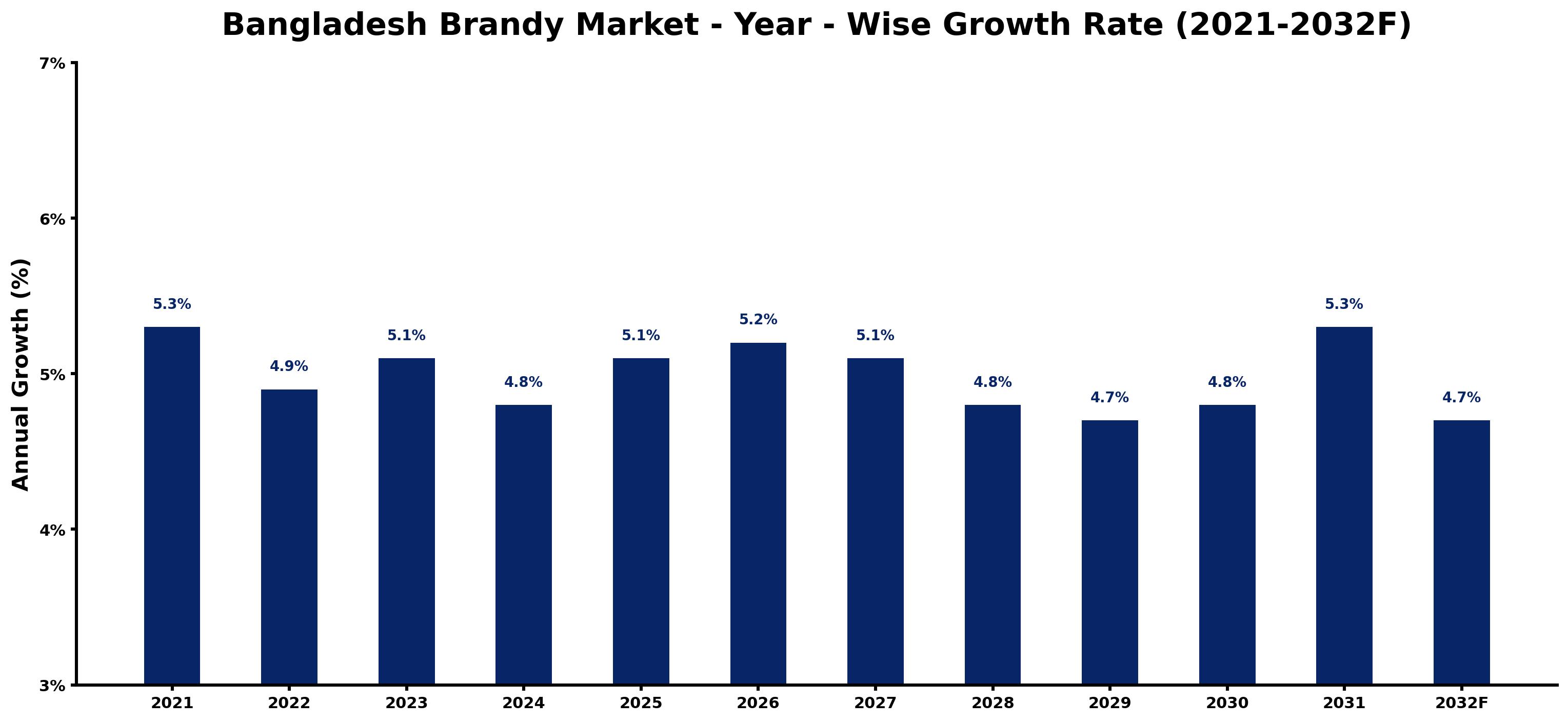
The table below presents the year wise growth rates along with the key drivers influencing the market
| Year | Growth Rate | Major Drivers |
| 2021 | 5.3% | Shifting consumer preferences highlight a growing acceptance of premium alcoholic beverages. |
| 2022 | 4.9% | Local distilleries enhance product offerings, catering to emerging middle-class consumers. |
| 2023 | 5.1% | Increased urbanization leads to broader distribution channels for brandy products. |
| 2024 | 4.8% | Tourism rebounds, creating heightened demand for local and international brandy brands. |
| 2025 | 5.1% | Social events and celebrations emphasize the role of brandy in cultural traditions. |
| 2026 | 5.2% | Online retail platforms expand, attracting younger demographics towards brandy consumption. |
| 2027 | 5.1% | Growing interest in cocktail culture supports innovative brandy-based drink recipes. |
| 2028 | 4.8% | Influencer collaborations boost brand visibility, appealing to trend-conscious consumers. |
| 2029 | 4.7% | Sustainability trends influence production methods, attracting environmentally aware buyers. |
| 2030 | 4.8% | Brandy tourism initiates, promoting local brands and engaging global audiences. |
| 2031 | 5.3% | Increased brand loyalty stems from effective marketing campaigns targeting young adults. |
| 2032 | 4.7% | Innovative packaging solutions capture consumer attention, enhancing product appeal and accessibility. |
Note - Market size estimations and growth projections presented in this report are based on 6Wresearch's advanced forecasting approach, validated with industry datasets as of June 2026.
Bangladesh Brandy Market Synopsis
The Bangladesh Brandy Market is projected to reach 5.2% and witness significant growth during the forecast period (2026-2032). This market segment, while niche, is characterized by a burgeoning urban population and an increase in disposable incomes, which are catalyzing shifts in consumption patterns. Cultural and social factors play an influential role in brandy consumption, with a notable preference for imported brands viewed as premium offerings. Domestic distilleries also contribute to the market, diversifying the available options for consumers. However, challenges such as high taxation on imports, stringent regulations, and competition from other spirits like whiskey and rum temper growth prospects.
Bangladesh Brandy Market Growth Drivers
The growth of the Bangladesh Brandy Market is primarily driven by several key factors:
- Increased Urbanization: The migration of populations to urban settings is expanding the consumer base for alcoholic beverages, including brandy.
- Rising Disposable Incomes: Economic growth is resulting in consumers having more income to spend on premium alcoholic beverages, including brandy.
- Cultural Shifts: Changing social norms are making brandy more acceptable among younger consumers, particularly in urban settings.
- Growth of the Cocktail Culture: The rising trend of cocktail drinking is increasing brandy consumption as it becomes a sought-after ingredient in mixed drinks.
- Interest in Premium Spirits: There is a notable trend among consumers seeking higher quality and unique flavor profiles in alcoholic beverages.
Bangladesh Brandy Market Trends and Opportunities
Current trends in the Bangladesh Brandy Market indicate a steady shift towards premiumization. As consumer preferences evolve, the demand for imported brandy brands, especially from regions renowned for their quality, such as France and Spain, is on the rise. Local distilleries are actively expanding their offerings to meet these changing tastes, contributing to the market's dynamism.
Opportunities also present themselves through:
- Expanding Distribution Networks: Companies can enhance market penetration by developing broader distribution channels within urban areas.
- Product Innovation: Introducing unique variants and flavors can attract adventurous consumers seeking new experiences.
- Strategic Partnerships: Collaborating with local producers can facilitate market entry and increase brand visibility.
- Marketing Campaigns: Educating consumers about brandy, its history, and its distinct characteristics can alleviate misconceptions and boost demand.
- Focus on Online Sales: With increasing digitization, e-commerce platforms present a new arena for brandy sales to tech-savvy consumers.
Bangladesh Brandy Market Challenges and Restraints
Despite the potential for growth in the Bangladesh Brandy Market, several challenges persist:
- Cultural Norms: Predominantly Muslim demographics impose significant cultural barriers to alcohol consumption, constraining the market size.
- Regulatory Constraints: Stringent governmental policies regarding alcohol production, sales, and marketing create operational hurdles for brands.
- High Import Duties: Elevated tariffs on imported brandy position it at a premium price point, reducing affordability for the average consumer.
- Consumer Awareness: A general lack of familiarity with brandy as a product inhibits market penetration efforts.
- Inter-Spirit Competition: Brandy faces stiff competition from other alcoholic beverages like whiskey and rum, which are more widely accepted and consumed.
Bangladesh Brandy Market Government Investment and Initiatives
The government of Bangladesh has established a framework of regulations that affect the production and distribution of alcoholic beverages, including brandy. High tariffs and import restrictions are designed to manage consumption patterns and maintain cultural sensitivities. In recent years, there have been attempts to streamline regulations to foster foreign investment and enhance the business climate for the alcoholic beverage industry. Initiatives aimed at promoting responsible drinking and reducing the stigma associated with alcohol consumption are also on the rise. These measures aim to create a balanced environment, allowing for economic development while respecting the cultural landscape.
Bangladesh Brandy Market Latest Developments (May 2025 - June 2026)
Recent developments in the Bangladesh Brandy Market indicate a notable trend toward premiumization, with rising consumer demand for high-quality brandy driving new product lines. Additionally, several local distilleries have announced plans to enhance their offerings, focusing on unique flavors and aging processes to compete with imported brands. The cocktail culture continues to grow, with various mixology events and consumer education initiatives being introduced. Regulatory discussions have also taken place, with government officials considering adjustments to taxation and import policies aimed at boosting the industry while addressing cultural concerns. Overall, the market is trending positively, with increasing interest and investment in brandy among consumers.
Bangladesh Brandy Market - Key Attractiveness of the Report
- 10 Years of Market Numbers
- Historical Data Starting from 2022 to 2025
- Base Year: 2025
- Forecast Data until 2032
- Key Performance Indicators Impacting the Market
- Major Upcoming Developments and Projects
Key Highlights of the Report:
- Bangladesh Brandy Market Outlook
- Market Size of Bangladesh Brandy Market, 2025
- Forecast of Bangladesh Brandy Market, 2032F
- Historical Data and Forecast of Bangladesh Brandy Revenues & Volume for the Period 2022-2032F
- Bangladesh Brandy Market Trend Evolution
- Bangladesh Brandy Market Drivers and Challenges
- Bangladesh Brandy Price Trends
- Bangladesh Brandy Porter's Five Forces
- Bangladesh Brandy Industry Life Cycle
- Historical Data and Forecast of Bangladesh Brandy Market Revenues & Volume By Type for the Period 2022-2032F
- Historical Data and Forecast of Bangladesh Brandy Market Revenues & Volume By V.S. ("very special") for the Period 2022-2032F
- Historical Data and Forecast of Bangladesh Brandy Market Revenues & Volume By V.S.O.P. ("very superior old pale") for the Period 2022-2032F
- Historical Data and Forecast of Bangladesh Brandy Market Revenues & Volume By XO ("extra old") for the Period 2022-2032F
- Historical Data and Forecast of Bangladesh Brandy Market Revenues & Volume By Hors d'age ("beyond age") for the Period 2022-2032F
- Historical Data and Forecast of Bangladesh Brandy Market Revenues & Volume By Applications for the Period 2022-2032F
- Historical Data and Forecast of Bangladesh Brandy Market Revenues & Volume By Shop & Supermarket for the Period 2022-2032F
- Historical Data and Forecast of Bangladesh Brandy Market Revenues & Volume By Restaurant & Bar & Club for the Period 2022-2032F
- Historical Data and Forecast of Bangladesh Brandy Market Revenues & Volume By Exclusive Store for the Period 2022-2032F
- Historical Data and Forecast of Bangladesh Brandy Market Revenues & Volume By Others for the Period 2022-2032F
- Bangladesh Brandy Import Export Trade Statistics
- Market Opportunity Assessment By Type
- Market Opportunity Assessment By Applications
- Bangladesh Brandy Top Companies Market Share
- Bangladesh Brandy Competitive Benchmarking By Technical and Operational Parameters
- Bangladesh Brandy Company Profiles
- Bangladesh Brandy Key Strategic Recommendations
Frequently Asked Questions About the Market Study (FAQs):
Increasing disposable income, urbanization, and cultural shifts towards acceptance of premium spirits are key drivers.
Cultural norms, high import duties, and regulatory restrictions present significant obstacles for market penetration.
Opportunities include product innovation, expanding distribution networks, and developing partnerships with local producers.
Through stringent regulations and tariff structures, while also exploring initiatives to foster a more favorable investment environment.
6Wresearch actively monitors the Bangladesh Brandy Market and publishes its comprehensive annual report, highlighting emerging trends, growth drivers, revenue analysis, and forecast outlook. Our insights help businesses to make data-backed strategic decisions with ongoing market dynamics. Our analysts track relevent industries related to the Bangladesh Brandy Market, allowing our clients with actionable intelligence and reliable forecasts tailored to emerging regional needs.
Yes, we provide customisation as per your requirements. To learn more, feel free to contact us on sales@6wresearch.com
1 Executive Summary |
2 Introduction |
2.1 Key Highlights of the Report |
2.2 Report Description |
2.3 Market Scope & Segmentation |
2.4 Research Methodology |
2.5 Assumptions |
3 Bangladesh Brandy Market Overview |
3.1 Bangladesh Country Macro Economic Indicators |
3.2 Bangladesh Brandy Market Revenues & Volume, 2022 & 2032F |
3.3 Bangladesh Brandy Market - Industry Life Cycle |
3.4 Bangladesh Brandy Market - Porter's Five Forces |
3.5 Bangladesh Brandy Market Revenues & Volume Share, By Type, 2022 & 2032F |
3.6 Bangladesh Brandy Market Revenues & Volume Share, By Applications, 2022 & 2032F |
4 Bangladesh Brandy Market Dynamics |
4.1 Impact Analysis |
4.2 Market Drivers |
4.3 Market Restraints |
5 Bangladesh Brandy Market Trends |
6 Bangladesh Brandy Market, By Types |
6.1 Bangladesh Brandy Market, By Type |
6.1.1 Overview and Analysis |
6.1.2 Bangladesh Brandy Market Revenues & Volume, By Type, 2022-2032F |
6.1.3 Bangladesh Brandy Market Revenues & Volume, By V.S. ("very special"), 2022-2032F |
6.1.4 Bangladesh Brandy Market Revenues & Volume, By V.S.O.P. ("very superior old pale"), 2022-2032F |
6.1.5 Bangladesh Brandy Market Revenues & Volume, By XO ("extra old"), 2022-2032F |
6.1.6 Bangladesh Brandy Market Revenues & Volume, By Hors d'age ("beyond age"), 2022-2032F |
6.2 Bangladesh Brandy Market, By Applications |
6.2.1 Overview and Analysis |
6.2.2 Bangladesh Brandy Market Revenues & Volume, By Shop & Supermarket, 2022-2032F |
6.2.3 Bangladesh Brandy Market Revenues & Volume, By Restaurant & Bar & Club, 2022-2032F |
6.2.4 Bangladesh Brandy Market Revenues & Volume, By Exclusive Store, 2022-2032F |
6.2.5 Bangladesh Brandy Market Revenues & Volume, By Others, 2022-2032F |
7 Bangladesh Brandy Market Import-Export Trade Statistics |
7.1 Bangladesh Brandy Market Export to Major Countries |
7.2 Bangladesh Brandy Market Imports from Major Countries |
8 Bangladesh Brandy Market Key Performance Indicators |
9 Bangladesh Brandy Market - Opportunity Assessment |
9.1 Bangladesh Brandy Market Opportunity Assessment, By Type, 2022 & 2032F |
9.2 Bangladesh Brandy Market Opportunity Assessment, By Applications, 2022 & 2032F |
10 Bangladesh Brandy Market - Competitive Landscape |
10.1 Bangladesh Brandy Market Revenue Share, By Companies, 2025 |
10.2 Bangladesh Brandy Market Competitive Benchmarking, By Operating and Technical Parameters |
11 Company Profiles |
12 Recommendations |
13 Disclaimer |
Global Go To Market Strategy - 2030
Export potential enables firms to identify high-growth global markets with greater confidence by combining advanced trade intelligence with a structured quantitative methodology. The framework analyzes emerging demand trends and country-level import patterns while integrating macroeconomic and trade datasets such as GDP and population forecasts, bilateral import–export flows, tariff structures, elasticity differentials between developed and developing economies, geographic distance, and import demand projections. Using weighted trade values from 2020–2024 as the base period to project country-to-country export potential for 2030, these inputs are operationalized through calculated drivers such as gravity model parameters, tariff impact factors, and projected GDP per-capita growth. Through an analysis of hidden potentials, demand hotspots, and market conditions that are most favorable to success, this method enables firms to focus on target countries, maximize returns, and global expansion with data, backed by accuracy.
By factoring in the projected importer demand gap that is currently unmet and could be potential opportunity, it identifies the potential for the Exporter (Country) among 190 countries, against the general trade analysis, which identifies the biggest importer or exporter.
To discover high-growth global markets and optimize your business strategy:
Click Here
Pricing
- Single User License$ 1,995
- Department License$ 2,400
- Site License$ 3,120
- Global License$ 3,795

Leadership Perspectives from Industry Events
Search
Thought Leadership and Analyst Meet





Our Clients








6WResearch In News
- India Air Conditioner Market Set for Strong Rebound in 2026 After Weather-Led Correction and GST-Driven Recovery: 6Wresearch
- ADAS in India: How Automatic Emergency Braking, Blind Spot Detection & Driver Monitoring are Transforming Road Safety
- Doha a strategic location for EV manufacturing hub: IPA Qatar
- Demand for luxury TVs surging in the GCC, says Samsung
- Empowering Growth: The Thriving Journey of Bangladesh’s Cable Industry
- Demand for luxury TVs surging in the GCC, says Samsung
Latest Reports
- Poland Fire Protection Systems Market (2026-2032)
- Cape Verde Portable Hand-Thrown Extinguisher Market (2026-2032)
- Canada Portable Hand-Thrown Extinguisher Market (2026-2032)
- Cameroon Portable Hand-Thrown Extinguisher Market (2026-2032)
- Burundi Portable Hand-Thrown Extinguisher Market (2026-2032)
- Burkina Faso Portable Hand-Thrown Extinguisher Market (2026-2032)
- Bulgaria Portable Hand-Thrown Extinguisher Market (2026-2032)
- Brunei Portable Hand-Thrown Extinguisher Market (2026-2032)
- Botswana Portable Hand-Thrown Extinguisher Market (2026-2032)
- Bosnia and Herzegovina Portable Hand-Thrown Extinguisher Market (2026-2032)
Industry Events and Analyst Meet

HIMTEX 2026

India Refining Summit 2026

India EV Show 2026

EV tech India Expo 2026

Auto Tech Asia 2026
Whitepaper
- Middle East & Africa Commercial Security Market Click here to view more.
- Middle East & Africa Fire Safety Systems & Equipment Market Click here to view more.
- GCC Drone Market Click here to view more.
- Middle East Lighting Fixture Market Click here to view more.
- GCC Physical & Perimeter Security Market Click here to view more.


