Brazil Security Analytics Market Size & Growth Rate (2026-2032)
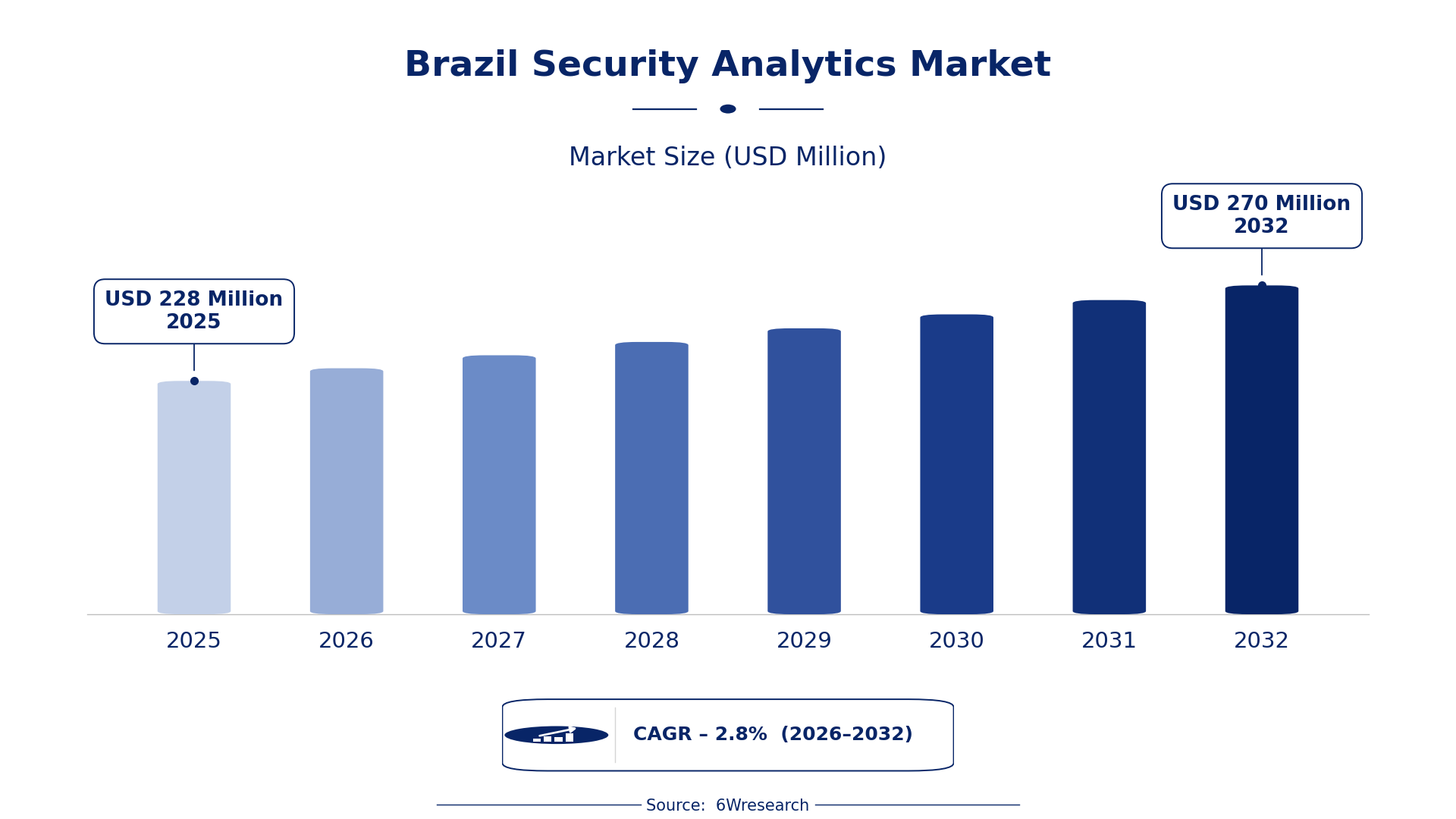
The Brazil Security Analytics Market was estimated at USD 228 Million in 2025 and is projected to reach USD 270 Million by 2032, growing at a CAGR of 2.8% from 2026 to 2032.
Brazil Security Analytics Market Synopsis
Brazil's need for enhanced security analytics has never been more urgent. With organizations facing escalating cyber threats, the focus on advanced analytical capabilities is critical for safeguarding data and infrastructure.
The local market is responding to a growing complexity in cyber threats, which demands immediate action and sophisticated tools. As Brazilian organizations strive for better threat detection and mitigation, investments in security analytics are set to rise significantly.
Brazil Security Analytics Market Year-wise Growth Rate and Key Drivers
This graph illustrates the annual growth rates of the Brazil Security Analytics Market from 2021 to 2032, highlighting a steady upward trajectory and projected expansion over the forecast period.
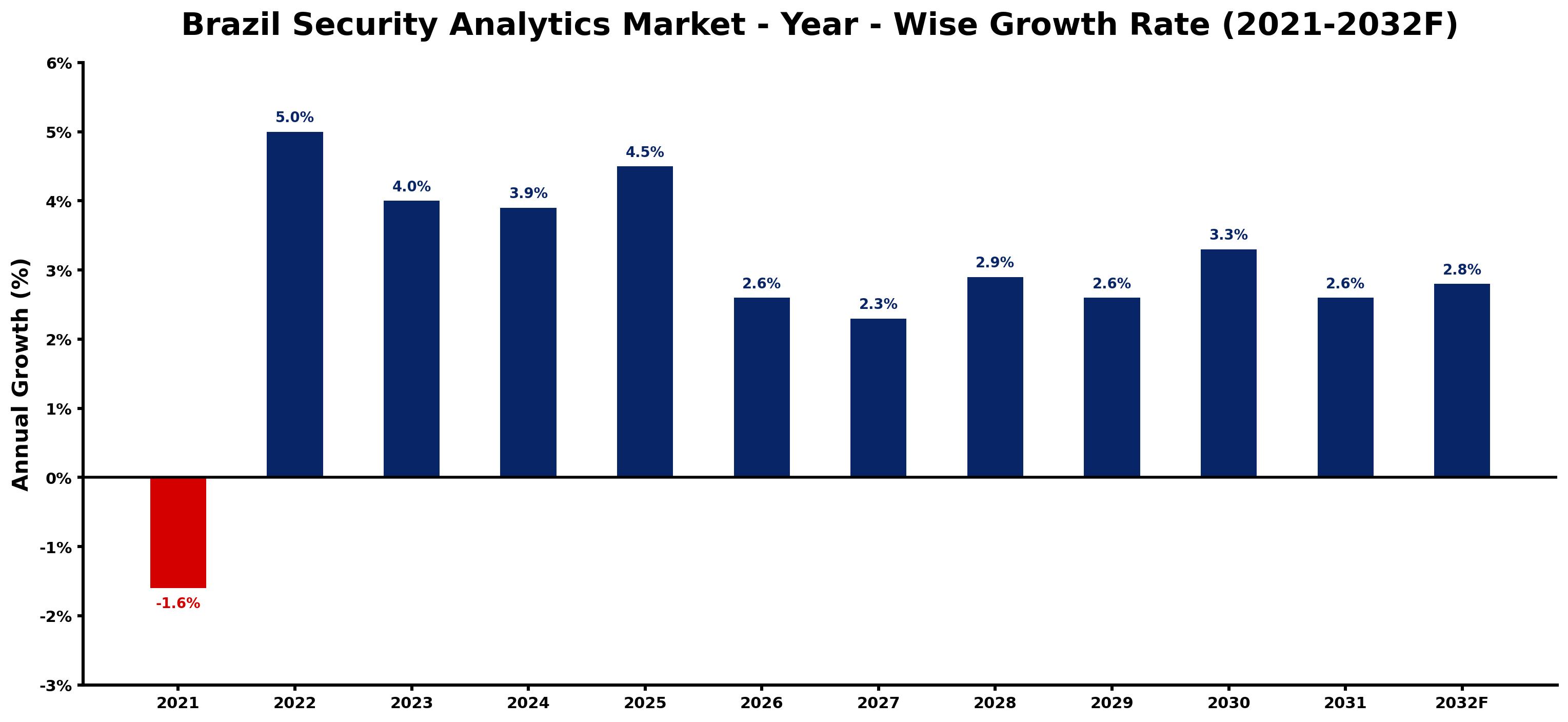
The table below presents the year‑wise growth rates along with the key drivers influencing the market
| Year | Growth Rate | Major Drivers |
| 2021 | -1.6% | Government budget cuts impacting cybersecurity projects. |
| 2022 | 5.0% | Government incentives for cybersecurity talent development programs. |
| 2023 | 4.0% | Growing emphasis on KYC regulations in Brazilian fintech. |
| 2024 | 3.9% | Increased cybersecurity funding in response to data breaches. |
| 2025 | 4.5% | Rising e-commerce activity boosting demand for security solutions. |
| 2026 | 2.6% | Growing concerns over personal data protection laws enactment. |
| 2027 | 2.3% | Adoption of cloud-based security analytics by enterprises. |
| 2028 | 2.9% | Heightened cross-border cybercrime awareness among local businesses. |
| 2029 | 2.6% | Investment in public sector cybersecurity frameworks and standards. |
| 2030 | 3.3% | Proliferation of IoT devices increasing need for analytics. |
| 2031 | 2.6% | Integration of AI technologies in Brazilian security firms. |
| 2032 | 2.8% | Partnerships between startups and established firms for innovation. |
Note: Market size estimations and growth projections presented in this report are based on 6Wresearch's proprietary forecasting methodology, utilizing the latest available industry data, government publications, and primary research inputs.
Brazil Security Analytics Market Key Takeaways
Below are some of the specific key takeaways from the market, including:
- Increasing recognition of the need for proactive threat detection is driving market growth.
- The surge in sophisticated cyber threats is pushing organizations to adopt advanced analytics tools.
- The application of artificial intelligence and machine learning is becoming integral to cybersecurity strategies.
- Real-time threat intelligence is a growing necessity for effective risk mitigation.
- A shortage of skilled professionals in the field poses challenges to market expansion.
Evaluation of Restraints in Brazil Security Analytics Market
Despite the upward trajectory, the Brazil Security Analytics market faces notable constraints. A primary challenge is the overwhelming volume of security data that organizations must analyze to detect threats effectively. Coupled with this is a skills gap; there simply aren’t enough qualified cybersecurity professionals to meet demand. These factors hinder organizations from fully leveraging analytics capabilities, limiting their effectiveness in real-time threat response.
Brazil Security Analytics Market Trends
Several trends are shaping the future of security analytics in Brazil. The growing emphasis on real-time monitoring is pushing organizations to invest in technologies that facilitate immediate threat detection. Adoption rates for artificial intelligence and machine learning tools are on the rise, as these technologies enable more effective data processing and risk assessment. Additionally, organizations are increasingly collaborating with cybersecurity firms to enhance their analytic capabilities.
Brazil Security Analytics Market Opportunities
Amidst the challenges, numerous growth opportunities exist. Investment in training programs to develop skilled cybersecurity professionals can help bridge the talent gap. on top of that, companies that can offer innovative and tailored analytics solutions are likely to find a receptive market. The push for compliance with regulatory frameworks also creates avenues for service providers to implement integrated security solutions, further driving market demand.
Government Initiatives in the Brazil Security Analytics Market
Government policies in Brazil play a critical role in shaping the security analytics market. With an acute awareness of national vulnerabilities, authorities are prioritizing cybersecurity initiatives. The emphasis is on building advanced analytics capabilities to safeguard critical infrastructure, which significantly impacts market dynamics.
- A national cybersecurity policy was launched in late 2023 to promote the adoption of analytics in threat detection.
- Current initiatives include a partnership with local tech firms to enhance real-time analytics capabilities for government agencies.
- Ongoing efforts aim to integrate AI and machine learning into public sector cybersecurity frameworks to streamline threat assessment.
- Future plans involve a comprehensive regulatory framework set to be introduced in 2025, mandating data protection protocols across industries.
Future Insights of the Brazil Security Analytics Market
Looking ahead, the Brazil Security Analytics Market is expected to evolve substantially. Organizations will increasingly invest in automation and artificial intelligence, which will transform how security data is processed and analyzed. As cyber threats continue to grow in sophistication, the demand for advanced analytics tools that can provide actionable insights will surge. This evolution will not only bolster security measures but will also facilitate compliance with stricter regulations.
Brazil Security Analytics Market Latest Developments
In the past year, the Brazilian Security Analytics Market has seen noteworthy advancements, reflecting a strong commitment to improving cybersecurity measures. Organizations are embracing new technologies and forming strategic partnerships to enhance their security frameworks.
- A major technology vendor launched a new analytics platform in early 2023, aimed at providing real-time threat detection capabilities.
- In mid-2023, a regional operator entered into a collaboration with a cybersecurity firm to expand its analytics services.
- An initiative started in Q3 2023 focuses on providing cybersecurity training to bolster the skills of local professionals.
- Plans for an upcoming conference in late 2024 aim to showcase the latest advancements in security analytics technology and foster collaboration among industry leaders.
Brazil Security Analytics Market - Key Attractiveness of the Report
- 10 Years of Market Numbers
- Historical Data Starting from 2022 to 2025
- Base Year: 2025
- Forecast Data until 2032
- Key Performance Indicators Impacting the Market
- Major Upcoming Developments and Projects
Key Highlights of the Report:
- Brazil Security Analytics Market Outlook
- Market Size of Brazil Security Analytics Market, 2025
- Forecast of Brazil Security Analytics Market, 2032
- Historical Data and Forecast of Brazil Security Analytics Revenues & Volume for the Period 2022-2032F
- Brazil Security Analytics Market Trend Evolution
- Brazil Security Analytics Market Drivers and Challenges
- Brazil Security Analytics Price Trends
- Brazil Security Analytics Porter's Five Forces
- Brazil Security Analytics Industry Life Cycle
- Historical Data and Forecast of Brazil Security Analytics Market Revenues & Volume By Application for the Period 2022-2032F
- Historical Data and Forecast of Brazil Security Analytics Market Revenues & Volume By Web Security Analytics for the Period 2022-2032F
- Historical Data and Forecast of Brazil Security Analytics Market Revenues & Volume By Network Security Analytics for the Period 2022-2032F
- Historical Data and Forecast of Brazil Security Analytics Market Revenues & Volume By Endpoint SecurityAnalytics for the Period 2022-2032F
- Historical Data and Forecast of Brazil Security Analytics Market Revenues & Volume By Application Security Analytics for the Period 2022-2032F
- Historical Data and Forecast of Brazil Security Analytics Market Revenues & Volume By Others(Content Security, ICS Security, Database Security, Cloud Security) for the Period 2022-2032F
- Historical Data and Forecast of Brazil Security Analytics Market Revenues & Volume By Vertical for the Period 2022-2032F
- Historical Data and Forecast of Brazil Security Analytics Market Revenues & Volume By BFSI for the Period 2022-2032F
- Historical Data and Forecast of Brazil Security Analytics Market Revenues & Volume By Retail and eCommerce for the Period 2022-2032F
- Historical Data and Forecast of Brazil Security Analytics Market Revenues & Volume By Media and Entertainment for the Period 2022-2032F
- Historical Data and Forecast of Brazil Security Analytics Market Revenues & Volume By Travel and Hospitality for the Period 2022-2032F
- Historical Data and Forecast of Brazil Security Analytics Market Revenues & Volume By Telecom and IT for the Period 2022-2032F
- Historical Data and Forecast of Brazil Security Analytics Market Revenues & Volume By Healthcare for the Period 2022-2032F
- Historical Data and Forecast of Brazil Security Analytics Market Revenues & Volume By Others(automobile, government, and education) for the Period 2022-2032F
- Historical Data and Forecast of Brazil Security Analytics Market Revenues & Volume By Component for the Period 2022-2032F
- Historical Data and Forecast of Brazil Security Analytics Market Revenues & Volume By Platform for the Period 2022-2032F
- Historical Data and Forecast of Brazil Security Analytics Market Revenues & Volume By Services for the Period 2022-2032F
- Historical Data and Forecast of Brazil Security Analytics Market Revenues & Volume By Professional Services for the Period 2022-2032F
- Historical Data and Forecast of Brazil Security Analytics Market Revenues & Volume By Deployment Mode for the Period 2022-2032F
- Historical Data and Forecast of Brazil Security Analytics Market Revenues & Volume By Cloud for the Period 2022-2032F
- Historical Data and Forecast of Brazil Security Analytics Market Revenues & Volume By On-premises for the Period 2022-2032F
- Historical Data and Forecast of Brazil Security Analytics Market Revenues & Volume By Organization Size for the Period 2022-2032F
- Historical Data and Forecast of Brazil Security Analytics Market Revenues & Volume By Large enterprises for the Period 2022-2032F
- Historical Data and Forecast of Brazil Security Analytics Market Revenues & Volume By Small and medium-sized enterprises (SMEs) for the Period 2022-2032F
- Brazil Security Analytics Import Export Trade Statistics
- Market Opportunity Assessment By Application
- Market Opportunity Assessment By Vertical
- Market Opportunity Assessment By Component
- Market Opportunity Assessment By Deployment Mode
- Market Opportunity Assessment By Organization Size
- Brazil Security Analytics Top Companies Market Share
- Brazil Security Analytics Competitive Benchmarking By Technical and Operational Parameters
- Brazil Security Analytics Company Profiles
- Brazil Security Analytics Key Strategic Recommendations






































