Mexico Security Analytics Market Size & Growth Rate (2026-2032)
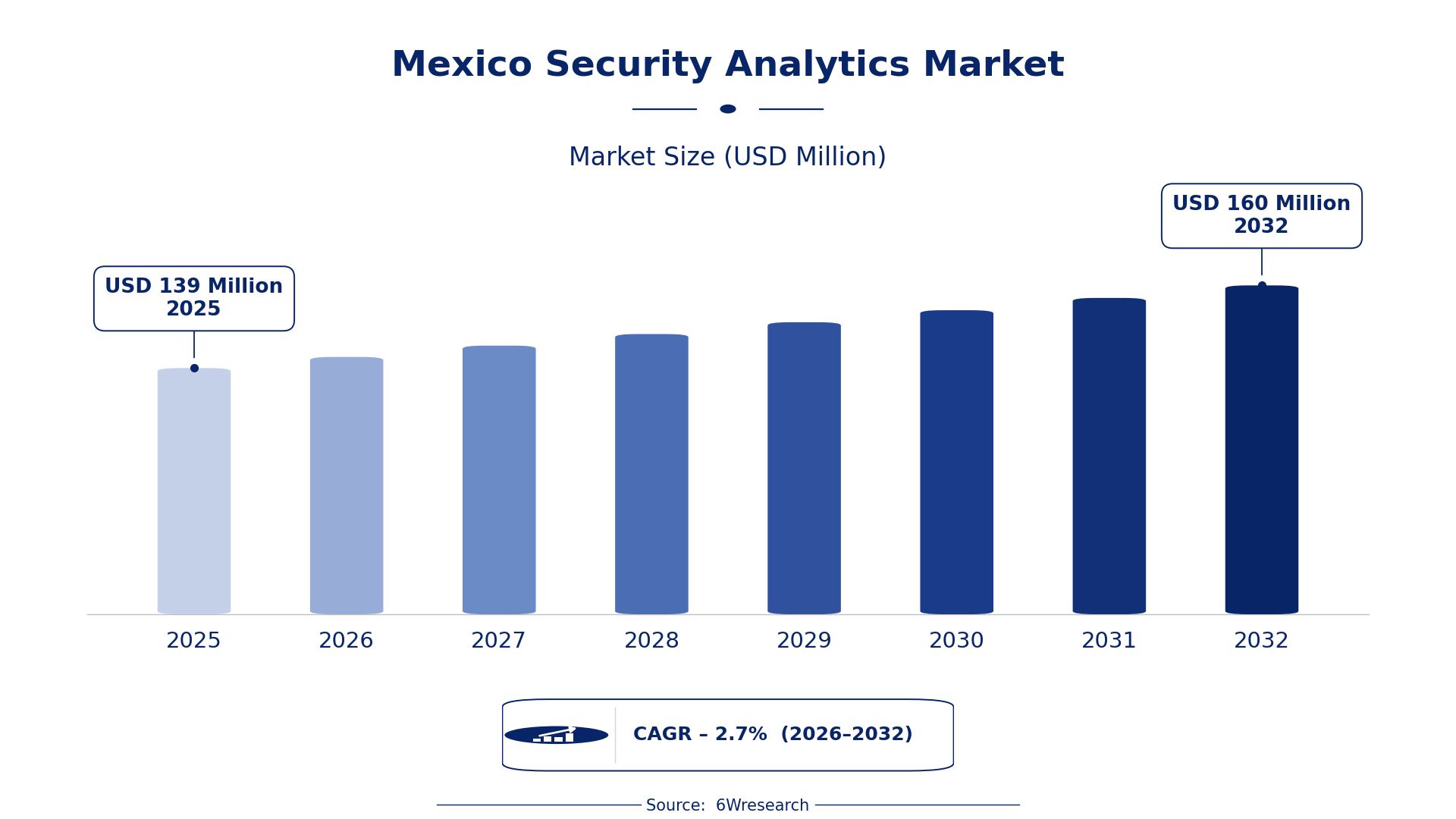
The Mexico Security Analytics Market was estimated at USD 139 Million in 2025 and is projected to reach USD 160 Million by 2032, growing at a CAGR of 2.7% from 2026 to 2032.
Mexico Security Analytics Market Synopsis
The Mexico Security Analytics Market is witnessing a surge in demand, propelled by escalating cyber threats that target organizations across various sectors. As companies increasingly digitize operations, the need for advanced security analytics to protect sensitive information has never been greater. This dynamic market responds to the urgency for solutions that can provide real-time threat detection and effective incident response.
Key players in the market are innovating rapidly, developing analytics technologies that not only detect but also anticipate potential cyber attacks. This proactive approach is essential, given the sophisticated nature of today's cybercriminal activities. Supported by government initiatives focused on enhancing cybersecurity infrastructure, the Mexico Security Analytics Market is set for notable expansion.
Mexico Security Analytics Market Year-wise Growth Rate and Key Drivers
This graph illustrates the annual growth rates of the Mexico Security Analytics Market from 2021 to 2032, highlighting a steady upward trajectory and projected expansion over the forecast period.
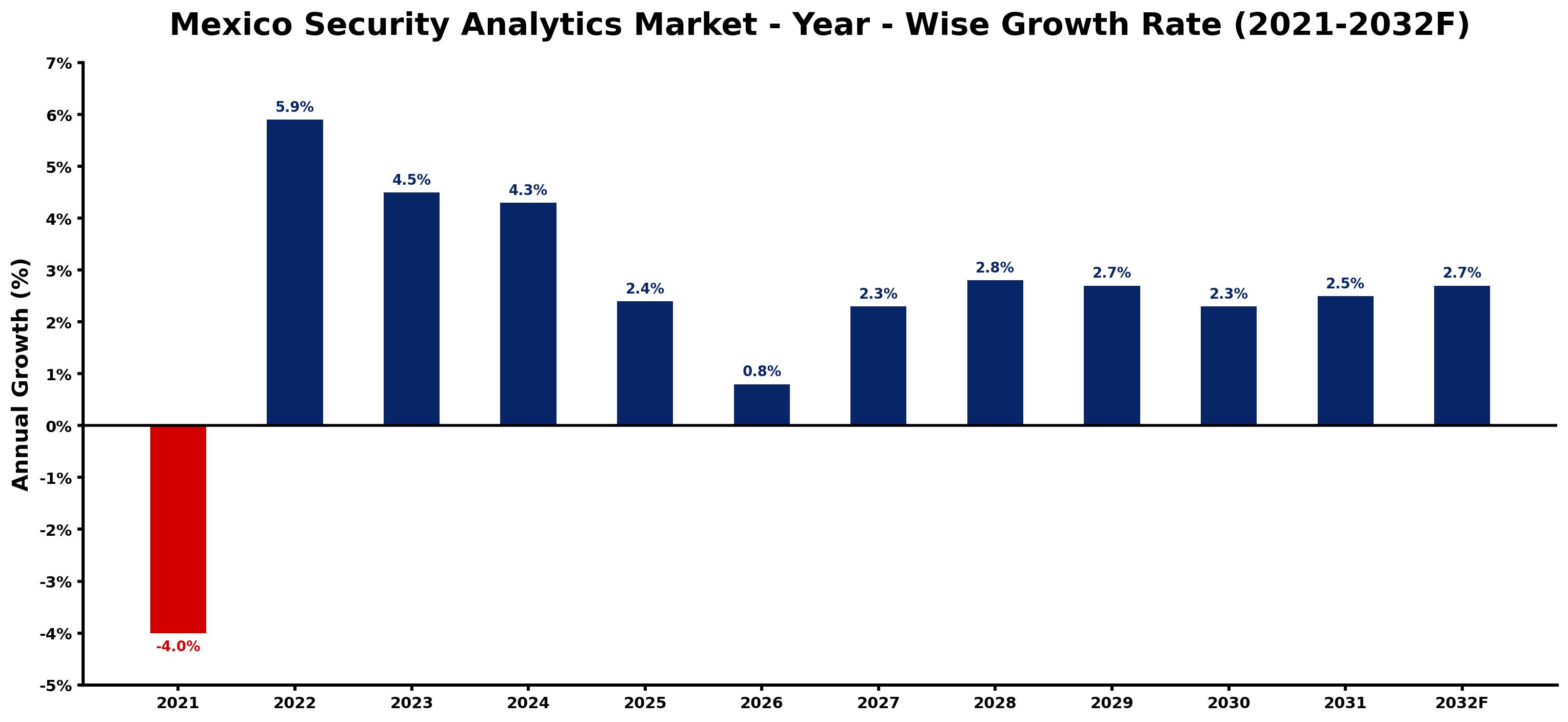
The table below presents the year‑wise growth rates along with the key drivers influencing the market
| Year | Growth Rate | Major Drivers |
| 2021 | -4.0% | COVID-19 restrictions affected security investments significantly. |
| 2022 | 5.9% | Government cybersecurity reforms following recent data breaches. |
| 2023 | 4.5% | Increased investments in public safety due to crime rates. |
| 2024 | 4.3% | Mandatory compliance with new data protection regulations. |
| 2025 | 2.4% | Growth of e-commerce driving security needs for online transactions. |
| 2026 | 0.8% | Surge in IoT devices raising security analytics requirements. |
| 2027 | 2.3% | Implementation of national cybersecurity strategy enhancing industry growth. |
| 2028 | 2.8% | Adoption of AI tools for advanced threat detection. |
| 2029 | 2.7% | Rising awareness of cybersecurity risks among SMEs. |
| 2030 | 2.3% | Collaboration with US on cross-border cybersecurity efforts. |
| 2031 | 2.5% | Local startups innovating in security analytics technology. |
| 2032 | 2.7% | Integration of security analytics in national critical infrastructure. |
Note: Market size estimations and growth projections presented in this report are based on 6Wresearch's proprietary forecasting methodology, utilizing the latest available industry data, government publications, and primary research inputs.
Mexico Security Analytics Market Key Takeaways
Below are some of the specific key takeaways from the market, including:
- Rising demand for AI and machine learning integration in security analytics solutions.
- Increased investment in cloud-based security analytics for improved scalability.
- Greater emphasis on compliance with data protection regulations across industries.
- Proactive security measures, including predictive and behavioral analytics, are on the rise.
- Government policies are driving advancements and standards in cybersecurity practices.
Evaluation of Restraints in Mexico Security Analytics Market
Despite growth potential, the Mexico Security Analytics Market is stifled by several challenges. The escalating sophistication of cyber threats continues to outpace existing security measures, making it difficult for companies to maintain an effective defense. Additionally, there is a glaring shortage of skilled cybersecurity professionals, resulting in increased operational strain for organizations looking to enhance their security capabilities. Many businesses also struggle with awareness regarding the importance of investing in security analytics, causing delays in adopting necessary technologies. on top of that, regulatory compliance requirements complicate implementation, as organizations must navigate complex legal frameworks while integrating new solutions into their existing infrastructures.
Mexico Security Analytics Market Trends
Several trends are shaping the Mexico Security Analytics Market. The integration of AI and machine learning is increasingly pivotal for enhancing threat detection and response. Organizations are also adopting cloud-based solutions for their flexibility and scalability, allowing businesses to adapt to changing security demands quickly. Compliance with data protection regulations is becoming a non-negotiable aspect of operations, pushing firms to prioritize security analytics that align with legal requirements. Additionally, the shift towards predictive analytics is gaining traction as organizations strive to stay ahead of emerging cyber threats by leveraging data-driven insights.
Mexico Security Analytics Market Opportunities
The Mexico Security Analytics Market is ripe with opportunities for investment and growth. As cyber threats escalate, there's an urgent need for innovative security analytics solutions that deliver real-time insights and predictive analysis. Areas for investment include the development of advanced threat intelligence capabilities and the creation of comprehensive security solutions tailored to the unique needs of businesses in Mexico. Collaborating with local cybersecurity firms can also provide a strategic advantage, enabling investors to tap into existing expertise and build a strong market presence.
Government Initiatives in the Mexico Security Analytics Market
The Mexican government is actively shaping the Security Analytics Market through various initiatives aimed at bolstering national cybersecurity. These policies emphasize the importance of robust security infrastructures and compliance standards to protect organizations and citizens alike. By prioritizing cybersecurity at a national level, the government is creating a favorable environment for the growth of advanced security solutions in the private sector.
- A recently completed initiative focused on establishing a national cybersecurity framework to enhance data protection practices across industries.
- Currently ongoing are efforts to launch a cybersecurity training program aimed at addressing the skilled labor shortage in the cybersecurity field.
- A planned public-private partnership expected to incentivize investments in advanced security technologies and bolster the cybersecurity infrastructure.
- Legislation being developed to streamline regulatory compliance for businesses adopting new security technologies.
- Ongoing support for startups specializing in cybersecurity solutions through funding and mentorship programs.
Future Insights of the Mexico Security Analytics Market
Looking ahead, the Mexico Security Analytics Market is expected to experience considerable growth. The ongoing rise in cyber threats, combined with increased digital transformation efforts, will drive demand for sophisticated security solutions. As more organizations recognize the need for effective incident response mechanisms, investments in security analytics will likely become a priority. Adopting cloud services and the proliferation of IoT devices will further complicate the cybersecurity landscape, necessitating advanced analytics capabilities to mitigate risks. The market's trajectory indicates a clear trend towards comprehensive, adaptive security solutions that can meet the challenges of an increasingly complex digital environment.
Mexico Security Analytics Market Latest Developments
In the past year, the Mexico Security Analytics Market has been active with numerous developments signaling a shift towards advanced cybersecurity measures. Businesses are increasingly prioritizing investments in security analytics to safeguard their operations and data. The focus has shifted towards integrating innovative technologies to bolster defenses against evolving threats.
- A major technology vendor launched a new line of AI-driven security analytics tools in early 2025, designed to enhance threat detection capabilities for enterprises.
- An initiative that began in Q2 2025 is currently underway, focusing on the development of an integrated security management platform that incorporates various analytics solutions.
- A leading regional operator is expected to initiate a partnership with local universities by mid-2026 to create a specialized cybersecurity training program.
- A new regulatory framework was rolled out in late 2025, mandating that all organizations implement basic cybersecurity protocols, pushing demand for analytics tools.
- Planned expansions by several firms are expected to increase their footprint in the market, with a rollout of enhanced services projected for late 2026.
Mexico Security Analytics Market - Key Attractiveness of the Report
- 10 Years of Market Numbers
- Historical Data Starting from 2022 to 2025
- Base Year: 2025
- Forecast Data until 2032
- Key Performance Indicators Impacting the Market
- Major Upcoming Developments and Projects
Key Highlights of the Report:
- Mexico Security Analytics Market Outlook
- Market Size of Mexico Security Analytics Market, 2025
- Forecast of Mexico Security Analytics Market, 2032
- Historical Data and Forecast of Mexico Security Analytics Revenues & Volume for the Period 2022-2032F
- Mexico Security Analytics Market Trend Evolution
- Mexico Security Analytics Market Drivers and Challenges
- Mexico Security Analytics Price Trends
- Mexico Security Analytics Porter's Five Forces
- Mexico Security Analytics Industry Life Cycle
- Historical Data and Forecast of Mexico Security Analytics Market Revenues & Volume By Application for the Period 2022-2032F
- Historical Data and Forecast of Mexico Security Analytics Market Revenues & Volume By Web Security Analytics for the Period 2022-2032F
- Historical Data and Forecast of Mexico Security Analytics Market Revenues & Volume By Network Security Analytics for the Period 2022-2032F
- Historical Data and Forecast of Mexico Security Analytics Market Revenues & Volume By Endpoint SecurityAnalytics for the Period 2022-2032F
- Historical Data and Forecast of Mexico Security Analytics Market Revenues & Volume By Application Security Analytics for the Period 2022-2032F
- Historical Data and Forecast of Mexico Security Analytics Market Revenues & Volume By Others(Content Security, ICS Security, Database Security, Cloud Security) for the Period 2022-2032F
- Historical Data and Forecast of Mexico Security Analytics Market Revenues & Volume By Vertical for the Period 2022-2032F
- Historical Data and Forecast of Mexico Security Analytics Market Revenues & Volume By BFSI for the Period 2022-2032F
- Historical Data and Forecast of Mexico Security Analytics Market Revenues & Volume By Retail and eCommerce for the Period 2022-2032F
- Historical Data and Forecast of Mexico Security Analytics Market Revenues & Volume By Media and Entertainment for the Period 2022-2032F
- Historical Data and Forecast of Mexico Security Analytics Market Revenues & Volume By Travel and Hospitality for the Period 2022-2032F
- Historical Data and Forecast of Mexico Security Analytics Market Revenues & Volume By Telecom and IT for the Period 2022-2032F
- Historical Data and Forecast of Mexico Security Analytics Market Revenues & Volume By Healthcare for the Period 2022-2032F
- Historical Data and Forecast of Mexico Security Analytics Market Revenues & Volume By Others(automobile, government, and education) for the Period 2022-2032F
- Historical Data and Forecast of Mexico Security Analytics Market Revenues & Volume By Component for the Period 2022-2032F
- Historical Data and Forecast of Mexico Security Analytics Market Revenues & Volume By Platform for the Period 2022-2032F
- Historical Data and Forecast of Mexico Security Analytics Market Revenues & Volume By Services for the Period 2022-2032F
- Historical Data and Forecast of Mexico Security Analytics Market Revenues & Volume By Professional Services for the Period 2022-2032F
- Historical Data and Forecast of Mexico Security Analytics Market Revenues & Volume By Deployment Mode for the Period 2022-2032F
- Historical Data and Forecast of Mexico Security Analytics Market Revenues & Volume By Cloud for the Period 2022-2032F
- Historical Data and Forecast of Mexico Security Analytics Market Revenues & Volume By On-premises for the Period 2022-2032F
- Historical Data and Forecast of Mexico Security Analytics Market Revenues & Volume By Organization Size for the Period 2022-2032F
- Historical Data and Forecast of Mexico Security Analytics Market Revenues & Volume By Large enterprises for the Period 2022-2032F
- Historical Data and Forecast of Mexico Security Analytics Market Revenues & Volume By Small and medium-sized enterprises (SMEs) for the Period 2022-2032F
- Mexico Security Analytics Import Export Trade Statistics
- Market Opportunity Assessment By Application
- Market Opportunity Assessment By Vertical
- Market Opportunity Assessment By Component
- Market Opportunity Assessment By Deployment Mode
- Market Opportunity Assessment By Organization Size
- Mexico Security Analytics Top Companies Market Share
- Mexico Security Analytics Competitive Benchmarking By Technical and Operational Parameters
- Mexico Security Analytics Company Profiles
- Mexico Security Analytics Key Strategic Recommendations






































