Brazil Viscose Filament Yarns Market Size, Share & Growth Rate
The Brazil Viscose Filament Yarns Market was estimated at USD 89 Million in 2025 and is projected to reach USD 105 Million by 2032, growing at a CAGR of 2.4% from 2026 to 2032. This growth trajectory is underpinned by the dynamic expansion of the textile and apparel sector within Brazil, where the silky texture and adaptability of viscose filament yarns are increasingly favored for a diverse array of fabrics. Additionally, the shift toward sustainable and eco-friendly materials among consumers is further propelling demand in this market.
Brazil Viscose Filament Yarns Market Growth Rate Analysis (2021-2032)
The Brazil viscose filament yarns market witnessed a decline of 1.5% in 2021, primarily due to fluctuating raw material prices and reduced consumer demand during the pandemic. However, the market rebounded strongly in 2022 with a growth rate of 4.9%, driven by a resurgence in textile production and increasing investments in sustainable fiber technologies. This upward momentum continued into 2023, with a growth of 3.6%, supported by rising consumer preferences for eco-friendly products. Over the next few years, growth is expected to stabilize, averaging around 2.7% to 4.5% from 2024 to 2032, as infrastructure improvements and digitalization in manufacturing processes further boost operational efficiency and scalability.
Brazil Viscose Filament Yarns Market Year-wise Growth Rate and Key Drivers
This graph highlights how the Brazil Viscose Filament Yarns Market has steadily grown over the past five years, supported by major growth factors.
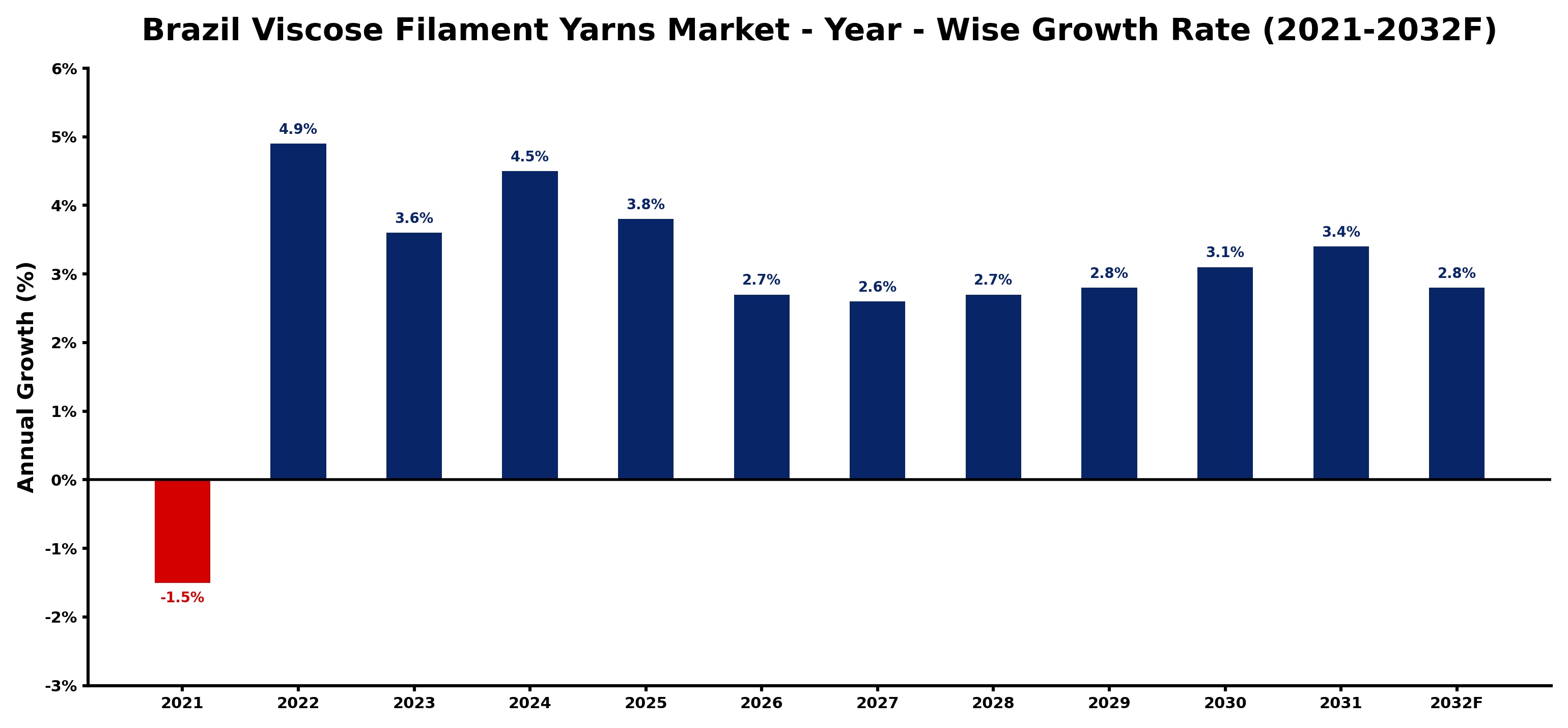
The table below presents the year‑wise growth rates along with the key drivers influencing the market
| Year | Growth Rate | Major Drivers |
| 2021 | -1.5% | Domestic manufacturing slowdown dampened viscose filament yarn production |
| 2022 | 4.9% | Improved capacity utilization in textiles boosted viscose yarn output |
| 2023 | 3.6% | Modernized textile mills enhance efficiency in viscose filament production |
| 2024 | 4.5% | Export driven domestic yarn production investment boosted factory output efficiency |
| 2025 | 3.8% | Manufacturing investments in sustainable technologies boost fiber production capabilities |
| 2026 | 2.7% | Higher domestic manufacturing investments boost Brazil's filament yarn output |
| 2027 | 2.6% | Local manufacturing recovery boosts demand for high performance yarn production |
| 2028 | 2.7% | Foundry modernization initiatives boosted production capacity and export potential |
| 2029 | 2.8% | Domestic manufacturing recovery spurred investment in filament yarn capacity |
| 2030 | 3.1% | Export driven demand boosts domestic viscose filament yarn production |
| 2031 | 3.4% | Domestic yarn manufacturers adopt automation for production efficiency improvements |
| 2032 | 2.8% | Domestic manufacturing recovery boosts demand for high quality yarn inputs |
Note - Market size estimations and growth projections presented in this report are based on 6Wresearch’s advanced forecasting approach, validated with industry datasets as of June 2026.
Brazil Viscose Filament Yarns Market Synopsis
Brazil has a vibrant textile industry that relies heavily on viscose filament yarns, particularly for high-fashion applications and luxurious apparel. The increasing consumer demand for sustainable fashion is prompting manufacturers to adopt eco-friendly production methods to meet these expectations.
As global awareness of environmental impacts intensifies, Brazilian producers are exploring innovative practices to mitigate the ecological footprint of viscose production. This shift not only addresses sustainability concerns but also positions local manufacturers favorably in the competitive international marketplace.
Brazil Viscose Filament Yarns Market Key Takeaways
- The market is experiencing growth due to the increasing demand from the textile and apparel sector.
- Consumer preferences are shifting towards sustainable and eco-friendly materials, driving innovation in production methods.
- Government policies focusing on quality standards and environmental compliance are reshaping operational practices.
- Competition from synthetic fibers remains a significant challenge, necessitating product differentiation.
- Market players are encouraged to diversify their offerings to adapt to evolving fashion trends.
Evaluation of Restraints in Brazil Viscose Filament Yarns Market
Despite its growth potential, the Brazil Viscose Filament Yarns market faces notable restraints. The increasing competition from synthetic fibers is particularly daunting, as these materials often offer lower costs and greater durability. Furthermore, the environmental concerns associated with traditional viscose production methods are prompting scrutiny from regulators and consumers alike, leading to a demand for more sustainable practices. As a result, players in this space must navigate these challenges while aligning with both regulatory and consumer expectations to ensure continued market relevance.
Brazil Viscose Filament Yarns Market Trends
Several key trends are emerging within the Brazil Viscose Filament Yarns market. One significant trend is the growing interest in circular fashion, where materials are reused and recycled, thereby reducing waste and environmental impact. Additionally, technological advancements in production processes are allowing for the creation of higher-quality yarns with improved characteristics, catering to the evolving demands of the fashion industry. Finally, there is an increasing focus on certifications and eco-labels, as consumers are more inclined to choose products that reflect their values regarding sustainability.
Brazil Viscose Filament Yarns Market Opportunities
Opportunities abound for growth within the Brazil Viscose Filament Yarns market. Producers can capitalize on the rising demand for eco-friendly textiles by developing innovative, sustainable production processes. By leveraging advancements in technology, manufacturers have the potential to create unique blends and properties in viscose yarns that cater to niche markets. Additionally, expanding into international markets where sustainable fashion is prioritized presents further avenues for growth, particularly in regions with stringent sustainability criteria.
Government Initiatives in the Brazil Viscose Filament Yarns Market
Government policies in Brazil are increasingly prioritizing sustainable textile manufacturing. Initiatives focused on reducing the environmental impact of production processes, such as regulations regarding chemical usage and wastewater management, are becoming standard. Public spending on eco-friendly technologies and resources is also on the rise, providing incentives for manufacturers to adapt to sustainable practices. Compliance with these regulations is essential for companies seeking to maintain competitive advantage and market share.
Future Insights of the Brazil Viscose Filament Yarns Market
Looking ahead, the Brazil Viscose Filament Yarns market is poised for steady growth through 2032. As the textile industry increasingly embraces sustainability, companies will need to enhance their production methods to meet new environmental standards. Furthermore, a continued emphasis on product differentiation will be crucial to attract consumers who are becoming more discerning about the materials they choose. In this landscape, companies that innovate and prioritize eco-friendly practices are likely to emerge as market leaders, reinforcing Brazil's position in the global textile arena.
Brazil Viscose Filament Yarns Market Latest Developments (May 2025 - June 2026)
Recent industry developments indicate a clear direction towards sustainability in the Brazil Viscose Filament Yarns market. Manufacturers are increasingly investing in R&D to explore new production techniques that minimize environmental impact. Additionally, collaborations between textile firms and environmental organizations are becoming more prevalent, aimed at enhancing sustainable practices across the supply chain. Moreover, consumer awareness around sustainable fashion is driving brands to adopt transparency in sourcing and production, influencing purchasing decisions significantly.
Brazil Viscose Filament Yarns Market - Key Attractiveness of the Report
- 10 Years of Market Numbers
- Historical Data Starting from 2022 to 2025
- Base Year: 2025
- Forecast Data until 2032
- Key Performance Indicators Impacting the Market
- Major Upcoming Developments and Projects
Key Highlights of the Report:
- Brazil Viscose Filament Yarns Market Outlook
- Market Size of Brazil Viscose Filament Yarns Market, 2025
- Forecast of Brazil Viscose Filament Yarns Market, 2032
- Historical Data and Forecast of Brazil Viscose Filament Yarns Revenues & Volume for the Period 2022-2032F
- Brazil Viscose Filament Yarns Market Trend Evolution
- Brazil Viscose Filament Yarns Market Drivers and Challenges
- Brazil Viscose Filament Yarns Price Trends
- Brazil Viscose Filament Yarns Porter's Five Forces
- Brazil Viscose Filament Yarns Industry Life Cycle
- Historical Data and Forecast of Brazil Viscose Filament Yarns Market Revenues & Volume By Type for the Period 2022-2032F
- Historical Data and Forecast of Brazil Viscose Filament Yarns Market Revenues & Volume By Continuous for the Period 2022-2032F
- Historical Data and Forecast of Brazil Viscose Filament Yarns Market Revenues & Volume By Semi-contunuous for the Period 2022-2032F
- Historical Data and Forecast of Brazil Viscose Filament Yarns Market Revenues & Volume By Application for the Period 2022-2032F
- Historical Data and Forecast of Brazil Viscose Filament Yarns Market Revenues & Volume By Garment industry for the Period 2022-2032F
- Historical Data and Forecast of Brazil Viscose Filament Yarns Market Revenues & Volume By Auto industry for the Period 2022-2032F
- Historical Data and Forecast of Brazil Viscose Filament Yarns Market Revenues & Volume By other for the Period 2022-2032F
- Brazil Viscose Filament Yarns Import Export Trade Statistics
- Market Opportunity Assessment By Type
- Market Opportunity Assessment By Application
- Brazil Viscose Filament Yarns Top Companies Market Share
- Brazil Viscose Filament Yarns Competitive Benchmarking By Technical and Operational Parameters
- Brazil Viscose Filament Yarns Company Profiles
- Brazil Viscose Filament Yarns Key Strategic Recommendations






































