Chile Apiculture Market Size, Share & Growth Rate
The Chile Apiculture Market was estimated at USD 474 Million in 2025 and is projected to reach USD 636 Million by 2032, growing at a CAGR of 4.3% from 2026 to 2032. This growth trajectory is driven by an increasing consumer preference for organic and sustainably produced honey products, as well as a burgeoning interest in specialty honey varieties that cater to health-conscious individuals. Coupled with government support for sustainable practices and quality control measures, the market is well-positioned for significant expansion.
Chile Apiculture Market Year-wise Growth Rate and Key Drivers
This graph highlights how the Chile Apiculture Market has steadily grown over the years, supported by major growth factors.
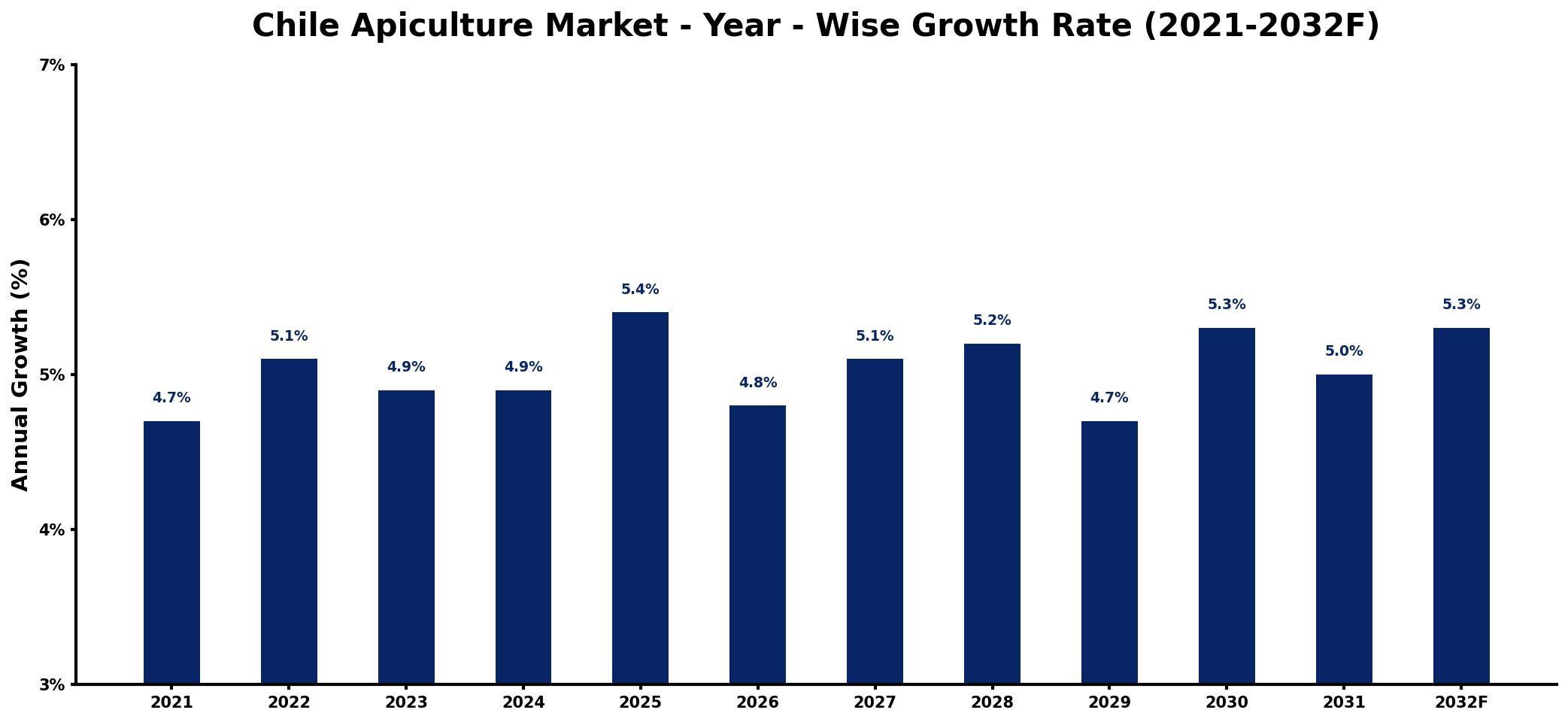
The table below presents the year‑wise growth rates along with the key drivers influencing the market
| Year | Growth Rate | Major Drivers |
| 2021 | 4.7% | Growing consumer health consciousness |
| 2022 | 5.1% | Increased demand for natural products |
| 2023 | 4.9% | Expansion of organic farming practices |
| 2024 | 4.9% | Rising popularity of local sourcing |
| 2025 | 5.4% | Investment in sustainable agriculture initiatives |
| 2026 | 4.8% | Strengthened export opportunities abroad |
| 2027 | 5.1% | Enhanced research and development funding |
| 2028 | 5.2% | Boost in environmental awareness campaigns |
| 2029 | 4.7% | Emerging market for specialty products |
| 2030 | 5.3% | Supportive government policies implemented |
| 2031 | 5.0% | Technological advancements in production |
| 2032 | 5.3% | Growing interest in biodiversity conservation |
Note: Market size estimations and growth projections presented in this report are based on 6Wresearch's proprietary forecasting methodology, utilizing the latest available industry data, government publications, and primary research inputs.
Chile Apiculture Market Synopsis
In Chile, the growing demand for high-quality honey is met by a robust network of small and medium-sized apiaries that emphasize organic and sustainable beekeeping. The country's rich biodiversity allows for the production of unique honey varieties, appealing to both local and international markets seeking distinct flavors and health benefits.
Chilean honey has gained a reputation for its purity and high standards, attracting health-conscious consumers who prioritize natural and unprocessed food products. Government initiatives aimed at enhancing bee health and promoting research in the apiculture sector further fortify this growing market.
Chile Apiculture Market Key Takeaways
- The market is dominated by small to medium-sized apiaries focusing on organic practices.
- There is a rising interest in unique honey varieties such as Manuka and Eucalyptus.
- Health benefits associated with honey are driving consumer demand.
- Government policies support sustainable beekeeping and quality control initiatives.
- Climate change and pest threats are challenges that need addressing for sustainable growth.
Evaluation of Restraints in Chile Apiculture Market
Despite the positive outlook, the Chile Apiculture Market faces several constraints that could impede growth. Climate change poses a significant threat, as it can lead to unpredictable weather patterns that disrupt honey production and affect the quality of harvests. Furthermore, the proliferation of pests, notably the Varroa mite, can devastate bee colonies, creating a direct impact on honey supply. Compounding these issues, competition from lower-cost imported honey creates pricing pressures, making it challenging for local producers to maintain profitability. Additionally, limited access to modern beekeeping technologies hampers productivity and efficiency, while inconsistent regulations may undermine consumer trust and hinder export opportunities.
Chile Apiculture Market Trends
The Chile Apiculture Market is currently witnessing a pronounced shift towards organic and sustainably produced honey. This trend is propelled by a growing consumer base that prioritizes eco-friendly products devoid of pesticides and chemicals. Additionally, unique honey varieties are gaining traction, with consumers seeking flavors that offer distinctive profiles and potential health benefits. Concurrently, there is an increasing emphasis on bee welfare and conservation, with beekeepers adopting practices that aim to protect bee populations and promote overall biodiversity.
Chile Apiculture Market Opportunities
Investment opportunities within the Chile Apiculture Market are robust, largely due to the country's favorable climate and diverse flora that enhance honey production potential. With a global shift towards natural and organic products, Chilean honey stands out for its quality and unique attributes. Investors can explore avenues in expanding honey production through sustainable practices and modern beekeeping technologies. Additionally, the market for value-added honey products is ripe for development, catering to both domestic and export demands. There is also potential growth in providing pollination services, as agriculture continues to expand across the region.
Government Initiatives in the Chile Apiculture Market
The Chilean government plays a pivotal role in fostering the growth of the apiculture sector through various policies focused on sustainability and quality enhancement. Programs aimed at providing technical assistance and training for beekeepers are essential for developing skills and best practices. Regulatory frameworks are being strengthened to monitor pesticide use and ensure the health of bee populations. Financial incentives and subsidies are also available, encouraging innovation and participation in the beekeeping industry, which ultimately supports the markets competitiveness.
Future Insights of the Chile Apiculture Market
Looking ahead to 2026-2032, the Chile Apiculture Market is poised for consistent growth as consumer awareness regarding the health benefits of honey and bee products continues to rise. The growing preference for organic and natural sweeteners will further drive demand. Enhanced government support, alongside initiatives aimed at improving training and quality standards, will also bolster the sector. However, ongoing challenges such as climate change and competition from imported honey necessitate proactive strategies to maintain a resilient market. The overall outlook remains positive, with numerous opportunities for growth and innovation on the horizon.
Chile Apiculture Market Latest Developments (2025 - 2026)
In recent months, the Chile Apiculture Market has seen significant movements toward sustainability, with many beekeepers adopting new practices aimed at enhancing biodiversity and ensuring bee health. Collaborations between local producers and environmental organizations are emerging, aimed at safeguarding pollinator populations. Meanwhile, there has been a noticeable uptick in the marketing of specialty honey varieties that highlight unique flavors and health benefits, appealing to a discerning consumer base. These developments indicate a dynamic shift towards premium and niche products, setting the stage for ongoing innovation in the sector.
Chile Apiculture Market - Key Attractiveness of the Report
- 10 Years of Market Numbers
- Historical Data Starting from 2022 to 2025
- Base Year: 2025
- Forecast Data until 2032
- Key Performance Indicators Impacting the Market
- Major Upcoming Developments and Projects
Key Highlights of the Report:
- Chile Apiculture Market Outlook
- Market Size of Chile Apiculture Market, 2025
- Forecast of Chile Apiculture Market, 2032
- Historical Data and Forecast of Chile Apiculture Revenues & Volume for the Period 2022-2032F
- Chile Apiculture Market Trend Evolution
- Chile Apiculture Market Drivers and Challenges
- Chile Apiculture Price Trends
- Chile Apiculture Porter's Five Forces
- Chile Apiculture Industry Life Cycle
- Historical Data and Forecast of Chile Apiculture Market Revenues & Volume By Product Type for the Period 2022-2032F
- Historical Data and Forecast of Chile Apiculture Market Revenues & Volume By Honey for the Period 2022-2032F
- Historical Data and Forecast of Chile Apiculture Market Revenues & Volume By Beeswax for the Period 2022-2032F
- Historical Data and Forecast of Chile Apiculture Market Revenues & Volume By Live-bees for the Period 2022-2032F
- Historical Data and Forecast of Chile Apiculture Market Revenues & Volume By Others for the Period 2022-2032F
- Historical Data and Forecast of Chile Apiculture Market Revenues & Volume By Application for the Period 2022-2032F
- Historical Data and Forecast of Chile Apiculture Market Revenues & Volume By Medical for the Period 2022-2032F
- Historical Data and Forecast of Chile Apiculture Market Revenues & Volume By Food Beverages for the Period 2022-2032F
- Historical Data and Forecast of Chile Apiculture Market Revenues & Volume By Cosmetics for the Period 2022-2032F
- Historical Data and Forecast of Chile Apiculture Market Revenues & Volume By Others for the Period 2022-2032F
- Chile Apiculture Import Export Trade Statistics
- Market Opportunity Assessment By Product Type
- Market Opportunity Assessment By Application
- Chile Apiculture Top Companies Market Share
- Chile Apiculture Competitive Benchmarking By Technical and Operational Parameters
- Chile Apiculture Company Profiles
- Chile Apiculture Key Strategic Recommendations






































