Chile Used Car Market Summary
The chile used car market was estimated at USD 127 Million in 2025 and is projected to reach USD 139 Million by 2032, growing at a CAGR of 1.5% from 2026 to 2032.
Chile Used Car Market Year-wise Growth Rate and Key Drivers
This graph highlights how the Chile Used Car Market has steadily grown over the past five years, supported by major growth factors.
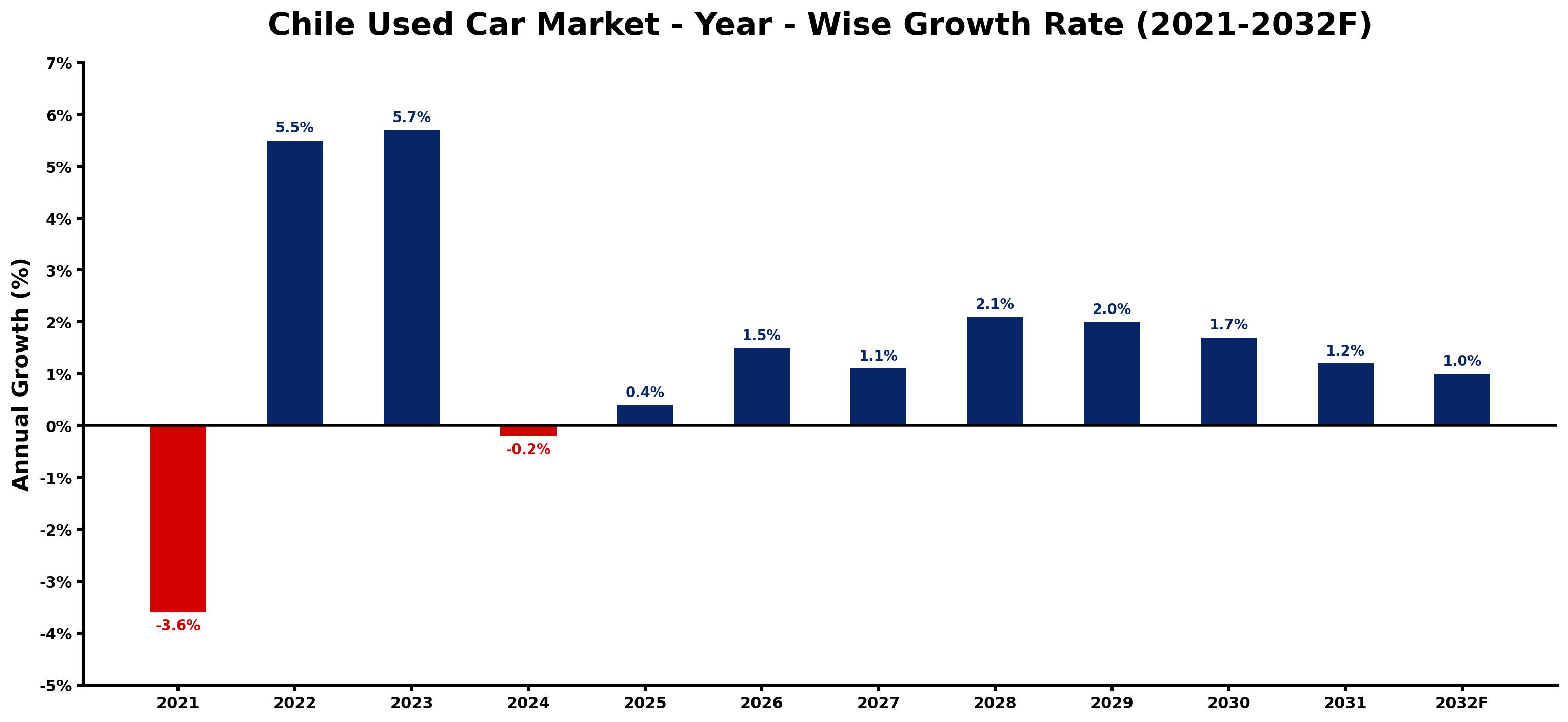
The table below presents the year wise growth rates along with the key drivers influencing the market
| Year | Growth Rate | Major Drivers |
| 2021 | -3.6% | Travel restrictions and economic uncertainty significantly diminished consumer willingness to purchase used vehicles. |
| 2022 | 5.5% | Economic stability contributed to a greater trust in the used car market. |
| 2023 | 5.7% | Digital platforms transformed how consumers buy and sell used cars effectively. |
| 2024 | -0.2% | Increased import tariffs on preowned vehicles deterred buyers, leading to a decline in transactions. |
| 2025 | 0.4% | Rising import costs prompted consumers to consider local used car purchases. |
| 2026 | 1.5% | Younger demographics showed a preference for used vehicles over new cars. |
| 2027 | 1.1% | Financial institutions offered competitive loans, boosting used car sales significantly. |
| 2028 | 2.1% | Sustainable practices led to an increase in electric used vehicle sales. |
| 2029 | 2.0% | Car-sharing services influenced consumer perceptions of vehicle ownership value. |
| 2030 | 1.7% | Technological advances in vehicle maintenance improved longevity and consumer confidence. |
| 2031 | 1.2% | Cultural shifts emphasized personal mobility, enhancing interest in used cars. |
| 2032 | 1.0% | Increased environmental awareness drove demand for fuel-efficient used vehicles. |
Note - Market size estimations and growth projections presented in this report are based on 6Wresearch's advanced forecasting approach, validated with industry datasets as of June 2026.
Chile Used Car Market Synopsis
The Chile Used Car Market is projected to reach 1.5% and witness significant growth during the forecast period (2026-2032). This market is characterized by a robust demand for pre-owned vehicles, with consumers increasingly turning towards affordable options amid rising prices in the new car segment. Factors influencing this trend include high vehicle prices, varied depreciation rates, and a strong consumer preference for well-maintained used vehicles. Online platforms are playing an essential role in this market, enhancing the buying and selling experience through improved transparency in pricing and vehicle history.
Chile Used Car Market Growth Drivers
The growth of the Chile used car market is significantly influenced by several key factors:
- The rising cost of new vehicles continues to push consumers towards the used car market, as affordability becomes a primary concern for many buyers.
- An increasing awareness of the benefits of fuel-efficient and environmentally friendly vehicles has shifted consumer preferences. This shift is particularly noticeable as the government implements strict emissions regulations.
- The expansion of online marketplaces facilitates a more convenient purchasing process, allowing consumers to access a wider array of used vehicles from the comfort of their homes.
- Rising fuel prices and urban congestion have led to a growing demand for compact and fuel-efficient cars, which are prevalent in the used car market.
- The economic stability and the expansion of the middle class in Chile are contributing to an increased purchasing power for used vehicles.
Chile Used Car Market Trends and Opportunities
Current trends in the Chile used car market indicate a dynamic shift towards sustainability and technology:
- There is a notable rise in demand for electric and hybrid vehicles as consumers seek environmentally responsible options, aligning with global sustainability trends.
- A surge in tech-savvy younger consumers is influencing the market, as these buyers prioritize advanced technological features and connectivity in their vehicle choices.
- Online platforms for buying and selling used cars are gaining traction, offering a vast selection of vehicles and simplifying the transaction process for consumers.
- The increasing inclination towards compact cars is driven by urban living conditions, which favor smaller, more maneuverable vehicles that are easier to park and economical on fuel.
- Opportunities for investment in innovative technologies that enhance the car buying process are becoming more prominent in this evolving market.
Chile Used Car Market Challenges and Restraints
Despite the favorable conditions, the Chile used car market faces several challenges:
- A lack of transparency regarding vehicle history often leaves buyers uncertain about the reliability and condition of the vehicles they purchase.
- The presence of informal sellers contributes to a fragmented market, complicating the buying experience and making it challenging for consumers to compare options effectively.
- Complex regulatory and paperwork requirements can hinder smooth transactions, discouraging some potential buyers.
- Without standard pricing and quality control measures, consumers may encounter significant disparities in vehicle pricing and quality, leading to distrust.
- Concerns about after-sales services and warranties can also impact consumer confidence in purchasing used vehicles.
Chile Used Car Market Investment Opportunities
The investment landscape in the Chile used car market is promising as it offers numerous opportunities:
- The sustained demand for affordable transportation, propelled by an expanding middle class, represents a lucrative opportunity for investors.
- Investors can explore partnerships with established dealerships to enhance the reach of their offerings in the growing online marketplace.
- Funding for innovative platforms that improve the buying and selling experience can attract investment, given the increasing reliance on digital solutions.
- Government initiatives supporting sustainable transportation and electric vehicles offer favorable conditions for investments tailored towards eco-friendly used vehicles.
- Potential expansion of financing options for consumers presents an avenue for investors to cater to a broader clientele seeking affordable purchase solutions.
Chile Used Car Market Government Investment and Initiatives
The Chilean government has enacted several policies that significantly influence the used car market:
- The "Revision Tecnica" program mandates vehicle inspections to ensure compliance with safety and emissions standards, ensuring that pre-owned vehicles are roadworthy.
- Import restrictions on used vehicles are designed to support the local automotive industry and prevent the influx of subpar vehicles into the market.
- Incentives for electric and hybrid vehicle purchases aim to promote environmental sustainability while reducing overall emissions in urban areas.
- Public spending towards enhancing infrastructure for electric vehicles, including charging stations, complements the government's sustainability initiatives.
- Overall, these regulations and initiatives are crafted to foster a competitive, safe, and environmentally responsible used car market in Chile.
Chile Used Car Market Latest Developments (May 2025 - June 2026)
Recent developments in the Chile used car market reflect evolving consumer preferences and technological advancements:
- The expansion of digital platforms has accelerated, with significant enhancements in user experience, making it easier for consumers to navigate the used car landscape.
- Increased collaboration between online marketplaces and dealerships is improving inventory access for buyers and creating a more transparent transaction process.
- Recognizing the growing demand for eco-friendly vehicles, numerous platforms are now featuring a dedicated section for electric and hybrid models.
- Sustainability initiatives from the government continue to drive interest in low-emission vehicles, further influencing market dynamics.
- Overall, these developments indicate a responsive market adapting to consumer needs while aligning with broader environmental goals.
Chile Used Car Market - Key Attractiveness of the Report
- 10 Years of Market Numbers
- Historical Data Starting from 2022 to 2025
- Base Year: 2025
- Forecast Data until 2032
- Key Performance Indicators Impacting the Market
- Major Upcoming Developments and Projects
Key Highlights of the Report:
- Chile Used Car Market Outlook
- Market Size of Chile Used Car Market, 2025
- Forecast of Chile Used Car Market, 2032F
- Historical Data and Forecast of Chile Used Car Revenues & Volume for the Period 2022-2032F
- Chile Used Car Market Trend Evolution
- Chile Used Car Market Drivers and Challenges
- Chile Used Car Price Trends
- Chile Used Car Porter's Five Forces
- Chile Used Car Industry Life Cycle
- Historical Data and Forecast of Chile Used Car Market Revenues & Volume By Vehicle Type for the Period 2022-2032F
- Historical Data and Forecast of Chile Used Car Market Revenues & Volume By Hatchbacks for the Period 2022-2032F
- Historical Data and Forecast of Chile Used Car Market Revenues & Volume By Sedan for the Period 2022-2032F
- Historical Data and Forecast of Chile Used Car Market Revenues & Volume By Sports Utility Vehicle for the Period 2022-2032F
- Historical Data and Forecast of Chile Used Car Market Revenues & Volume By Others for the Period 2022-2032F
- Historical Data and Forecast of Chile Used Car Market Revenues & Volume By Vendor for the Period 2022-2032F
- Historical Data and Forecast of Chile Used Car Market Revenues & Volume By Organized for the Period 2022-2032F
- Historical Data and Forecast of Chile Used Car Market Revenues & Volume By Unorganized for the Period 2022-2032F
- Historical Data and Forecast of Chile Used Car Market Revenues & Volume By Fuel Type for the Period 2022-2032F
- Historical Data and Forecast of Chile Used Car Market Revenues & Volume By Gasoline for the Period 2022-2032F
- Historical Data and Forecast of Chile Used Car Market Revenues & Volume By Diesel for the Period 2022-2032F
- Historical Data and Forecast of Chile Used Car Market Revenues & Volume By Alternative Fuel Vehicles for the Period 2022-2032F
- Chile Used Car Import Export Trade Statistics
- Market Opportunity Assessment By Vehicle Type
- Market Opportunity Assessment By Vendor
- Market Opportunity Assessment By Fuel Type
- Chile Used Car Top Companies Market Share
- Chile Used Car Competitive Benchmarking By Technical and Operational Parameters
- Chile Used Car Company Profiles
- Chile Used Car Key Strategic Recommendations






































