China Ice Detection Sensor Market Size & Growth Rate
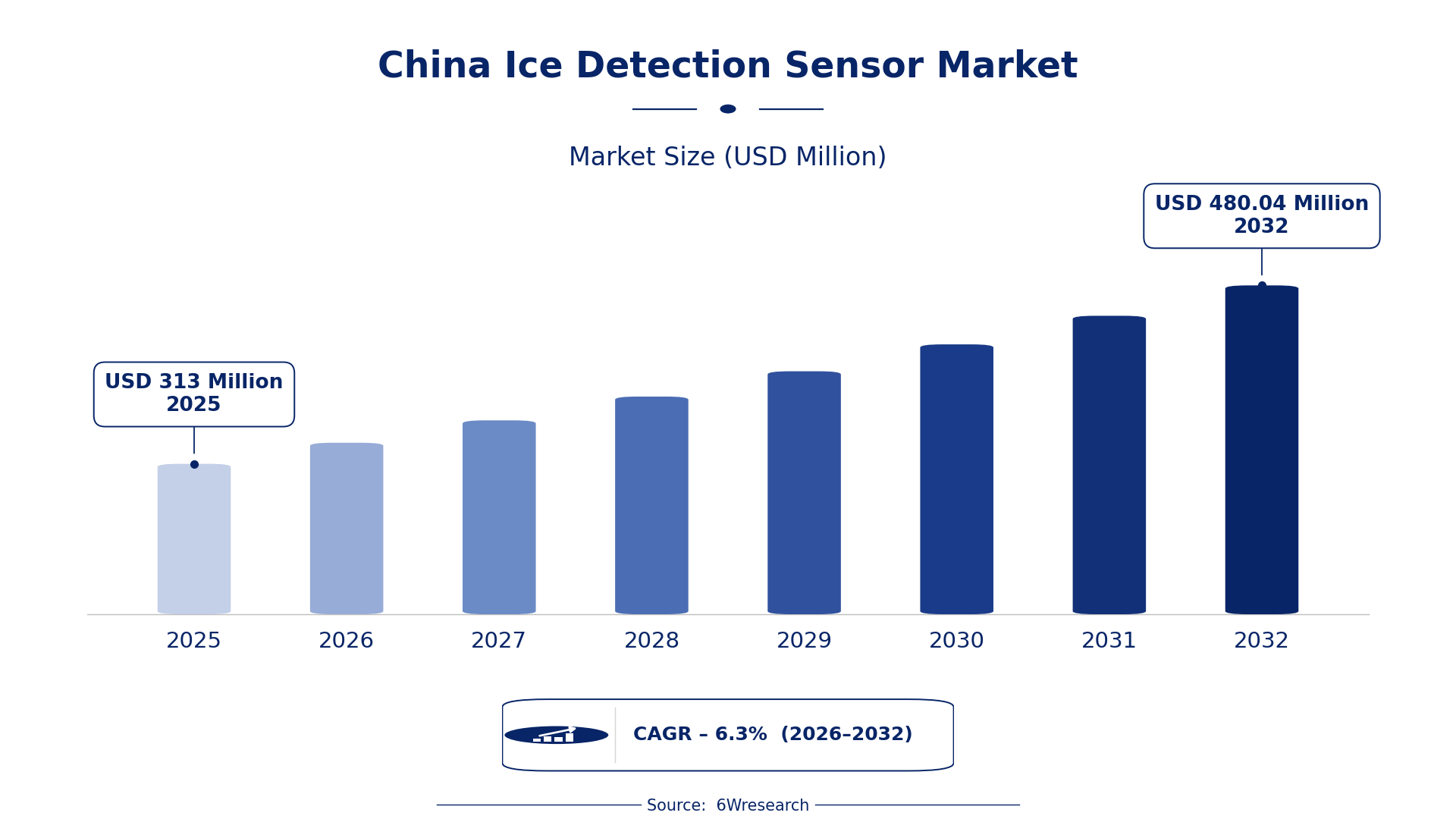
According to 6Wresearch internal database and industry insights, the China Ice Detection Sensor Market was valued at USD 313.0 million in 2025 and is projected to reach USD 480.04 million by 2032, growing at a CAGR of approximately 6.3% during 2026–2032.
China Ice Detection Sensor Market Highlights
| Report Metric | Details |
| Report Name | China Ice Detection Sensor Market |
| Market Size 2025 | USD 313.0 million |
| Market Size 2032 | USD 480.04 million |
| Absolute Growth 2025–2032 | USD 167.04 million |
| CAGR 2026–2032 | 6.3% |
| Peak Annual Growth | 8.3% in 2028 |
| Forecast Period | 2026–2032 |
| Historical Data | 2022–2025 |
| Base Year | 2025 |
| Leading Sensor Type, 2025 | Optical Sensors (53% share) |
| Leading Detection Principle, 2025 | Temperature & Conductivity (51% share) |
| Leading Application, 2025 | Roads & Bridges (45% share) |
| Leading End User, 2025 | Aviation OEMs (35% share) |
| Fastest-Growing Sensor Type | Ultrasonic Sensors (8.4% CAGR) |
| Fastest-Growing Detection Principle | Light Scattering (7.5% CAGR) |
| Fastest-Growing Application | Smart Cars (7.7% CAGR) |
| Fastest-Growing End User | ADAS Integrators (8.6% CAGR) |
| Growing Sector | Smart Cars |
| Key End Users | Roads & Bridges, Aircraft Wings, Wind Turbines, Smart Cars |
China Ice Detection Sensor Market Year-wise Growth Rate and Key Drivers (2022–2032)
This graph illustrates the annual growth rates of the market from 2022 to 2032, highlighting a steady upward trajectory and projected market expansion over the forecast period.
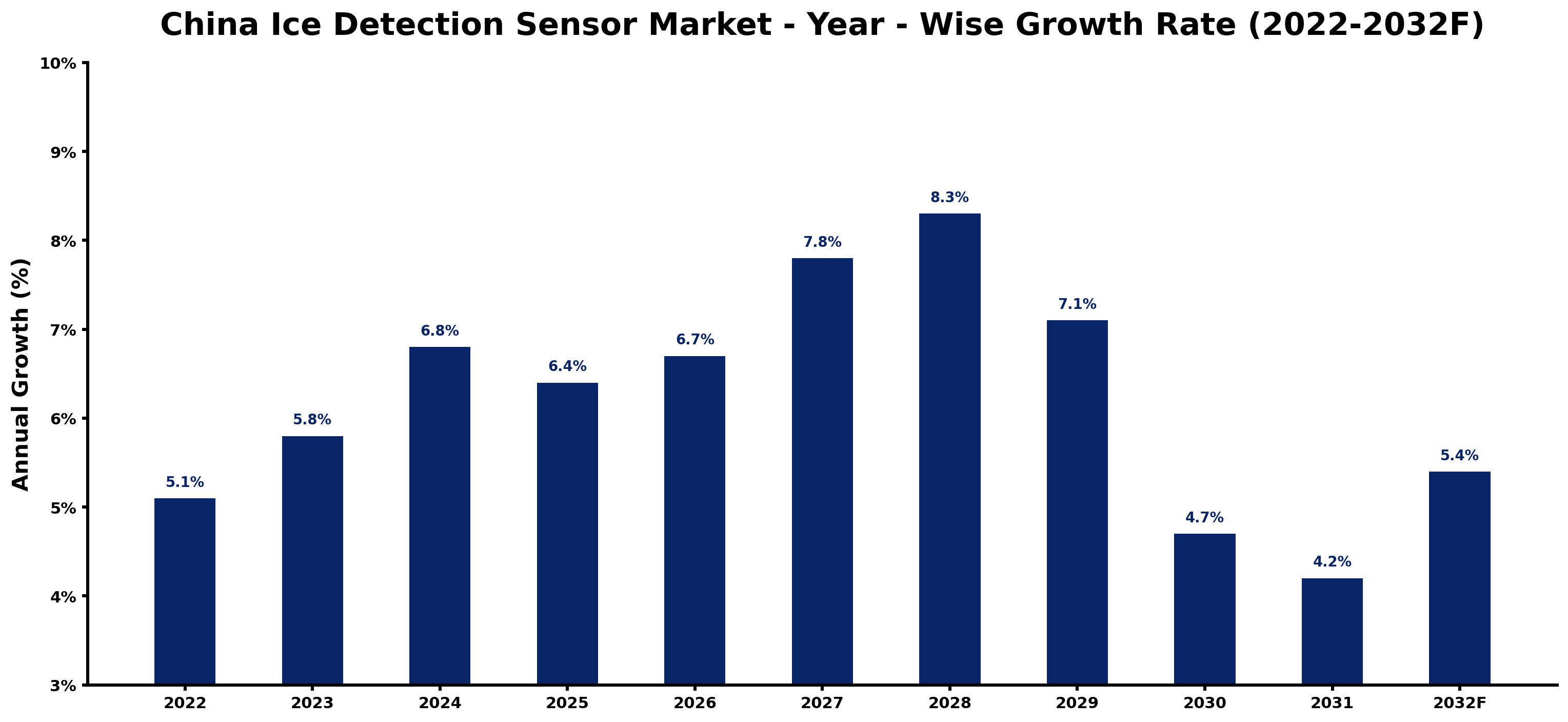
The following table presents the estimated annual growth rate for each year together with the principal factor influencing market performance.
| Year | Estimated Annual Growth (%) | Market Rationale |
| 2022 | 5.1 | The market showed steady demand for safety technologies amid increasing safety concerns. |
| 2023 | 5.8 | Growth accelerated as the aviation sector expanded, driving the need for advanced safety measures. |
| 2024 | 6.8 | Demand rose further due to the implementation of new safety standards in aviation. |
| 2025 | 6.4 | Growth slowed slightly as the market adjusted to the previous year's rapid expansion. |
| 2026 | 6.7 | An increase in investments in road safety technologies spurred demand for ice detection sensors. |
| 2027 | 7.8 | The adoption of sensors in renewable energy projects contributed to higher growth rates. |
| 2028 | 8.3 | The market peaked as demand surged from both aviation and winter road safety initiatives. |
| 2029 | 7.1 | Growth slowed as the market began to stabilise after reaching its peak. |
| 2030 | 4.7 | A decrease in growth rate reflected market maturation and increased competition. |
| 2031 | 4.2 | The market continued to grow, albeit at a slower pace due to established safety measures. |
| 2032 | 5.4 | Demand is expected to rise as new technologies are integrated into existing systems. |
Note: Market size estimations and growth projections presented in this report are based on 6Wresearch's proprietary forecasting methodology, utilizing the latest available industry data, government publications, and primary research inputs.
China Ice Detection Sensor Market Synopsis
Ice Detection Sensor Market in China encompasses devices designed to identify ice on surfaces such as roads and aircraft wings. These sensors utilise technologies like resistive, optical, and ultrasonic methods to improve safety and efficiency. The market is expanding due to the growing aviation sector, which demands advanced safety measures across more than 300 airports. Furthermore, the wind energy sector's capacity reached 300 GW in 2023, heightening the need for effective ice detection in turbines. This combination of factors is propelling demand for ice detection sensors in the country.
Market Dynamics Impact Analysis (2026–2032)
| Factor | Type | Impact | Primary Segment Affected |
| Expansion of the aviation sector requiring advanced safety measures | Driver | High | Aviation OEMs |
| Increased investment in renewable energy projects | Driver | High | Renewable Energy Firms |
| Growing demand for smart road technologies | Opportunity | Medium | Highway Authorities |
| Rising adoption of sensors in advanced driver-assistance systems | Opportunity | Medium | ADAS Integrators |
| High initial investment costs for advanced sensor technologies | Restraint | High | Roads & Bridges |
| Limited awareness of the benefits of ice detection sensors | Restraint | Medium | Aviation OEMs |
| Competition from alternative safety technologies | Challenge | High | Renewable Energy Firms |
| Regulatory compliance requirements leading to delays | Challenge | Medium | Highway Authorities |
Evaluation of Drivers in China Ice Detection Sensor Market (2026–2032)
The table below links each growth driver to the segment it affects and the evidence for it.
| Drivers | Primary Segment Affected | Why It Matters (Evidence) |
| Expansion of the aviation sector | Aviation OEMs | The rapid growth of over 300 airports increases the demand for safety technologies, resulting in heightened sensor purchases. |
| Investment in renewable energy | Renewable Energy Firms | With wind energy capacity reaching 300 GW, firms are investing in ice detection to maintain operational efficiency. |
| Government initiatives for road safety | Highway Authorities | The 'Winter Road Safety Enhancement Program' promotes the adoption of ice detection technologies for better maintenance, increasing sensor purchases. |
| Integration of sensors in smart cars | ADAS Integrators | The projected increase in optical sensors for smart cars drives demand for advanced ice detection solutions, improving safety features. |
| Implementation of new safety standards | Aviation OEMs | The adoption of the National Standard GB/T 12348-2022 mandates the use of ice detection systems in aviation, boosting demand. |
The aviation sector's rapid growth, with over 300 airports, drives demand for safety technologies, resulting in heightened sensor purchases. Wind energy capacity reached 300 GW in 2023, prompting firms to invest in ice detection for operational efficiency. The integration of sensors into advanced driver-assistance systems is expected to increase safety and operational efficiency across various applications.
Evaluation of Restraints in China Ice Detection Sensor Market
The following restraints limit how fast demand can grow.
| Market Restraint | Primary Segment Affected | Why It Matters (Evidence) |
| Supply chain disruptions | Aviation OEMs | A leading supplier on imports causes delays in technology availability, increasing lead times and costs for buyers. |
| Shortage of skilled technicians | Renewable Energy Firms | Limited availability of qualified personnel hampers the installation and maintenance of ice detection systems. |
| High initial investment costs | Highway Authorities | Budget constraints limit the adoption of advanced ice detection technologies for road safety. |
| Regulatory compliance challenges | ADAS Integrators | Navigating complex regulations can delay the integration of ice detection systems in smart vehicles. |
| Market competition driving down prices | Aviation OEMs | Intense competition among local manufacturers can compromise quality and reliability of sensors. |
China Ice Detection Sensor Market Challenges
The China Ice Detection Sensor Market encounters practical issues, starting with supply chain disruptions that impede the timely availability of advanced technologies. These disruptions stem from a heavy reliance on imports, resulting in longer lead times and potential stock shortages for producers, which can delay critical projects in the aviation sector. Buyers in aviation must absorb higher costs as they invest in alternative safety measures while awaiting sensor deliveries, inflating operational budgets by up to 15%. A shortage of skilled technicians limits producers' ability to install and maintain these systems, leading to inefficiencies for buyers. Intense competition among local manufacturers exerts downward pressure on prices, risking quality and reliability for end-users, which ultimately compromises safety standards.
Trends in the China Ice Detection Sensor Market
Several trends are reshaping the China Ice Detection Sensor Market; the most important are set out below.
- Shift towards Advanced Sensor Technologies: China is increasingly embracing advanced sensor technologies in ice detection systems. The implementation of the National Standard GB/T 12348-2022 in 2022 has established a benchmark for quality and safety, driving innovation in the sector.
- Transition to Smart Road Solutions: Highway Authorities are investing in smart road technologies to enhance winter maintenance. The annual investment in these technologies is projected to reach substantial levels, improving road safety during adverse weather conditions.
- Emergence of Integrated Safety Systems: The integration of ice detection sensors into smart cars is gaining momentum. By 2025, the use of optical sensors in these vehicles is expected to rise by 20%, enhancing safety features.
- Growth in Renewable Energy Applications: The wind energy sector is increasingly adopting ice detection sensors. With a capacity of 300 GW in 2023, firms are implementing these sensors to ensure operational efficiency and safety.
Investment Opportunities in the China Ice Detection Sensor Market
Some of the investment opportunities in the China Ice Detection Sensor Market are mentioned below.
- Investment in Smart Road Technologies: Highway Authorities are currently investing in smart road technologies to improve winter maintenance. This presents opportunities for suppliers of ice detection sensors, especially in northern provinces.
- Expansion in Aviation Safety Measures: Aviation OEMs are seeking advanced safety technologies to comply with international standards. Suppliers can enter this market by partnering with local manufacturers and obtaining necessary certifications.
- Integration in Renewable Energy Projects: Renewable Energy Firms are increasingly adopting ice detection technologies to maintain operational efficiency. Suppliers can engage with these firms through joint ventures and local partnerships.
- Focus on Smart Car Integration: ADAS Integrators are looking to improve safety features in vehicles. Suppliers can capitalize on this opportunity by providing advanced ice detection sensors that meet the projected growth in smart car technologies.
Government Initiatives in the China Ice Detection Sensor Market
The 'Winter Road Safety Enhancement Program' launched by the Ministry of Transport in 2021 aims to advance ice detection technologies across major highways. This initiative mandates the adoption of advanced safety measures, ensuring that highway authorities invest in effective ice detection solutions. The program targets a reduction in winter road accidents by 30%, promoting the integration of these technologies. Additionally, the National Energy Administration's 'Renewable Energy Safety Initiative' introduced in 2022 encourages the use of ice detection sensors in wind farms to bolster operational safety.
Highway Authorities benefit from the 'Winter Road Safety Enhancement Program' by receiving funding for the implementation of ice detection technologies. This program supports projects that aim to improve road safety during winter conditions, ensuring timely maintenance and reducing accidents. The National Energy Administration also provides approvals for integrating ice detection systems in renewable energy projects, facilitating the adoption of these technologies in wind farms. This support allows producers to enhance their offerings and meet safety regulations.
Future Insight of the China Ice Detection Sensor Market
The China Ice Detection Sensor Market will undergo significant evolution by 2032, driven by technological advancements and supportive regulations. The implementation of the National Standard GB/T 12349-2022 will strengthen safety protocols across sectors, ensuring adherence to international benchmarks. By 2025, the anticipated 20% increase in the use of optical sensors in vehicles will embed ice detection capabilities into everyday transportation. The annual investment in renewable energy technology, estimated at 100 billion USD, will further facilitate the integration of ice detection systems in wind energy projects, creating opportunities for both producers and buyers.
Market Segmentation Analysis
The report offers a comprehensive study of the following market segments and their leading categories in the market.
By Sensor Type – Optical Sensors Dominated, Ultrasonic Sensors Expected to Grow Fastest
According to Bhawna Singh, Assistant Manager at 6Wresearch, with a 53% revenue share in 2025, Optical Sensors was the largest sensor type category. Optical sensors hold the largest share in the China ice detection sensor market due to their widespread use in aviation and road safety applications. Their ability to detect ice through light scattering techniques is crucial for maintaining safety in critical infrastructures like airports and highways. Ultrasonic Sensors are set to record the highest CAGR in this split, 8.4% over 2026–2032. Ultrasonic sensors are experiencing rapid growth as they are increasingly adopted for measuring ice thickness, particularly in smart road technologies. The projected 20% increase in their use within smart cars by 2025 highlights their growing importance in the market. Suppliers should focus on enhancing ultrasonic sensor capabilities to meet the rising demand in smart technologies.
By Detection Principle – Temperature & Conductivity Dominated, Light Scattering Expected to Grow Fastest
In 2025, Temperature & Conductivity led the detection principle split with a 51% share. Temperature and conductivity detection principles dominate the market because they are essential for assessing ice formation based on temperature changes. This method is widely used in road maintenance and aviation safety protocols, ensuring a strong installed base. Over 2026–2032, Light Scattering is expected to post the fastest growth, at a CAGR of 7.5%. Light scattering detection is rapidly gaining traction for its effectiveness in identifying ice through changes in light patterns, making it particularly valuable in smart car applications. The integration of this technology into advanced driver-assistance systems is driving its adoption. Buyers should consider investing in light scattering technologies to improve safety features in emerging automotive applications.
By Application – Roads & Bridges Dominated, Smart Cars Expected to Grow Fastest
Roads & Bridges accounted for a 45% market share by application in 2025. Roads and bridges represent the largest application segment, critical for ensuring safety during winter conditions. Significant investments in smart road technologies by highway authorities further reinforce this segment's dominant position. Smart Cars are projected to grow fastest, at a CAGR of 7.7% during 2026–2032. Smart cars are the fastest-growing application for ice detection sensors, driven by their integration into advanced driver-assistance systems. This trend reflects the increasing emphasis on safety and automation within the automotive sector. Suppliers must adapt their offerings to align with the evolving needs of the smart car market to seize new opportunities.
By End User – Aviation OEMs Dominated, ADAS Integrators Expected to Grow Fastest
Aviation OEMs held a 35% share of the China Ice Detection Sensor Market by end user in 2025. Aviation OEMs are the leading end users of ice detection sensors, primarily due to stringent safety requirements for aircraft operations. Their commitment to adopting advanced safety measures ensures a consistent demand for these sensors in the aviation sector. The quickest growth will come from ADAS Integrators, forecast to expand at a CAGR of 8.6% between 2026 and 2032. ADAS integrators are experiencing the fastest growth as they increasingly incorporate ice detection sensors into their systems for enhanced vehicle safety. The rising focus on automation in vehicles is propelling this segment forward. Suppliers should align their product development with the needs of ADAS integrators to capitalise on the growth in automotive safety technologies.
Key Attractiveness of the Report
- 10 Years of Market Numbers
- Historical Data Starting from 2022 to 2025
- Base Year 2025
- Forecast Data until 2032
- Key Performance Indicators Impacting the Market
- Major Upcoming Developments and Projects
Key Highlights of the Report:
- China Ice Detection Sensor Market Outlook
- Market Size of China Ice Detection Sensor Market, 2025
- Forecast of China Ice Detection Sensor Market, 2032
- Historical Data and Forecast of China Ice Detection Sensor Revenues & Volume for the Period 2022 - 2032F
- China Ice Detection Sensor Market Trend Evolution
- China Ice Detection Sensor Market Drivers and Challenges
- China Ice Detection Sensor Price Trends
- China Ice Detection Sensor Porter's Five Forces
- China Ice Detection Sensor Industry Life Cycle
- Historical Data and Forecast of China Ice Detection Sensor Market Revenues & Volume By Sensor Type for the Period 2022 - 2032F
- Historical Data and Forecast of China Ice Detection Sensor Market Revenues & Volume By Resistive Sensors for the Period 2022 - 2032F
- Historical Data and Forecast of China Ice Detection Sensor Market Revenues & Volume By Optical Sensors for the Period 2022 - 2032F
- Historical Data and Forecast of China Ice Detection Sensor Market Revenues & Volume By Ultrasonic Sensors for the Period 2022 - 2032F
- Historical Data and Forecast of China Ice Detection Sensor Market Revenues & Volume By Infrared Sensors for the Period 2022 - 2032F
- Historical Data and Forecast of China Ice Detection Sensor Market Revenues & Volume By Detection Principle for the Period 2022 - 2032F
- Historical Data and Forecast of China Ice Detection Sensor Market Revenues & Volume By Temperature & Conductivity for the Period 2022 - 2032F
- Historical Data and Forecast of China Ice Detection Sensor Market Revenues & Volume By Light Scattering for the Period 2022 - 2032F
- Historical Data and Forecast of China Ice Detection Sensor Market Revenues & Volume By Surface Echo Detection for the Period 2022 - 2032F
- Historical Data and Forecast of China Ice Detection Sensor Market Revenues & Volume By Radiation Analysis for the Period 2022 - 2032F
- Historical Data and Forecast of China Ice Detection Sensor Market Revenues & Volume By Application for the Period 2022 - 2032F
- Historical Data and Forecast of China Ice Detection Sensor Market Revenues & Volume By Aircraft Wings for the Period 2022 - 2032F
- Historical Data and Forecast of China Ice Detection Sensor Market Revenues & Volume By Wind Turbines for the Period 2022 - 2032F
- Historical Data and Forecast of China Ice Detection Sensor Market Revenues & Volume By Roads & Bridges for the Period 2022 - 2032F
- Historical Data and Forecast of China Ice Detection Sensor Market Revenues & Volume By Smart Cars for the Period 2022 - 2032F
- Historical Data and Forecast of China Ice Detection Sensor Market Revenues & Volume By End User for the Period 2022 - 2032F
- Historical Data and Forecast of China Ice Detection Sensor Market Revenues & Volume By Aviation OEMs for the Period 2022 - 2032F
- Historical Data and Forecast of China Ice Detection Sensor Market Revenues & Volume By Renewable Energy Firms for the Period 2022 - 2032F
- Historical Data and Forecast of China Ice Detection Sensor Market Revenues & Volume By Highway Authorities for the Period 2022 - 2032F
- Historical Data and Forecast of China Ice Detection Sensor Market Revenues & Volume By ADAS Integrators for the Period 2022 - 2032F
- China Ice Detection Sensor Import Export Trade Statistics
- Market Opportunity Assessment By Sensor Type
- Market Opportunity Assessment By Detection Principle
- Market Opportunity Assessment By Application
- Market Opportunity Assessment By End User
- China Ice Detection Sensor Top Companies Market Share
- China Ice Detection Sensor Competitive Benchmarking By Technical and Operational Parameters
- China Ice Detection Sensor Company Profiles
- China Ice Detection Sensor Key Strategic Recommendations
Market Covered
This report examines the market across the segments below.
By Sensor Type
- Resistive Sensors
- Optical Sensors
- Ultrasonic Sensors
- Infrared Sensors
By Detection Principle
- Temperature & Conductivity
- Light Scattering
- Surface Echo Detection
- Radiation Analysis
By Application
- Aircraft Wings
- Wind Turbines
- Roads & Bridges
- Smart Cars
By End User
- Aviation OEMs
- Renewable Energy Firms
- Highway Authorities
- ADAS Integrators































