China Ice Inhibition Solutions Market Size & Growth Rate
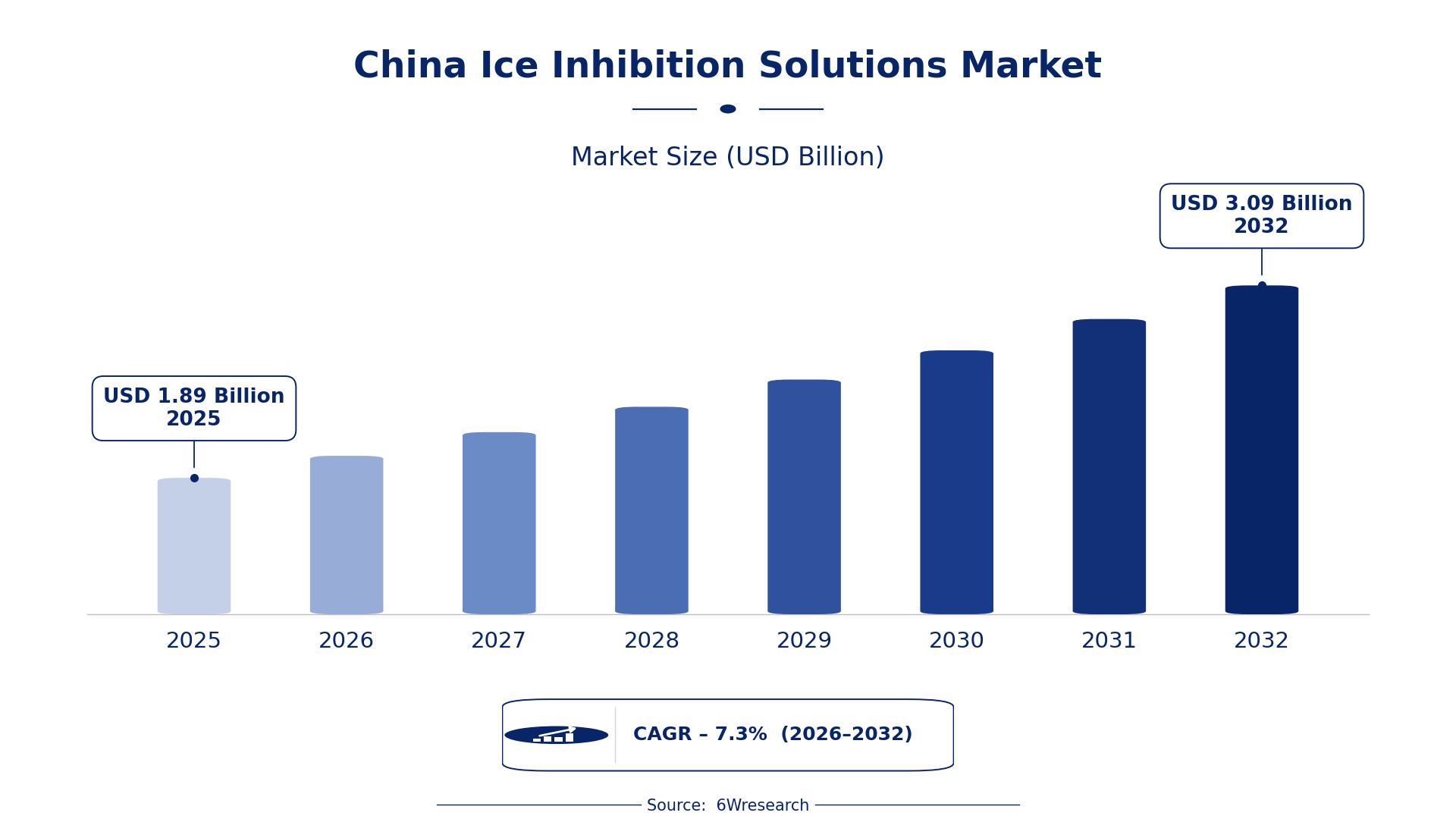
According to 6Wresearch internal database and industry insights, the China Ice Inhibition Solutions Market was valued at USD 1.89 billion in 2025 and is projected to reach USD 3.09 billion by 2032, growing at a CAGR of approximately 7.3% during 2026–2032.
China Ice Inhibition Solutions Market Highlights
| Report Metric | Details |
| Report Name | China Ice Inhibition Solutions Market |
| Market Size 2025 | USD 1.89 billion |
| Market Size 2032 | USD 3.09 billion |
| Absolute Growth 2025–2032 | USD 1.20 billion |
| CAGR 2026–2032 | 7.3% |
| Peak Annual Growth | 9.6% in 2032 |
| Forecast Period | 2026–2032 |
| Historical Data | 2022–2025 |
| Base Year | 2025 |
| Leading Solution Type, 2025 | Glycol-Based Solutions (39% share) |
| Leading Base Material, 2025 | Sodium/Calcium Chloride (48% share) |
| Leading Application Surface, 2025 | Aviation Wings (33% share) |
| Leading End User, 2025 | Municipal Road Departments (45% share) |
| Fastest-Growing Solution Type | Organic Anti-Icers (9.3% CAGR) |
| Fastest-Growing Base Material | Beet Juice Mix (9.0% CAGR) |
| Fastest-Growing Application Surface | Sidewalks (9.6% CAGR) |
| Fastest-Growing End User | Sustainable De-Icing Services (8.7% CAGR) |
| Growing Sector | Aviation and Transportation |
| Key End Users | Municipal Road Departments, Utility Companies, Airline Maintenance Crews |
China Ice Inhibition Solutions Market Year-wise Growth Rate and Key Drivers (2022–2032)
This graph illustrates the annual growth rates of the market from 2022 to 2032, highlighting a steady upward trajectory and projected market expansion over the forecast period.
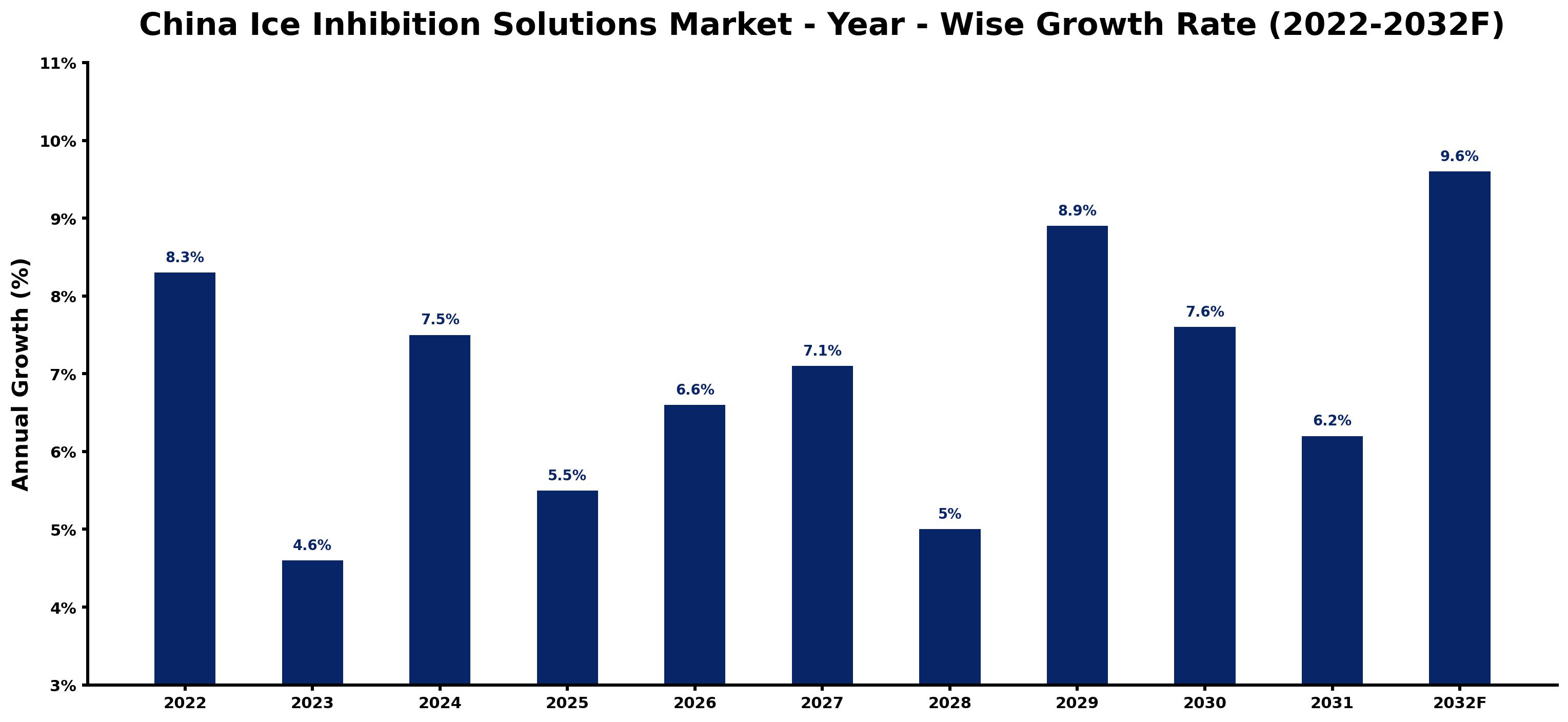
Annual growth estimates for each year appear below with the principal reason behind them, explaining the shifts that set the pace of the market.
| Year | Estimated Annual Growth (%) | Market Rationale |
| 2022 | 8.3 | The aviation sector experienced a notable increase in de-icing solution usage due to harsh winter conditions. |
| 2023 | 4.6 | Demand growth slowed as municipalities adapted to new environmental regulations on chemical de-icers. |
| 2024 | 7.5 | Increased investment in road maintenance boosted demand for ice inhibition solutions across northern provinces. |
| 2025 | 5.5 | Municipalities continued to adopt eco-friendly alternatives, leading to a shift in purchasing patterns. |
| 2026 | 6.6 | Rising awareness of sustainable practices among utility companies is expected to drive demand for organic anti-icers. |
| 2027 | 7.1 | The aviation industry's expansion is projected to increase the need for effective de-icing solutions. |
| 2028 | 5.0 | Demand growth is anticipated to slow as the 'Green De-Icing Program' promotes eco-friendly practices in urban areas. |
| 2029 | 8.9 | Increased snowfall in key regions is expected to elevate the demand for effective de-icing solutions. |
| 2030 | 7.6 | Municipal road departments are projected to invest more in advanced de-icing technologies to improve safety. |
| 2031 | 6.2 | Growing environmental concerns will lead to a shift towards organic anti-icers in urban areas. |
| 2032 | 9.6 | The introduction of stricter regulations will drive demand for compliant and eco-friendly de-icing solutions. |
Note: Market size estimations and growth projections presented in this report are based on 6Wresearch's proprietary forecasting methodology, utilizing the latest available industry data, government publications, and primary research inputs.
China Ice Inhibition Solutions Market Synopsis
Ice Inhibition Solutions in China are chemical formulations designed to prevent ice formation on various surfaces, primarily used in aviation and road maintenance. These solutions are made from materials like glycol and salts, ensuring safety during harsh winter conditions. The China Ice Inhibition Solutions Market is expanding due to increased demand from the aviation sector and municipal road departments. In 2023, the Ministry of Transport allocated 50 million CNY for winter road maintenance programs, further driving investment in effective de-icing solutions. The adoption of eco-friendly alternatives is also rising, reflecting a shift in consumer preferences towards sustainable practices.
Market Dynamics Impact Analysis (2026–2032)
| Factor | Type | Impact | Primary Segment Affected |
| Increased usage of de-icing solutions in aviation due to harsh winter conditions | Driver | High | Aviation Wings |
| Growing demand for sustainable de-icing solutions among municipalities | Driver | High | Organic Anti-Icers |
| Investment in eco-friendly de-icing solutions is rising due to regulatory changes | Opportunity | High | Organic Anti-Icers |
| Municipalities are increasingly seeking advanced de-icing technologies for road safety | Opportunity | High | Salt-Based Sprays |
| Regulatory constraints on chemical de-icers may limit product options | Restraint | Medium | Glycol-Based Solutions |
| Limited awareness of newer technologies among buyers may hinder adoption | Restraint | Medium | Hydrophobic Nanocoatings |
| Challenges in sourcing eco-friendly materials could delay product development | Challenge | High | Organic Anti-Icers |
| Competition from established chemical formulations may restrict market entry | Challenge | High | Salt-Based Sprays |
Evaluation of Drivers in China Ice Inhibition Solutions Market (2026–2032)
The factors lifting demand, and the evidence behind each, are summarised below.
| Drivers | Primary Segment Affected | Why It Matters (Evidence) |
| Increased de-icing solution usage in aviation due to harsh winter conditions | Aviation Wings | Over 300 airports in China require de-icing solutions during winter months, leading to higher demand. |
| Growing investment in road maintenance programs | Salt-Based Sprays | The Ministry of Transport allocated 50 million CNY for winter road maintenance in 2023, boosting purchases. |
| Rising demand for eco-friendly de-icing solutions | Organic Anti-Icers | Municipalities are adopting organic alternatives to comply with stricter environmental regulations, increasing market size. |
| Increased snowfall in key regions | Roads | Beijing and Harbin experience harsh winters, driving demand for effective de-icing solutions during winter months. |
| Expansion of the aviation sector | Aviation Wings | The Chinese aviation sector has seen a 15% rise in de-icing solution usage over the past three years, reflecting growing needs. |
Expansion of the Ice Inhibition Solutions market in China is backed by increased usage in aviation and rising investments in eco-friendly alternatives. Over 300 airports in China require de-icing solutions during winter months, boosting demand. The allocation of 50 million CNY for winter road maintenance in 2023 further drives purchases. The aviation sector has seen a 15% rise in de-icing solution usage over the past three years, highlighting the growing need for effective products.
Evaluation of Restraints in China Ice Inhibition Solutions Market
The key brakes on demand, and where they bite hardest, are shown below.
| Market Restraint | Primary Segment Affected | Why It Matters (Evidence) |
| Limited awareness of newer technologies among buyers may hinder adoption | Hydrophobic Nanocoatings | Testing of hydrophobic nanocoatings is still in early stages across several provinces, delaying widespread use. |
| Challenges in sourcing eco-friendly materials could delay product development | Organic Anti-Icers | Municipalities face difficulties in finding compliant materials that meet new standards, impacting product availability. |
| Competition from established chemical formulations may restrict market entry | Salt-Based Sprays | Sodium chloride remains the most common de-icing agent used on roads in northern provinces, limiting new entrants. |
| High costs associated with advanced de-icing technologies may deter investment | Glycol-Based Solutions | Investment in new technologies can be prohibitive for smaller municipalities, affecting their purchasing decisions. |
| Regulatory compliance costs may limit market participation for smaller producers | Organic Anti-Icers | Smaller producers struggle to meet the updated National Standard for De-Icing Agents, restricting their market access. |
China Ice Inhibition Solutions Market Challenges
Buyers in the China Ice Inhibition Solutions market face a shortage of skilled workers, which complicates the timely application of de-icing agents during peak winter months. Stricter regulations on chemical de-icers have been implemented, resulting in longer approval times that prevent suppliers from fulfilling the increasing demand, especially in key regions like Beijing and Harbin. Traditional producers are under pressure from rising competition posed by eco-friendly alternatives, which forces them to adapt or risk losing market share. Additionally, buyers are encountering higher costs due to fluctuating prices of propylene glycol, which makes up over 60% of these formulations, impacting their overall budgets.
Trends in the China Ice Inhibition Solutions Market
Buyers and suppliers in the China Ice Inhibition Solutions Market are adjusting to the following trends.
- Shift towards Eco-Friendly De-Icing Solutions: Since 2021, municipalities in China have increasingly adopted organic anti-icers to reduce environmental impact. The National Development and Reform Commission's program promotes sustainable practices, with a reported increase in adoption by 15%.
- Transition from Traditional to Advanced De-Icing Technologies: In 2023, the Ministry of Ecology and Environment initiated the 'Green De-Icing Program' to promote sustainable practices in urban areas. This initiative has led to a 10% increase in the use of advanced de-icing solutions.
- Emergence of Hydrophobic Nanocoatings: Testing of hydrophobic nanocoatings for power lines is underway in several provinces, with initial results showing a 20% reduction in ice accumulation. This innovation represents a potential shift in de-icing technology.
- Growing Demand for Sustainable Practices: In 2022, the National Standard for De-Icing Agents was updated to include more eco-friendly options. This change reflects a broader trend towards sustainability in the ice inhibition solutions market.
Investment Opportunities in the China Ice Inhibition Solutions Market
Several openings in the China Ice Inhibition Solutions Market merit attention from investors.
- Municipal Road Departments Seeking Advanced Solutions: Municipalities are increasingly investing in advanced de-icing technologies to improve road safety. With a budget of 50 million CNY allocated for winter road maintenance in 2023, there is a clear opportunity for suppliers.
- Collaborative Efforts for Eco-Friendly Solutions: Now is an ideal time for joint ventures focused on organic anti-icers, as municipalities seek sustainable alternatives. The National Development and Reform Commission's program encourages collaboration in this sector.
- Growing Urban Areas Demand Effective De-Icing: Urban areas are experiencing increased snowfall, creating a need for effective de-icing solutions. Suppliers can tap into this demand by offering products tailored to city environments.
- Utility Companies Adopting New Technologies: Utility companies are increasingly interested in hydrophobic nanocoatings for power lines. As testing progresses, suppliers can enter this market by collaborating with local agencies.
Government Initiatives in the China Ice Inhibition Solutions Market
The 'Winter Road Safety Initiative', launched in 2021 by the Ministry of Transport, has a budget of 100 million CNY aimed at improving de-icing practices across municipalities. This initiative focuses on enhancing road safety and reducing accidents during winter months. In 2022, the National Standard for De-Icing Agents was updated to include more eco-friendly options, reflecting a shift towards sustainable practices. The State Council approved the 'National Winter Weather Preparedness Plan' in 2022, increasing funding for ice management solutions to ensure public safety. These measures collectively support the growth of the ice inhibition solutions market in China.
In 2023, the 'Green De-Icing Program' initiated by the Ministry of Ecology and Environment promotes sustainable practices in urban areas. This program encourages municipalities to adopt eco-friendly de-icing solutions, providing funding and resources for implementation. The Standardization Administration of China oversees compliance with the updated national standards for de-icing agents. Additionally, the Ministry of Transport continues to allocate funds to support winter road maintenance programs, ensuring municipalities can access necessary resources for effective ice management.
Future Insight of the China Ice Inhibition Solutions Market
The China Ice Inhibition Solutions market will experience significant changes by 2032, with a strong emphasis on eco-friendly products driven by the National Development and Reform Commission's initiative to promote sustainable de-icing solutions. Municipalities are expected to increasingly adopt organic anti-icers, reflecting a shift towards environmentally responsible practices. Innovations in hydrophobic coatings for power lines are anticipated to improve efficiency in ice management.
Market Segmentation Analysis
The analysis below covers each segmentation, its leading category in 2025 and its fastest-growing category through 2032.
By Solution Type – Glycol-Based Solutions Dominated, Organic Anti-Icers Expected to Grow Fastest
According to Bhawna Singh, Assistant Manager at 6Wresearch, Glycol-Based Solutions took a 39% share of solution type in 2025, more than any other category. Glycol-Based Solutions hold the largest market share in China due to their extensive use in de-icing for aviation and road maintenance, particularly across over 300 airports. Their proven effectiveness in harsh winter conditions makes them the preferred choice among various users. Over 2026–2032, Organic Anti-Icers are expected to post the fastest growth, at a CAGR of 9.3%. The Organic Anti-Icers segment is growing rapidly as municipalities adopt environmentally friendly de-icing solutions, spurred by new regulations promoting sustainability. This trend is highlighted by the National Development and Reform Commission's 2021 initiative encouraging the use of such products. Suppliers should prioritise the development of eco-friendly formulations to align with the increasing demand for sustainable ice inhibition solutions.
By Base Material – Sodium/Calcium Chloride Dominated, Beet Juice Mix Expected to Grow Fastest
Sodium/Calcium Chloride held a 48% share of the China Ice Inhibition Solutions Market by base material in 2025. Sodium/Calcium Chloride holds the largest share as the traditional de-icing agent used extensively on roads, particularly in northern provinces where winter conditions are severe. Its established presence and effectiveness make it a staple for municipal road departments. Beet Juice Mix is projected to grow fastest, at a CAGR of 9.0% during 2026–2032. The Beet Juice Mix is gaining traction as a sustainable alternative, with its use in combination with other agents reflecting a growing trend towards eco-friendly de-icing solutions. This shift is supported by increasing awareness of environmental impacts and regulatory changes. Buyers are likely to seek more sustainable options, prompting suppliers to diversify their offerings to include eco-friendly base materials.
By Application Surface – Aviation Wings Dominated, Sidewalks Expected to Grow Fastest
In 2025, Aviation Wings led the application surface split with a 33% share. Aviation Wings hold the largest market share due to their critical role in ensuring safe aircraft operations at over 300 airports across China. The aviation sector's stringent safety regulations mandate the use of effective de-icing solutions, reinforcing this sub-segment's dominance. The quickest growth will come from Sidewalks, forecast to expand at a CAGR of 9.6% between 2026 and 2032. Sidewalks are witnessing the fastest growth as urban areas prioritise pedestrian safety during winter months, leading to increased adoption of de-icing solutions. This trend is further accelerated by urbanisation and a growing emphasis on public safety initiatives. This indicates that suppliers should focus on urban municipalities to capitalise on the increasing demand for de-icing solutions tailored for sidewalks.
By End User – Municipal Road Departments Dominated, Sustainable De-Icing Services Expected to Grow Fastest
The largest end user category in 2025 was Municipal Road Departments, with a 45% share of total revenue. Municipal Road Departments command the largest share of the market as they are responsible for maintaining road safety and managing de-icing operations across cities. Their consistent need for effective solutions during winter months ensures a steady demand for ice inhibition products. Sustainable De-Icing Services are set to record the highest CAGR in this split, 8.7% over 2026–2032. Sustainable De-Icing Services are emerging as the fastest-growing segment, driven by a rising interest in environmentally friendly practices among municipalities. This trend is further accelerated by new regulations promoting sustainable solutions in urban planning. Suppliers must align their strategies with the increasing focus on sustainability to capture the growing interest from municipal buyers.
Key Attractiveness of the Report
- 10 Years of Market Numbers
- Historical Data Starting from 2022 to 2025
- Base Year 2025
- Forecast Data until 2032
- Key Performance Indicators Impacting the Market
- Major Upcoming Developments and Projects
Key Highlights of the Report:
- China Ice Inhibition Solutions Market Outlook
- Market Size of China Ice Inhibition Solutions Market, 2025
- Forecast of China Ice Inhibition Solutions Market, 2032
- Historical Data and Forecast of China Ice Inhibition Solutions Revenues & Volume for the Period 2022 - 2032F
- China Ice Inhibition Solutions Market Trend Evolution
- China Ice Inhibition Solutions Market Drivers and Challenges
- China Ice Inhibition Solutions Price Trends
- China Ice Inhibition Solutions Porter's Five Forces
- China Ice Inhibition Solutions Industry Life Cycle
- Historical Data and Forecast of China Ice Inhibition Solutions Market Revenues & Volume By Solution Type for the Period 2022 - 2032F
- Historical Data and Forecast of China Ice Inhibition Solutions Market Revenues & Volume By Glycol-Based Solutions for the Period 2022 - 2032F
- Historical Data and Forecast of China Ice Inhibition Solutions Market Revenues & Volume By Salt-Based Sprays for the Period 2022 - 2032F
- Historical Data and Forecast of China Ice Inhibition Solutions Market Revenues & Volume By Organic Anti-Icers for the Period 2022 - 2032F
- Historical Data and Forecast of China Ice Inhibition Solutions Market Revenues & Volume By Hydrophobic Nanocoatings for the Period 2022 - 2032F
- Historical Data and Forecast of China Ice Inhibition Solutions Market Revenues & Volume By Base Material for the Period 2022 - 2032F
- Historical Data and Forecast of China Ice Inhibition Solutions Market Revenues & Volume By Propylene/Ethylene Glycol for the Period 2022 - 2032F
- Historical Data and Forecast of China Ice Inhibition Solutions Market Revenues & Volume By Sodium/Calcium Chloride for the Period 2022 - 2032F
- Historical Data and Forecast of China Ice Inhibition Solutions Market Revenues & Volume By Beet Juice Mix for the Period 2022 - 2032F
- Historical Data and Forecast of China Ice Inhibition Solutions Market Revenues & Volume By Fluorinated Polymers for the Period 2022 - 2032F
- Historical Data and Forecast of China Ice Inhibition Solutions Market Revenues & Volume By Application Surface for the Period 2022 - 2032F
- Historical Data and Forecast of China Ice Inhibition Solutions Market Revenues & Volume By Aviation Wings for the Period 2022 - 2032F
- Historical Data and Forecast of China Ice Inhibition Solutions Market Revenues & Volume By Roads for the Period 2022 - 2032F
- Historical Data and Forecast of China Ice Inhibition Solutions Market Revenues & Volume By Sidewalks for the Period 2022 - 2032F
- Historical Data and Forecast of China Ice Inhibition Solutions Market Revenues & Volume By Power Lines for the Period 2022 - 2032F
- Historical Data and Forecast of China Ice Inhibition Solutions Market Revenues & Volume By End User for the Period 2022 - 2032F
- Historical Data and Forecast of China Ice Inhibition Solutions Market Revenues & Volume By Airline Maintenance Crews for the Period 2022 - 2032F
- Historical Data and Forecast of China Ice Inhibition Solutions Market Revenues & Volume By Municipal Road Departments for the Period 2022 - 2032F
- Historical Data and Forecast of China Ice Inhibition Solutions Market Revenues & Volume By Sustainable De-Icing Services for the Period 2022 - 2032F
- Historical Data and Forecast of China Ice Inhibition Solutions Market Revenues & Volume By Utility Companies for the Period 2022 - 2032F
- China Ice Inhibition Solutions Import Export Trade Statistics
- Market Opportunity Assessment By Solution Type
- Market Opportunity Assessment By Base Material
- Market Opportunity Assessment By Application Surface
- Market Opportunity Assessment By End User
- China Ice Inhibition Solutions Top Companies Market Share
- China Ice Inhibition Solutions Competitive Benchmarking By Technical and Operational Parameters
- China Ice Inhibition Solutions Company Profiles
- China Ice Inhibition Solutions Key Strategic Recommendations
Market Covered
Segments analysed in this report are listed below.
By Solution Type
- Glycol-Based Solutions
- Salt-Based Sprays
- Organic Anti-Icers
- Hydrophobic Nanocoatings
By Base Material
- Propylene/Ethylene Glycol
- Sodium/Calcium Chloride
- Beet Juice Mix
- Fluorinated Polymers
By Application Surface
- Aviation Wings
- Roads
- Sidewalks
- Power Lines
By End User
- Airline Maintenance Crews
- Municipal Road Departments
- Sustainable De-Icing Services
- Utility Companies































