China Identity Verification Systems Market Size & Growth Rate
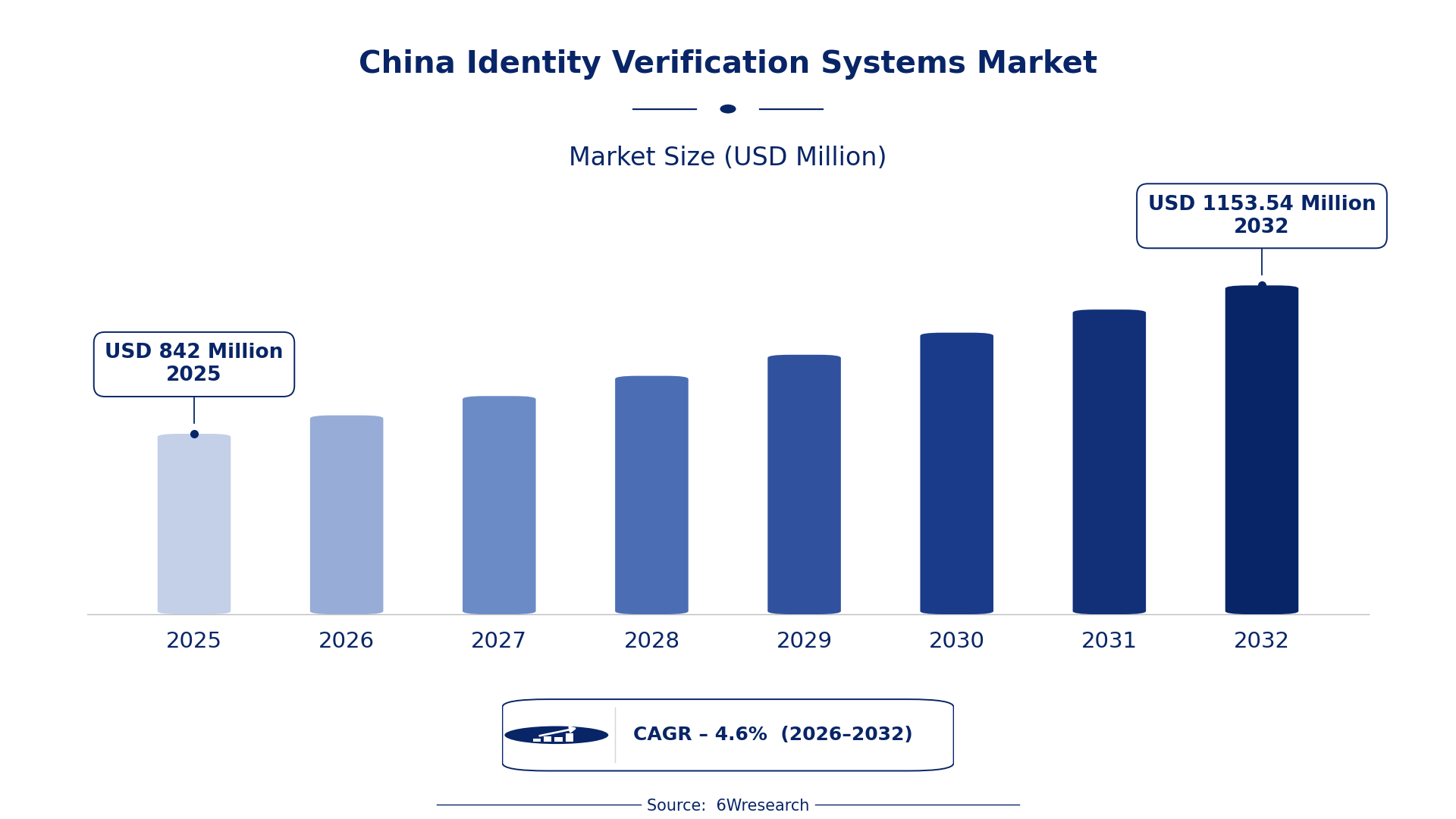
According to 6Wresearch internal database and industry insights, the China Identity Verification Systems Market was valued at USD 842.0 million in 2025 and is projected to reach USD 1,153.54 million by 2032, growing at a CAGR of approximately 4.6% during 2026–2032.
China Identity Verification Systems Market Highlights
| Report Metric | Details |
| Report Name | China Identity Verification Systems Market |
| Market Size 2025 | USD 842.0 million |
| Market Size 2032 | USD 1,153.54 million |
| Absolute Growth 2025–2032 | USD 311.54 million |
| CAGR 2026–2032 | 4.6% |
| Peak Annual Growth | 7.0% in 2030 |
| Forecast Period | 2026–2032 |
| Historical Data | 2022–2025 |
| Base Year | 2025 |
| Leading System Type, 2025 | Integrated Biometric System (42% share) |
| Leading Functional Focus, 2025 | Facial (48% share) |
| Leading Hardware Integration, 2025 | Embedded Terminals (39% share) |
| Leading End User, 2025 | Border Control (36% share) |
| Fastest-Growing System Type | Digital ID Management (6.1% CAGR) |
| Fastest-Growing Functional Focus | AI/ML Tracking (6.7% CAGR) |
| Fastest-Growing End User | Smart City Infrastructure (6.7% CAGR) |
| Growing Sector | Smart City Infrastructure |
| Key End Users | Border Control, Healthcare & Education, Office Security Providers, Smart City Infrastructure |
China Identity Verification Systems Market Year-wise Growth Rate and Key Drivers (2022–2032)
This graph illustrates the annual growth rates of the market from 2022 to 2032, highlighting a steady upward trajectory and projected market expansion over the forecast period.
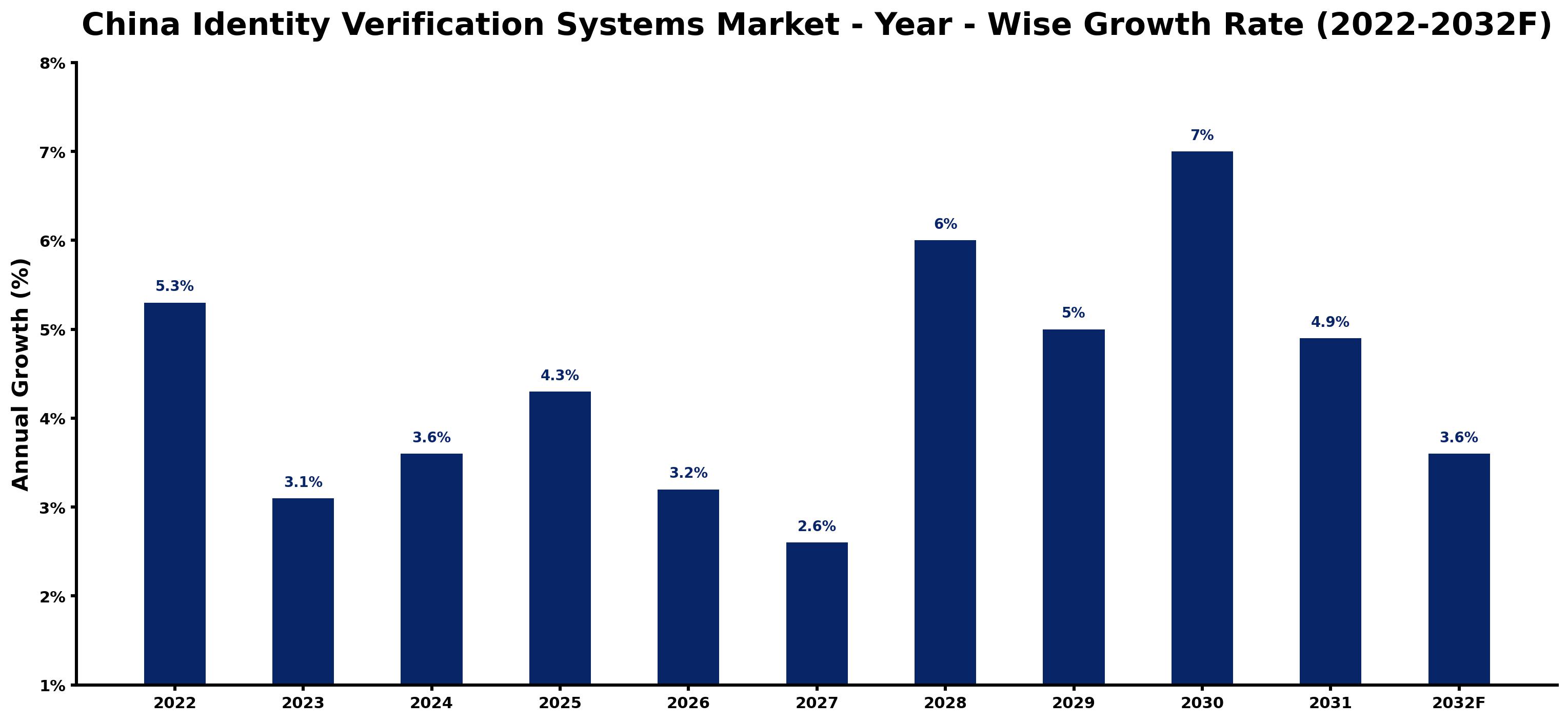
Annual growth estimates for each year appear below with the principal reason behind them, explaining the shifts that set the pace of the market.
| Year | Estimated Annual Growth (%) | Market Rationale |
| 2022 | 5.3 | The market experienced strong demand due to increased biometric ID registrations. |
| 2023 | 3.1 | Growth slowed as the market adjusted to new regulations and standards. |
| 2024 | 3.6 | Demand rose with the expansion of digital ID initiatives across sectors. |
| 2025 | 4.3 | The market saw improved growth driven by urban security investments. |
| 2026 | 3.2 | Growth slowed as the market faced regulatory challenges and adjustments. |
| 2027 | 2.6 | Demand continued to slow as integration of systems became complex. |
| 2028 | 6.0 | A resurgence in growth occurred with advancements in AI technologies. |
| 2029 | 5.0 | Demand slowed as the market stabilised after rapid technological changes. |
| 2030 | 7.0 | The market peaked with heightened investments in border control systems. |
| 2031 | 4.9 | Growth slowed as the market adjusted to new compliance requirements. |
| 2032 | 3.6 | The market continues to grow, driven by ongoing digital ID projects. |
Note: Market size estimations and growth projections presented in this report are based on 6Wresearch's proprietary forecasting methodology, utilizing the latest available industry data, government publications, and primary research inputs.
China Identity Verification Systems Market Synopsis
Identity Verification Systems in China include technologies that authenticate individual identities through biometric data and digital credentials. These systems improve security across various sectors such as border control, healthcare, and smart city projects. The China Identity Verification Systems Market is expanding due to strong domestic demand driven by government initiatives and private sector investments. With over 1 billion registered biometric ID users, the need for secure identity verification is substantial. The Smart City initiative is integrating identity systems, further increasing demand.
Market Dynamics Impact Analysis (2026–2032)
| Factor | Type | Impact | Primary Segment Affected |
| Increasing biometric ID registrations | Driver | High | Integrated Biometric System |
| Government investments in digital ID projects | Driver | High | Digital ID Management |
| Rising demand for secure access control in urban areas | Opportunity | High | Smart City Infrastructure |
| Expansion of healthcare identity verification systems | Opportunity | Medium | Healthcare & Education |
| Regulatory compliance costs for identity verification systems | Restraint | High | Authentication Systems |
| Challenges in integrating new technologies with existing systems | Restraint | Medium | Surveillance-Based ID |
| Complexity of compliance with national standards | Challenge | High | Digital ID Management |
| Rapid technological advancements leading to obsolescence | Challenge | Medium | Facial |
Evaluation of Drivers in China Identity Verification Systems Market (2026–2032)
Key forces behind demand, with the segment each one moves most, are listed below.
| Drivers | Primary Segment Affected | Why It Matters (Evidence) |
| Growing number of biometric ID users | Integrated Biometric System | In 2022, over 1 billion registered biometric ID users increased demand for secure identity verification. |
| Government funding for digital ID projects | Digital ID Management | In 2023, the government allocated 500 million CNY for digital ID projects, driving system adoption. |
| Smart City initiative integration | Smart City Infrastructure | The Smart City initiative aims to implement identity systems in 100 cities by 2025, boosting demand. |
| Healthcare sector adoption of identity systems | Healthcare & Education | Over 70% of healthcare institutions use identity verification systems, increasing demand for secure access. |
| Regulatory standards for personal information protection | Authentication Systems | The Cybersecurity Law of 2017 mandates secure identity verification processes, influencing system requirements. |
Growth in the Identity Verification Systems market in China comes from increasing biometric ID registrations, government investments in digital ID projects, and the Smart City initiative's integration of identity systems. In 2022, over 1 billion registered biometric ID users heightened the demand for secure identity verification. The government allocated 500 million CNY for digital ID projects in 2023, driving system adoption across sectors. The Smart City initiative aims to implement identity systems in 100 cities by 2025, further boosting demand. Additionally, over 70% of healthcare institutions now use identity verification systems, reflecting a growing need for secure access control.
Evaluation of Restraints in China Identity Verification Systems Market
The following restraints limit how fast demand can grow.
| Market Restraint | Primary Segment Affected | Why It Matters (Evidence) |
| High compliance costs for identity verification systems | Authentication Systems | Compliance with the Cybersecurity Law of 2017 increases operational costs for system providers, raising expenses by up to 20%. |
| Integration challenges with existing technologies | Surveillance-Based ID | Complexity in integrating new technologies delays deployment and increases costs for buyers, with potential delays of up to six months. |
| Regulatory changes impacting system requirements | Digital ID Management | Frequent updates to standards create uncertainty and increase compliance costs for producers, raising operational expenses by approximately 15%. |
| Limited awareness of identity verification benefits | Integrated Biometric System | Some sectors remain unaware of the advantages of biometric systems, hindering market growth and adoption rates. |
| Market saturation in urban areas | Smart City Infrastructure | High competition in urban regions leads to price pressures and reduced profit margins for suppliers, affecting profitability. |
China Identity Verification Systems Market Challenges
Buyers and suppliers in the China Identity Verification Systems market encounter considerable technological integration challenges, as aligning biometric systems with existing infrastructure can extend project timelines by up to six months. Healthcare institutions face high compliance costs due to the Cybersecurity Law of 2017, which raises operational expenses, particularly for those managing patient data securely. A shortage of skilled professionals in this sector hinders effective service delivery, especially in urban areas where demand is high. Competition intensifies as over 70% of healthcare institutions adopt these systems, leading to price reductions that pressure profit margins for producers.
Trends in the China Identity Verification Systems Market
Four trends stand out in the China Identity Verification Systems Market.
- Shift Towards AI-Driven Identity Verification: China is increasingly adopting AI technologies in identity verification systems, as seen in the AI Innovation Action Plan from 2022, which allocated 300 million CNY for pilot projects. This shift improves accuracy and efficiency in identity verification processes.
- Expansion of Digital ID in Healthcare: In 2022, over 70% of healthcare institutions in China adopted identity verification systems for patient management. This trend is driven by the need for secure access control and improved patient identification, enhancing operational efficiency and patient safety.
- Integration of Identity Systems in Smart Cities: The Smart City Development Plan launched in 2023 aims to integrate identity verification systems into urban infrastructure across 100 cities by 2025. This integration improves security and efficiency in urban management, benefiting public services and citizen safety.
- Increased Surveillance for Public Safety: In 2021, the number of surveillance cameras in urban areas exceeded 200 million, reflecting a growing trend towards enhanced public safety measures. This increase drives demand for effective identity verification systems in urban environments, ensuring safety and security.
Investment Opportunities in the China Identity Verification Systems Market
Some of the investment opportunities in the China Identity Verification Systems Market are mentioned below.
- Growing Demand for Secure Access Control: With China's population of approximately 1.4 billion, there is a substantial opportunity in providing secure access control systems. Urban security providers are increasingly seeking advanced identity verification solutions to improve safety and manage risks effectively.
- Investment in Smart City Infrastructure: The Smart City initiative offers an opportunity for suppliers to invest in identity verification systems. With 500 smart cities planned by 2025, partnerships with local governments can facilitate entry into this market and broaden reach for suppliers.
- Healthcare Sector Expansion: The increasing adoption of identity verification systems in the healthcare sector presents a promising opportunity. With over 70% of institutions using these systems, suppliers can target hospitals and clinics for new installations and upgrades to enhance patient safety.
- Digital ID Management Innovations: The demand for digital ID management solutions is on the rise, particularly with the government's 500 million CNY allocation for projects. Collaborating with technology developers can assist suppliers in entering this growing segment and effectively meeting emerging needs.
Government Initiatives in the China Identity Verification Systems Market
The updated 'Regulations on the Administration of Identity Verification' in 2022 strengthened data protection measures for personal information, ensuring compliance with the Cybersecurity Law of 2017. This law requires producers to implement secure verification processes, influencing how systems are developed and deployed. The 'Digital Identity Initiative' launched by the National Development and Reform Commission in 2021 aims to improve security and efficiency in identity verification systems, focusing on urban areas and enhancing integration into public services with an emphasis on 100 cities by 2025.
The National Development and Reform Commission oversees the funding of the 'AI Innovation Action Plan' from 2022, which supports the development of AI-driven identity verification technologies. This initiative has a budget of 300 million CNY for pilot projects, enabling producers to innovate and refine their offerings in the identity verification market. Additionally, the National Standards Administration publishes guidelines that assist in standardising processes and ensuring compliance across sectors, facilitating smoother operations for producers.
Future Insight of the China Identity Verification Systems Market
The China Identity Verification Systems market is set for transformative changes by 2032, driven by government initiatives and advancements in technology. The Smart City initiative will embed identity verification systems into urban planning, improving public service efficiency. In 2023, the government allocated 500 million CNY for digital ID projects, which will spur innovation across the sector. As the number of smart cities approaches 1,000, the demand for robust identity verification solutions will surge, presenting new opportunities for suppliers and buyers alike.
Market Segmentation Analysis
Each segment group is reviewed below, with the leader by share and the fastest grower by CAGR.
By System Type – Integrated Biometric System Dominated, Digital ID Management Expected to Grow Fastest
According to Bhawna Singh, Assistant Manager at 6Wresearch, Integrated Biometric System held a 42% share of the China Identity Verification Systems Market by system type in 2025. The Integrated Biometric System commands the largest share due to its extensive use in critical sectors such as border control and healthcare. With over 1 billion registered biometric ID users, this system is integral to secure identity verification processes across China. Digital ID Management is set to record the highest CAGR in this split, 6.1% over 2026–2032. Digital ID Management is experiencing rapid growth as it becomes essential for managing digital identities across various platforms. The government's allocation of 500 million CNY for digital ID projects in 2023 highlights the increasing urgency for these systems. Suppliers should prioritise the development of digital ID solutions to capitalise on the rising market demand.
By Functional Focus – Facial Dominated, AI/ML Tracking Expected to Grow Fastest
With a 48% revenue share in 2025, Facial was the largest functional focus category. Facial recognition technology commands the largest market share due to its widespread use in security systems for real-time identification. Its proven effectiveness across various sectors, including border control and public safety, solidifies its position as the leading method for identity verification. Over 2026–2032, AI/ML Tracking is expected to post the fastest growth, at a CAGR of 6.7%. AI/ML Tracking is experiencing rapid growth as it significantly enhances the performance of existing identity verification systems. This surge is driven by the increasing demand for more efficient and accurate verification processes across multiple applications. Suppliers must prioritise the integration of advanced tracking technologies to meet the evolving requirements of identity verification systems.
By Hardware Integration – Embedded Terminals Dominated and Is Expected to Record the Fastest Growth
The largest hardware integration category in 2025 was Embedded Terminals, with a 39% share of total revenue. Embedded Terminals lead the market due to their critical role in capturing biometric data across various locations. Their integration into identity verification systems is essential for ensuring accurate and secure identity authentication. The same category are also set to grow fastest, at a CAGR of 7.2% during 2026–2032. As Embedded Terminals are both the leader and fastest-growing segment, their continued development will likely expand their market share further. This growth is supported by the increasing demand for efficient biometric data capture solutions. Suppliers must prioritise the innovation of Embedded Terminals to maintain competitive advantage.
By End User – Border Control Dominated, Smart City Infrastructure Expected to Grow Fastest
Border Control took a 36% share of end user in 2025, more than any other category. Border Control holds the largest share as it is crucial for identity verification at entry points, ensuring national security and public safety. The considerable investments in border control technologies highlight the importance of robust identity verification in this sector. The quickest growth will come from Smart City Infrastructure, forecast to expand at a CAGR of 6.7% between 2026 and 2032. Smart City Infrastructure is rapidly gaining traction as cities implement secure management systems that rely heavily on identity verification. The increase in the number of smart cities, which reached 500 in 2022, illustrates the growing demand for these solutions. Suppliers should align their offerings with smart city projects to capitalise on the escalating need for effective identity verification systems.
Key Attractiveness of the Report
- 10 Years of Market Numbers
- Historical Data Starting from 2022 to 2025
- Base Year 2025
- Forecast Data until 2032
- Key Performance Indicators Impacting the Market
- Major Upcoming Developments and Projects
Key Highlights of the Report:
- China Identity Verification Systems Market Outlook
- Market Size of China Identity Verification Systems Market, 2025
- Forecast of China Identity Verification Systems Market, 2032
- Historical Data and Forecast of China Identity Verification Systems Revenues & Volume for the Period 2022 - 2032F
- China Identity Verification Systems Market Trend Evolution
- China Identity Verification Systems Market Drivers and Challenges
- China Identity Verification Systems Price Trends
- China Identity Verification Systems Porter's Five Forces
- China Identity Verification Systems Industry Life Cycle
- Historical Data and Forecast of China Identity Verification Systems Market Revenues & Volume By System Type for the Period 2022 - 2032F
- Historical Data and Forecast of China Identity Verification Systems Market Revenues & Volume By Integrated Biometric System for the Period 2022 - 2032F
- Historical Data and Forecast of China Identity Verification Systems Market Revenues & Volume By Authentication Systems for the Period 2022 - 2032F
- Historical Data and Forecast of China Identity Verification Systems Market Revenues & Volume By Digital ID Management for the Period 2022 - 2032F
- Historical Data and Forecast of China Identity Verification Systems Market Revenues & Volume By Surveillance-Based ID for the Period 2022 - 2032F
- Historical Data and Forecast of China Identity Verification Systems Market Revenues & Volume By Functional Focus for the Period 2022 - 2032F
- Historical Data and Forecast of China Identity Verification Systems Market Revenues & Volume By Facial, Fingerprint Scan for the Period 2022 - 2032F
- Historical Data and Forecast of China Identity Verification Systems Market Revenues & Volume By Real-Time Access Validation for the Period 2022 - 2032F
- Historical Data and Forecast of China Identity Verification Systems Market Revenues & Volume By Lifecycle & Credentials for the Period 2022 - 2032F
- Historical Data and Forecast of China Identity Verification Systems Market Revenues & Volume By AI/ML Tracking for the Period 2022 - 2032F
- Historical Data and Forecast of China Identity Verification Systems Market Revenues & Volume By Hardware Integration for the Period 2022 - 2032F
- Historical Data and Forecast of China Identity Verification Systems Market Revenues & Volume By Embedded Terminals for the Period 2022 - 2032F
- Historical Data and Forecast of China Identity Verification Systems Market Revenues & Volume By Card/Token Devices for the Period 2022 - 2032F
- Historical Data and Forecast of China Identity Verification Systems Market Revenues & Volume By Secure Database Backend for the Period 2022 - 2032F
- Historical Data and Forecast of China Identity Verification Systems Market Revenues & Volume By Video Analytics for the Period 2022 - 2032F
- Historical Data and Forecast of China Identity Verification Systems Market Revenues & Volume By End User for the Period 2022 - 2032F
- Historical Data and Forecast of China Identity Verification Systems Market Revenues & Volume By Border Control for the Period 2022 - 2032F
- Historical Data and Forecast of China Identity Verification Systems Market Revenues & Volume By Office Security Providers for the Period 2022 - 2032F
- Historical Data and Forecast of China Identity Verification Systems Market Revenues & Volume By Healthcare & Education for the Period 2022 - 2032F
- Historical Data and Forecast of China Identity Verification Systems Market Revenues & Volume By Smart City Infrastructure for the Period 2022 - 2032F
- China Identity Verification Systems Import Export Trade Statistics
- Market Opportunity Assessment By System Type
- Market Opportunity Assessment By Functional Focus
- Market Opportunity Assessment By Hardware Integration
- Market Opportunity Assessment By End User
- China Identity Verification Systems Top Companies Market Share
- China Identity Verification Systems Competitive Benchmarking By Technical and Operational Parameters
- China Identity Verification Systems Company Profiles
- China Identity Verification Systems Key Strategic Recommendations
Market Covered
This report examines the market across the segments below.
By System Type
- Integrated Biometric System
- Authentication Systems
- Digital ID Management
- Surveillance-Based ID
By Functional Focus
- Facial
- Fingerprint Scan
- Real-Time Access Validation
- Lifecycle & Credentials
- AI/ML Tracking
By Hardware Integration
- Embedded Terminals
- Card/Token Devices
- Secure Database Backend
- Video Analytics
By End User
- Border Control
- Office Security Providers
- Healthcare & Education
- Smart City Infrastructure































