China Immunomodulatory Drugs Market Size & Growth Rate
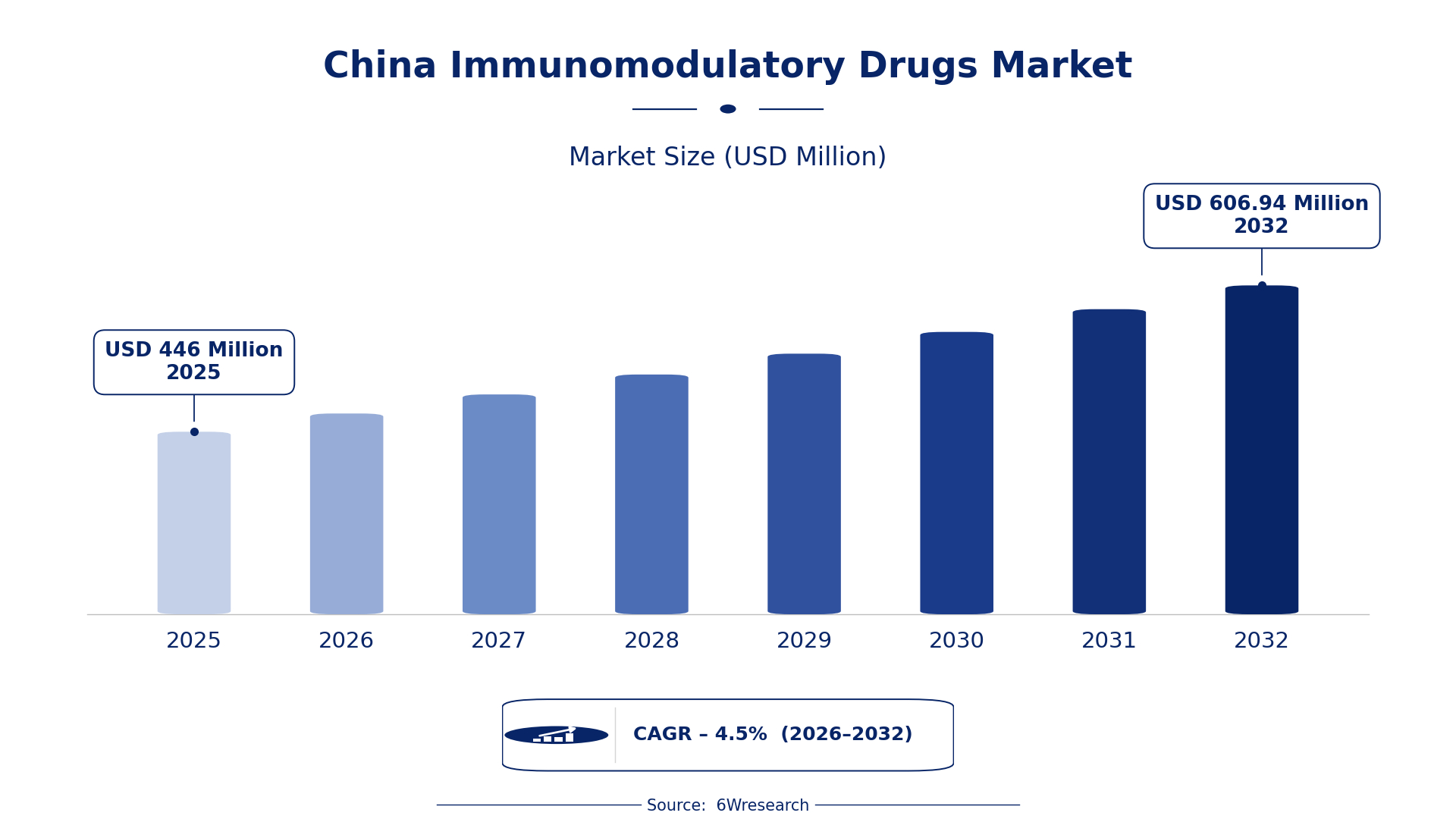
According to 6Wresearch internal database and industry insights, the China Immunomodulatory Drugs Market was valued at USD 446.0 million in 2025 and is projected to reach USD 606.94 million by 2032, growing at a CAGR of approximately 4.5% during 2026–2032.
China Immunomodulatory Drugs Market Highlights
| Report Metric | Details |
| Report Name | China Immunomodulatory Drugs Market |
| Market Size 2025 | USD 446.0 million |
| Market Size 2032 | USD 606.94 million |
| Absolute Growth 2025–2032 | USD 160.94 million |
| CAGR 2026–2032 | 4.5% |
| Peak Annual Growth | 6.0% in 2031 |
| Forecast Period | 2026–2032 |
| Historical Data | 2022–2025 |
| Base Year | 2025 |
| Leading Drug Type, 2025 | Corticosteroids (39% share) |
| Leading Action Type, 2025 | Broad Immunosuppression (36% share) |
| Leading Disease Target, 2025 | Asthma (28% share) |
| Leading End User, 2025 | Clinics & Pharmacies (43% share) |
| Fastest-Growing Drug Type | Biologics (6.7% CAGR) |
| Fastest-Growing Action Type | Targeted Inhibition (6.7% CAGR) |
| Fastest-Growing Disease Target | Lupus (7.0% CAGR) |
| Fastest-Growing End User | Specialty Drug Providers (6.0% CAGR) |
| Growing Sector | Chronic Disease Management |
| Key End Users | Clinics, Pharmacies, Specialty Drug Providers, Oncology Centers |
China Immunomodulatory Drugs Market Year-wise Growth Rate and Key Drivers (2022–2032)
This graph illustrates the annual growth rates of the market from 2022 to 2032, highlighting a steady upward trajectory and projected market expansion over the forecast period.
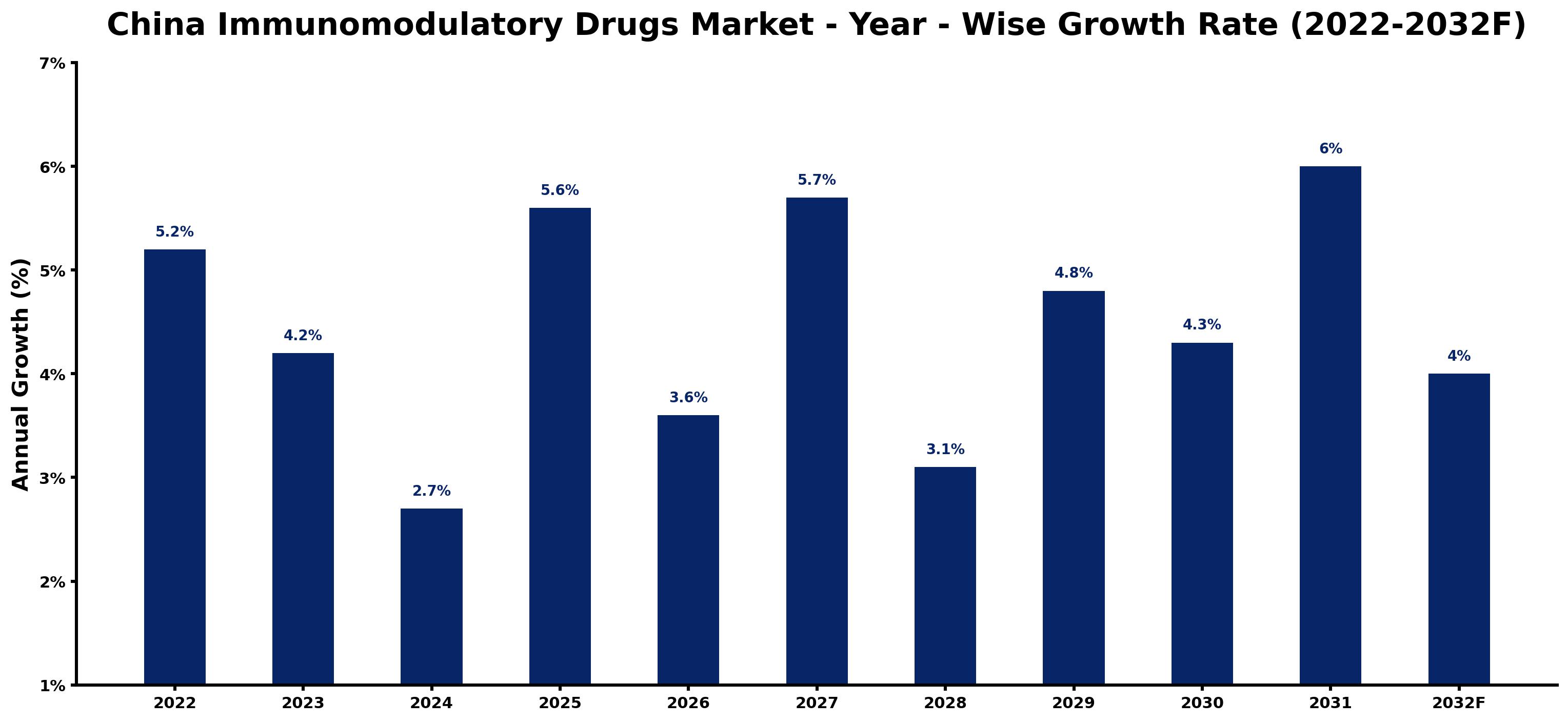
Each row of the following table gives one year's estimated growth and the event or demand shift that explains it.
| Year | Estimated Annual Growth (%) | Market Rationale |
| 2022 | 5.2 | The market experienced steady growth as healthcare providers expanded access to immunomodulatory drugs. |
| 2023 | 4.2 | Demand growth slowed due to regulatory adjustments impacting drug approvals and market entry. |
| 2024 | 2.7 | A continued slowdown occurred as healthcare expenditure faced constraints amid economic pressures. |
| 2025 | 5.6 | Growth accelerated again as the prevalence of autoimmune diseases spurred higher demand for treatments. |
| 2026 | 3.6 | Market growth slowed as the introduction of new therapies faced regulatory hurdles. |
| 2027 | 5.7 | Demand increased as rheumatology clinics adopted biologics for enhanced treatment options. |
| 2028 | 3.1 | Growth decelerated again as the market adjusted to new healthcare policies and regulations. |
| 2029 | 4.8 | Demand surged as awareness of immunomodulatory therapies expanded among healthcare providers. |
| 2030 | 4.3 | A slowdown in growth occurred as market saturation began to impact new drug introductions. |
| 2031 | 6.0 | The market peaked with significant demand driven by rising cases of chronic diseases. |
| 2032 | 4.0 | Growth slowed as the market stabilised following the peak in demand. |
Note: Market size estimations and growth projections presented in this report are based on 6Wresearch's proprietary forecasting methodology, utilizing the latest available industry data, government publications, and primary research inputs.
China Immunomodulatory Drugs Market Synopsis
Immunomodulatory Drugs in China are pharmaceutical agents that modify immune responses, produced through chemical synthesis or biotechnology. These drugs primarily treat autoimmune diseases, cancers, and inflammatory conditions. The China Immunomodulatory Drugs Market is expanding due to rising healthcare access and increasing prevalence of chronic diseases. The National Health Commission's initiatives and growing patient populations are driving demand. The adoption of biologics and advancements in treatment options are also contributing to market growth.
Market Dynamics Impact Analysis (2026–2032)
| Factor | Type | Impact | Primary Segment Affected |
| Rising prevalence of autoimmune diseases drives demand for effective treatments. | Driver | High | Corticosteroids |
| Increased adoption of biologics in rheumatology clinics enhances treatment efficacy. | Driver | High | Biologics |
| Expansion of specialty drug providers increases access to advanced therapies. | Opportunity | High | Specialty Drug Providers |
| Government initiatives to improve healthcare access create new market opportunities. | Opportunity | High | Clinics & Pharmacies |
| Regulatory hurdles slow down the approval of new immunomodulatory drugs. | Restraint | High | Biologics |
| Market saturation limits the introduction of new therapies and slows growth. | Restraint | Medium | Corticosteroids |
| Challenges in maintaining consistent supply chains affect drug availability. | Challenge | High | Oncology Centers |
| Rising costs of research and development hinder innovation in drug production. | Challenge | Medium | Cancer Immunomodulators |
Evaluation of Drivers in China Immunomodulatory Drugs Market (2026–2032)
The main growth drivers and the segments they affect most are set out below.
| Drivers | Primary Segment Affected | Why It Matters (Evidence) |
| Increased prevalence of autoimmune diseases leads to higher demand for immunomodulatory drugs. | Corticosteroids | In 2022, approximately 1.4 billion people in China had a significant portion suffering from autoimmune diseases. |
| Growing adoption of biologics expands treatment options for chronic diseases. | Biologics | Biologics accounted for over 30% of the immunomodulatory drug market in China in 2022. |
| Expansion of healthcare facilities increases access to immunomodulatory therapies. | Specialty Drug Providers | In 2022, the number of specialty drug providers in China reached over 1,000. |
| Government initiatives improve healthcare access for chronic disease management. | Clinics & Pharmacies | The 'Healthy China 2030' initiative aims to improve healthcare services for chronic diseases. |
| Rising healthcare expenditure boosts demand for advanced treatment options. | Oncology Centers | China's healthcare expenditure on chronic diseases is projected to reach 10 trillion yuan by 2025. |
The Immunomodulatory Drugs market in China is expanding as rising healthcare access, increasing prevalence of autoimmune diseases, and growing adoption of biologics drive demand. Approximately 1.4 billion people in China are affected by autoimmune diseases, necessitating effective treatments. In 2022, biologics accounted for over 30% of the immunomodulatory drug market, reflecting a shift towards advanced therapies. The number of specialty drug providers reached over 1,000, improving access to these medications.
Evaluation of Restraints in China Immunomodulatory Drugs Market
The key brakes on demand, and where they bite hardest, are shown below.
| Market Restraint | Primary Segment Affected | Why It Matters (Evidence) |
| Regulatory hurdles delay the approval of new immunomodulatory drugs, limiting market growth. | Biologics | The China Food and Drug Administration has established stringent standards for drug approvals since 2020. |
| Market saturation limits the introduction of new therapies, affecting growth potential. | Corticosteroids | The market has seen a high concentration of established therapies, reducing opportunities for new entrants. |
| Supply chain challenges impact the availability of immunomodulatory drugs in clinics. | Oncology Centers | Challenges in maintaining consistent supply chains have been reported in urban areas. |
| Rising costs of research and development hinder innovation and new product launches. | Cancer Immunomodulators | The increasing complexity of drug development processes raises financial barriers for producers. |
| Limited awareness among healthcare providers affects the adoption of new therapies. | Specialty Drug Providers | Despite advancements, many providers remain cautious about integrating newer immunomodulatory drugs. |
China Immunomodulatory Drugs Market Challenges
The China Immunomodulatory Drugs Market still has to solve a few problems, starting with technology gaps in drug development. Limited access to advanced biotechnological processes delays the introduction of new therapies, which restricts treatment options for patients suffering from autoimmune diseases. Skills shortages among healthcare professionals hinder effective prescription practices, leading to underutilisation of immunomodulatory drugs and negatively impacting patient outcomes. Buyers face rising costs due to increased demand, with a 15% surge in prescriptions reported in urban areas, straining budgets for healthcare providers. Competition from alternative treatments complicates market conditions, forcing suppliers to adjust pricing strategies and reducing profit margins.
Trends in the China Immunomodulatory Drugs Market
The trends below show where the China Immunomodulatory Drugs Market is heading.
- Shift Towards Biologics in Treatment: In recent years, major cities like Beijing have seen a shift towards biologics for treating autoimmune diseases. In 2022, biologics accounted for over 30% of the market, reflecting their growing importance in therapy.
- Increase in Specialty Drug Providers: The number of specialty drug providers in China has surpassed 1,000 as of 2023. This increase is improving patient access to advanced immunomodulatory therapies, indicating a shift in distribution strategies.
- Growing Focus on Chronic Disease Management: The 'Healthy China 2030' initiative, launched in 2023, aims to improve healthcare services for chronic diseases. This initiative is expected to drive demand for immunomodulatory drugs as healthcare access expands.
- Rising Healthcare Expenditure: China's healthcare expenditure on chronic diseases is projected to reach 10 trillion yuan by 2025. This increase is likely to boost demand for immunomodulatory drugs across various treatment settings.
Investment Opportunities in the China Immunomodulatory Drugs Market
Some of the investment opportunities in the China Immunomodulatory Drugs Market are mentioned below.
- Expansion of Biologics Market: With biologics projected to grow, there is a strong opportunity for investment in this sector. Specialty drug providers are key players in this market, facilitating access to these advanced therapies.
- Growing Demand in Urban Areas: The rising prevalence of autoimmune diseases in urban areas creates a demand gap for effective treatments. Clinics in cities like Shanghai are ideal locations for new product introductions, supported by local partnerships.
- Investment in Research and Development: The Chinese government has allocated substantial funding for research into new immunomodulatory therapies. Collaborating with local research institutions can provide access to this funding and accelerate product development.
- Increased Coverage for Biologics: The National Health Insurance Administration's expanded coverage for biologics since 2021 presents a timely opportunity. Engaging with healthcare providers to enhance awareness of these therapies can drive market penetration.
Government Initiatives in the China Immunomodulatory Drugs Market
The 'Healthy China 2030' initiative, introduced by the National Health Commission in 2020, aims to improve healthcare services for chronic diseases, including autoimmune disorders. This initiative has led to increased funding for healthcare infrastructure and expanded access to immunomodulatory drugs. The 'National Drug Administration Reform Plan' launched in 2021 by the National Medical Products Administration streamlined drug approval processes, improving access to these critical therapies for patients across China. The focus on chronic disease management has resulted in more resources allocated to immunomodulatory drug development and distribution.
In 2022, the Ministry of Health expanded the National Essential Medicines List to include more immunomodulatory drugs, increasing patient access. The National Medical Products Administration oversees the regulation of these drugs, ensuring compliance with safety and efficacy standards. The agency has been instrumental in approving new therapies, facilitating faster access to effective treatments for patients. The 'National Strategy for the Development of Pharmaceuticals' updated in 2023 promotes advancements in immunomodulatory therapies, focusing on domestic production and research initiatives.
Future Insight of the China Immunomodulatory Drugs Market
The China Immunomodulatory Drugs Market is expected to evolve by 2032, driven by several key factors. The 'Healthy China 2030' initiative will improve healthcare access for chronic disease management, benefiting both buyers and suppliers. The Chinese government aims to increase the number of registered immunomodulatory drugs by 20% by 2025, expanding treatment options. Funding for research into new therapies under the 'National Key R&D Program' will encourage advancements in drug development. Healthcare expenditure on chronic diseases is projected to reach 10 trillion yuan by 2025, stimulating demand for these therapies.
Market Segmentation Analysis
Each segment group is reviewed below, with the leader by share and the fastest grower by CAGR.
By Drug Type – Corticosteroids Dominated, Biologics Expected to Grow Fastest
According to Sachin Kumar Rai, Senior Research Analyst at 6Wresearch, Corticosteroids held a 39% share of the China Immunomodulatory Drugs Market by drug type in 2025. Corticosteroids hold the largest market share due to their widespread use in treating conditions like asthma and lupus, making them a staple in many treatment protocols. Their established presence in healthcare facilities ensures consistent demand from both providers and patients. The quickest growth will come from Biologics, forecast to expand at a CAGR of 6.7% between 2026 and 2032. Biologics are experiencing rapid growth as they provide targeted therapies for autoimmune diseases, with significant adoption in urban centres such as Beijing and Shanghai. This trend is bolstered by updated guidelines that promote their use in clinical settings, further widening the gap with corticosteroids. Suppliers should focus on expanding their biologics portfolio to meet the increasing demand for targeted immunomodulatory therapies.
By Action Type – Broad Immunosuppression Dominated, Targeted Inhibition Expected to Grow Fastest
Broad Immunosuppression took a 36% share of action type in 2025, more than any other category. Broad immunosuppression leads the market due to its essential role in managing organ transplantation and autoimmune disorders, making it a standard choice in treatment regimens. Its extensive application across various medical facilities solidifies its dominant market share. Over 2026–2032, Targeted Inhibition is expected to post the fastest growth, at a CAGR of 6.7%. Targeted inhibition is witnessing rapid growth as it addresses specific pathways in disease mechanisms, aligning with the trend towards personalised medicine. This method is increasingly favoured by healthcare providers seeking more effective treatment options, indicating a shift in market dynamics. Buyers will likely pursue more targeted therapies, prompting suppliers to invest in the development of advanced solutions within the immunomodulatory drugs sector.
By Disease Target – Asthma Dominated, Lupus Expected to Grow Fastest
Asthma accounted for a 28% market share by disease target in 2025. Asthma is the primary disease target for immunomodulatory drugs, driven by its high prevalence within the population, which necessitates effective treatment options. The substantial market share reflects the urgent need for medications that manage inflammation associated with asthma. Lupus is set to record the highest CAGR in this split, 7.0% over 2026–2032. Lupus is emerging as the fastest-growing disease target, with increasing case numbers highlighting the need for effective immunomodulatory treatments. Enhanced awareness and improved diagnostic capabilities are driving demand for therapies specifically tailored to lupus management. Suppliers should concentrate on developing drugs that specifically target lupus to capitalise on the growing demand for effective treatment solutions in this area.
By End User – Clinics & Pharmacies Dominated, Specialty Drug Providers Expected to Grow Fastest
The largest end user category in 2025 was Clinics & Pharmacies, with a 43% share of total revenue. Clinics and pharmacies hold the largest share in the end-user segment, acting as the primary distribution points for immunomodulatory drugs throughout China. Their established networks and accessibility ensure that patients can obtain necessary medications in a timely manner. Specialty Drug Providers are projected to grow fastest, at a CAGR of 6.0% during 2026–2032. Specialty drug providers are rapidly expanding their role in the market, becoming essential in supplying advanced therapies tailored for chronic conditions. The increasing number of these providers reflects the growing demand for specialised treatment options. Suppliers should strengthen partnerships with specialty drug providers to improve distribution and access to advanced immunomodulatory therapies.
Key Attractiveness of the Report
- 10 Years of Market Numbers
- Historical Data Starting from 2022 to 2025
- Base Year 2025
- Forecast Data until 2032
- Key Performance Indicators Impacting the Market
- Major Upcoming Developments and Projects
Key Highlights of the Report:
- China Immunomodulatory Drugs Market Outlook
- Market Size of China Immunomodulatory Drugs Market, 2025
- Forecast of China Immunomodulatory Drugs Market, 2032
- Historical Data and Forecast of China Immunomodulatory Drugs Revenues & Volume for the Period 2022 - 2032F
- China Immunomodulatory Drugs Market Trend Evolution
- China Immunomodulatory Drugs Market Drivers and Challenges
- China Immunomodulatory Drugs Price Trends
- China Immunomodulatory Drugs Porter's Five Forces
- China Immunomodulatory Drugs Industry Life Cycle
- Historical Data and Forecast of China Immunomodulatory Drugs Market Revenues & Volume By Drug Type for the Period 2022 - 2032F
- Historical Data and Forecast of China Immunomodulatory Drugs Market Revenues & Volume By Corticosteroids for the Period 2022 - 2032F
- Historical Data and Forecast of China Immunomodulatory Drugs Market Revenues & Volume By Biologics for the Period 2022 - 2032F
- Historical Data and Forecast of China Immunomodulatory Drugs Market Revenues & Volume By Small Molecule Drugs for the Period 2022 - 2032F
- Historical Data and Forecast of China Immunomodulatory Drugs Market Revenues & Volume By Cancer Immunomodulators for the Period 2022 - 2032F
- Historical Data and Forecast of China Immunomodulatory Drugs Market Revenues & Volume By Action Type for the Period 2022 - 2032F
- Historical Data and Forecast of China Immunomodulatory Drugs Market Revenues & Volume By Broad Immunosuppression for the Period 2022 - 2032F
- Historical Data and Forecast of China Immunomodulatory Drugs Market Revenues & Volume By Targeted Inhibition for the Period 2022 - 2032F
- Historical Data and Forecast of China Immunomodulatory Drugs Market Revenues & Volume By JAK/BTK Inhibitors for the Period 2022 - 2032F
- Historical Data and Forecast of China Immunomodulatory Drugs Market Revenues & Volume By Immune System Activation for the Period 2022 - 2032F
- Historical Data and Forecast of China Immunomodulatory Drugs Market Revenues & Volume By Disease Target for the Period 2022 - 2032F
- Historical Data and Forecast of China Immunomodulatory Drugs Market Revenues & Volume By Asthma, Lupus, RA for the Period 2022 - 2032F
- Historical Data and Forecast of China Immunomodulatory Drugs Market Revenues & Volume By MS, Psoriasis for the Period 2022 - 2032F
- Historical Data and Forecast of China Immunomodulatory Drugs Market Revenues & Volume By Autoimmune Conditions for the Period 2022 - 2032F
- Historical Data and Forecast of China Immunomodulatory Drugs Market Revenues & Volume By Multiple Myeloma for the Period 2022 - 2032F
- Historical Data and Forecast of China Immunomodulatory Drugs Market Revenues & Volume By End User for the Period 2022 - 2032F
- Historical Data and Forecast of China Immunomodulatory Drugs Market Revenues & Volume By Clinics & Pharmacies for the Period 2022 - 2032F
- Historical Data and Forecast of China Immunomodulatory Drugs Market Revenues & Volume By Specialty Drug Providers for the Period 2022 - 2032F
- Historical Data and Forecast of China Immunomodulatory Drugs Market Revenues & Volume By Rheumatology Clinics for the Period 2022 - 2032F
- Historical Data and Forecast of China Immunomodulatory Drugs Market Revenues & Volume By Oncology Centers for the Period 2022 - 2032F
- China Immunomodulatory Drugs Import Export Trade Statistics
- Market Opportunity Assessment By Drug Type
- Market Opportunity Assessment By Action Type
- Market Opportunity Assessment By Disease Target
- Market Opportunity Assessment By End User
- China Immunomodulatory Drugs Top Companies Market Share
- China Immunomodulatory Drugs Competitive Benchmarking By Technical and Operational Parameters
- China Immunomodulatory Drugs Company Profiles
- China Immunomodulatory Drugs Key Strategic Recommendations
Market Covered
Segments analysed in this report are listed below.
By Drug Type
- Corticosteroids
- Biologics
- Small Molecule Drugs
- Cancer Immunomodulators
By Action Type
- Broad Immunosuppression
- Targeted Inhibition
- JAK/BTK Inhibitors
- Immune System Activation
By Disease Target
- Asthma
- Lupus
- RA
- MS
- Psoriasis
- Autoimmune Conditions
- Multiple Myeloma
By End User
- Clinics & Pharmacies
- Specialty Drug Providers
- Rheumatology Clinics
- Oncology Centers































