China Immunosuppressive Drugs Market Size & Growth Rate
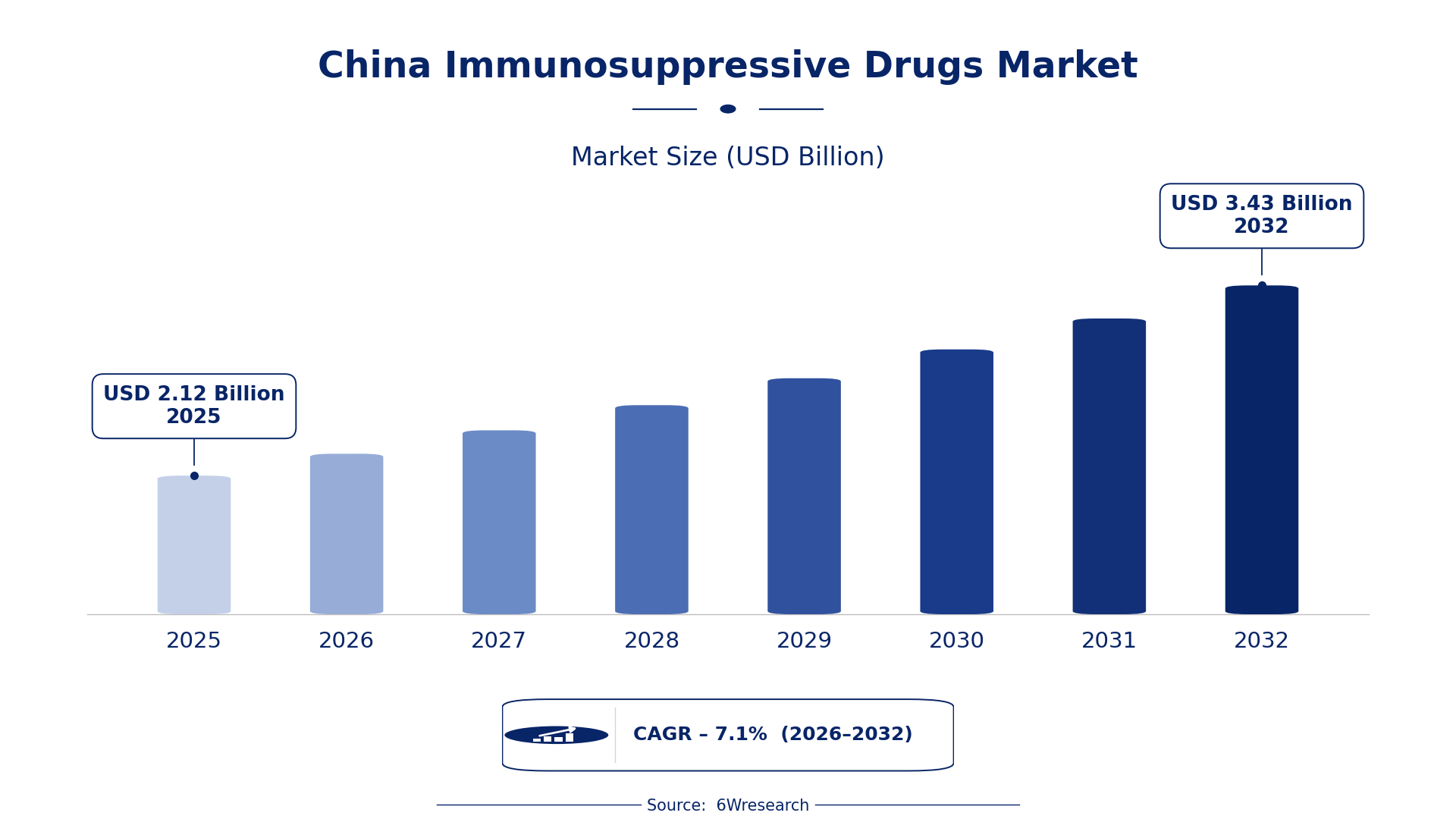
According to 6Wresearch internal database and industry insights, the China Immunosuppressive Drugs Market was valued at USD 2.12 billion in 2025 and is projected to reach USD 3.43 billion by 2032, growing at a CAGR of approximately 7.1% during 2026–2032.
China Immunosuppressive Drugs Market Highlights
| Report Metric | Details |
| Report Name | China Immunosuppressive Drugs Market |
| Market Size 2025 | USD 2.12 billion |
| Market Size 2032 | USD 3.43 billion |
| Absolute Growth 2025–2032 | USD 1.31 billion |
| CAGR 2026–2032 | 7.1% |
| Peak Annual Growth | 9.3% in 2031 |
| Forecast Period | 2026–2032 |
| Historical Data | 2022–2025 |
| Base Year | 2025 |
| Leading Drug Category, 2025 | Long-Term Immunosuppressants (46% share) |
| Leading Duration of Therapy, 2025 | Chronic Use (42% share) |
| Leading Formulation Type, 2025 | Injectable/Oral (43% share) |
| Leading End User, 2025 | Transplant Centers (53% share) |
| Fastest-Growing Drug Category | Combination Therapy (9.6% CAGR) |
| Fastest-Growing Duration of Therapy | Multi-Drug Regimens (9.0% CAGR) |
| Fastest-Growing Formulation Type | Extended-Release Tablets (8.9% CAGR) |
| Fastest-Growing End User | Autoimmune Disease Clinics (9.6% CAGR) |
| Growing Sector | Transplant Centers |
| Key End Users | Transplant Centers, Autoimmune Disease Clinics, Specialty Drug Clinics |
China Immunosuppressive Drugs Market Year-wise Growth Rate and Key Drivers (2022–2032)
This graph illustrates the annual growth rates of the market from 2022 to 2032, highlighting a steady upward trajectory and projected market expansion over the forecast period.
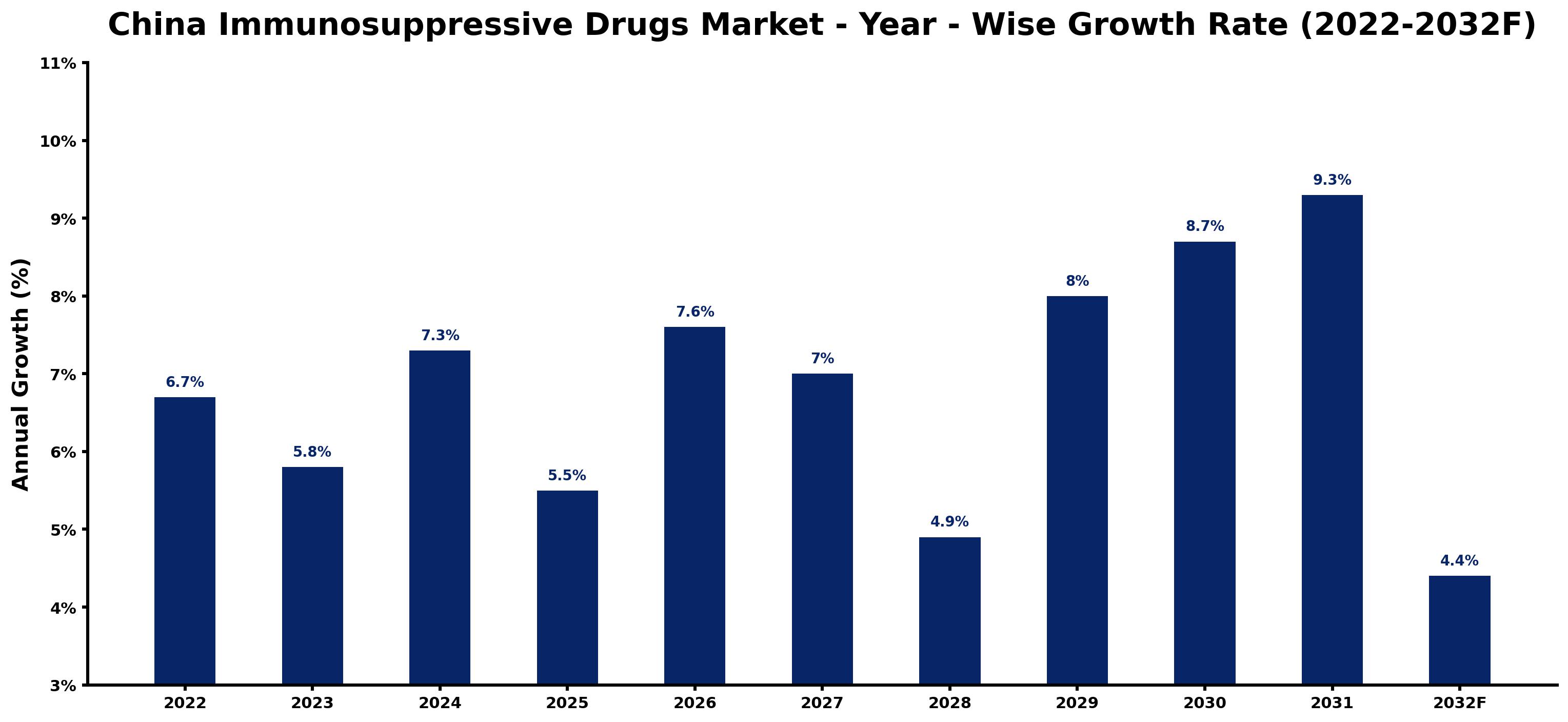
The following table presents the estimated annual growth rate for each year together with the principal factor influencing market performance.
| Year | Estimated Annual Growth (%) | Market Rationale |
| 2022 | 6.7 | The market experienced steady growth due to approximately 1.5 million organ transplant procedures performed annually. |
| 2023 | 5.8 | Growth slowed as the market adjusted to updated treatment protocols from the National Medical Products Administration. |
| 2024 | 7.3 | Increased transplant rates contributed to a faster growth rate this year, driven by over 300 accredited transplant centers. |
| 2025 | 5.5 | Growth slowed again as the market faced saturation in certain areas, particularly in long-term immunosuppressant usage. |
| 2026 | 7.6 | A rise in demand for long-term immunosuppressants drove growth higher, supported by over 4 million patients with autoimmune diseases. |
| 2027 | 7.0 | Growth slowed as the market stabilised after previous peaks in demand for immunosuppressive therapies. |
| 2028 | 4.9 | A slowdown in growth occurred as competition intensified among manufacturers of immunosuppressive drugs. |
| 2029 | 8.0 | Increased focus on autoimmune disease treatment boosted growth, driven by the Ministry of Health's awareness programs. |
| 2030 | 8.7 | Demand surged as new biologic therapies entered the market, enhancing treatment options for patients with chronic conditions. |
| 2031 | 9.3 | The market peaked due to heightened transplant activity and improved patient outcomes from updated guidelines. |
| 2032 | 4.4 | Growth slowed as the market matures and faces regulatory challenges from the National Medical Products Administration. |
Note: Market size estimations and growth projections presented in this report are based on 6Wresearch's proprietary forecasting methodology, utilizing the latest available industry data, government publications, and primary research inputs.
China Immunosuppressive Drugs Market Synopsis
Immunosuppressive Drugs in China are pharmaceutical agents that inhibit immune system activity, primarily used in organ transplantation and autoimmune diseases. These drugs are synthesized through chemical processes and come in various formulations. The China Immunosuppressive Drugs Market is expanding due to rising organ transplant rates and a high prevalence of autoimmune diseases, supported by over 300 accredited transplant centres. The average patient in transplant centres receives immunosuppressive therapy for five years post-surgery, driving demand for these critical medications.
Market Dynamics Impact Analysis (2026–2032)
| Factor | Type | Impact | Primary Segment Affected |
| Increasing organ transplant procedures drive demand for immunosuppressive drugs. | Driver | High | Long-Term Immunosuppressants |
| Growing prevalence of autoimmune diseases necessitates ongoing treatment options. | Driver | High | Chronic Use |
| Investment in research for biologic-based therapies presents new market opportunities. | Opportunity | High | Biologic-Based |
| The rising number of specialty drug clinics focusing on immunosuppressive therapies is expanding access. | Opportunity | Medium | Specialty Drug Clinics |
| High costs of immunosuppressive therapy can limit patient access. | Restraint | High | Long-Term Immunosuppressants |
| Regulatory hurdles for new drug approvals can delay market entry. | Restraint | Medium | Biologic-Based |
| Supply chain disruptions can impact the availability of essential drugs. | Challenge | High | Injectable/Oral |
| Competition among manufacturers can lead to pricing pressures. | Challenge | Medium | Combination Therapy |
Evaluation of Drivers in China Immunosuppressive Drugs Market (2026–2032)
The factors lifting demand, and the evidence behind each, are summarised below.
| Drivers | Primary Segment Affected | Why It Matters (Evidence) |
| Increased organ transplant procedures lead to higher demand for immunosuppressive drugs. | Long-Term Immunosuppressants | Approximately 1.5 million organ transplants were performed in China in 2022. |
| The rising prevalence of autoimmune diseases drives the need for long-term treatment. | Chronic Use | Over 4 million patients with autoimmune diseases were reported in 2021, necessitating ongoing therapy. |
| Investment in biologic-based therapies is increasing treatment options for patients. | Biologic-Based | The annual budget for immunosuppressive drug research is approximately 500 million CNY, enhancing development. |
| Specialty drug clinics are expanding access to immunosuppressive therapies. | Specialty Drug Clinics | In 2021, there were over 200 specialty drug clinics focusing on these therapies, improving patient access. |
| Increasing awareness of autoimmune diseases encourages more patients to seek treatment. | Autoimmune Disease Clinics | The Ministry of Health is implementing a program to increase awareness of these conditions, driving demand. |
Growth across the Immunosuppressive Drugs market in China is anchored in increasing end-use demand from transplant centres and autoimmune disease clinics. The number of organ transplants performed in 2022 reached approximately 1.5 million, necessitating long-term immunosuppressive therapy for patients. Over 4 million individuals were reported with autoimmune diseases in 2021, driving demand for chronic use medications. The establishment of over 200 specialty drug clinics is broadening access to these crucial therapies, encouraging more patients to seek necessary treatments. Increased investment in biologic-based therapies, supported by an annual research budget of around 500 million CNY, is expected to improve patient outcomes and treatment efficacy. This combination of factors is creating a vibrant growth environment for immunosuppressive drugs in China.
Evaluation of Restraints in China Immunosuppressive Drugs Market
The table below lists the restraints and the evidence behind each.
| Market Restraint | Primary Segment Affected | Why It Matters (Evidence) |
| High costs of immunosuppressive therapy can limit patient access. | Long-Term Immunosuppressants | The average cost of immunosuppressive therapy per patient is around 30,000 CNY annually. |
| Regulatory hurdles for new drug approvals can delay market entry. | Biologic-Based | The National Medical Products Administration oversees the approval of new immunosuppressive drugs, impacting time to market. |
| Supply chain disruptions can impact the availability of essential drugs. | Injectable/Oral | Manufacturers face challenges in sourcing raw materials due to global supply chain issues affecting production timelines. |
| Limited awareness of autoimmune diseases can hinder patient treatment. | Autoimmune Disease Clinics | Despite government initiatives, many patients remain unaware of available therapies, limiting treatment uptake. |
| Intense competition among manufacturers can lead to pricing pressures. | Combination Therapy | Market players often engage in aggressive pricing strategies to gain market share, affecting profitability. |
China Immunosuppressive Drugs Market Challenges
Hospitals in the China immunosuppressive drugs market face regulatory hurdles due to the stringent approval processes mandated by the National Medical Products Administration, leading to delays in drug availability that can extend patient waiting times by up to six months. Skills shortages in transplant centers hinder the effective administration of immunosuppressive therapies, potentially resulting in complications for over 1 million patients and increasing their recovery periods. Technology gaps in manufacturing processes create inconsistencies in drug quality, raising liability concerns for healthcare providers and jeopardising patient safety. Competition among producers is intense, driving down prices and limiting investment in research and development for new therapies, which can stall innovation.
Trends in the China Immunosuppressive Drugs Market
Buyers and suppliers in the China Immunosuppressive Drugs Market are adjusting to the following trends.
- Shift towards Biologic-Based Therapies: The market is experiencing a shift towards biologic-based immunosuppressive therapies, with new guidelines issued in 2023 to standardise their use. This change is projected to improve treatment efficacy and patient outcomes, particularly in transplant centres.
- Increase in Specialty Drug Clinics: The number of specialty drug clinics focusing on immunosuppressive therapies is growing, with over 200 clinics reported in 2021. This trend is improving patient access to targeted treatments, especially for autoimmune diseases.
- Growing Demand for Combination Therapy: Combination therapy is becoming more prevalent in treatment protocols, driven by its effectiveness in managing complex cases. This approach is gaining traction in transplant centres, where multi-drug regimens are common.
- Expansion of Transplant Centers: China's network of transplant centres is expanding, with over 300 accredited facilities. This growth supports the increasing number of organ transplants, further driving demand for immunosuppressive drugs.
Investment Opportunities in the China Immunosuppressive Drugs Market
The following opportunities in the China Immunosuppressive Drugs Market pair current demand with a clear way in.
- Investment in Biologic-Based Therapies: The growing focus on biologic-based therapies presents an investment opportunity, with an annual research budget of approximately 500 million CNY. Collaborating with research institutions can facilitate product development and improve treatment options for patients.
- Expansion of Specialty Drug Clinics: Now is an opportune time to invest in specialty drug clinics, as their number is increasing. Establishing partnerships with these clinics can facilitate access to a broader patient base and improve treatment outcomes.
- Development of Combination Therapies: The demand for combination therapies is rising, with a projected growth rate of 9.0% for Multi-Drug Regimens. Investing in research for these therapies can effectively meet the needs of complex cases and improve patient care.
- Enhancing Awareness Programs: With the Ministry of Health's initiatives to increase awareness of autoimmune diseases, there is an opportunity to develop educational programs. Engaging with healthcare providers can improve patient outreach and treatment adherence.
Government Initiatives in the China Immunosuppressive Drugs Market
In 2023, the "National Organ Transplant Development Plan" was launched by the National Health Commission to improve transplant services and patient outcomes. This plan builds on previous guidelines, aiming to standardise practices across the country and ensure better access to immunosuppressive therapies for patients post-transplant. The initiative is designed to enhance the quality of care and support the growing number of transplant procedures, with over 1.5 million surgeries performed annually. Additionally, the updated "Guidelines for the Use of Immunosuppressive Drugs" by the National Medical Products Administration in 2021 standardise treatment protocols, ensuring consistent care for patients.
The National Medical Products Administration oversees the approval of new immunosuppressive drugs, ensuring they meet national standards. In 2022, a subsidy program was initiated to assist patients requiring long-term immunosuppressive therapy, reducing their financial burden. This program aims to increase patient adherence to treatment protocols, thereby improving health outcomes and quality of life for those affected by autoimmune diseases. The agency also funds research initiatives to support the development of innovative therapies, enhancing treatment options available to healthcare providers.
Future Insight of the China Immunosuppressive Drugs Market
The China immunosuppressive drugs market will undergo notable changes by 2032, driven by several pivotal factors. The "National Organ Transplant Development Plan" will enhance transplant services, likely increasing the demand for immunosuppressive therapies across hospitals. With over 4 million patients suffering from autoimmune diseases, healthcare providers will need to expand their treatment capabilities to meet rising needs. The annual budget for immunosuppressive drug research is projected to grow, facilitating advancements in drug formulation and improving patient outcomes. The prevalence of kidney transplants is anticipated to rise by 10% annually, further amplifying the demand for effective immunosuppressive treatments.
Market Segmentation Analysis
The analysis below covers each segmentation, its leading category in 2025 and its fastest-growing category through 2032.
By Drug Category – Long-Term Immunosuppressants Dominated, Combination Therapy Expected to Grow Fastest
According to Sachin Kumar Rai, Senior Research Analyst at 6Wresearch, Long-Term Immunosuppressants took a 46% share of drug category in 2025, more than any other category. Long-Term Immunosuppressants dominate the market due to their critical role in managing patients post-organ transplantation. With approximately 1.5 million organ transplants performed in China in 2022, this category serves a substantial installed base of patients requiring ongoing therapy. Over 2026–2032, Combination Therapy is expected to post the fastest growth, at a CAGR of 9.6%. Combination Therapy is experiencing rapid growth as it is increasingly recognised for its efficacy when used alongside other medications. The government's focus on improving transplant services is likely to further boost this segment's adoption. Suppliers should prioritise the development of Combination Therapy options to meet the rising demand from healthcare providers.
By Duration of Therapy – Chronic Use Dominated, Multi-Drug Regimens Expected to Grow Fastest
In 2025, Chronic Use led the duration of therapy split with a 42% share. Chronic Use holds the largest share as it is essential for the ongoing treatment of patients with long-term conditions. With over 4 million individuals diagnosed with autoimmune diseases in China, the necessity for continuous therapy is clear. Multi-Drug Regimens are set to record the highest CAGR in this split, 9.0% over 2026–2032. Multi-Drug Regimens are witnessing rapid growth due to their comprehensive approach to immune management. The establishment of more specialty clinics focusing on immunosuppressive therapies indicates a shift towards integrated treatment strategies, further driving this segment's expansion. Suppliers should consider offering Multi-Drug Regimens to enhance treatment efficacy for chronic conditions.
By Formulation Type – Injectable/Oral Dominated, Extended-Release Tablets Expected to Grow Fastest
Injectable/Oral held a 43% share of the China Immunosuppressive Drugs Market by formulation type in 2025. Injectable/Oral formulations dominate the market because they offer various forms that improve patient convenience and accessibility. The adherence to national standards by regulatory bodies ensures these formulations are reliable and trusted by healthcare providers. Extended-Release Tablets are projected to grow fastest, at a CAGR of 8.9% during 2026–2032. Extended-Release Tablets are gaining traction as they provide stable dosing, which is crucial for patient adherence over time. The increasing demand for long-term immunosuppressants in treatment protocols is propelling this segment's growth. Suppliers should prioritise the development of Extended-Release formulations to cater to patients needing consistent dosing.
By End User – Transplant Centers Dominated, Autoimmune Disease Clinics Expected to Grow Fastest
Transplant Centers accounted for a 53% market share by end user in 2025. Transplant Centers are the primary users of immunosuppressive drugs, as they manage post-operative care for organ transplant patients. With over 300 accredited transplant centres in China, this segment commands a substantial market share. The quickest growth will come from Autoimmune Disease Clinics, forecast to expand at a CAGR of 9.6% between 2026 and 2032. Autoimmune Disease Clinics are rapidly growing as they focus on managing chronic conditions. The Ministry of Health's initiatives to raise awareness about autoimmune diseases are expected to further accelerate growth in this segment. Healthcare providers should enhance partnerships with Autoimmune Disease Clinics to improve patient care and treatment access.
Key Attractiveness of the Report
- 10 Years of Market Numbers
- Historical Data Starting from 2022 to 2025
- Base Year 2025
- Forecast Data until 2032
- Key Performance Indicators Impacting the Market
- Major Upcoming Developments and Projects
Key Highlights of the Report:
- China Immunosuppressive Drugs Market Outlook
- Market Size of China Immunosuppressive Drugs Market, 2025
- Forecast of China Immunosuppressive Drugs Market, 2032
- Historical Data and Forecast of China Immunosuppressive Drugs Revenues & Volume for the Period 2022 - 2032F
- China Immunosuppressive Drugs Market Trend Evolution
- China Immunosuppressive Drugs Market Drivers and Challenges
- China Immunosuppressive Drugs Price Trends
- China Immunosuppressive Drugs Porter's Five Forces
- China Immunosuppressive Drugs Industry Life Cycle
- Historical Data and Forecast of China Immunosuppressive Drugs Market Revenues & Volume By Drug Category for the Period 2022 - 2032F
- Historical Data and Forecast of China Immunosuppressive Drugs Market Revenues & Volume By Short-Term Steroids for the Period 2022 - 2032F
- Historical Data and Forecast of China Immunosuppressive Drugs Market Revenues & Volume By Long-Term Immunosuppressants for the Period 2022 - 2032F
- Historical Data and Forecast of China Immunosuppressive Drugs Market Revenues & Volume By Combination Therapy for the Period 2022 - 2032F
- Historical Data and Forecast of China Immunosuppressive Drugs Market Revenues & Volume By Biologic-Based for the Period 2022 - 2032F
- Historical Data and Forecast of China Immunosuppressive Drugs Market Revenues & Volume By Duration of Therapy for the Period 2022 - 2032F
- Historical Data and Forecast of China Immunosuppressive Drugs Market Revenues & Volume By Acute Flare-Ups for the Period 2022 - 2032F
- Historical Data and Forecast of China Immunosuppressive Drugs Market Revenues & Volume By Chronic Use for the Period 2022 - 2032F
- Historical Data and Forecast of China Immunosuppressive Drugs Market Revenues & Volume By Multi-Drug Regimens for the Period 2022 - 2032F
- Historical Data and Forecast of China Immunosuppressive Drugs Market Revenues & Volume By Selective Immune Modulation for the Period 2022 - 2032F
- Historical Data and Forecast of China Immunosuppressive Drugs Market Revenues & Volume By Formulation Type for the Period 2022 - 2032F
- Historical Data and Forecast of China Immunosuppressive Drugs Market Revenues & Volume By Injectable/Oral for the Period 2022 - 2032F
- Historical Data and Forecast of China Immunosuppressive Drugs Market Revenues & Volume By Extended-Release Tablets for the Period 2022 - 2032F
- Historical Data and Forecast of China Immunosuppressive Drugs Market Revenues & Volume By Fixed Dose Combinations for the Period 2022 - 2032F
- Historical Data and Forecast of China Immunosuppressive Drugs Market Revenues & Volume By Subcutaneous Injection for the Period 2022 - 2032F
- Historical Data and Forecast of China Immunosuppressive Drugs Market Revenues & Volume By End User for the Period 2022 - 2032F
- Historical Data and Forecast of China Immunosuppressive Drugs Market Revenues & Volume By Emergency Care Units for the Period 2022 - 2032F
- Historical Data and Forecast of China Immunosuppressive Drugs Market Revenues & Volume By Transplant Centers for the Period 2022 - 2032F
- Historical Data and Forecast of China Immunosuppressive Drugs Market Revenues & Volume By Autoimmune Disease Clinics for the Period 2022 - 2032F
- Historical Data and Forecast of China Immunosuppressive Drugs Market Revenues & Volume By Specialty Drug Clinics for the Period 2022 - 2032F
- China Immunosuppressive Drugs Import Export Trade Statistics
- Market Opportunity Assessment By Drug Category
- Market Opportunity Assessment By Duration of Therapy
- Market Opportunity Assessment By Formulation Type
- Market Opportunity Assessment By End User
- China Immunosuppressive Drugs Top Companies Market Share
- China Immunosuppressive Drugs Competitive Benchmarking By Technical and Operational Parameters
- China Immunosuppressive Drugs Company Profiles
- China Immunosuppressive Drugs Key Strategic Recommendations
Market Covered
Segments analysed in this report are listed below.
By Drug Category
- Short-Term Steroids
- Long-Term Immunosuppressants
- Combination Therapy
- Biologic-Based
By Duration of Therapy
- Acute Flare-Ups
- Chronic Use
- Multi-Drug Regimens
- Selective Immune Modulation
By Formulation Type
- Injectable/Oral
- Extended-Release Tablets
- Fixed Dose Combinations
- Subcutaneous Injection
By End User
- Emergency Care Units
- Transplant Centers
- Autoimmune Disease Clinics
- Specialty Drug Clinics































