China Indoor Entertainment Market Size & Growth Rate
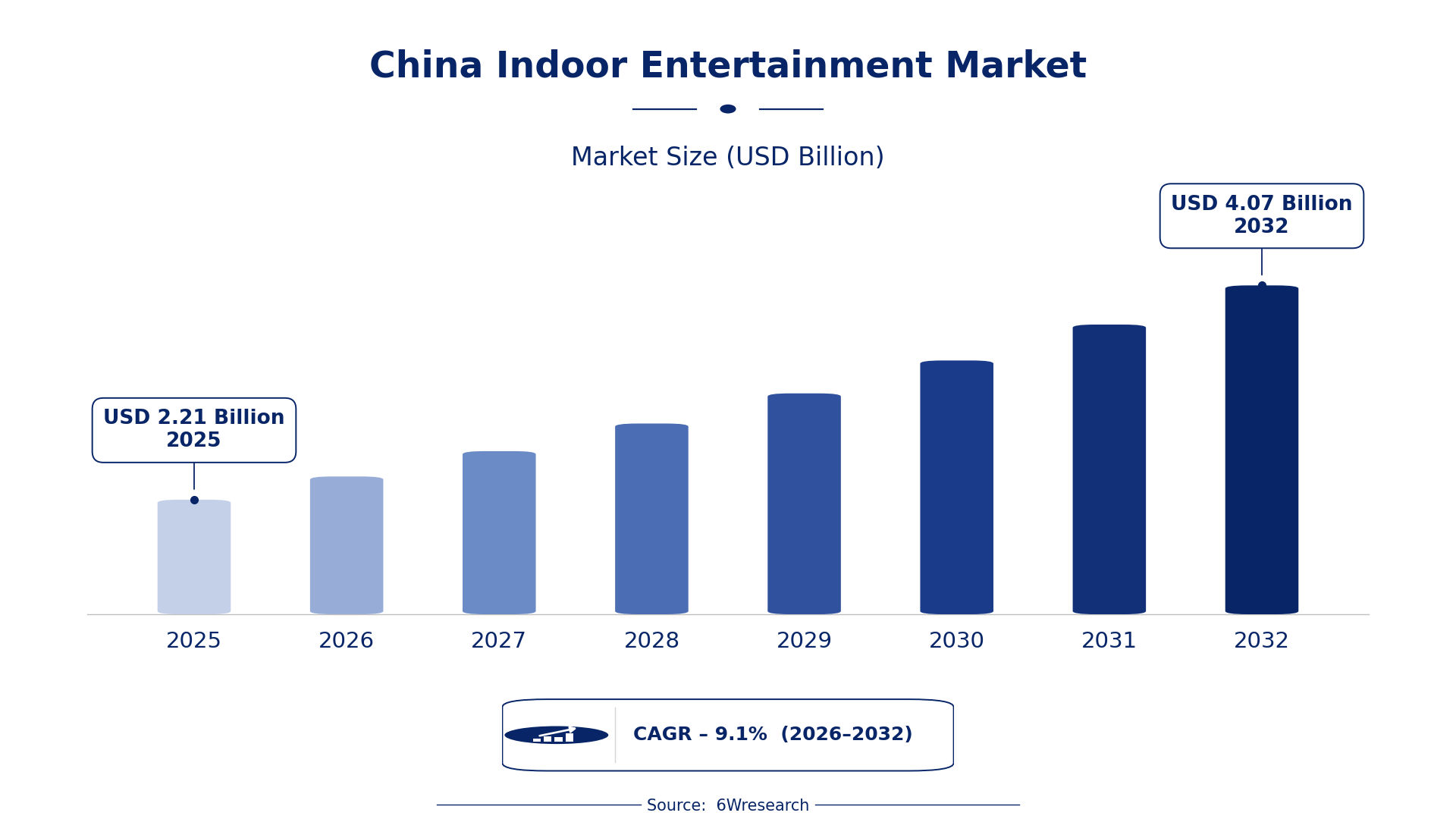
According to 6Wresearch internal database and industry insights, the China Indoor Entertainment Market was valued at USD 2.21 billion in 2025 and is projected to reach USD 4.07 billion by 2032, growing at a CAGR of approximately 9.1% during 2026–2032.
China Indoor Entertainment Market Highlights
| Report Metric | Details |
| Report Name | China Indoor Entertainment Market |
| Market Size 2025 | USD 2.21 billion |
| Market Size 2032 | USD 4.07 billion |
| Absolute Growth 2025–2032 | USD 1.86 billion |
| CAGR 2026–2032 | 9.1% |
| Peak Annual Growth | 11.6% in 2027 |
| Forecast Period | 2026–2032 |
| Historical Data | 2022–2025 |
| Base Year | 2025 |
| Leading Entertainment Type, 2025 | Indoor Theme Parks (44% share) |
| Leading Venue Type, 2025 | Urban Malls (40% share) |
| Leading Content Type, 2025 | VR Games (43% share) |
| Leading End User, 2025 | Gaming Arcades (34% share) |
| Fastest-Growing Entertainment Type | Virtual Reality Zones (10.2% CAGR) |
| Fastest-Growing Venue Type | Game Centers (11.4% CAGR) |
| Fastest-Growing Content Type | Edutainment (10.8% CAGR) |
| Growing Sector | Indoor Theme Parks |
| Key End Users | Families, Educational Institutions, Urban Malls, Game Centers |
China Indoor Entertainment Market Year-wise Growth Rate and Key Drivers (2022–2032)
This graph illustrates the annual growth rates of the market from 2022 to 2032, highlighting a steady upward trajectory and projected market expansion over the forecast period.
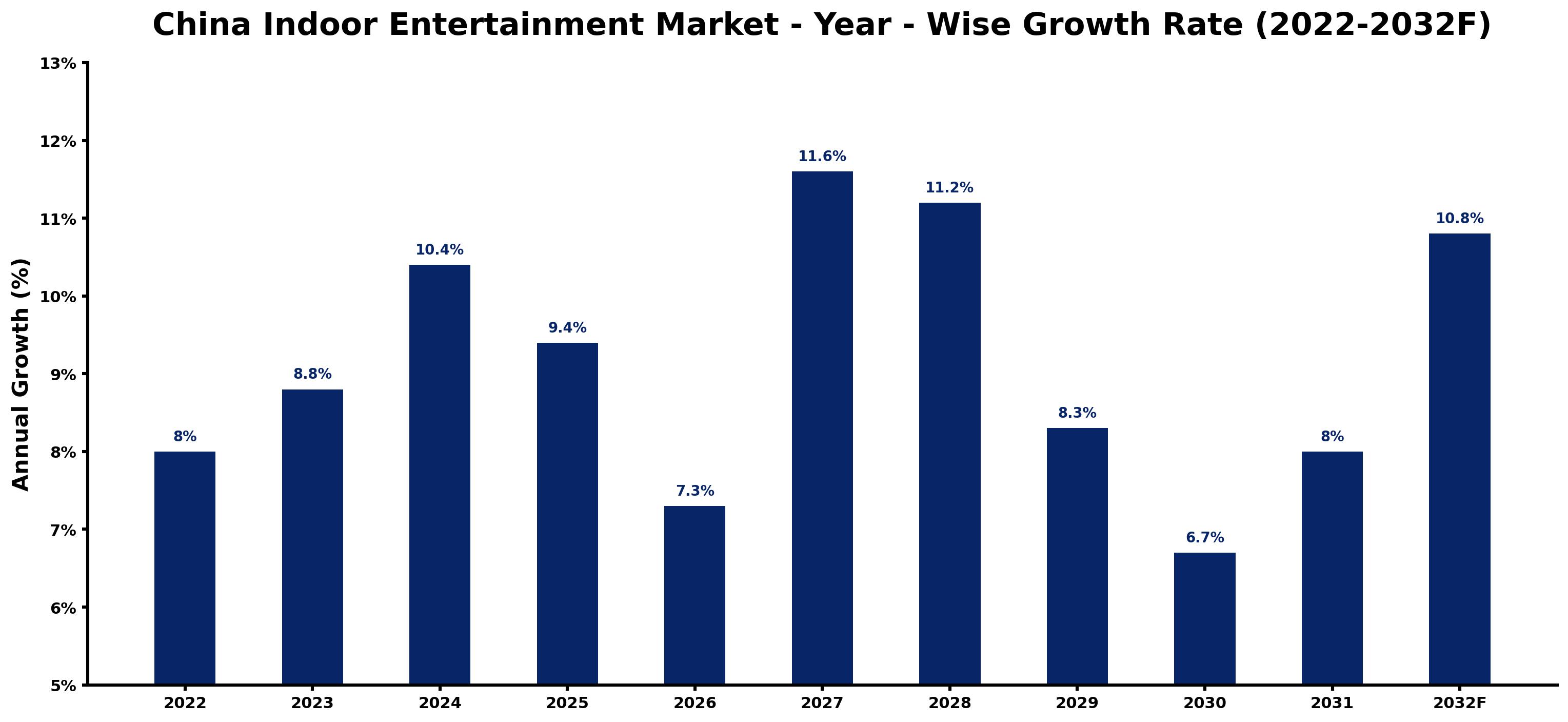
Annual growth estimates for each year appear below with the principal reason behind them, explaining the shifts that set the pace of the market.
| Year | Estimated Annual Growth (%) | Market Rationale |
| 2022 | 8.0 | The market experienced steady growth due to increasing urban population density. |
| 2023 | 8.8 | Demand accelerated as urban families sought more leisure activities. |
| 2024 | 10.4 | The rise in disposable income contributed to higher spending on entertainment. |
| 2025 | 9.4 | Growth slowed slightly as market adjustments took place. |
| 2026 | 7.3 | A further slowdown occurred as competition intensified in urban areas. |
| 2027 | 11.6 | The market rebounded with a surge in VR technology adoption. |
| 2028 | 11.2 | Demand remained strong, supported by new entertainment offerings. |
| 2029 | 8.3 | Growth slowed again as consumer preferences began to shift. |
| 2030 | 6.7 | The market continued to grow, albeit at a slower pace. |
| 2031 | 8.0 | Increased interest in gaming arcades boosted market performance. |
| 2032 | 10.8 | A resurgence in family-oriented entertainment options spurred growth. |
Note: Market size estimations and growth projections presented in this report are based on 6Wresearch's proprietary forecasting methodology, utilizing the latest available industry data, government publications, and primary research inputs.
China Indoor Entertainment Market Synopsis
Indoor Entertainment in China includes a variety of leisure activities, such as virtual reality zones and indoor theme parks. These venues leverage cutting-edge technology to improve user experiences. The China Indoor Entertainment Market is expanding due to increasing urban populations and a growing middle class. Families are on the lookout for leisure activities, resulting in higher spending. The average annual expenditure on indoor entertainment per family is around 5,000 CNY, demonstrating robust demand.
Market Dynamics Impact Analysis (2026–2032)
| Factor | Type | Impact | Primary Segment Affected |
| Growing urban population density driving demand for leisure activities | Driver | High | Indoor Theme Parks |
| Increased disposable income leading to higher spending on entertainment | Driver | High | Gaming Arcades |
| Rising interest in educational entertainment among families | Opportunity | Medium | Edutainment |
| Expansion of VR technology creating new entertainment experiences | Opportunity | High | Virtual Reality Zones |
| Intense competition among entertainment venues limiting profit margins | Restraint | High | Game Centers |
| Regulatory compliance costs for safety standards in amusement parks | Restraint | Medium | Indoor Theme Parks |
| Infrastructure limitations in less developed urban areas | Challenge | High | Urban Malls |
| Changing consumer preferences affecting traditional entertainment venues | Challenge | Medium | Bowling Alleys |
Evaluation of Drivers in China Indoor Entertainment Market (2026–2032)
The factors lifting demand, and the evidence behind each, are summarised below.
| Drivers | Primary Segment Affected | Why It Matters (Evidence) |
| Increased investment in urban entertainment facilities | Indoor Theme Parks | The average annual spending on indoor entertainment per family is approximately 5,000 CNY, encouraging new developments in urban areas. |
| Rising demand for family-oriented leisure activities | Gaming Arcades | Major urban areas host the highest concentration of gaming arcades, attracting more visitors and increasing revenue. |
| Expansion of VR technology in entertainment venues | Virtual Reality Zones | The government announced a plan to support the development of VR technology in entertainment, targeting a 30% increase in VR facilities by 2025. |
| Growing popularity of interactive experiences among visitors | Interactive Museums | Interactive museums have seen a 20% rise in attendance since 2021, indicating strong demand for engaging experiences among families. |
| Increased integration of entertainment in urban malls | Urban Malls | Indoor entertainment facilities are increasingly being integrated into urban malls to attract visitors and boost foot traffic. |
Growth in the Indoor Entertainment market in China comes from increased investment in urban entertainment facilities, driven by rising disposable incomes and family-oriented leisure activities. The average annual spending on indoor entertainment per family is approximately 5,000 CNY, which stimulates new developments in urban areas. Urban centres are experiencing a surge in gaming arcades, attracting more visitors and boosting revenues. Interactive museums have seen a 20% rise in attendance since 2021, reflecting a growing demand for engaging experiences among consumers.
Evaluation of Restraints in China Indoor Entertainment Market
The table below lists the restraints and the evidence behind each.
| Market Restraint | Primary Segment Affected | Why It Matters (Evidence) |
| Intense competition limiting profit margins | Game Centers | The rapid growth of entertainment venues has led to increased competition, affecting profitability for existing operators. |
| High compliance costs for safety regulations | Indoor Theme Parks | Producers must invest in safety certifications due to revised National Standards for Indoor Amusement Parks, increasing operational costs. |
| Infrastructure challenges in less developed urban areas | Urban Malls | Limited infrastructure in smaller cities restricts the establishment of new entertainment venues, hindering market expansion. |
| Changing consumer preferences impacting traditional venues | Bowling Alleys | As consumer interests shift towards newer entertainment forms, traditional venues like bowling alleys see declining patronage. |
| Economic fluctuations affecting discretionary spending | Gaming Arcades | Economic downturns can lead to reduced spending on leisure activities, impacting revenues for gaming arcades. |
China Indoor Entertainment Market Challenges
Buyers in the China indoor entertainment market encounter technological limitations, as many venues lack advanced VR systems, which reduces visitor engagement and impacts potential revenue. Competition escalates with the swift emergence of new facilities in urban centres, compelling established operators to lower prices, affecting profitability. Urban families are feeling financial pressure, with average annual spending on indoor entertainment at 5,000 CNY, leading to fewer outings and less leisure enjoyment. Supply chain disruptions hinder the acquisition of essential equipment, resulting in operational inefficiencies and delays in opening new attractions for producers.
Trends in the China Indoor Entertainment Market
Buyers and suppliers in the China Indoor Entertainment Market are adjusting to the following trends.
- Shift towards VR Experiences in Major Cities: Urban centres in China are moving towards virtual reality experiences, especially in cities like Beijing. Government support for VR technology aims for a 30% increase in facilities by 2025, boosting consumer engagement.
- Growth of Edutainment in Schools: The 'Edutainment in Schools' programme initiated by the Ministry of Education in 2021 is promoting educational entertainment. This initiative has resulted in a 15% rise in participation in educational entertainment activities, appealing to families.
- Rise of Interactive Museums: Interactive museums are gaining popularity, with a 20% increase in attendance since 2021. These venues captivate visitors through hands-on exhibits, attracting families and educational groups seeking interactive experiences.
- Integration of Entertainment in Urban Malls: Urban malls are now adding entertainment options to draw in visitors. This trend is apparent in major cities, where indoor entertainment facilities are incorporated to increase foot traffic and improve customer engagement.
Investment Opportunities in the China Indoor Entertainment Market
Several openings in the China Indoor Entertainment Market merit attention from investors.
- Timing for Investment in VR Technology: With a projected 30% increase in VR facilities by 2025, there is a prime opportunity for investment in VR technology. Urban families are keen for new entertainment experiences that utilise advanced technology.
- Entry through Joint Ventures in Urban Areas: Forming joint ventures with local operators can ease entry into the expanding indoor entertainment sector. Major urban centres like Shanghai are ideal for such partnerships, offering access to a large consumer base.
- Growing Demand from Educational Institutions: Schools are increasingly seeking educational entertainment options, creating a demand for edutainment facilities. The 'Edutainment in Schools' programme highlights this opportunity for new developments in educational entertainment.
- Gap in Family-Oriented Entertainment Options: The average annual spending on indoor entertainment per family is approximately 5,000 CNY, indicating a gap for new family-oriented entertainment venues in urban areas. This presents an opportunity for developers to meet family needs.
Government Initiatives in the China Indoor Entertainment Market
The 'Digital Economy Development Strategy' approved in 2022 by the State Council encourages the growth of VR technology in entertainment. This strategy aims to increase VR facilities by 30% by 2025, supporting the overall development of indoor entertainment sectors. It builds on the 'Cultural and Creative Industry Development Plan' launched in 2020, which promotes the growth of entertainment sectors across urban areas.
The Ministry of Culture and Tourism oversees the implementation of various programmes, including funding for safety improvements in amusement parks. The 'Edutainment in Schools' programme launched in 2021 aims to integrate entertainment into educational settings, providing funding for interactive learning experiences and increasing engagement among students.
Future Insight of the China Indoor Entertainment Market
The indoor entertainment market in China is poised for considerable evolution by 2032, driven by advancements in VR technology and supportive government initiatives. The Ministry of Education's 'Edutainment in Schools' programme will broaden educational entertainment options, promoting interactive experiences for families. Urban malls will increasingly feature indoor entertainment venues, attracting more visitors and boosting engagement. By 2025, over 300 indoor theme parks are anticipated to operate, reflecting the rising demand for diverse leisure activities among urban populations.
Market Segmentation Analysis
The report offers a comprehensive study of the following market segments and their leading categories in the market.
By Entertainment Type – Indoor Theme Parks Dominated, Virtual Reality Zones Expected to Grow Fastest
According to Sachin Kumar Rai, Senior Research Analyst at 6Wresearch, in 2025, Indoor Theme Parks led the entertainment type split with a 44% share. Indoor theme parks dominate the market share as they cater to families seeking a variety of entertainment options. With over 300 theme parks operating across major cities, they effectively attract urban populations looking for leisure activities. Virtual Reality Zones are set to record the highest CAGR in this split, 10.2% over 2026–2032. Virtual reality zones are rapidly expanding due to their ability to provide immersive experiences that appeal to tech-savvy consumers. The government's commitment to supporting VR technology further accelerates this segment's growth. Suppliers should prioritise the development of VR offerings to meet the increasing demand for immersive entertainment experiences.
By Venue Type – Urban Malls Dominated, Game Centers Expected to Grow Fastest
With a 40% revenue share in 2025, Urban Malls was the largest venue type category. Urban malls dominate the market as they integrate entertainment options to attract foot traffic while primarily serving retail needs. Their strategic locations in densely populated areas make them ideal venues for indoor entertainment. Over 2026–2032, Game Centers are expected to post the fastest growth, at a CAGR of 11.4%. Game centers are rapidly gaining popularity as social hubs for entertainment, appealing to younger demographics seeking interactive experiences. Their ability to provide a casual environment for socialising drives their growth. Buyers should consider the potential of game centers as key venues for social interaction and entertainment in urban settings.
By Content Type – VR Games Dominated, Edutainment Expected to Grow Fastest
VR Games took a 43% share of content type in 2025, more than any other category. VR games dominate the market share in content type due to their immersive experiences that captivate audiences in entertainment venues. The increasing number of VR installations in major urban centres like Beijing and Shanghai underscores their strong position in the indoor entertainment landscape. The quickest growth will come from Edutainment, forecast to expand at a CAGR of 10.8% between 2026 and 2032. Edutainment is experiencing rapid growth as it effectively blends learning with fun, appealing to families looking for enriching activities. The 'Edutainment in Schools' programme launched in 2021 has significantly boosted interest and participation in educational entertainment. This trend indicates that suppliers should prioritise the development of edutainment offerings to meet the rising demand for educational experiences within the indoor entertainment market.
By End User – Gaming Arcades Dominated and Is Expected to Record the Fastest Growth
Gaming Arcades held a 34% share of the China Indoor Entertainment Market by end user in 2025. Gaming arcades maintain the largest share as they are a staple for casual gamers, providing a social atmosphere that encourages interaction. Their established presence in urban areas ensures a consistent customer base. Its lead should widen, with a projected CAGR of 10.2% during 2026–2032, the highest in this split. Gaming arcades are also the fastest-growing segment, as their appeal to social gamers continues to expand. The combination of nostalgia and modern gaming experiences keeps them relevant and in demand. Suppliers must recognise the enduring popularity of gaming arcades and adapt their offerings to sustain growth in this vibrant segment.
Key Attractiveness of the Report
- 10 Years of Market Numbers
- Historical Data Starting from 2022 to 2025
- Base Year 2025
- Forecast Data until 2032
- Key Performance Indicators Impacting the Market
- Major Upcoming Developments and Projects
Key Highlights of the Report:
- China Indoor Entertainment Market Outlook
- Market Size of China Indoor Entertainment Market, 2025
- Forecast of China Indoor Entertainment Market, 2032
- Historical Data and Forecast of China Indoor Entertainment Revenues & Volume for the Period 2022 - 2032F
- China Indoor Entertainment Market Trend Evolution
- China Indoor Entertainment Market Drivers and Challenges
- China Indoor Entertainment Price Trends
- China Indoor Entertainment Porter's Five Forces
- China Indoor Entertainment Industry Life Cycle
- Historical Data and Forecast of China Indoor Entertainment Market Revenues & Volume By Entertainment Type for the Period 2022 - 2032F
- Historical Data and Forecast of China Indoor Entertainment Market Revenues & Volume By Virtual Reality Zones for the Period 2022 - 2032F
- Historical Data and Forecast of China Indoor Entertainment Market Revenues & Volume By Bowling Alleys for the Period 2022 - 2032F
- Historical Data and Forecast of China Indoor Entertainment Market Revenues & Volume By Interactive Museums for the Period 2022 - 2032F
- Historical Data and Forecast of China Indoor Entertainment Market Revenues & Volume By Indoor Theme Parks for the Period 2022 - 2032F
- Historical Data and Forecast of China Indoor Entertainment Market Revenues & Volume By Venue Type for the Period 2022 - 2032F
- Historical Data and Forecast of China Indoor Entertainment Market Revenues & Volume By Game Centers for the Period 2022 - 2032F
- Historical Data and Forecast of China Indoor Entertainment Market Revenues & Volume By Urban Malls for the Period 2022 - 2032F
- Historical Data and Forecast of China Indoor Entertainment Market Revenues & Volume By Public Institutions for the Period 2022 - 2032F
- Historical Data and Forecast of China Indoor Entertainment Market Revenues & Volume By Resorts for the Period 2022 - 2032F
- Historical Data and Forecast of China Indoor Entertainment Market Revenues & Volume By Content Type for the Period 2022 - 2032F
- Historical Data and Forecast of China Indoor Entertainment Market Revenues & Volume By VR Games for the Period 2022 - 2032F
- Historical Data and Forecast of China Indoor Entertainment Market Revenues & Volume By Physical Games for the Period 2022 - 2032F
- Historical Data and Forecast of China Indoor Entertainment Market Revenues & Volume By Edutainment for the Period 2022 - 2032F
- Historical Data and Forecast of China Indoor Entertainment Market Revenues & Volume By Rides & Augmented Media for the Period 2022 - 2032F
- Historical Data and Forecast of China Indoor Entertainment Market Revenues & Volume By End User for the Period 2022 - 2032F
- Historical Data and Forecast of China Indoor Entertainment Market Revenues & Volume By Gaming Arcades for the Period 2022 - 2032F
- Historical Data and Forecast of China Indoor Entertainment Market Revenues & Volume By Commercial Real Estate for the Period 2022 - 2032F
- Historical Data and Forecast of China Indoor Entertainment Market Revenues & Volume By City Planners for the Period 2022 - 2032F
- Historical Data and Forecast of China Indoor Entertainment Market Revenues & Volume By Hospitality Industry for the Period 2022 - 2032F
- China Indoor Entertainment Import Export Trade Statistics
- Market Opportunity Assessment By Entertainment Type
- Market Opportunity Assessment By Venue Type
- Market Opportunity Assessment By Content Type
- Market Opportunity Assessment By End User
- China Indoor Entertainment Top Companies Market Share
- China Indoor Entertainment Competitive Benchmarking By Technical and Operational Parameters
- China Indoor Entertainment Company Profiles
- China Indoor Entertainment Key Strategic Recommendations
Market Covered
The report offers an extensive study of the following market segments.
By Entertainment Type
- Virtual Reality Zones
- Bowling Alleys
- Interactive Museums
- Indoor Theme Parks
By Venue Type
- Game Centers
- Urban Malls
- Public Institutions
- Resorts
By Content Type
- VR Games
- Physical Games
- Edutainment
- Rides & Augmented Media
By End User
- Gaming Arcades
- Commercial Real Estate
- City Planners
- Hospitality Industry































