China Space Apparel Market Size & Growth Rate
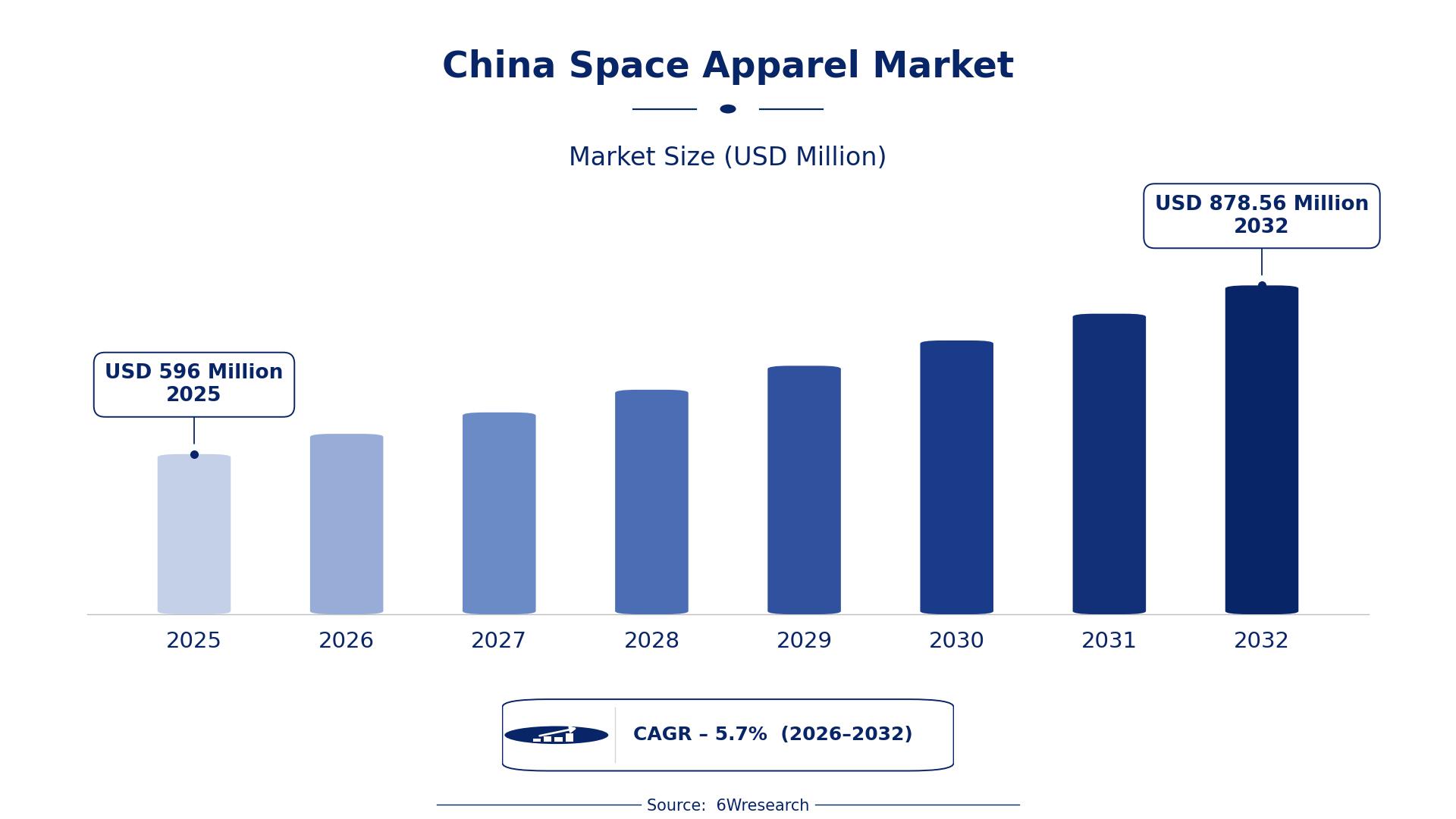
According to 6Wresearch internal database and industry insights, the China Space Apparel Market was valued at USD 596.0 million in 2025 and is projected to reach USD 878.56 million by 2032, growing at a CAGR of approximately 5.7% during 2026–2032.
China Space Apparel Market Highlights
| Report Metric | Details |
| Report Name | China Space Apparel Market |
| Market Size 2025 | USD 596.0 million |
| Market Size 2032 | USD 878.56 million |
| Absolute Growth 2025–2032 | USD 282.56 million |
| CAGR 2026–2032 | 5.7% |
| Peak Annual Growth | 7.6% in 2026 |
| Forecast Period | 2026–2032 |
| Historical Data | 2022–2025 |
| Base Year | 2025 |
| Leading Apparel Type, 2025 | Pressurized Suits (33% share) |
| Leading Functionality, 2025 | Life Support (52% share) |
| Leading Material Composition, 2025 | Multi-layer Laminates (45% share) |
| Leading End User, 2025 | Space Agencies (41% share) |
| Fastest-Growing Apparel Type | Mission-Specific Gear (7.7% CAGR) |
| Fastest-Growing Functionality | Mobility & Storage (8.2% CAGR) |
| Fastest-Growing Material Composition | Phase Change Materials (6.7% CAGR) |
| Fastest-Growing End User | Private Space Companies (7.6% CAGR) |
| Growing Sector | Space Exploration |
| Key End Users | Space Agencies, Astronauts, Private Space Companies, Space Research Centers |
China Space Apparel Market Year-wise Growth Rate and Key Drivers (2022–2032)
This graph illustrates the annual growth rates of the market from 2022 to 2032, highlighting a steady upward trajectory and projected market expansion over the forecast period.
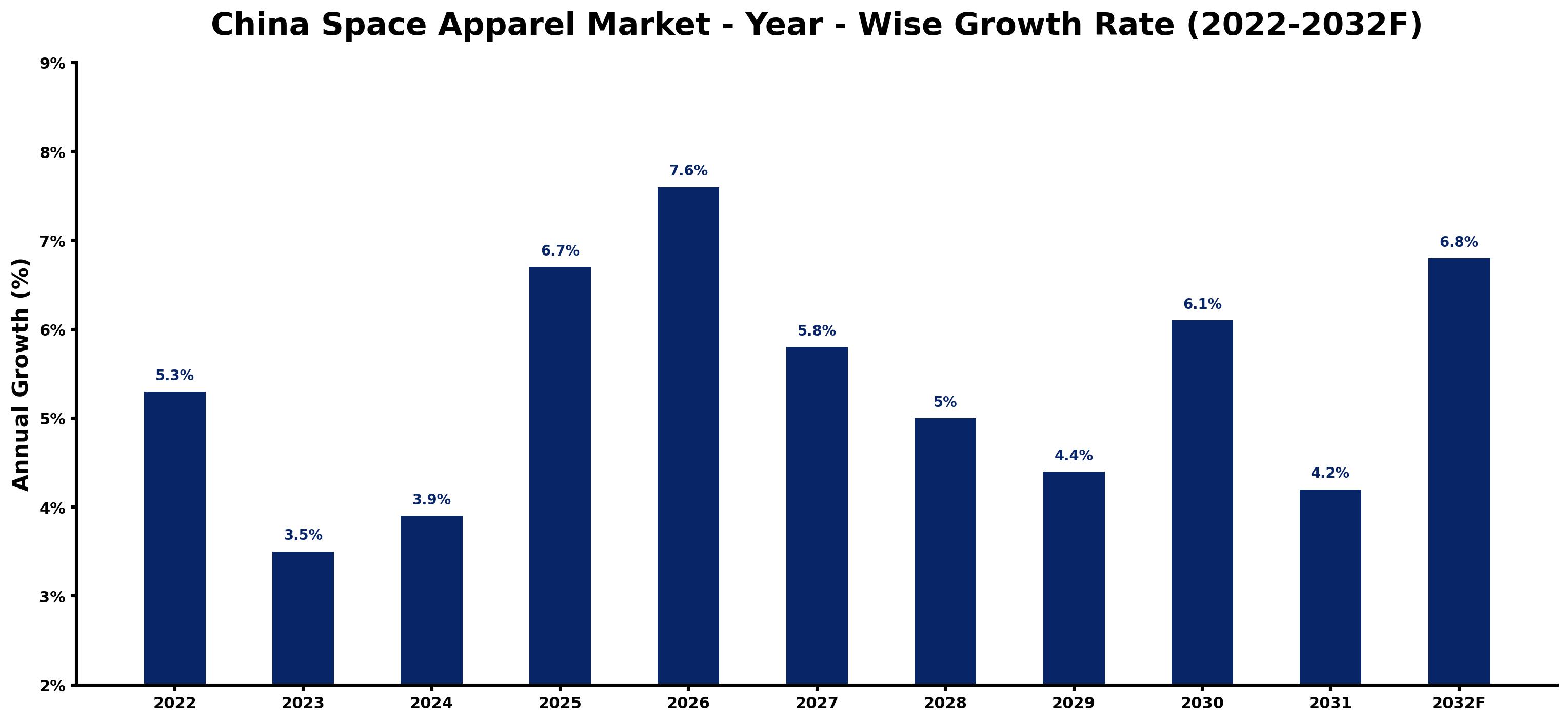
The table below sets out the estimated growth rate for each year and the main factor behind it.
| Year | Estimated Annual Growth (%) | Market Rationale |
| 2022 | 5.3 | The market experienced stable growth, driven by ongoing space missions and research initiatives. |
| 2023 | 3.5 | Growth slowed due to the completion of major projects, yet demand remained strong from space agencies. |
| 2024 | 3.9 | Increased investments in space exploration led to a rise in demand for advanced apparel for astronauts. |
| 2025 | 6.7 | The Chang'e lunar program boosted demand for specialized suits, enhancing procurement efforts. |
| 2026 | 7.6 | Peak growth is expected to be driven by the launch of new astronaut training initiatives in 2026. |
| 2027 | 5.8 | Demand growth is projected to slow as the market adjusts to previous expansions and investments. |
| 2028 | 5.0 | Continued focus on safety standards is expected to contribute to a further slowdown in growth. |
| 2029 | 4.4 | Market growth is anticipated to continue slowing as the industry matures and consolidates. |
| 2030 | 6.1 | Rising interest in private space ventures will lead to renewed demand for apparel among suppliers. |
| 2031 | 4.2 | Growth is expected to slow again as the market faces increased competition and pricing pressures. |
| 2032 | 6.8 | A resurgence in space missions is projected to stimulate demand for advanced apparel and suits. |
Note: Market size estimations and growth projections presented in this report are based on 6Wresearch's proprietary forecasting methodology, utilizing the latest available industry data, government publications, and primary research inputs.
China Space Apparel Market Synopsis
The China Space Apparel Market encompasses specialized clothing designed for astronauts, including thermal undergarments and radiation suits. These garments are engineered to withstand extreme conditions and ensure astronaut safety during missions. The market is expanding due to ongoing investments in space exploration and research initiatives. Key buyer groups include space agencies and private space companies, which are driving demand for advanced apparel. With China's commitment to send 12 astronauts to space by 2025, the market is set for substantial growth.
Market Dynamics Impact Analysis (2026–2032)
| Factor | Type | Impact | Primary Segment Affected |
| Ongoing space missions drive demand for advanced apparel, particularly radiation suits. | Driver | High | Radiation Suits |
| The rise of private space companies is increasing demand for mission-specific gear. | Driver | High | Mission-Specific Gear |
| Growing investments in astronaut training facilities create opportunities for apparel suppliers. | Opportunity | High | Thermal Undergarments |
| The need for compliance with new safety standards presents opportunities for innovative materials. | Opportunity | Medium | Multi-layer Laminates |
| High production costs limit the affordability of advanced space apparel. | Restraint | High | Pressurized Suits |
| Strict compliance with international standards can delay product development timelines. | Restraint | Medium | Life Support |
| Limited domestic suppliers can hinder the availability of specialized materials. | Challenge | High | Heat Retention |
| Technological advancements require continuous investment, straining smaller manufacturers. | Challenge | Medium | Cosmic Ray Protection |
Evaluation of Drivers in China Space Apparel Market (2026–2032)
The main growth drivers and the segments they affect most are set out below.
| Drivers | Primary Segment Affected | Why It Matters (Evidence) |
| Increased astronaut training programs boost demand for thermal undergarments. | Thermal Undergarments | In 2023, astronaut training centers in Beijing utilized advanced apparel for simulations, increasing procurement needs. |
| The Chang'e lunar exploration program necessitates advanced radiation suits. | Radiation Suits | The program's requirements for astronaut safety drive procurement of specialized gear for upcoming missions. |
| The rise of private space companies boosts demand for mission-specific gear. | Mission-Specific Gear | Emerging private ventures are expanding the need for tailored apparel for various missions in the sector. |
| Innovations in material technology improve product offerings in space apparel. | Multi-layer Laminates | Over 60% of materials are sourced domestically, promoting local production and enhancing supply chains. |
| National research funding supports advancements in space apparel technology. | Life Support | Funding programs aim to improve design and production capabilities, enhancing the overall quality of space apparel. |
Market growth in China for Space Apparel rests on rising end-use demand from ongoing space missions and increasing private sector involvement. In 2023, astronaut training centers utilized advanced thermal undergarments for simulations, boosting demand. Innovations in material technology, particularly multi-layer laminates, are improving product offerings, with over 60% of materials sourced domestically. National research funding is supporting advancements in life support systems, aiming for improved design and production capabilities by 2025.
Evaluation of Restraints in China Space Apparel Market
The key brakes on demand, and where they bite hardest, are shown below.
| Market Restraint | Primary Segment Affected | Why It Matters (Evidence) |
| High production costs limit the affordability of advanced space apparel. | Pressurized Suits | Production costs can exceed 30% of the total price, affecting buyer decisions. |
| Strict compliance with international standards can delay product development timelines. | Life Support | Compliance with ISO 14644 for cleanroom standards can extend approval processes by several months. |
| Limited domestic suppliers can hinder the availability of specialized materials. | Heat Retention | Dependence on a few suppliers can disrupt the supply chain during peak demand periods, affecting production schedules. |
| Technological advancements require continuous investment, straining smaller manufacturers. | Cosmic Ray Protection | Smaller firms may struggle to keep pace with the latest innovations due to limited resources. |
| Market maturity leads to increased competition, impacting pricing strategies. | Mission-Specific Gear | As more players enter, established firms face pressure to lower prices, affecting profit margins. |
China Space Apparel Market Challenges
The China Space Apparel Market encounters supply chain disruptions, particularly in sourcing advanced materials essential for specialised suits. This dependence on specific suppliers can delay production, affecting the timely delivery of space apparel for missions, which is critical as China aims to send 12 astronauts to space by 2025. Cost challenges arise from the high expenses of developing these suits, which can inflate project budgets by 20% for space agencies. Skills shortages in advanced textile engineering hinder production capacity, delaying the introduction of important designs and technologies. Regulatory compliance with standards like ISO 14644 complicates the approval process, potentially extending timelines for new apparel by several months.
Trends in the China Space Apparel Market
The trends below show where the China Space Apparel Market is heading.
- Shift towards Advanced Materials in Space Apparel: China is increasingly adopting phase change materials in thermal undergarments to improve performance. In 2023, over 40% of new designs incorporated these materials, enhancing temperature regulation for astronauts.
- Growing Demand from Private Space Companies: Private space companies are emerging as significant buyers of mission-specific gear. In 2023, these firms accounted for 25% of total market demand, reflecting a shift in the industry dynamics.
- Increased Focus on Safety Standards: The China National Space Administration's new guidelines in 2022 for space suit development emphasise safety. Compliance with these standards is expected to drive improvements in product quality and reliability.
- Expansion of Astronaut Training Facilities: The establishment of new astronaut training centres in Beijing is reshaping the market. These facilities are projected to increase demand for specialised apparel by 15% by 2025.
Investment Opportunities in the China Space Apparel Market
Below are the investment opportunities with the strongest case in the China Space Apparel Market.
- Investment in Astronaut Training Facilities: The growth of astronaut training centres in Beijing presents a strong opportunity. With a projected 20% increase in training programs by 2025, suppliers can enter through local partnerships to meet demand.
- Rising Demand for Advanced Materials: The need for advanced materials in space apparel is clear, with a 25% increase in demand expected. Collaborating with research institutions can facilitate entry into this market segment.
- Focus on Safety Compliance: The introduction of new safety standards creates a gap for compliant apparel. Suppliers can target space agencies looking to meet these regulations effectively to enhance their offerings.
- Emerging Private Space Ventures: The rise of private space companies presents a timely opportunity. With these companies projected to account for 25% of market demand, partnerships can enhance market entry and growth.
Government Initiatives in the China Space Apparel Market
The National Space Technology Development Plan 2021-2025 aims to improve the design and production of space apparel for astronauts. This initiative emphasises the importance of advanced materials and safety features, focusing on enhancing domestic capabilities. Additionally, the Space Suit Development Initiative launched by the China National Space Administration in 2022, with a budget of 500 million yuan, seeks to improve safety and functionality in space apparel. These measures support growth and innovation within the sector, enabling producers to meet evolving demands effectively.
The Aerospace Industry Development Fund, established in 2021, allocates resources for innovations in space apparel technology. This fund targets a 30% increase in domestic production by 2025, allowing manufacturers to enhance their capabilities. The Ministry of Industry and Information Technology approved a new standard for space suit materials in 2023, ensuring quality and safety during missions. These initiatives enable producers to comply with evolving standards while improving the overall quality of space apparel.
Future Insight of the China Space Apparel Market
The China Space Apparel Market will undergo significant changes by 2032, driven by advancements in material technology and increased investment in space exploration. The integration of phase change materials in thermal undergarments will improve comfort and performance for astronauts. New guidelines from the National Space Administration will streamline development processes, enhancing efficiency. The expansion of astronaut training centres will facilitate rigorous testing and refinement of space apparel, ensuring higher quality standards. By 2025, China's space industry is projected to employ over 100,000 people, further boosting innovation and production capabilities in this sector.
Market Segmentation Analysis
The report offers a comprehensive study of the following market segments and their leading categories in the market.
By Apparel Type – Pressurized Suits Dominated, Mission-Specific Gear Expected to Grow Fastest
According to Summon Dutta, Assistant Manager at 6Wresearch, Pressurized Suits held a 33% share of the China Space Apparel Market by apparel type in 2025. Pressurized suits hold the largest market share because they are essential for maintaining pressure in the harsh environment of space. As China's space program aims to send 12 astronauts to space by 2025, the demand for these suits will remain strong. Over 2026–2032, Mission-Specific Gear is expected to post the fastest growth, at a CAGR of 7.7%. Mission-specific gear is experiencing rapid growth as the complexity of space missions increases. The Tianwen-1 mission highlighted the necessity for tailored apparel, driving this segment's expansion significantly. Suppliers should focus on developing advanced mission-specific gear to meet the changing demands of space missions.
By Functionality – Life Support Dominated, Mobility & Storage Expected to Grow Fastest
With a 52% revenue share in 2025, Life Support was the largest functionality category. Life support systems dominate the market share as they are crucial for providing breathable air and temperature control in space. Given that astronauts can spend an average of six months in space, the reliance on these systems is paramount. The quickest growth will come from Mobility & Storage, forecast to expand at a CAGR of 8.2% between 2026 and 2032. Mobility and storage solutions are growing quickly as they enhance astronauts' ability to move and carry essential equipment. This demand is driven by the increasing complexity of space missions that require versatile apparel. Buyers will benefit from suppliers prioritising advancements in mobility and storage functionalities within space apparel.
By Material Composition – Multi-layer Laminates Dominated, Phase Change Materials Expected to Grow Fastest
The largest material composition category in 2025 was Multi-layer Laminates, with a 45% share of total revenue. Multi-layer laminates command a substantial market share, as they are vital for insulation and protection against extreme conditions. Their extensive use in pressurized suits ensures astronaut safety during missions, solidifying their market position. Phase Change Materials are projected to grow fastest, at a CAGR of 6.7% during 2026–2032. Phase change materials are gaining traction due to their role in advanced thermal management systems. As the need for improved temperature regulation in space missions rises, this segment is set for notable growth. Suppliers should invest in research and development of phase change materials to remain competitive in the evolving space apparel market.
By End User – Space Agencies Dominated, Private Space Companies Expected to Grow Fastest
Space Agencies accounted for a 41% market share by end user in 2025. Space agencies represent the largest share of the market as they are key stakeholders in the development and procurement of space apparel. Ongoing initiatives, such as the Chang'e lunar exploration program, consistently drive demand for these products. Private Space Companies are set to record the highest CAGR in this split, 7.6% over 2026–2032. Private space companies are emerging as the fastest-growing segment, reflecting the rise of commercial space exploration efforts. This shift indicates a diversification of the market beyond traditional space agencies, opening new opportunities. Suppliers must adapt their strategies to meet the increasing demands of private space companies entering the market.
Key Attractiveness of the Report
- 10 Years of Market Numbers
- Historical Data Starting from 2022 to 2025
- Base Year 2025
- Forecast Data until 2032
- Key Performance Indicators Impacting the Market
- Major Upcoming Developments and Projects
Key Highlights of the Report:
- China Space Apparel Market Outlook
- Market Size of China Space Apparel Market, 2025
- Forecast of China Space Apparel Market, 2032
- Historical Data and Forecast of China Space Apparel Revenues & Volume for the Period 2022 - 2032F
- China Space Apparel Market Trend Evolution
- China Space Apparel Market Drivers and Challenges
- China Space Apparel Price Trends
- China Space Apparel Porter's Five Forces
- China Space Apparel Industry Life Cycle
- Historical Data and Forecast of China Space Apparel Market Revenues & Volume By Apparel Type for the Period 2022 - 2032F
- Historical Data and Forecast of China Space Apparel Market Revenues & Volume By Thermal Undergarments for the Period 2022 - 2032F
- Historical Data and Forecast of China Space Apparel Market Revenues & Volume By Radiation Suits for the Period 2022 - 2032F
- Historical Data and Forecast of China Space Apparel Market Revenues & Volume By Pressurized Suits for the Period 2022 - 2032F
- Historical Data and Forecast of China Space Apparel Market Revenues & Volume By Mission-Specific Gear for the Period 2022 - 2032F
- Historical Data and Forecast of China Space Apparel Market Revenues & Volume By Functionality for the Period 2022 - 2032F
- Historical Data and Forecast of China Space Apparel Market Revenues & Volume By Heat Retention for the Period 2022 - 2032F
- Historical Data and Forecast of China Space Apparel Market Revenues & Volume By Cosmic Ray Protection for the Period 2022 - 2032F
- Historical Data and Forecast of China Space Apparel Market Revenues & Volume By Life Support for the Period 2022 - 2032F
- Historical Data and Forecast of China Space Apparel Market Revenues & Volume By Mobility & Storage for the Period 2022 - 2032F
- Historical Data and Forecast of China Space Apparel Market Revenues & Volume By Material Composition for the Period 2022 - 2032F
- Historical Data and Forecast of China Space Apparel Market Revenues & Volume By Phase Change Materials for the Period 2022 - 2032F
- Historical Data and Forecast of China Space Apparel Market Revenues & Volume By Multi-layer Laminates for the Period 2022 - 2032F
- Historical Data and Forecast of China Space Apparel Market Revenues & Volume By Neoprene + Aluminum Foil for the Period 2022 - 2032F
- Historical Data and Forecast of China Space Apparel Market Revenues & Volume By Custom Fabric Blends for the Period 2022 - 2032F
- Historical Data and Forecast of China Space Apparel Market Revenues & Volume By End User for the Period 2022 - 2032F
- Historical Data and Forecast of China Space Apparel Market Revenues & Volume By Astronauts for the Period 2022 - 2032F
- Historical Data and Forecast of China Space Apparel Market Revenues & Volume By Space Research Centers for the Period 2022 - 2032F
- Historical Data and Forecast of China Space Apparel Market Revenues & Volume By Space Agencies for the Period 2022 - 2032F
- Historical Data and Forecast of China Space Apparel Market Revenues & Volume By Private Space Companies for the Period 2022 - 2032F
- China Space Apparel Import Export Trade Statistics
- Market Opportunity Assessment By Apparel Type
- Market Opportunity Assessment By Functionality
- Market Opportunity Assessment By Material Composition
- Market Opportunity Assessment By End User
- China Space Apparel Top Companies Market Share
- China Space Apparel Competitive Benchmarking By Technical and Operational Parameters
- China Space Apparel Company Profiles
- China Space Apparel Key Strategic Recommendations
Market Covered
Segments analysed in this report are listed below.
By Apparel Type
- Thermal Undergarments
- Radiation Suits
- Pressurized Suits
- Mission-Specific Gear
By Functionality
- Heat Retention
- Cosmic Ray Protection
- Life Support
- Mobility & Storage
By Material Composition
- Phase Change Materials
- Multi-layer Laminates
- Neoprene + Aluminum Foil
- Custom Fabric Blends
By End User
- Astronauts
- Space Research Centers
- Space Agencies
- Private Space Companies































