China Space Mobility Gear Market Size & Growth Rate
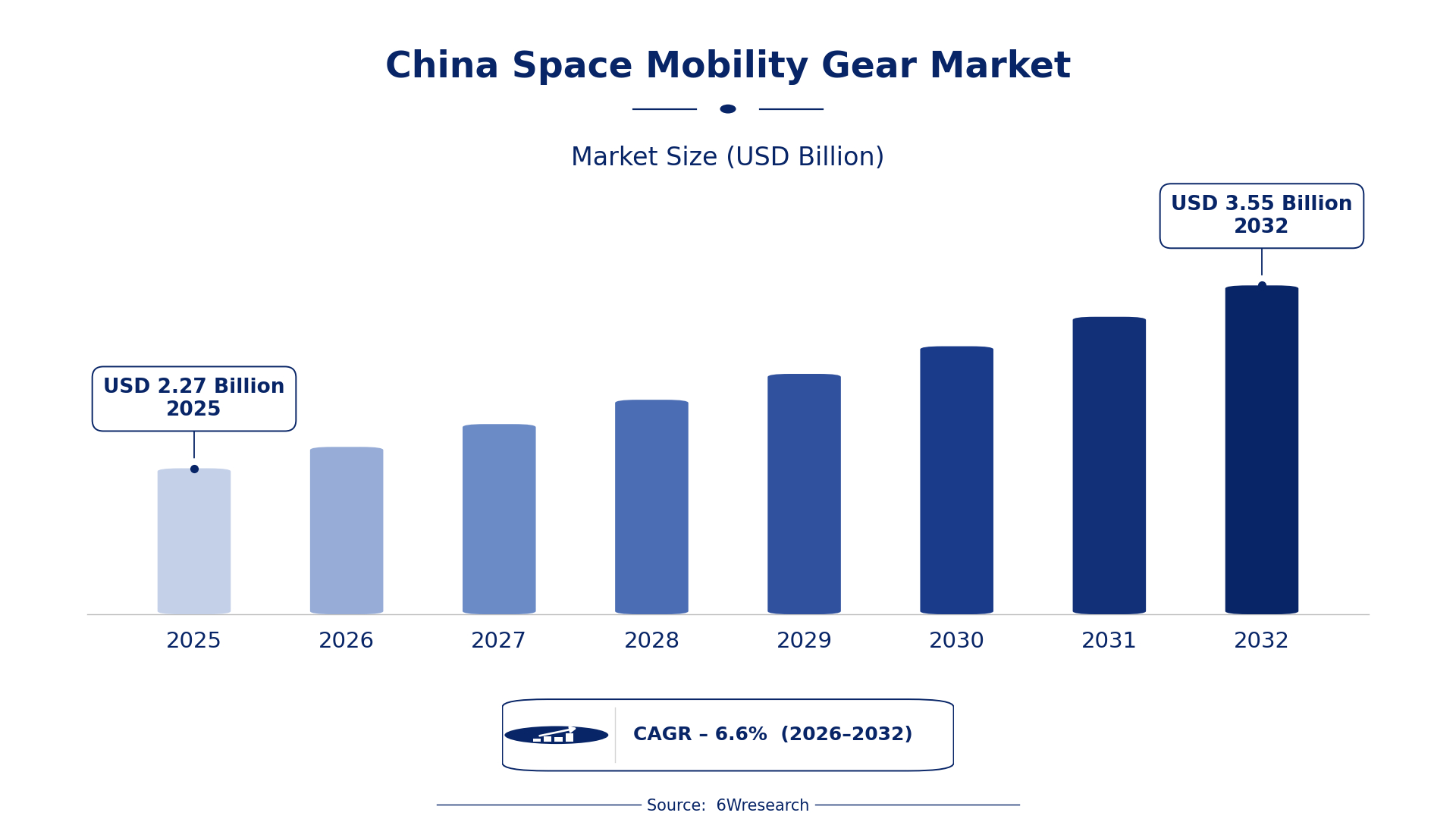
According to 6Wresearch internal database and industry insights, the China Space Mobility Gear Market was valued at USD 2.27 billion in 2025 and is projected to reach USD 3.55 billion by 2032, growing at a CAGR of approximately 6.6% during 2026–2032.
China Space Mobility Gear Market Highlights
| Report Metric | Details |
| Report Name | China Space Mobility Gear Market |
| Market Size 2025 | USD 2.27 billion |
| Market Size 2032 | USD 3.55 billion |
| Absolute Growth 2025–2032 | USD 1.28 billion |
| CAGR 2026–2032 | 6.6% |
| Peak Annual Growth | 9.0% in 2030 |
| Forecast Period | 2026–2032 |
| Historical Data | 2022–2025 |
| Base Year | 2025 |
| Leading Gear Type, 2025 | Exoskeleton Suits (45% share) |
| Leading Application, 2025 | Mobility Safety (44% share) |
| Leading Material Used, 2025 | Carbon Fiber (41% share) |
| Leading End User, 2025 | Space Programs (43% share) |
| Fastest-Growing Gear Type | Jetpacks (9.2% CAGR) |
| Fastest-Growing Application | Load Management (9.3% CAGR) |
| Fastest-Growing Material Used | Insulated Polymer (9.1% CAGR) |
| Growing Sector | Space Programs |
| Key End Users | Space Engineers, Astronauts, Space Programs |
China Space Mobility Gear Market Year-wise Growth Rate and Key Drivers (2022–2032)
This graph illustrates the annual growth rates of the market from 2022 to 2032, highlighting a steady upward trajectory and projected market expansion over the forecast period.
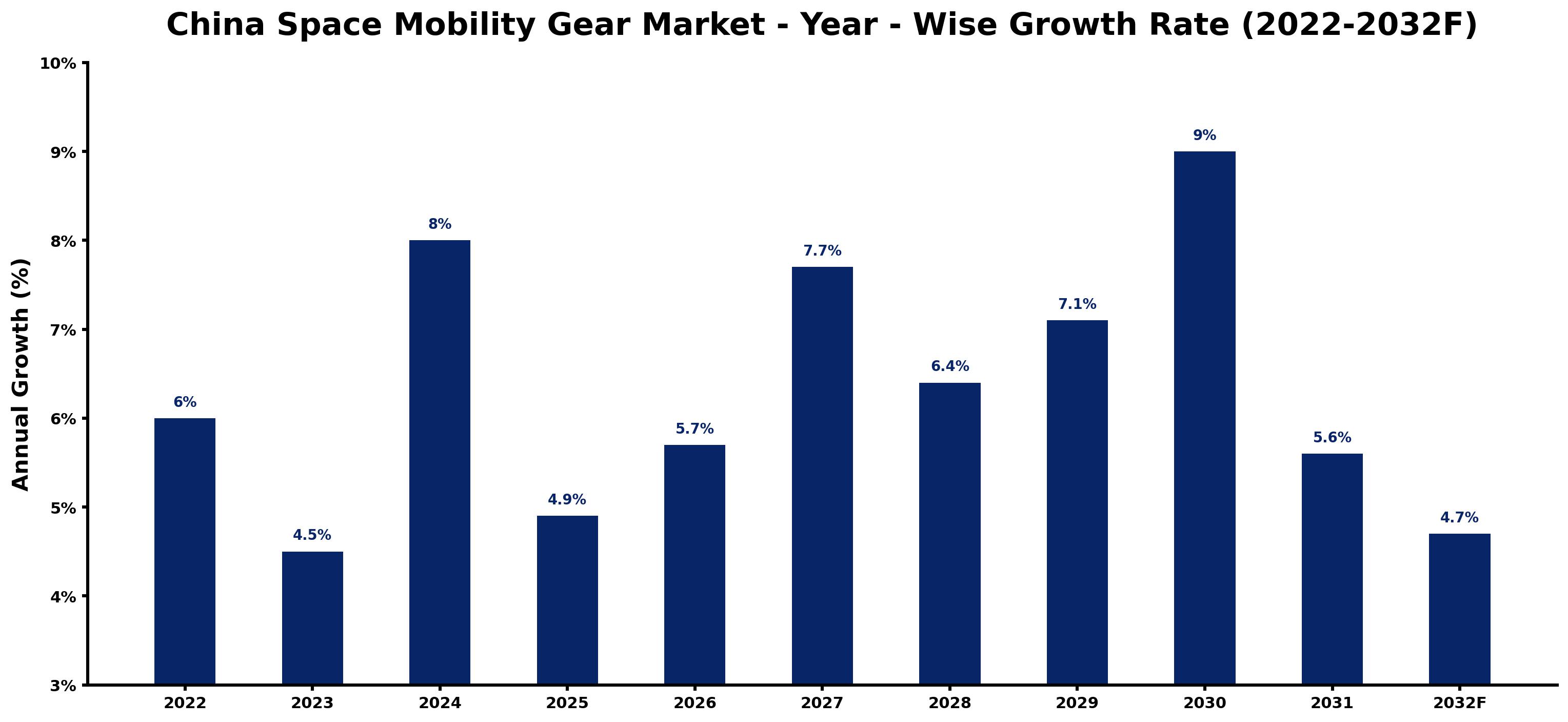
Below, each year's estimated growth is shown next to the factor that most influenced it.
| Year | Estimated Annual Growth (%) | Market Rationale |
| 2022 | 6.0 | The market experienced steady growth due to ongoing domestic space missions and investments in technology. |
| 2023 | 4.5 | Growth slowed as the focus shifted towards enhancing safety standards for space mobility gear. |
| 2024 | 8.0 | Demand surged as new lunar exploration missions commenced, increasing the need for advanced mobility solutions. |
| 2025 | 4.9 | A slowdown occurred as the market adjusted to new material standards and production practices. |
| 2026 | 5.7 | Growth picked up again as investments in research and development for space gear technologies increased. |
| 2027 | 7.7 | Continued advancements in space technology drove demand for innovative mobility solutions in lunar missions. |
| 2028 | 6.4 | The market experienced a slowdown as production capacities were realigned to meet new safety standards. |
| 2029 | 7.1 | Demand rose again as the Chinese government announced plans for additional lunar missions. |
| 2030 | 9.0 | A peak in growth was reached, driven by significant investments in space exploration and mobility technologies. |
| 2031 | 5.6 | Growth slowed as the market stabilised following the peak demand for lunar exploration gear. |
| 2032 | 4.7 | The market continues to grow, albeit at a slower rate, as new projects are initiated. |
Note: Market size estimations and growth projections presented in this report are based on 6Wresearch's proprietary forecasting methodology, utilizing the latest available industry data, government publications, and primary research inputs.
China Space Mobility Gear Market Synopsis
The Space Mobility Gear Market in China includes cutting-edge equipment designed for extraterrestrial environments, such as exoskeleton suits and jetpacks. These products utilise high-performance materials like carbon fibre and heat-resistant alloys. Robust domestic space programmes and lunar exploration initiatives drive this market, with over 30 missions launched in 2023. Investments, including the $2 billion allocated for space technology advancements, further stimulate demand. As the Chinese government targets a permanent lunar base by 2030, the market is poised for sustained growth.
Market Dynamics Impact Analysis (2026–2032)
| Factor | Type | Impact | Primary Segment Affected |
| Increasing investments in space technology development | Driver | High | Mobility Safety |
| Growing domestic space missions and lunar exploration initiatives | Driver | High | Space Programs |
| Rising demand for advanced mobility solutions in lunar missions | Opportunity | High | Exoskeleton Suits |
| Need for lightweight and durable materials for space gear | Opportunity | Medium | Carbon Fiber |
| High costs associated with advanced material development | Restraint | High | Heat-Resistant Alloys |
| Limited production capacity for specialized space gear | Restraint | Medium | EVA Boots |
| Space Mobility Gear Market in China faces practical problems | Challenge | High | Jetpacks |
| Technological challenges in developing new propulsion systems | Challenge | Medium | Tethering Systems |
Evaluation of Drivers in China Space Mobility Gear Market (2026–2032)
The table below links each growth driver to the segment it affects and the evidence for it.
| Drivers | Primary Segment Affected | Why It Matters (Evidence) |
| Increased funding for space technology advancements | Mobility Safety | The Chinese government allocated $2 billion for space technology advancements in 2023, boosting demand for safety gear. |
| Expansion of lunar exploration missions | Space Programs | China's space program launched over 30 missions in 2023, increasing the need for mobility solutions. |
| Testing of exoskeleton suits in lunar missions | Exoskeleton Suits | Exoskeleton Suits are being tested in the Chang'e lunar missions, improving mobility for astronauts. |
| Growing focus on lightweight materials | Carbon Fiber | Carbon Fiber is used in 80% of space suits, driving demand for lightweight and strong gear. |
| Development of new safety standards for EVA gear | EVA Boots | The updated China Lunar Exploration Program includes new standards for EVA gear, improving astronaut safety. |
Market growth in China for Space Mobility Gear rests on increased funding for space technology advancements, expansion of lunar exploration missions, and testing of exoskeleton suits in lunar environments. In 2023, over 30 missions were launched, increasing the need for mobility solutions. The use of lightweight materials in space suits drives demand for strong gear.
Evaluation of Restraints in China Space Mobility Gear Market
The table below lists the restraints and the evidence behind each.
| Market Restraint | Primary Segment Affected | Why It Matters (Evidence) |
| High costs associated with advanced material development | Heat-Resistant Alloys | In 2022, 15% of space gear was made from Heat-Resistant Alloys, which are costly to produce. |
| Limited production capacity for specialized space gear | EVA Boots | The demand for EVA Boots is high, but production capacity has not fully met this need. |
| Regulatory hurdles in material certification | Jetpacks | Stringent regulations delay the certification process for new propulsion systems in Jetpacks. |
| Complexity in developing new propulsion systems | Tethering Systems | The complexity of propulsion systems presents ongoing challenges for manufacturers. |
| Dependence on high-performance materials | Carbon Fiber | The reliance on Carbon Fiber limits options for manufacturers, impacting supply chains. |
China Space Mobility Gear Market Challenges
The China Space Mobility Gear Market faces a few practical problems, starting with supply chain disruptions that have raised costs for producers. For instance, delays in sourcing carbon fiber can increase production timelines by 20%, affecting delivery schedules for buyers. Technological limitations also hinder the rapid development of new equipment; many innovations remain in testing phases, postponing the rollout of essential gear. Buyers struggle with high compliance costs associated with ISO 14644 standards, which can inflate manufacturing expenses by up to 15%. Unpredictable government funding creates uncertainty, with the recent $2 billion allocation not ensuring future support, complicating long-term planning for suppliers.
Trends in the China Space Mobility Gear Market
Below mentioned are some of the trends shaping the China Space Mobility Gear Market growth.
- Shift towards Lightweight Materials: China is increasingly adopting lightweight materials like carbon fibre in space mobility gear. This shift supports the need for durable yet manageable gear, as demonstrated in the 2023 missions where 80% of space suits utilised carbon fibre.
- Transition to New Safety Standards: New safety standards for EVA gear have been introduced under the updated China Lunar Exploration Program. This change aims to improve astronaut safety and performance, with updated regulations expected to be fully implemented by 2023.
- Emergence of Advanced Propulsion Technologies: The development of new propulsion technologies is becoming a focus in China's space missions. The ongoing testing of jetpacks in lunar environments highlights this trend, with a projected increase in their use by 2025.
- Prioritisation of Research in Aerospace Materials: Research in aerospace materials is being prioritised through initiatives like the Aerospace Material Innovation Program. This program, initiated in 2022, aims to advance the development of heat-resistant alloys and polymers.
Investment Opportunities in the China Space Mobility Gear Market
The following opportunities in the China Space Mobility Gear Market pair current demand with a clear way in.
- Supply of Advanced Mobility Gear: The demand for advanced mobility gear is rising, particularly for lunar missions, with a projected increase of 25% by 2025. Suppliers can target space programs in Jiangsu province, partnering with local manufacturers to meet this need.
- Development of Lightweight Materials: There is an opportunity to invest in the development of lightweight materials for space gear. Space engineers in China are actively seeking solutions, making this a promising area for investment.
- Production of Safety Gear: The growing focus on safety gear presents an opportunity for manufacturers. With the Chinese government prioritising astronaut safety, suppliers can engage with space programs to provide necessary equipment.
- Expansion of Research Facilities: Investing in research facilities dedicated to aerospace materials can yield substantial returns. The National Key Research and Development Program supports such initiatives, offering funding for innovative projects.
Government Initiatives in the China Space Mobility Gear Market
The 'National Space Strategy' launched in 2020 aims to boost domestic capabilities in space exploration, including mobility gear. This strategy has led to increased funding for space technology advancements, with a budget of $3 billion allocated in 2021 under the 'Space Technology Development Plan'. The 'Aerospace Material Innovation Program' initiated in 2022 promotes research in heat-resistant alloys and polymers, further supporting the development of space mobility gear. The 'China Lunar Exploration Program' was updated in 2023 to include new standards for EVA gear, enhancing safety and performance for astronauts.
The National Space Administration oversees the approval of space mobility gear development projects. Additionally, the Ministry of Industry and Information Technology funds research initiatives aimed at improving material standards for space gear. These agencies work collaboratively to ensure that new technologies meet safety and performance requirements, facilitating the growth of the Space Mobility Gear Market. In 2023, funding for these initiatives reached $500 million, enabling advancements in material technologies.
Future Insight of the China Space Mobility Gear Market
Several forward-looking factors should support the China Space Mobility Gear Market over the coming years. The anticipated 25% increase in lunar missions by 2025 will drive demand for advanced mobility equipment, prompting innovation among suppliers. The establishment of a permanent lunar base by 2030 will require the development of new technologies and materials, fostering collaboration between research institutions and manufacturers. The operational status of the Chinese space station by 2025 will create new opportunities for buyers and suppliers, enhancing the overall market.
Market Segmentation Analysis
The analysis below covers each segmentation, its leading category in 2025 and its fastest-growing category through 2032.
By Gear Type – Exoskeleton Suits Dominated, Jetpacks Expected to Grow Fastest
According to Summon Dutta, Assistant Manager at 6Wresearch, with a 45% revenue share in 2025, Exoskeleton Suits was the largest gear type category. Exoskeleton Suits dominate the market due to their essential role in enhancing astronaut mobility during space missions. Their deployment in significant initiatives like the Chang'e lunar explorations exemplifies their critical importance in this sector. Jetpacks are set to record the highest CAGR in this split, 9.2% over 2026–2032. Jetpacks are rapidly gaining popularity as they offer unique propulsion capabilities in low-gravity environments, making them vital for future lunar explorations. The increasing focus on innovative mobility solutions for space missions will further accelerate their growth. Suppliers should prioritise the development of jetpack technologies to meet the rising demand in the space mobility gear market.
By Application – Mobility Safety Dominated, Load Management Expected to Grow Fastest
The largest application category in 2025 was Mobility Safety, with a 44% share of total revenue. Mobility Safety holds the largest market share as it is crucial for ensuring astronaut protection during space operations. Compliance with safety standards, such as ISO 14644, highlights the importance of this application in gear development. Load Management is projected to grow fastest, at a CAGR of 9.3% during 2026–2032. Load Management is experiencing the fastest growth due to its critical role in efficiently managing equipment during space missions. With lunar missions expected to increase by 25% by 2025, the demand for effective load management solutions will intensify. Buyers must focus on acquiring advanced load management solutions to improve operational efficiency in upcoming space missions.
By Material Used – Carbon Fiber Dominated, Insulated Polymer Expected to Grow Fastest
In 2025, Carbon Fiber led the material used split with a 41% share. Carbon Fiber leads the market, being used in 80% of space suits for its lightweight and robust properties. These characteristics are essential for meeting the demanding requirements of space mobility gear. The quickest growth will come from Insulated Polymer, forecast to expand at a CAGR of 9.1% between 2026 and 2032. Insulated Polymer is witnessing rapid growth due to its ability to provide crucial thermal protection for space gear, necessary for upcoming missions. The emphasis on safety and performance in extreme conditions is driving the adoption of this material. Suppliers should invest in insulated polymer technologies to address the evolving needs of the space mobility gear market.
By End User – Space Programs Dominated and Is Expected to Record the Fastest Growth
Space Programs accounted for a 43% market share by end user in 2025. Space Programs are the primary end users, significantly driving demand for advanced mobility solutions essential for mission success. The substantial investment from the Chinese government in space technology reinforces this segment's leading position. Its lead should widen, with a projected CAGR of 8.7% during 2026–2032, the highest in this split. Space Programs are also the fastest-growing end user segment, as the expansion of lunar and Mars missions creates an urgent need for advanced mobility gear. Continued support from national initiatives ensures this growth trajectory will persist. Suppliers should align their strategies with the objectives of space programs to effectively capture the expanding market share.
Key Attractiveness of the Report
- 10 Years of Market Numbers
- Historical Data Starting from 2022 to 2025
- Base Year 2025
- Forecast Data until 2032
- Key Performance Indicators Impacting the Market
- Major Upcoming Developments and Projects
Key Highlights of the Report:
- China Space Mobility Gear Market Outlook
- Market Size of China Space Mobility Gear Market, 2025
- Forecast of China Space Mobility Gear Market, 2032
- Historical Data and Forecast of China Space Mobility Gear Revenues & Volume for the Period 2022 - 2032F
- China Space Mobility Gear Market Trend Evolution
- China Space Mobility Gear Market Drivers and Challenges
- China Space Mobility Gear Price Trends
- China Space Mobility Gear Porter's Five Forces
- China Space Mobility Gear Industry Life Cycle
- Historical Data and Forecast of China Space Mobility Gear Market Revenues & Volume By Gear Type for the Period 2022 - 2032F
- Historical Data and Forecast of China Space Mobility Gear Market Revenues & Volume By Exoskeleton Suits for the Period 2022 - 2032F
- Historical Data and Forecast of China Space Mobility Gear Market Revenues & Volume By Jetpacks for the Period 2022 - 2032F
- Historical Data and Forecast of China Space Mobility Gear Market Revenues & Volume By EVA Boots for the Period 2022 - 2032F
- Historical Data and Forecast of China Space Mobility Gear Market Revenues & Volume By Tethering Systems for the Period 2022 - 2032F
- Historical Data and Forecast of China Space Mobility Gear Market Revenues & Volume By Application for the Period 2022 - 2032F
- Historical Data and Forecast of China Space Mobility Gear Market Revenues & Volume By Load Management for the Period 2022 - 2032F
- Historical Data and Forecast of China Space Mobility Gear Market Revenues & Volume By Propulsion for the Period 2022 - 2032F
- Historical Data and Forecast of China Space Mobility Gear Market Revenues & Volume By Surface Stability for the Period 2022 - 2032F
- Historical Data and Forecast of China Space Mobility Gear Market Revenues & Volume By Mobility Safety for the Period 2022 - 2032F
- Historical Data and Forecast of China Space Mobility Gear Market Revenues & Volume By Material Used for the Period 2022 - 2032F
- Historical Data and Forecast of China Space Mobility Gear Market Revenues & Volume By Carbon Fiber for the Period 2022 - 2032F
- Historical Data and Forecast of China Space Mobility Gear Market Revenues & Volume By Heat-Resistant Alloys for the Period 2022 - 2032F
- Historical Data and Forecast of China Space Mobility Gear Market Revenues & Volume By Insulated Polymer for the Period 2022 - 2032F
- Historical Data and Forecast of China Space Mobility Gear Market Revenues & Volume By Kevlar Ropes for the Period 2022 - 2032F
- Historical Data and Forecast of China Space Mobility Gear Market Revenues & Volume By End User for the Period 2022 - 2032F
- Historical Data and Forecast of China Space Mobility Gear Market Revenues & Volume By Lunar Missions for the Period 2022 - 2032F
- Historical Data and Forecast of China Space Mobility Gear Market Revenues & Volume By Astronauts for the Period 2022 - 2032F
- Historical Data and Forecast of China Space Mobility Gear Market Revenues & Volume By Space Programs for the Period 2022 - 2032F
- Historical Data and Forecast of China Space Mobility Gear Market Revenues & Volume By Space Engineers for the Period 2022 - 2032F
- China Space Mobility Gear Import Export Trade Statistics
- Market Opportunity Assessment By Gear Type
- Market Opportunity Assessment By Application
- Market Opportunity Assessment By Material Used
- Market Opportunity Assessment By End User
- China Space Mobility Gear Top Companies Market Share
- China Space Mobility Gear Competitive Benchmarking By Technical and Operational Parameters
- China Space Mobility Gear Company Profiles
- China Space Mobility Gear Key Strategic Recommendations
Market Covered
The report offers an extensive study of the following market segments.
By Gear Type
- Exoskeleton Suits
- Jetpacks
- EVA Boots
- Tethering Systems
By Application
- Load Management
- Propulsion
- Surface Stability
- Mobility Safety
By Material Used
- Carbon Fiber
- Heat-Resistant Alloys
- Insulated Polymer
- Kevlar Ropes
By End User
- Lunar Missions
- Astronauts
- Space Programs
- Space Engineers































