China Space Observation Equipment Market Size & Growth Rate
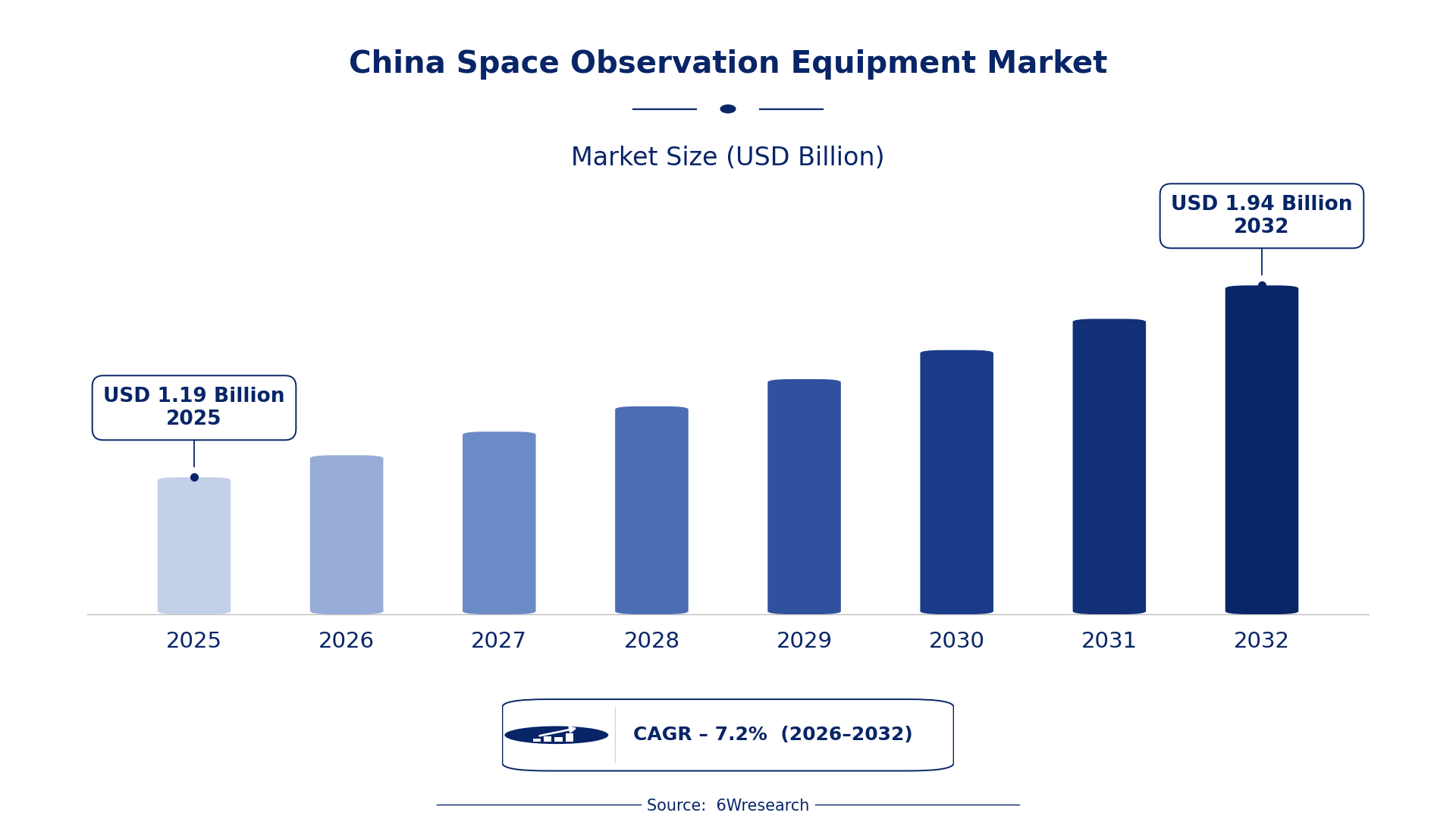
According to 6Wresearch internal database and industry insights, the China Space Observation Equipment Market was valued at USD 1.19 billion in 2025 and is projected to reach USD 1.94 billion by 2032, growing at a CAGR of approximately 7.2% during 2026–2032.
China Space Observation Equipment Market Highlights
| Report Metric | Details |
| Report Name | China Space Observation Equipment Market |
| Market Size 2025 | USD 1.19 billion |
| Market Size 2032 | USD 1.94 billion |
| Absolute Growth 2025–2032 | USD 0.75 billion |
| CAGR 2026–2032 | 7.2% |
| Peak Annual Growth | 9.5% in 2028 |
| Forecast Period | 2026–2032 |
| Historical Data | 2022–2025 |
| Base Year | 2025 |
| Leading Equipment Type, 2025 | Telescopes (45% share) |
| Leading Observation Target, 2025 | Celestial Objects (49% share) |
| Leading Wavelength Spectrum, 2025 | Optical/Infrared (39% share) |
| Leading End User, 2025 | Space Research Centers (40% share) |
| Fastest-Growing Equipment Type | Imaging Sensors (9.4% CAGR) |
| Fastest-Growing Observation Target | Deep Space (8.9% CAGR) |
| Fastest-Growing Wavelength Spectrum | X-Ray/UV (9.7% CAGR) |
| Growing Sector | Space Research Centers |
| Key End Users | Astronomical Institutes, Space Research Centers, Satellite Builders, Planetary Scientists |
China Space Observation Equipment Market Year-wise Growth Rate and Key Drivers (2022–2032)
This graph illustrates the annual growth rates of the market from 2022 to 2032, highlighting a steady upward trajectory and projected market expansion over the forecast period.
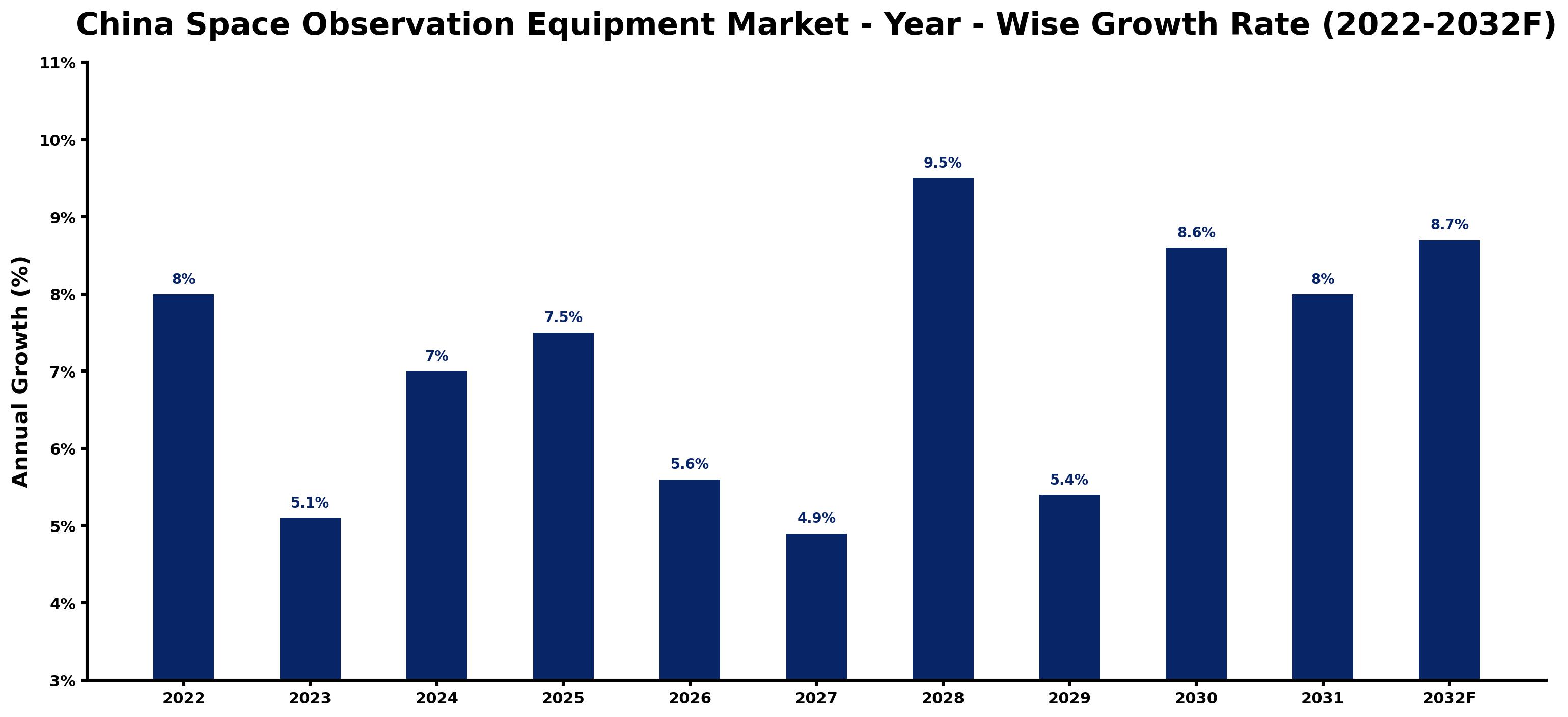
Each row of the following table gives one year's estimated growth and the event or demand shift that explains it.
| Year | Estimated Annual Growth (%) | Market Rationale |
| 2022 | 8.0 | Demand surged due to the success of the Tianwen-1 Mars mission, driving investments in technology. |
| 2023 | 5.1 | Growth slowed as the market adjusted to the previous year's high demand and project completions. |
| 2024 | 7.0 | Increased funding for space exploration projects led to a rise in equipment purchases by research institutions. |
| 2025 | 7.5 | Higher investments in telescopes and spectrometers were driven by plans for a lunar research station. |
| 2026 | 5.6 | Budget constraints affected the pace of new projects, leading to a slowdown in growth. |
| 2027 | 4.9 | The focus on deep space missions contributed to a continued but slower demand for equipment. |
| 2028 | 9.5 | A resurgence in demand occurred as new imaging sensor technologies were introduced to the market. |
| 2029 | 5.4 | Growth slowed as the market stabilised after the peak demand for deep space exploration equipment. |
| 2030 | 8.6 | Renewed interest in planetary science and exploration spurred increased demand for observation technologies. |
| 2031 | 8.0 | Investment in space research centres remained strong, but growth rates normalised after previous highs. |
| 2032 | 8.7 | The market is expected to grow as international collaborations in space observation expand. |
Note: Market size estimations and growth projections presented in this report are based on 6Wresearch's proprietary forecasting methodology, utilizing the latest available industry data, government publications, and primary research inputs.
China Space Observation Equipment Market Synopsis
Space Observation Equipment in China includes technologies for observing celestial bodies, such as telescopes and imaging sensors. These tools play a crucial role in astronomical research, space exploration, and satellite navigation. The China Space Observation Equipment Market is on an upward path, supported by over 30 astronomical institutes and robust government funding. The National Space Administration's allocation of 5 billion CNY for space exploration projects in 2023 underscores the increasing investment in this sector. Furthermore, the establishment of a lunar research station by 2025 is anticipated to further drive demand for advanced observation technologies.
Market Dynamics Impact Analysis (2026–2032)
| Factor | Type | Impact | Primary Segment Affected |
| Growing demand for advanced telescopes driven by lunar exploration plans. | Driver | High | Telescopes |
| Increased funding for imaging sensor technologies enhances research capabilities. | Driver | High | Imaging Sensors |
| Investment in lunar research stations creates opportunities for telescope manufacturers. | Opportunity | High | Telescopes |
| The need for enhanced deep space exploration drives demand for spectrometers. | Opportunity | High | Spectrometers |
| Budget constraints limit the pace of new projects in space observation. | Restraint | High | Imaging Sensors |
| Competition from international suppliers may impact local manufacturers' market share. | Restraint | Medium | Telescopes |
| The market faces challenges in maintaining technological advancements amid budget cuts. | Challenge | High | Imaging Sensors |
| Delays in project approvals can hinder timely equipment deployment for research. | Challenge | Medium | Spectrometers |
Evaluation of Drivers in China Space Observation Equipment Market (2026–2032)
The main growth drivers and the segments they affect most are set out below.
| Drivers | Primary Segment Affected | Why It Matters (Evidence) |
| Increased funding for space exploration projects. | Telescopes | The National Space Administration allocated 5 billion CNY for projects, boosting telescope purchases by research institutions. |
| Growing interest in deep space missions. | Imaging Sensors | The 'Deep Space Exploration Program' aims to develop imaging sensor technologies, increasing demand from space research centres. |
| Expansion of astronomical research institutes. | Star Trackers | Over 30 astronomical institutes in China are investing in star trackers for spacecraft navigation. |
| Technological advancements in spectrometers. | Spectrometers | New capabilities in spectrometers are being developed to analyse celestial objects more effectively. |
| Rising international collaborations in space research. | Celestial Objects | Collaborations with foreign space agencies are driving demand for equipment to observe celestial bodies. |
Growth in the Space Observation Equipment market in China comes from rising end-use demand driven by increased funding for space exploration projects, alongside a strong supply response from local manufacturers. The National Space Administration's allocation of 5 billion CNY for 2023 fuels investments in telescopes and imaging sensors, while over 30 astronomical institutes are expanding their research capabilities. The launch of the Tianwen-1 Mars mission in 2021 showcased the importance of advanced imaging sensors, leading to heightened purchases for future missions.
Evaluation of Restraints in China Space Observation Equipment Market
The key brakes on demand, and where they bite hardest, are shown below.
| Market Restraint | Primary Segment Affected | Why It Matters (Evidence) |
| Budget constraints affecting project timelines. | Imaging Sensors | Limited funding for space exploration projects has delayed the acquisition of new imaging sensors by research centres. |
| Competition from international suppliers impacting local manufacturers. | Telescopes | Local telescope manufacturers face pressure from international competitors offering advanced technologies at lower prices. |
| Technological advancements may not keep pace with demand. | Star Trackers | The rapid evolution of technology can lead to gaps in capabilities, affecting star tracker effectiveness. |
| Regulatory hurdles delaying project approvals. | Spectrometers | Complex approval processes can slow down the deployment of new spectrometers for research purposes. |
| Market saturation in certain equipment types. | Celestial Objects | An oversupply of basic observation equipment may limit growth opportunities for manufacturers. |
China Space Observation Equipment Market Challenges
The China Space Observation Equipment Market encounters several practical issues, beginning with high production costs linked to advanced manufacturing techniques. Precision engineering raises expenses, pushing prices for buyers, such as research institutions, up by as much as 20%. Technological limitations impede progress; outdated equipment can delay project timelines for governmental space programs, affecting mission schedules. Buyers, including international partners, face challenges with inconsistent quality standards, leading to costly rework that can surpass 15% of project budgets. Supply chain disruptions further complicate operations, causing delays in equipment delivery for over 30 astronomical institutes nationwide.
Trends in the China Space Observation Equipment Market
Several trends are reshaping the China Space Observation Equipment Market; the most important are set out below.
- Shift towards Advanced Imaging Technologies: China is increasingly adopting advanced imaging sensor technologies for space observation, as demonstrated by the Tianwen-1 Mars mission, which utilised imaging sensors for data collection.
- Expansion of Deep Space Exploration Initiatives: The 'Deep Space Exploration Program' launched in 2022 is generating interest in deep space missions, with a budget of 3 billion CNY to strengthen capabilities in planetary science.
- Growing Focus on Lunar Research: China's objective to establish a lunar research station by 2025 is driving investments in telescopes and spectrometers, necessitating advancements in observational technologies.
- Increased International Collaboration in Space Research: Collaborations with foreign space agencies are becoming more common, enhancing research capabilities and resource sharing for deep space missions.
Investment Opportunities in the China Space Observation Equipment Market
Some of the investment opportunities in the China Space Observation Equipment Market are mentioned below.
- Investment in Lunar Research Equipment: With the aim of establishing a lunar research station by 2025, there is an opportunity for telescope manufacturers to supply advanced equipment, requiring investments exceeding 5 billion CNY.
- Demand for Advanced Spectrometers: The emphasis on deep space exploration creates a need for advanced spectrometers, with space research centres seeking suppliers to provide effective technologies for analysing celestial bodies.
- Expansion of Astronomical Research Facilities: The growth of over 30 astronomical institutes presents opportunities for manufacturers of space observation equipment, facilitating access to a growing market through collaboration.
- Technological Advancements in Imaging Sensors: The introduction of new imaging sensor technologies offers investment opportunities for suppliers, with the 'Space Technology Innovation Action Plan' allocating 3 billion CNY for advancements.
Government Initiatives in the China Space Observation Equipment Market
The 'National Medium- and Long-Term Program for Science and Technology Development' (2021-2035) aims to improve astronomical observation technologies. This program outlines specific targets for satellite development and research capabilities, ensuring that producers align with national objectives. The 'Space Science and Technology Promotion Act' passed in 2023 supports research initiatives and international collaboration, providing a framework for funding and approvals in the space observation sector. These measures enhance the operational environment for manufacturers and buyers alike, promoting innovation and growth in the industry.
The 'Space Technology Innovation Action Plan' introduced in 2022 focuses on advancing imaging sensor technologies with a budget of 3 billion CNY. Managed by the Ministry of Industry and Information Technology, this plan aims to support research institutions and private companies in developing effective technologies. Additionally, the National Space Administration oversees various funding initiatives to promote advancements in space observation equipment, ensuring that the industry remains competitive and responsive to emerging challenges. These efforts are crucial for maintaining China's position in the global space observation market.
Future Insight of the China Space Observation Equipment Market
The China Space Observation Equipment Market is poised for substantial evolution by 2032, driven by technological advancements and increased governmental investment. The National Space Administration's budget of 5 billion CNY for 2023 will support the development of innovative telescopes and spectrometers. The establishment of a lunar research station by 2025 will generate considerable demand for cutting-edge equipment. The 'Deep Space Exploration Program' will expand capabilities in planetary science, creating collaboration opportunities between suppliers and buyers.
Market Segmentation Analysis
The analysis below covers each segmentation, its leading category in 2025 and its fastest-growing category through 2032.
By Equipment Type – Telescopes Dominated, Imaging Sensors Expected to Grow Fastest
According to Summon Dutta, Assistant Manager at 6Wresearch, Telescopes held a 45% share of the China Space Observation Equipment Market by equipment type in 2025. Telescopes hold the largest market share in China because they are essential for astronomical observations, widely used by research institutions and universities. Their critical role in government-funded space exploration projects underscores their importance in the space observation equipment market. Over 2026–2032, Imaging Sensors are expected to post the fastest growth, at a CAGR of 9.4%. Imaging Sensors are experiencing rapid growth due to their necessity for capturing high-resolution images of celestial bodies, highlighted by the Tianwen-1 Mars mission. The increasing deployment of active satellites equipped with these sensors further drives their demand, ensuring continued expansion in this segment. Suppliers should focus on advancing imaging sensor technologies to meet the rising demands of space exploration.
By Observation Target – Celestial Objects Dominated, Deep Space Expected to Grow Fastest
With a 49% revenue share in 2025, Celestial Objects was the largest observation target category. Celestial Objects represent the primary focus of observation equipment, which is vital for astronomical research conducted by numerous institutes across China. This focus is supported by the country's extensive investment in space exploration initiatives. The quickest growth will come from Deep Space, forecast to expand at a CAGR of 8.9% between 2026 and 2032. The Deep Space segment is growing quickly as China's ambitions expand towards exploring distant astronomical phenomena, particularly with initiatives like the Deep Space Exploration Program. This focus on deep space will likely attract more funding and technological advancements. Buyers should prepare for increased availability of advanced equipment tailored for deep space observation.
By Wavelength Spectrum – Optical/Infrared Dominated, X-Ray/UV Expected to Grow Fastest
Optical/Infrared accounted for a 39% market share by wavelength spectrum in 2025. Optical/Infrared wavelengths dominate the market share as they are extensively applied in astronomical observations, making them the preferred choice for research institutions. This spectrum is vital for obtaining detailed images of celestial bodies, reinforcing its leading position in the market. X-Ray/UV is set to record the highest CAGR in this split, 9.7% over 2026–2032. X-Ray/UV wavelengths are rapidly gaining traction as they are crucial for studying high-energy astronomical events, which are increasingly central to research efforts. The growing focus on these phenomena will likely stimulate further investments in related technologies, enhancing their market presence. Suppliers must prioritise the development of X-Ray/UV technologies to capitalise on the rising demand for high-energy observation equipment.
By End User – Space Research Centers Dominated and Is Expected to Record the Fastest Growth
Space Research Centers took a 40% share of end user in 2025, more than any other category. Space Research Centers account for the largest market share as they are key institutions driving research and development in space observation technologies. Their substantial government funding ensures a steady demand for advanced equipment, reinforcing their dominant position in the market. Its lead should widen, with a projected CAGR of 8.5% during 2026–2032, the highest in this split. Space Research Centers are also the fastest-growing segment, continuously enhancing their research capabilities and projects, especially with government support for space exploration. This dual role as both leader and fastest will further solidify their market position. Suppliers should align their offerings with the needs of space research centres to seize emerging growth opportunities.
Key Attractiveness of the Report
- 10 Years of Market Numbers
- Historical Data Starting from 2022 to 2025
- Base Year 2025
- Forecast Data until 2032
- Key Performance Indicators Impacting the Market
- Major Upcoming Developments and Projects
Key Highlights of the Report:
- China Space Observation Equipment Market Outlook
- Market Size of China Space Observation Equipment Market, 2025
- Forecast of China Space Observation Equipment Market, 2032
- Historical Data and Forecast of China Space Observation Equipment Revenues & Volume for the Period 2022 - 2032F
- China Space Observation Equipment Market Trend Evolution
- China Space Observation Equipment Market Drivers and Challenges
- China Space Observation Equipment Price Trends
- China Space Observation Equipment Porter's Five Forces
- China Space Observation Equipment Industry Life Cycle
- Historical Data and Forecast of China Space Observation Equipment Market Revenues & Volume By Equipment Type for the Period 2022 - 2032F
- Historical Data and Forecast of China Space Observation Equipment Market Revenues & Volume By Telescopes for the Period 2022 - 2032F
- Historical Data and Forecast of China Space Observation Equipment Market Revenues & Volume By Imaging Sensors for the Period 2022 - 2032F
- Historical Data and Forecast of China Space Observation Equipment Market Revenues & Volume By Star Trackers for the Period 2022 - 2032F
- Historical Data and Forecast of China Space Observation Equipment Market Revenues & Volume By Spectrometers for the Period 2022 - 2032F
- Historical Data and Forecast of China Space Observation Equipment Market Revenues & Volume By Observation Target for the Period 2022 - 2032F
- Historical Data and Forecast of China Space Observation Equipment Market Revenues & Volume By Celestial Objects for the Period 2022 - 2032F
- Historical Data and Forecast of China Space Observation Equipment Market Revenues & Volume By Deep Space for the Period 2022 - 2032F
- Historical Data and Forecast of China Space Observation Equipment Market Revenues & Volume By Navigation for the Period 2022 - 2032F
- Historical Data and Forecast of China Space Observation Equipment Market Revenues & Volume By Elemental Analysis for the Period 2022 - 2032F
- Historical Data and Forecast of China Space Observation Equipment Market Revenues & Volume By Wavelength Spectrum for the Period 2022 - 2032F
- Historical Data and Forecast of China Space Observation Equipment Market Revenues & Volume By Optical/Infrared for the Period 2022 - 2032F
- Historical Data and Forecast of China Space Observation Equipment Market Revenues & Volume By X-Ray/UV for the Period 2022 - 2032F
- Historical Data and Forecast of China Space Observation Equipment Market Revenues & Volume By Visual Spectrum for the Period 2022 - 2032F
- Historical Data and Forecast of China Space Observation Equipment Market Revenues & Volume By Multispectral for the Period 2022 - 2032F
- Historical Data and Forecast of China Space Observation Equipment Market Revenues & Volume By End User for the Period 2022 - 2032F
- Historical Data and Forecast of China Space Observation Equipment Market Revenues & Volume By Astronomical Institutes for the Period 2022 - 2032F
- Historical Data and Forecast of China Space Observation Equipment Market Revenues & Volume By Space Research Centers for the Period 2022 - 2032F
- Historical Data and Forecast of China Space Observation Equipment Market Revenues & Volume By Satellite Builders for the Period 2022 - 2032F
- Historical Data and Forecast of China Space Observation Equipment Market Revenues & Volume By Planetary Scientists for the Period 2022 - 2032F
- China Space Observation Equipment Import Export Trade Statistics
- Market Opportunity Assessment By Equipment Type
- Market Opportunity Assessment By Observation Target
- Market Opportunity Assessment By Wavelength Spectrum
- Market Opportunity Assessment By End User
- China Space Observation Equipment Top Companies Market Share
- China Space Observation Equipment Competitive Benchmarking By Technical and Operational Parameters
- China Space Observation Equipment Company Profiles
- China Space Observation Equipment Key Strategic Recommendations
Market Covered
Segments analysed in this report are listed below.
By Equipment Type
- Telescopes
- Imaging Sensors
- Star Trackers
- Spectrometers
By Observation Target
- Celestial Objects
- Deep Space
- Navigation
- Elemental Analysis
By Wavelength Spectrum
- Optical/Infrared
- X-Ray/UV
- Visual Spectrum
- Multispectral
By End User
- Astronomical Institutes
- Space Research Centers
- Satellite Builders
- Planetary Scientists































