China Specialty Metals Market Size & Growth Rate
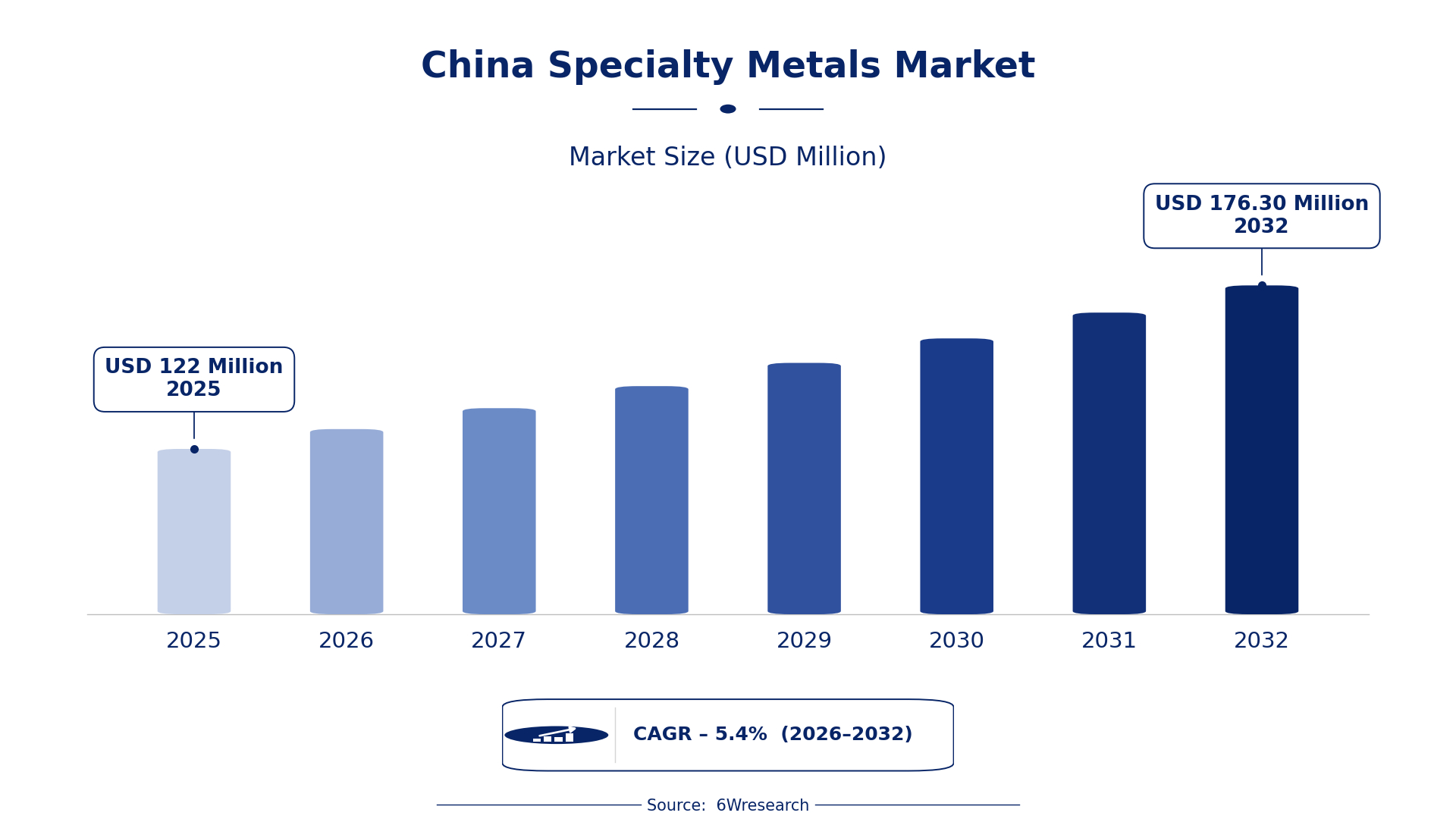
According to 6Wresearch internal database and industry insights, the China Specialty Metals Market was valued at USD 122.0 million in 2025 and is projected to reach USD 176.30 million by 2032, growing at a CAGR of approximately 5.4% during 2026–2032.
China Specialty Metals Market Highlights
| Report Metric | Details |
| Report Name | China Specialty Metals Market |
| Market Size 2025 | USD 122.0 million |
| Market Size 2032 | USD 176.30 million |
| Absolute Growth 2025–2032 | USD 54.30 million |
| CAGR 2026–2032 | 5.4% |
| Peak Annual Growth | 7.1% in 2030 |
| Forecast Period | 2026–2032 |
| Historical Data | 2022–2025 |
| Base Year | 2025 |
| Leading Metal Type, 2025 | Titanium (48% share) |
| Leading Purity Grade, 2025 | Aerospace Grade (38% share) |
| Leading Application Use, 2025 | Jet Engines (45% share) |
| Leading End User, 2025 | Aircraft OEMs (49% share) |
| Fastest-Growing Metal Type | Zirconium (7.2% CAGR) |
| Fastest-Growing Purity Grade | Nuclear Grade (8.1% CAGR) |
| Fastest-Growing Application Use | Reactor Components (6.5% CAGR) |
| Fastest-Growing End User | Semiconductor Firms (6.8% CAGR) |
| Growing Sector | Aerospace |
| Key End Users | Aircraft OEMs, Semiconductor Firms, Power Utilities, Energy Equipment Makers |
China Specialty Metals Market Year-wise Growth Rate and Key Drivers (2022–2032)
This graph illustrates the annual growth rates of the market from 2022 to 2032, highlighting a steady upward trajectory and projected market expansion over the forecast period.
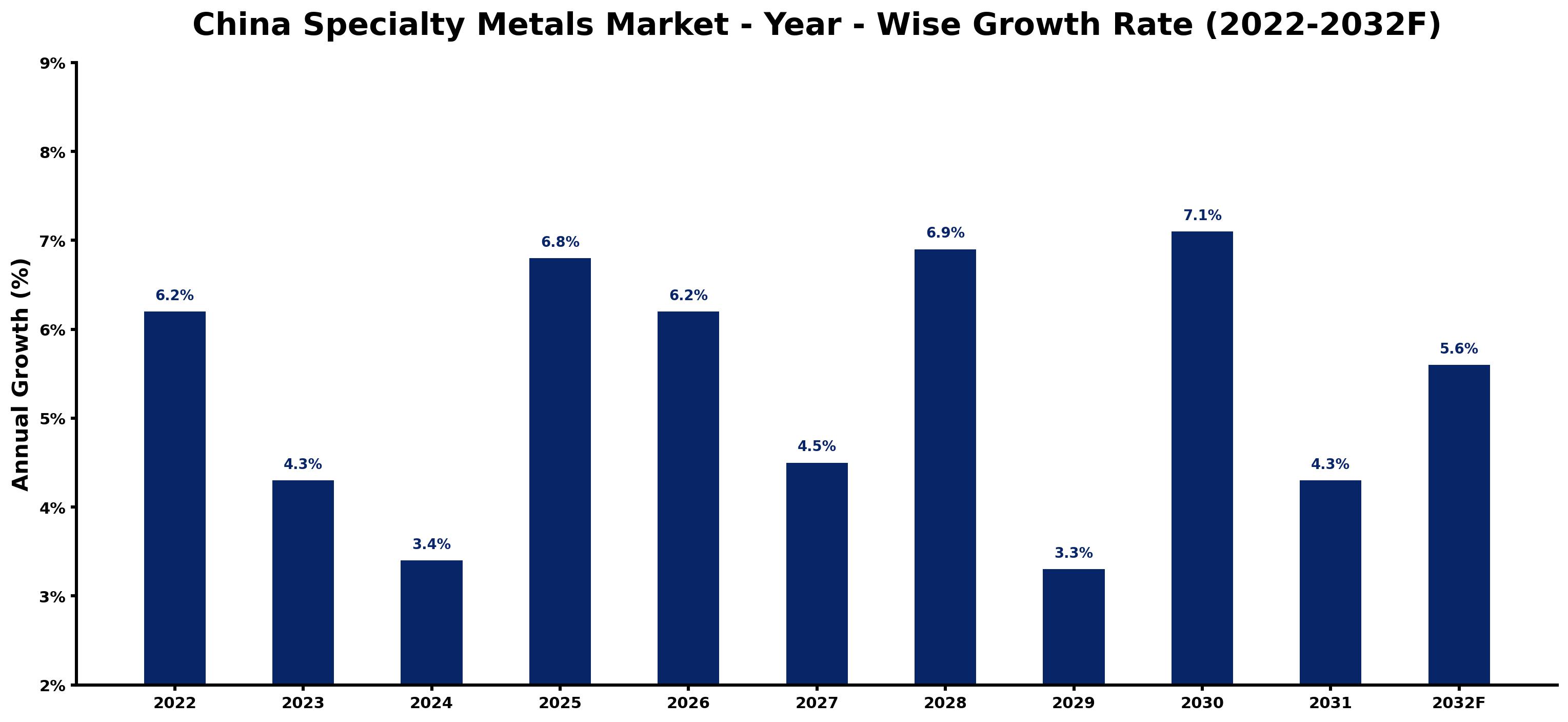
The following table presents the estimated annual growth rate for each year together with the principal factor influencing market performance.
| Year | Estimated Annual Growth (%) | Market Rationale |
| 2022 | 6.2 | The market showed strong activity due to high aerospace sector demand. |
| 2023 | 4.3 | Growth slowed as the aerospace sector faced temporary supply chain challenges. |
| 2024 | 3.4 | Demand continued to moderate, reflecting adjustments in the semiconductor industry. |
| 2025 | 6.8 | Aerospace growth accelerated as new aircraft programs were launched. |
| 2026 | 6.2 | Market growth will slow as the semiconductor sector stabilises. |
| 2027 | 4.5 | Demand will remain strong despite a slight slowdown from previous years. |
| 2028 | 6.9 | Aerospace demand is expected to surge, pushing growth rates higher once more. |
| 2029 | 3.3 | Growth is projected to slow as market conditions normalise after the previous peak. |
| 2030 | 7.1 | The market peaked due to unprecedented demand from aerospace applications. |
| 2031 | 4.3 | Growth will decelerate as the market adjusts to high production levels. |
| 2032 | 5.6 | Demand is expected to stabilise as the aerospace sector matures and diversifies. |
Note: Market size estimations and growth projections presented in this report are based on 6Wresearch's proprietary forecasting methodology, utilizing the latest available industry data, government publications, and primary research inputs.
China Specialty Metals Market Synopsis
The China Specialty Metals Market includes high-performance alloys essential for demanding applications in aerospace and electronics. These metals are crafted through advanced metallurgical processes that impart unique properties such as corrosion resistance and high strength. The market is growing due to rising demand from both the aerospace and electronics sectors. By 2035, the aerospace industry is expected to reach a market size of $1 trillion, significantly increasing the need for specialty metals. The semiconductor sector is projected to expand to $300 billion by 2025, further driving this demand.
Market Dynamics Impact Analysis (2026–2032)
| Factor | Type | Impact | Primary Segment Affected |
| Growing aerospace sector driving demand for high-performance materials | Driver | High | Aerospace Grade |
| Increasing semiconductor production requiring high-quality metals | Driver | High | Electronics Grade |
| Investment in aerospace technology development creating new opportunities | Opportunity | High | Aerospace Grade |
| Rising demand for nuclear-grade materials in reactor components | Opportunity | Medium | Nuclear Grade |
| Quality standards impacting production capabilities | Restraint | High | Titanium |
| Supply chain disruptions affecting timely deliveries | Restraint | Medium | Zirconium |
| High production costs limiting market entry for new players | Challenge | High | Niobium |
| Technological advancements requiring continuous investment | Challenge | Medium | Superalloys |
Evaluation of Drivers in China Specialty Metals Market (2026–2032)
The factors lifting demand, and the evidence behind each, are summarised below.
| Drivers | Primary Segment Affected | Why It Matters (Evidence) |
| Growth in the aerospace sector | Aerospace Grade | The aerospace sector in China is expected to reach a market size of $1 trillion by 2035, increasing demand for specialty metals. |
| Expansion of the semiconductor industry | Electronics Grade | China's semiconductor industry is set to grow to $300 billion by 2025, driving demand for electronics-grade metals. |
| Government investment in aerospace technology | Titanium | The Chinese government has committed $10 billion to aerospace technology development, improving the use of specialty metals. |
| Increased demand for nuclear applications | Nuclear Grade | China's installed base of nuclear reactors reached 55 units by 2023, increasing demand for nuclear-grade zirconium. |
| Growing need for superalloys in aerospace | Superalloys | The demand for superalloys in the aerospace sector is anticipated to rise by 15% annually through 2025. |
The Specialty Metals market in China is on an upward trajectory as the aerospace sector expands, semiconductor production rises, and investments fuel technological advancements. In 2022, approximately 100,000 tons of titanium were produced, primarily for aerospace applications. The aerospace sector is anticipated to reach a market size of $1 trillion by 2035, which will boost demand for specialty metals. China's semiconductor industry is set to grow to $300 billion by 2025, further elevating the need for electronics-grade metals. The demand for superalloys in aerospace is forecasted to increase by 15% annually through 2025, supporting continued market growth.
Evaluation of Restraints in China Specialty Metals Market
The main factors holding the market back are set out below.
| Market Restraint | Primary Segment Affected | Why It Matters (Evidence) |
| Quality standards impacting production capabilities | Titanium | The National Standard for Titanium Alloys (GB/T 13810-2017) regulates the quality of titanium used in aerospace, affecting production. |
| Supply chain disruptions affecting timely deliveries | Zirconium | In 2021, China exported 20,000 tons of zirconium products, mainly to the nuclear industry, indicating reliance on stable supply chains. |
| High production costs limiting market entry for new players | Niobium | The production of specialty metals involves advanced processes, contributing to higher costs that can deter new entrants. |
| Limited availability of raw materials | Tantalum | The annual production of tantalum capacitors is estimated at 500 million units, highlighting the pressure on raw material availability. |
| Regulatory compliance increasing operational costs | Superalloys | Compliance with safety and performance standards in aerospace applications raises operational costs for manufacturers. |
China Specialty Metals Market Challenges
The China Specialty Metals Market encounters several practical challenges, with cost being a primary concern. Rising raw material prices have resulted in a 10% increase in production costs for manufacturers, directly impacting prices for buyers in the aerospace sector. Electronics industry buyers also face supply chain disruptions, leading to delivery delays that can extend lead times by 15%. Stringent regulations, such as the National Standard for Titanium Alloys, complicate the sourcing of high-quality materials for manufacturers, limiting their operational flexibility. Gaps in technology related to advanced metallurgical processes hinder innovation, affecting producers' competitiveness in the global market.
Trends in the China Specialty Metals Market
Several trends are reshaping the China Specialty Metals Market; the most important are set out below.
- Shift towards Aerospace Applications: China's focus on aerospace applications has intensified, leading to increased production of specialty metals. The aerospace sector is projected to reach a market size of $1 trillion by 2035.
- Growing Demand for Electronics-Grade Metals: The semiconductor industry is driving demand for electronics-grade metals, with expectations of growth to $300 billion by 2025. This shift is prompting manufacturers to improve their production capabilities.
- Investment in Nuclear Applications: The emphasis on nuclear power development has led to a heightened demand for high-quality zirconium in reactor components. China's installed base of nuclear reactors reached 55 units by 2023.
- Advancements in Superalloy Technologies: Technological advancements in superalloys are prioritised for turbine engine applications. The demand for superalloys in aerospace is anticipated to rise by 15% annually through 2025.
Investment Opportunities in the China Specialty Metals Market
Several openings in the China Specialty Metals Market merit attention from investors.
- Supply of Aerospace-Grade Metals: With the aerospace sector projected to reach $1 trillion by 2035, there is a clear opportunity for suppliers of aerospace-grade metals. Collaborating with Aircraft OEMs in Jiangsu province could facilitate market entry.
- Production of Electronics-Grade Metals: The anticipated growth of China's semiconductor industry to $300 billion by 2025 creates opportunities for suppliers of electronics-grade metals. Establishing partnerships with Semiconductor Firms will enable market access.
- Investment in Nuclear-Grade Materials: The increasing number of nuclear reactors in China presents an opportunity for suppliers of nuclear-grade materials. Engaging with Power Utilities in regions with active nuclear facilities can lead to successful partnerships.
- Development of Superalloys for Aerospace: The rising demand for superalloys in aerospace applications offers a chance for investment in advanced materials. Collaborating with Aircraft OEMs can provide access to this promising market.
Government Initiatives in the China Specialty Metals Market
The 'Advanced Materials Industry Development Plan' launched by the Ministry of Industry and Information Technology in 2021 aims to boost production of specialty metals, particularly for aerospace applications. This initiative seeks to improve production capabilities and innovation in the sector, targeting a 30% increase in domestic output by 2025. Additionally, the plan aims to enhance quality standards, benefiting both producers and buyers. The 'National Strategy for the Development of New Materials' approved by the National Development and Reform Commission in 2022 supports local producers in meeting growing demand, encouraging investment in advanced manufacturing technologies. Agencies like the Ministry of Science and Technology fund research and development initiatives, such as the 'High-Performance Metal Materials Innovation Program', which allocates $500 million to improve specialty metal production capabilities.
The 'Nuclear Power Development Plan' issued by the National Energy Administration in 2020 emphasises the need for high-quality zirconium in reactor components. This plan supports the production of specialty metals necessary for nuclear applications, ensuring that producers can meet safety and performance standards. The State Administration for Market Regulation oversees compliance with updated standards for titanium alloys, which improves quality and safety in aerospace applications. These measures collectively enhance the operational framework for specialty metal producers and ensure that buyers have access to high-quality materials.
Future Insight of the China Specialty Metals Market
The China Specialty Metals Market is set to experience notable growth by 2032, driven by several key factors. The expansion of the aerospace sector will contribute to a surge in demand for high-performance alloys, with the market size projected to reach $1 trillion by 2035. The semiconductor industry is expected to grow to $300 billion by 2025, increasing the need for electronics-grade metals. Government initiatives like the 'Made in China 2025' plan will enhance production capabilities, enabling suppliers to better serve domestic users and meet rising demand.
Market Segmentation Analysis
The report offers a comprehensive study of the following market segments and their leading categories in the market.
By Metal Type – Titanium Dominated, Zirconium Expected to Grow Fastest
According to Summon Dutta, Assistant Manager at 6Wresearch, the largest metal type category in 2025 was Titanium, with a 48% share of total revenue. Titanium holds the largest share in the China Specialty Metals Market due to its extensive use in aerospace applications, where approximately 100,000 tons were produced in 2022. Its unique properties make it indispensable for aircraft and medical implants, leading to high demand from manufacturers. Zirconium is projected to grow fastest, at a CAGR of 7.2% during 2026–2032. Zirconium is experiencing rapid growth, particularly due to its critical role in nuclear reactors, where China's installed base of 55 units by 2023 has heightened the need for this metal. As nuclear applications expand, zirconium's demand is expected to surge, widening the gap with titanium. This indicates that suppliers should focus on enhancing production capabilities for zirconium to meet the increasing demand from the nuclear sector.
By Purity Grade – Aerospace Grade Dominated, Nuclear Grade Expected to Grow Fastest
With a 38% revenue share in 2025, Aerospace Grade was the largest purity grade category. Aerospace Grade specialty metals dominate the market as they are essential for aircraft components that must endure extreme conditions, ensuring safety and performance. The growing aerospace sector in China, projected to reach a market size of $1 trillion by 2035, fuels this demand. Over 2026–2032, Nuclear Grade is expected to post the fastest growth, at a CAGR of 8.1%. Nuclear Grade metals are set to grow rapidly, driven by the need for components in nuclear reactors that adhere to stringent safety and performance standards. As the nuclear industry expands, the demand for high-quality Nuclear Grade materials will increase significantly. Suppliers must prioritise the production of Nuclear Grade materials to align with the rising safety requirements in the nuclear sector.
By Application Use – Jet Engines Dominated, Reactor Components Expected to Grow Fastest
Jet Engines accounted for a 45% market share by application use in 2025. Jet Engines are the leading application for specialty metals, as critical components made from these materials ensure optimal performance and safety in aviation. The aerospace industry's growth directly correlates with the increasing demand for high-performance metals in jet engine manufacturing. Reactor Components are set to record the highest CAGR in this split, 6.5% over 2026–2032. Reactor Components are witnessing the fastest growth due to the rising need for zirconium in nuclear reactors, where it is used in fuel rods and other critical components. The expansion of China's nuclear reactor installations is a key driver for this surge. This suggests that manufacturers should invest in technologies that enhance the production of materials suitable for reactor components.
By End User – Aircraft OEMs Dominated, Semiconductor Firms Expected to Grow Fastest
Aircraft OEMs held a 49% share of the China Specialty Metals Market by end user in 2025. Aircraft OEMs represent the largest end user of specialty metals, as they are the primary consumers for manufacturing aircraft parts. The robust growth of the aerospace sector in China ensures a steady demand for high-performance materials from these manufacturers. The quickest growth will come from Semiconductor Firms, forecast to expand at a CAGR of 6.8% between 2026 and 2032. Semiconductor Firms are the fastest-growing end users, driven by the booming semiconductor industry, which is expected to reach $300 billion by 2025. The increasing complexity of electronic components necessitates the use of specialty metals, propelling this segment's growth. This highlights the need for suppliers to adapt their offerings to meet the specific requirements of semiconductor firms.
Key Attractiveness of the Report
- 10 Years of Market Numbers
- Historical Data Starting from 2022 to 2025
- Base Year 2025
- Forecast Data until 2032
- Key Performance Indicators Impacting the Market
- Major Upcoming Developments and Projects
Key Highlights of the Report:
- China Specialty Metals Market Outlook
- Market Size of China Specialty Metals Market, 2025
- Forecast of China Specialty Metals Market, 2032
- Historical Data and Forecast of China Specialty Metals Revenues & Volume for the Period 2022 - 2032F
- China Specialty Metals Market Trend Evolution
- China Specialty Metals Market Drivers and Challenges
- China Specialty Metals Price Trends
- China Specialty Metals Porter's Five Forces
- China Specialty Metals Industry Life Cycle
- Historical Data and Forecast of China Specialty Metals Market Revenues & Volume By Metal Type for the Period 2022 - 2032F
- Historical Data and Forecast of China Specialty Metals Market Revenues & Volume By Titanium for the Period 2022 - 2032F
- Historical Data and Forecast of China Specialty Metals Market Revenues & Volume By Tantalum for the Period 2022 - 2032F
- Historical Data and Forecast of China Specialty Metals Market Revenues & Volume By Zirconium for the Period 2022 - 2032F
- Historical Data and Forecast of China Specialty Metals Market Revenues & Volume By Niobium for the Period 2022 - 2032F
- Historical Data and Forecast of China Specialty Metals Market Revenues & Volume By Purity Grade for the Period 2022 - 2032F
- Historical Data and Forecast of China Specialty Metals Market Revenues & Volume By Aerospace Grade for the Period 2022 - 2032F
- Historical Data and Forecast of China Specialty Metals Market Revenues & Volume By Electronics Grade for the Period 2022 - 2032F
- Historical Data and Forecast of China Specialty Metals Market Revenues & Volume By Nuclear Grade for the Period 2022 - 2032F
- Historical Data and Forecast of China Specialty Metals Market Revenues & Volume By Superalloys for the Period 2022 - 2032F
- Historical Data and Forecast of China Specialty Metals Market Revenues & Volume By Application Use for the Period 2022 - 2032F
- Historical Data and Forecast of China Specialty Metals Market Revenues & Volume By Jet Engines for the Period 2022 - 2032F
- Historical Data and Forecast of China Specialty Metals Market Revenues & Volume By Capacitors for the Period 2022 - 2032F
- Historical Data and Forecast of China Specialty Metals Market Revenues & Volume By Reactor Components for the Period 2022 - 2032F
- Historical Data and Forecast of China Specialty Metals Market Revenues & Volume By Turbine Blades for the Period 2022 - 2032F
- Historical Data and Forecast of China Specialty Metals Market Revenues & Volume By End User for the Period 2022 - 2032F
- Historical Data and Forecast of China Specialty Metals Market Revenues & Volume By Aircraft OEMs for the Period 2022 - 2032F
- Historical Data and Forecast of China Specialty Metals Market Revenues & Volume By Semiconductor Firms for the Period 2022 - 2032F
- Historical Data and Forecast of China Specialty Metals Market Revenues & Volume By Power Utilities for the Period 2022 - 2032F
- Historical Data and Forecast of China Specialty Metals Market Revenues & Volume By Energy Equipment Makers for the Period 2022 - 2032F
- China Specialty Metals Import Export Trade Statistics
- Market Opportunity Assessment By Metal Type
- Market Opportunity Assessment By Purity Grade
- Market Opportunity Assessment By Application Use
- Market Opportunity Assessment By End User
- China Specialty Metals Top Companies Market Share
- China Specialty Metals Competitive Benchmarking By Technical and Operational Parameters
- China Specialty Metals Company Profiles
- China Specialty Metals Key Strategic Recommendations
Market Covered
Segments analysed in this report are listed below.
By Metal Type
- Titanium
- Tantalum
- Zirconium
- Niobium
By Purity Grade
- Aerospace Grade
- Electronics Grade
- Nuclear Grade
- Superalloys
By Application Use
- Jet Engines
- Capacitors
- Reactor Components
- Turbine Blades
By End User
- Aircraft OEMs
- Semiconductor Firms
- Power Utilities
- Energy Equipment Makers































