China Transit Analytics Market Size & Growth Rate
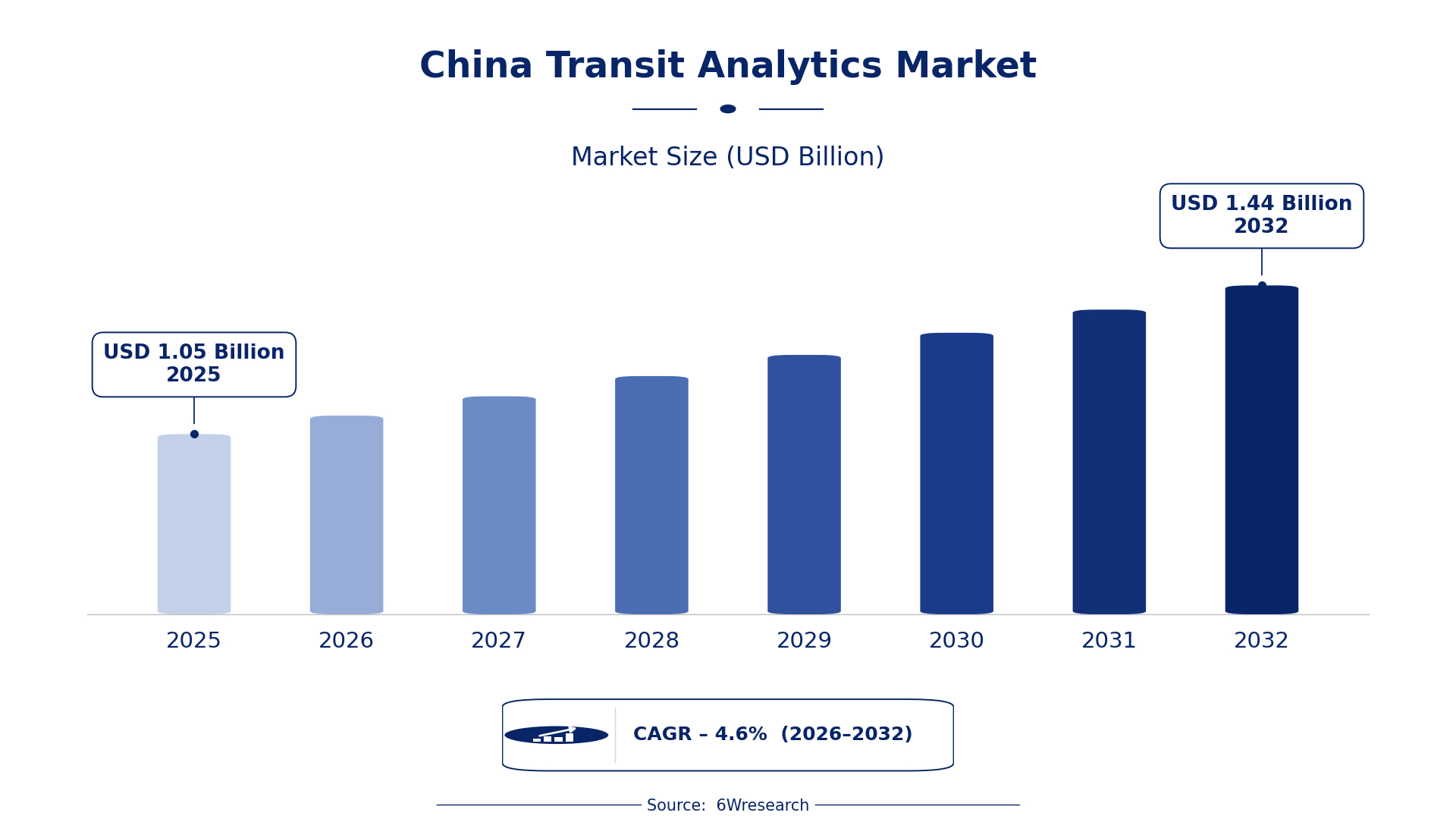
According to 6Wresearch internal database and industry insights, the China Transit Analytics Market was valued at USD 1.05 billion in 2025 and is projected to reach USD 1.44 billion by 2032, growing at a CAGR of approximately 4.6% during 2026–2032.
China Transit Analytics Market Highlights
| Report Metric | Details |
| Report Name | China Transit Analytics Market |
| Market Size 2025 | USD 1.05 billion |
| Market Size 2032 | USD 1.44 billion |
| Absolute Growth 2025–2032 | USD 0.39 billion |
| CAGR 2026–2032 | 4.6% |
| Peak Annual Growth | 7.2% in 2026 |
| Forecast Period | 2026–2032 |
| Historical Data | 2022–2025 |
| Base Year | 2025 |
| Leading Analytics Type, 2025 | Operational Analytics (35% share) |
| Leading Data Focus, 2025 | Scheduling Efficiency (37% share) |
| Leading Application Area, 2025 | Metro Systems (44% share) |
| Leading End User, 2025 | City Transit Authorities (38% share) |
| Fastest-Growing Analytics Type | Predictive Analytics (6.5% CAGR) |
| Fastest-Growing Data Focus | Revenue Optimization (7.0% CAGR) |
| Fastest-Growing Application Area | Rail & Bus Fleets (5.9% CAGR) |
| Fastest-Growing End User | Transport Planners (6.6% CAGR) |
| Growing Sector | Rail & Bus Fleets |
| Key End Users | Metro Systems, Rail & Bus Fleets, Station Management, Public Transport |
China Transit Analytics Market Year-wise Growth Rate and Key Drivers (2022–2032)
This graph illustrates the annual growth rates of the market from 2022 to 2032, highlighting a steady upward trajectory and projected market expansion over the forecast period.
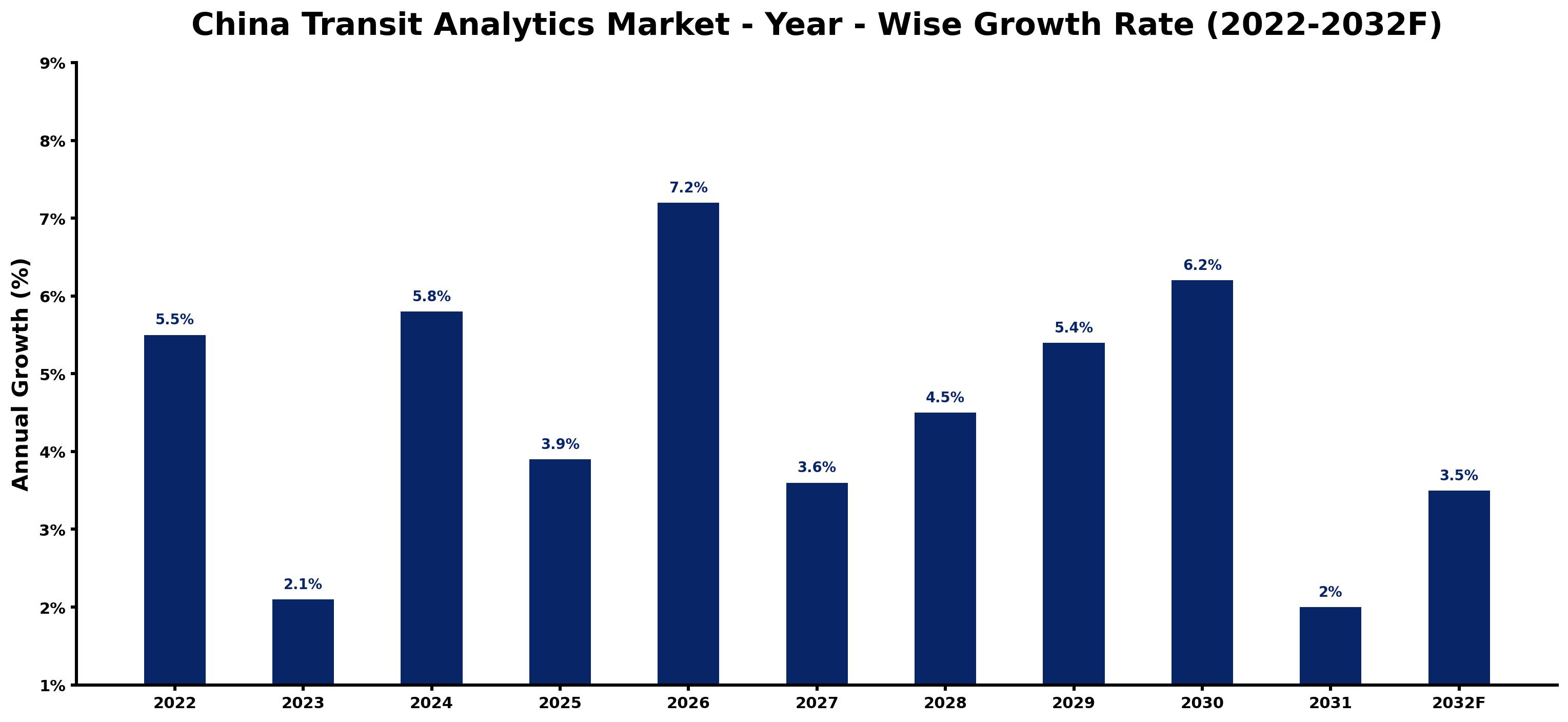
Year by year, the estimates below pair each growth rate with the development that shaped it.
| Year | Estimated Annual Growth (%) | Market Rationale |
| 2022 | 5.5 | The urban population reached 64%, increasing the demand for efficient transit solutions. |
| 2023 | 2.1 | Growth slowed due to ongoing adjustments in the Smart Public Transport initiative. |
| 2024 | 5.8 | The market rebounded as urban transit authorities implemented more data-driven solutions. |
| 2025 | 3.9 | Demand growth slowed as local governments reassessed transit analytics investments. |
| 2026 | 7.2 | The peak growth year saw strong adoption of predictive analytics across major cities. |
| 2027 | 3.6 | Growth slowed as the market matured and competition intensified among analytics providers. |
| 2028 | 4.5 | Demand increased again as urban mobility managers sought to improve service delivery. |
| 2029 | 5.4 | Growth continued as city transit authorities expanded their analytics capabilities. |
| 2030 | 6.2 | The market grew as the National Development and Reform Commission promoted smart transit solutions. |
| 2031 | 2.0 | Growth slowed as the focus shifted to optimizing existing analytics systems. |
| 2032 | 3.5 | Demand increased as local governments invested in advanced transit analytics solutions. |
Note: Market size estimations and growth projections presented in this report are based on 6Wresearch's proprietary forecasting methodology, utilizing the latest available industry data, government publications, and primary research inputs.
China Transit Analytics Market Synopsis
Transit Analytics in China involves the use of data analysis technologies to improve public transportation systems. It integrates data from various sources to improve operational efficiency and predict passenger demand. The China Transit Analytics Market is expanding due to the urban population reaching 64% and the government's push for smart transit solutions. Initiatives like the 'Smart Public Transport' programme are driving demand for advanced analytics. With over 200 million daily public transport users, the need for effective transit management solutions is critical.
Market Dynamics Impact Analysis (2026–2032)
| Factor | Type | Impact | Primary Segment Affected |
| Urban population growth drives demand for efficient transit solutions. | Driver | High | Passenger Flow Analytics |
| The 'Smart Public Transport' initiative promotes data-driven decision-making. | Driver | High | Operational Analytics |
| Investment in transit analytics is increasing among local governments. | Opportunity | High | Predictive Analytics |
| The adoption of AI-driven analytics is expected to rise by 2025. | Opportunity | High | Fare Analytics |
| Budget constraints limit the implementation of advanced analytics solutions. | Restraint | Medium | Scheduling Efficiency |
| The complexity of integrating multiple data sources poses challenges. | Restraint | Medium | Maintenance Forecasting |
| Competition among analytics providers can lead to pricing pressures. | Challenge | Medium | Rail & Bus Fleets |
| Regulatory compliance can delay the adoption of new technologies. | Challenge | Medium | Metro Systems |
Evaluation of Drivers in China Transit Analytics Market (2026–2032)
Key forces behind demand, with the segment each one moves most, are listed below.
| Drivers | Primary Segment Affected | Why It Matters (Evidence) |
| Urban population growth | Passenger Flow Analytics | In 2022, 64% of China's population lived in urban areas, increasing the need for passenger flow analytics to manage transit systems. |
| Smart Public Transport initiative | Operational Analytics | Launched in 2021, this initiative aims to improve urban mobility, driving demand for operational analytics solutions. |
| Investment in transit analytics | Predictive Analytics | In 2023, local governments invested significantly in predictive analytics to forecast passenger demand and optimize services. |
| AI-driven analytics adoption | Fare Analytics | By 2025, the public transport sector is projected to adopt AI-driven analytics, improving fare optimization strategies. |
| Daily ridership growth | Scheduling Efficiency | With over 200 million daily public transport users, the need for scheduling efficiency analytics is critical. |
Urban transit authorities are investing in predictive analytics, with 80% of major cities already implementing these solutions. The average daily ridership of Beijing's metro system exceeds 10 million passengers, highlighting the need for effective scheduling and fare analytics. As urban mobility managers seek to improve service delivery, the demand for advanced analytics continues to rise.
Evaluation of Restraints in China Transit Analytics Market
The following restraints limit how fast demand can grow.
| Market Restraint | Primary Segment Affected | Why It Matters (Evidence) |
| Budget constraints limit advanced analytics implementation. | Scheduling Efficiency | In 2023, local governments faced budget limitations, hindering investments in advanced scheduling analytics. |
| Complex data integration poses challenges. | Maintenance Forecasting | In 2023, the integration of multiple data sources complicated maintenance forecasting efforts for transit authorities. |
| Regulatory compliance delays new technology adoption. | Metro Systems | Compliance with the National Standard for Public Transport Systems can slow the implementation of new analytics technologies. |
| Limited awareness of analytics benefits among stakeholders. | Passenger Flow Analytics | In 2023, some local governments remained unaware of the potential benefits of passenger flow analytics, limiting adoption. |
| Competition leads to pricing pressures among providers. | Rail & Bus Fleets | Increased competition among analytics providers can drive down prices, affecting profitability. |
China Transit Analytics Market Challenges
The China Transit Analytics Market encounters regulatory hurdles that impede technology adoption, as compliance with the National Standard for Public Transport Systems can delay project approvals by up to six months for local governments. Many transit authorities face challenges with technology integration, leading to inefficiencies that affect service delivery for the 200 million daily public transport users. Supply chain issues arise from outdated infrastructure, restricting the deployment of advanced analytics solutions and raising operational costs for urban transit authorities. High initial investments discourage local governments from upgrading systems, potentially resulting in millions in lost revenue opportunities.
Trends in the China Transit Analytics Market
Several trends are reshaping the China Transit Analytics Market; the most important are set out below.
- Shift to AI-Driven Analytics in Public Transport: In 2025, the public transport sector is set to adopt AI-driven analytics, improving operational efficiency. This shift is supported by the National Development and Reform Commission's focus on smart transit solutions, targeting a 30% efficiency increase.
- Transition from Traditional to Predictive Analytics: The adoption of predictive analytics is increasing, with 80% of major cities implementing these solutions. This trend is driven by urban transit authorities seeking to optimize service schedules and improve passenger experiences.
- Emergence of Data-Driven Fare Structures: In 2023, Shanghai introduced a new fare structure based on data analytics to improve revenue. This approach reflects a growing trend among city transit authorities to optimize pricing strategies using passenger data.
- Increased Focus on Scheduling Efficiency: The need for improved scheduling efficiency is rising as urban populations grow. Local governments are prioritizing analytics solutions to improve the reliability of transit services.
Investment Opportunities in the China Transit Analytics Market
Some of the investment opportunities in the China Transit Analytics Market are mentioned below.
- Timing for Investment in Predictive Analytics: With 80% of major cities embracing predictive analytics, now is an opportune moment to invest in these solutions. Local governments are key buyers, eager to optimise service schedules and enhance passenger experiences.
- Supply of Advanced Fare Analytics Solutions: The rollout of AI-driven fare analytics solutions is timely as cities aim to boost revenue. City transit authorities are seeking effective pricing strategies informed by data-driven insights.
- Focus on Rail & Bus Fleet Management: Investment opportunities abound in rail and bus fleet management analytics as local governments strive to improve operational efficiency. Collaborating with city transit authorities can facilitate market entry.
- Entry into Urban Mobility Management: The increasing focus on urban mobility management offers opportunities for analytics providers. Partnering with transport planners can aid in implementing effective data-driven solutions.
Government Initiatives in the China Transit Analytics Market
The 'Public Transport Digitalization Strategy' launched by the Ministry of Transport in 2023 seeks to enhance service efficiency through advanced analytics. This strategy allocates funding for local governments to implement transit analytics solutions. Local authorities can apply for support to develop infrastructure that integrates analytics into public transport systems, improving operational management. The Urban Transport Research Institute's guidelines encourage local governments to adopt analytics for better transit management and decision-making.
The Urban Transport Research Institute advocates for the integration of analytics into transit systems through its 2023 guidelines. Local governments can seek funding to bolster their transit management capabilities, ensuring that analytics solutions align with urban mobility goals. This support enables city transit authorities to make data-driven decisions that improve service delivery and operational efficiency.
Future Insight of the China Transit Analytics Market
By 2032, buyers and suppliers in the China Transit Analytics Market will transition towards AI-driven analytics, propelled by government initiatives like the 14th Five-Year Plan focused on urban mobility. The implementation of smart fare structures, such as Shanghai's new model, will optimise revenue generation for transit authorities. With $1 billion allocated in 2023 for urban transit improvements, infrastructure will facilitate better integration of advanced analytics. The emphasis on sustainable practices under the 'Green Transport' initiative will further reinforce the importance of data analysis in public transport systems.
Market Segmentation Analysis
The analysis below covers each segmentation, its leading category in 2025 and its fastest-growing category through 2032.
By Analytics Type – Operational Analytics Dominated, Predictive Analytics Expected to Grow Fastest
According to Vasudha, AM at 6Wresearch, Operational Analytics took a 35% share of analytics type in 2025, more than any other category. Operational Analytics commands the largest share due to its critical role in real-time monitoring and decision-making for transit operations. With a daily ridership of over 200 million public transport users, this analytics type is essential for maintaining service efficiency. Predictive Analytics is set to record the highest CAGR in this split, 6.5% over 2026–2032. Predictive Analytics is experiencing rapid growth as it enables transit authorities to forecast passenger demand and optimise service schedules. The fact that 80% of major cities are implementing predictive analytics highlights its increasing importance in urban transit management. Suppliers should focus on enhancing predictive analytics capabilities to meet the growing needs of transit authorities.
By Data Focus – Scheduling Efficiency Dominated, Revenue Optimization Expected to Grow Fastest
The largest data focus category in 2025 was Scheduling Efficiency, with a 37% share of total revenue. Scheduling Efficiency leads in market share as it significantly enhances the timeliness and reliability of transit services. With metro systems operating over 7,000 kilometers, effective scheduling is vital for managing operations efficiently. The quickest growth will come from Revenue Optimization, forecast to expand at a CAGR of 7.0% between 2026 and 2032. Revenue Optimization is swiftly growing as transit systems adopt data-driven pricing strategies to maximise revenue. The recent introduction of a new fare structure in Shanghai illustrates the urgent need for effective revenue optimisation in public transport. Buyers should prioritise investments in data solutions that improve revenue optimisation to ensure financial sustainability.
By Application Area – Metro Systems Dominated, Rail & Bus Fleets Expected to Grow Fastest
In 2025, Metro Systems led the application area split with a 44% share. Metro Systems dominate the market share due to their complexity and the need for effective management of urban rail networks. With over 10 million daily riders in Beijing, analytics for metro systems is critical for operational success. Rail & Bus Fleets are projected to grow fastest, at a CAGR of 5.9% during 2026–2032. Rail & Bus Fleets are experiencing the fastest growth as they are key to improving operational efficiency and service delivery. The increasing emphasis on integrating analytics within these fleets reflects a broader trend towards smarter transit solutions. Suppliers should focus on developing analytics capabilities tailored for rail and bus fleets.
By End User – City Transit Authorities Dominated, Transport Planners Expected to Grow Fastest
With a 38% revenue share in 2025, City Transit Authorities was the largest end user category. City Transit Authorities represent the largest share as they are the primary users of analytics for strategic planning and operations. Their role in managing urban mobility for millions of passengers underscores the importance of analytics in this sector. Over 2026–2032, Transport Planners are expected to post the fastest growth, at a CAGR of 6.6%. Transport Planners are growing rapidly in importance as they utilise analytics for effective transport system design, driven by the need for improved urban mobility solutions. Their increasing engagement in analytics reflects a shift towards data-driven decision-making. Buyers must engage with transport planners to ensure their analytics solutions align with evolving urban transport needs.
Key Attractiveness of the Report
- 10 Years of Market Numbers
- Historical Data Starting from 2022 to 2025
- Base Year 2025
- Forecast Data until 2032
- Key Performance Indicators Impacting the Market
- Major Upcoming Developments and Projects
Key Highlights of the Report:
- China Transit Analytics Market Outlook
- Market Size of China Transit Analytics Market, 2025
- Forecast of China Transit Analytics Market, 2032
- Historical Data and Forecast of China Transit Analytics Revenues & Volume for the Period 2022 - 2032F
- China Transit Analytics Market Trend Evolution
- China Transit Analytics Market Drivers and Challenges
- China Transit Analytics Price Trends
- China Transit Analytics Porter's Five Forces
- China Transit Analytics Industry Life Cycle
- Historical Data and Forecast of China Transit Analytics Market Revenues & Volume By Analytics Type for the Period 2022 - 2032F
- Historical Data and Forecast of China Transit Analytics Market Revenues & Volume By Operational Analytics for the Period 2022 - 2032F
- Historical Data and Forecast of China Transit Analytics Market Revenues & Volume By Predictive Analytics for the Period 2022 - 2032F
- Historical Data and Forecast of China Transit Analytics Market Revenues & Volume By Passenger Flow Analytics for the Period 2022 - 2032F
- Historical Data and Forecast of China Transit Analytics Market Revenues & Volume By Fare Analytics for the Period 2022 - 2032F
- Historical Data and Forecast of China Transit Analytics Market Revenues & Volume By Data Focus for the Period 2022 - 2032F
- Historical Data and Forecast of China Transit Analytics Market Revenues & Volume By Scheduling Efficiency for the Period 2022 - 2032F
- Historical Data and Forecast of China Transit Analytics Market Revenues & Volume By Maintenance Forecasting for the Period 2022 - 2032F
- Historical Data and Forecast of China Transit Analytics Market Revenues & Volume By Footfall Data for the Period 2022 - 2032F
- Historical Data and Forecast of China Transit Analytics Market Revenues & Volume By Revenue Optimization for the Period 2022 - 2032F
- Historical Data and Forecast of China Transit Analytics Market Revenues & Volume By Application Area for the Period 2022 - 2032F
- Historical Data and Forecast of China Transit Analytics Market Revenues & Volume By Metro Systems for the Period 2022 - 2032F
- Historical Data and Forecast of China Transit Analytics Market Revenues & Volume By Rail & Bus Fleets for the Period 2022 - 2032F
- Historical Data and Forecast of China Transit Analytics Market Revenues & Volume By Station Management for the Period 2022 - 2032F
- Historical Data and Forecast of China Transit Analytics Market Revenues & Volume By Public Transport for the Period 2022 - 2032F
- Historical Data and Forecast of China Transit Analytics Market Revenues & Volume By End User for the Period 2022 - 2032F
- Historical Data and Forecast of China Transit Analytics Market Revenues & Volume By City Transit Authorities for the Period 2022 - 2032F
- Historical Data and Forecast of China Transit Analytics Market Revenues & Volume By Transport Planners for the Period 2022 - 2032F
- Historical Data and Forecast of China Transit Analytics Market Revenues & Volume By Urban Mobility Managers for the Period 2022 - 2032F
- Historical Data and Forecast of China Transit Analytics Market Revenues & Volume By Local Governments for the Period 2022 - 2032F
- China Transit Analytics Import Export Trade Statistics
- Market Opportunity Assessment By Analytics Type
- Market Opportunity Assessment By Data Focus
- Market Opportunity Assessment By Application Area
- Market Opportunity Assessment By End User
- China Transit Analytics Top Companies Market Share
- China Transit Analytics Competitive Benchmarking By Technical and Operational Parameters
- China Transit Analytics Company Profiles
- China Transit Analytics Key Strategic Recommendations
Market Covered
The report offers an extensive study of the following market segments.
By Analytics Type
- Operational Analytics
- Predictive Analytics
- Passenger Flow Analytics
- Fare Analytics
By Data Focus
- Scheduling Efficiency
- Maintenance Forecasting
- Footfall Data
- Revenue Optimization
By Application Area
- Metro Systems
- Rail & Bus Fleets
- Station Management
- Public Transport
By End User
- City Transit Authorities
- Transport Planners
- Urban Mobility Managers
- Local Governments































