China Two-Wheeler Sharing Market Size & Growth Rate
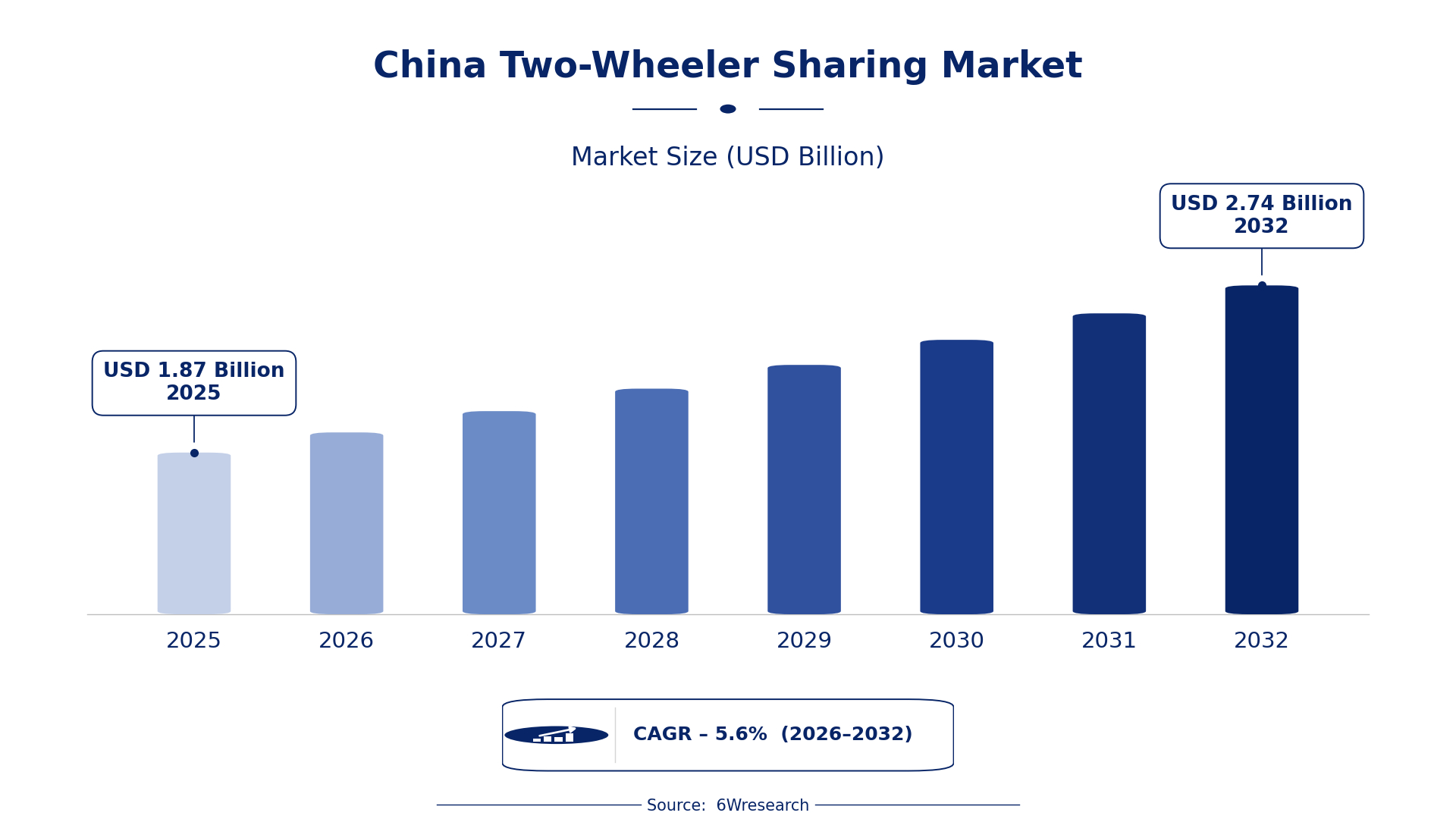
According to 6Wresearch internal database and industry insights, the China Two-Wheeler Sharing Market was valued at USD 1.87 billion in 2025 and is projected to reach USD 2.74 billion by 2032, growing at a CAGR of approximately 5.6% during 2026–2032.
China Two-Wheeler Sharing Market Highlights
| Report Metric | Details |
| Report Name | China Two-Wheeler Sharing Market |
| Market Size 2025 | USD 1.87 billion |
| Market Size 2032 | USD 2.74 billion |
| Absolute Growth 2025–2032 | USD 0.87 billion |
| CAGR 2026–2032 | 5.6% |
| Peak Annual Growth | 7.9% in 2027 |
| Forecast Period | 2026–2032 |
| Historical Data | 2022–2025 |
| Base Year | 2025 |
| Leading Sharing Type, 2025 | Dockless Scooters (39% share) |
| Leading Power Source, 2025 | Electric (61% share) |
| Leading Distribution Channel, 2025 | Mobile App Platforms (39% share) |
| Leading End User Industry, 2025 | Commuters (36% share) |
| Fastest-Growing Sharing Type | Kick-Scooters (7.7% CAGR) |
| Fastest-Growing Power Source | Commuter E-Bikes (7.0% CAGR) |
| Fastest-Growing End User Industry | Students/Urban Users (8.3% CAGR) |
| Growing Sector | Students/Urban Users |
| Key End Users | Commuters, Students/Urban Users, Short Trip Users, Corporate Clients |
China Two-Wheeler Sharing Market Year-wise Growth Rate and Key Drivers (2022–2032)
This graph illustrates the annual growth rates of the market from 2022 to 2032, highlighting a steady upward trajectory and projected market expansion over the forecast period.
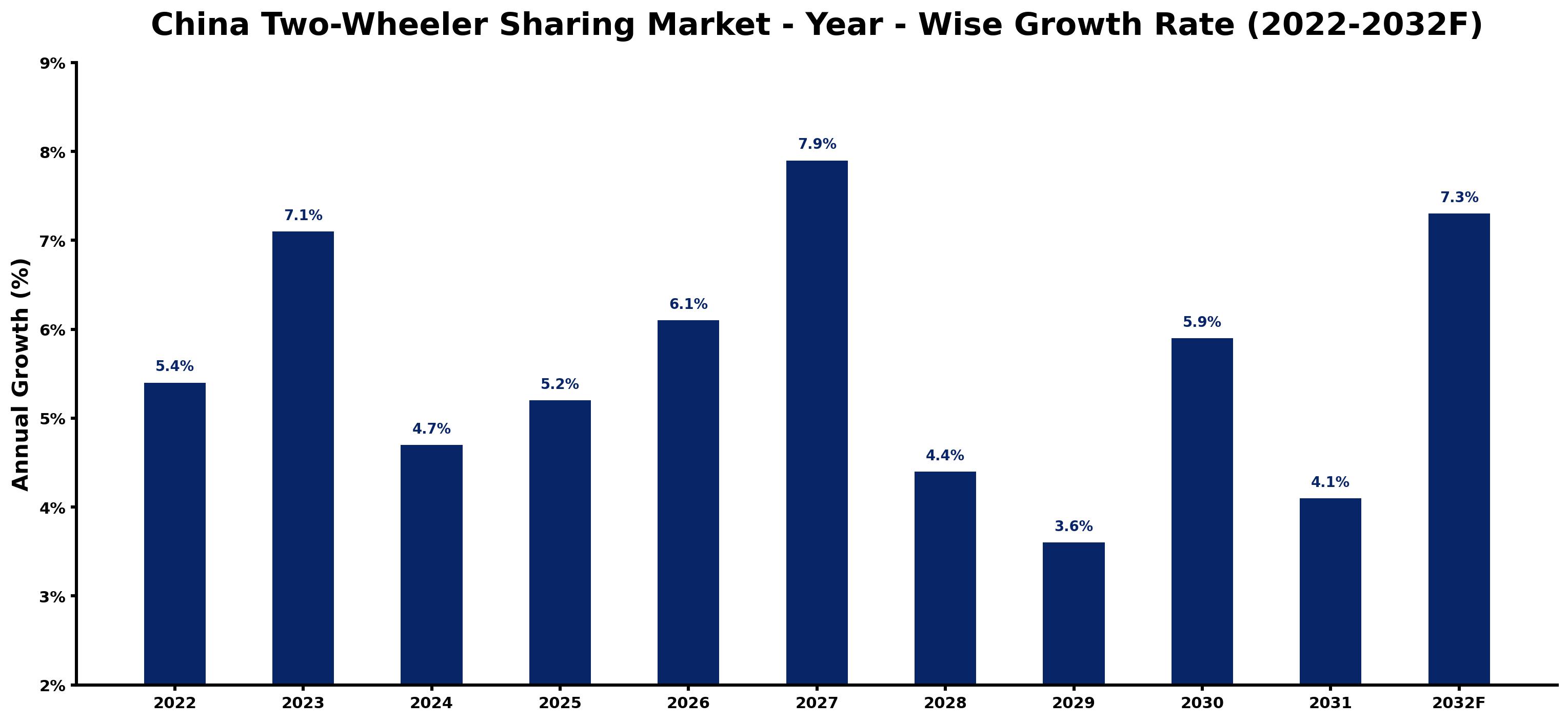
Annual growth estimates for each year appear below with the principal reason behind them, explaining the shifts that set the pace of the market.
| Year | Estimated Annual Growth (%) | Market Rationale |
| 2022 | 5.4 | The market showed a solid growth rate due to increasing urbanisation and commuter reliance on shared mobility. |
| 2023 | 7.1 | Demand surged as major cities expanded their two-wheeler sharing networks and improved infrastructure. |
| 2024 | 4.7 | Growth slowed as market maturity set in, with fewer new users joining the existing platforms. |
| 2025 | 5.2 | A recovery in growth occurred as user engagement strategies were enhanced and services expanded. |
| 2026 | 6.1 | Continued investment in electric vehicles and infrastructure supported a rise in user adoption. |
| 2027 | 7.9 | The peak growth year was driven by significant government initiatives promoting shared mobility. |
| 2028 | 4.4 | Growth slowed as regulatory frameworks began to tighten, impacting new service launches. |
| 2029 | 3.6 | A further slowdown was noted as market saturation limited new user acquisition opportunities. |
| 2030 | 5.9 | Growth rebounded as innovative service models attracted new users and expanded existing fleets. |
| 2031 | 4.1 | The market experienced a slowdown due to increased competition and regulatory challenges. |
| 2032 | 7.3 | Growth accelerated again as urban mobility solutions gained traction and user preferences shifted. |
Note: Market size estimations and growth projections presented in this report are based on 6Wresearch's proprietary forecasting methodology, utilizing the latest available industry data, government publications, and primary research inputs.
China Two-Wheeler Sharing Market Synopsis
Two-Wheeler Sharing in China includes the use of electric scooters and bikes for short-distance travel. These lightweight, eco-friendly vehicles primarily cater to urban commuters and students. The China Two-Wheeler Sharing Market is expanding due to rising urbanisation and supportive government initiatives. With more than 200 million registered users in urban areas, demand is set to increase. The Ministry of Transport's goal to boost shared mobility by 30% by 2025 serves as a major growth driver.
Market Dynamics Impact Analysis (2026–2032)
| Factor | Type | Impact | Primary Segment Affected |
| Urban commuter demand for eco-friendly transport options is rising. | Driver | High | Commuters |
| Government initiatives promote electric vehicle adoption in shared mobility. | Driver | High | Electric |
| The growing popularity of electric scooters presents investment opportunities. | Opportunity | High | Dockless Scooters |
| The integration of bike-sharing with public transport systems opens new markets. | Opportunity | Medium | Commuter E-Bikes |
| Regulatory changes may limit operational flexibility for sharing services. | Restraint | High | Dockless Scooters |
| Market saturation in urban areas could hinder growth potential. | Restraint | Medium | Kick-Scooters |
| Increased competition from alternative transport modes may impact user retention. | Challenge | High | Electric |
| Rising operational costs for fleet management could pressure profitability. | Challenge | Medium | Fleet Operators |
Evaluation of Drivers in China Two-Wheeler Sharing Market (2026–2032)
Key forces behind demand, with the segment each one moves most, are listed below.
| Drivers | Primary Segment Affected | Why It Matters (Evidence) |
| Rising urbanisation increases the need for convenient transport solutions. | Commuters | In urban areas, over 200 million registered users are seeking efficient travel options. |
| Government support for electric vehicles boosts adoption rates. | Electric | The Ministry of Transport aims to increase shared mobility by 30% by 2025. |
| The popularity of electric scooters drives fleet expansion. | Dockless Scooters | Electric scooters account for over 70% of the sharing fleet in major cities. |
| Integration with public transport improves user convenience. | Commuter E-Bikes | Cities like Hangzhou have successfully merged bike-sharing with public transport, increasing usage. |
| Mobile app platforms facilitate easy access to sharing services. | Mobile App Platforms | These platforms hold a 39% share in the distribution channel for two-wheelers. |
Over 200 million registered users in urban areas are driving demand for convenient transport solutions. The popularity of electric scooters, which represent over 70% of the fleet, is attracting more users. Integration with public transport systems, as seen in cities like Hangzhou, is improving user convenience and expanding the market further.
Evaluation of Restraints in China Two-Wheeler Sharing Market
The main factors holding the market back are set out below.
| Market Restraint | Primary Segment Affected | Why It Matters (Evidence) |
| Regulatory changes may restrict operational flexibility for sharing services. | Dockless Scooters | The updated 'Regulations on the Management of Shared Bicycles' in Beijing impact service offerings. |
| Market saturation in urban areas could limit growth potential. | Kick-Scooters | In major cities, the number of users is stabilising, affecting new service uptake. |
| Increased competition from alternative transport modes may affect user retention. | Electric | The rise of ride-hailing services is drawing users away from two-wheeler sharing. |
| Rising operational costs for fleet management could pressure profitability. | Fleet Operators | Increased maintenance and regulatory compliance costs are impacting profit margins. |
| Limited infrastructure for electric vehicle charging may hinder expansion. | Commuter E-Bikes | Insufficient charging stations in urban areas restrict the growth of electric bike sharing. |
China Two-Wheeler Sharing Market Challenges
In China, urban commuters face rising costs as operational expenses for two-wheeler sharing services increase, potentially leading to fare hikes of up to 15%. A shortage of skilled workers in maintenance and customer service affects service quality, risking a 20% drop in ridership for operators. Compliance with new regulations, such as those introduced in Shanghai for dockless vehicle parking, requires costly adjustments that can delay service expansion by several months. Supply chain disruptions for electric scooter components can cause significant delays in fleet upgrades, impacting service availability for over 200 million registered users.
Trends in the China Two-Wheeler Sharing Market
Four trends stand out in the China Two-Wheeler Sharing Market.
- Shift towards Electric Two-Wheelers: The 'Green Transport Development Plan' launched in 2021 promotes electric two-wheelers, aiming for a more sustainable transport model. Currently, electric scooters account for over 70% of shared vehicles in major cities.
- Integration with Public Transport: Hangzhou is successfully integrating bike-sharing with public transport systems, improving user convenience. This integration has led to a 20% increase in shared bike usage in the city.
- Increased Popularity of Kick-Scooters: Kick-scooters are gaining traction among younger urban users, with a projected CAGR of 7.7% from 2026 to 2032. This trend reflects changing preferences for short-distance travel solutions.
- Expansion of Mobile App Platforms: Mobile app platforms are becoming essential for accessing two-wheeler sharing services, holding a 39% market share. This trend supports increased user engagement and service accessibility.
Investment Opportunities in the China Two-Wheeler Sharing Market
Some of the investment opportunities in the China Two-Wheeler Sharing Market are mentioned below.
- Form Partnerships with Local Operators: With a projected market size of USD 2.74 billion by 2032, forming partnerships with local operators can facilitate market entry and expansion. Collaborating with fleet operators in Beijing can improve service offerings.
- Invest in Charging Infrastructure: As the number of electric bikes grows, investing in charging infrastructure is vital. The target of a 30% increase in shared mobility by 2025 indicates strong demand for charging solutions.
- Leverage Mobile App Technology: The rise of mobile app platforms presents an opportunity to improve user experience. Developing user-friendly apps can attract the 200 million registered users seeking efficient transport options.
- Focus on Urban Commuters: Targeting urban commuters, who represent the largest user group, can drive growth. With over 5 billion trips recorded in 2022, tailored services can meet their specific needs.
Government Initiatives in the China Two-Wheeler Sharing Market
In 2020, the State Council approved the 'Urban Transport Development Strategy', emphasising the role of shared mobility in reducing urban congestion and pollution. This strategy encourages local governments to develop infrastructure that supports two-wheeler sharing services. In 2021, the National Development and Reform Commission launched the 'Green Transport Development Plan' to promote shared mobility solutions, focusing on electric vehicles and infrastructure improvements. This plan aims to create a more sustainable transport environment, targeting a 30% increase in shared mobility by 2025.
The National Development and Reform Commission oversees the implementation of various initiatives, including the 'Shared Mobility Promotion Initiative' introduced in 2022. This initiative aims to increase shared vehicle usage by 25% by 2025 through subsidies and infrastructure support. Additionally, the Ministry of Ecology and Environment initiated the 'Sustainable Urban Mobility Program' in 2022, targeting increased adoption of electric two-wheelers in urban areas. These measures provide funding and support for infrastructure development, ensuring the growth of the two-wheeler sharing market.
Future Insight of the China Two-Wheeler Sharing Market
The two-wheeler sharing market in China will evolve by 2032, driven by initiatives like the Two-Wheeler Sharing Development Program. Integration with public transport systems, as seen in Hangzhou, will enhance user convenience and attract more riders. The Ministry of Transport's target to increase shared mobility by 30% by 2025 will stimulate demand. With over 5 billion trips recorded in 2022, the shift towards eco-friendly transportation options will solidify the market's position as a key player in urban mobility.
Market Segmentation Analysis
The analysis below covers each segmentation, its leading category in 2025 and its fastest-growing category through 2032.
By Sharing Type – Dockless Scooters Dominated, Kick-Scooters Expected to Grow Fastest
According to Vasudha, AM at 6Wresearch, Dockless Scooters accounted for a 39% market share by sharing type in 2025. Dockless scooters dominate the market due to their convenience for urban users, particularly in major cities like Beijing and Shanghai. Their extensive use is reflected in the high number of registered users who rely on them for everyday commuting. Kick-Scooters are projected to grow fastest, at a CAGR of 7.7% during 2026–2032. Kick-scooters are rapidly gaining traction among younger urban users, especially for short trips. This growth is driven by their suitability for the average trip length of approximately 3 kilometers, making them ideal for quick journeys. Suppliers should consider expanding their fleets to include more kick-scooters to cater to the preferences of younger users.
By Power Source – Electric Dominated, Commuter E-Bikes Expected to Grow Fastest
The largest power source category in 2025 was Electric, with a 61% share of total revenue. Electric vehicles represent the primary power source for the majority of two-wheeler sharing services, accounting for over 70% of the fleet in major cities. This widespread adoption aligns with government initiatives promoting sustainable transport solutions. Over 2026–2032, Commuter E-Bikes are expected to post the fastest growth, at a CAGR of 7.0%. Commuter e-bikes are emerging as a popular choice for longer commutes, appealing to users seeking efficient travel options. Their growth is supported by increasing urbanisation and the need for eco-friendly transportation alternatives. Buyers are likely to benefit from a wider selection of commuter e-bikes as demand for longer-distance travel options continues to rise.
By Distribution Channel – Mobile App Platforms Dominated and Is Expected to Record the Fastest Growth
Mobile App Platforms took a 39% share of distribution channel in 2025, more than any other category. Mobile app platforms are crucial for accessing two-wheeler sharing services, allowing users to easily find and rent vehicles. Their importance is underscored by the reliance of over 200 million users on these platforms for a seamless sharing experience. The same category are also set to grow fastest, at a CAGR of 7.0% during 2026–2032. Mobile app platforms are also the fastest growing segment, with continuous improvements enhancing user engagement and service accessibility. This trend ensures that these platforms will remain integral to the two-wheeler sharing market. Suppliers need to invest in app enhancements to improve user experience and stay competitive in the market.
By End User Industry – Commuters Dominated, Students/Urban Users Expected to Grow Fastest
Commuters held a 36% share of the China Two-Wheeler Sharing Market by end user industry in 2025. Commuters form the largest user group for two-wheeler sharing services, driven by their need for efficient transportation solutions in urban settings. The staggering total of over 5 billion trips recorded in 2022 highlights their heavy reliance on these services. The quickest growth will come from Students/Urban Users, forecast to expand at a CAGR of 8.3% between 2026 and 2032. Students and urban users are increasingly adopting two-wheeler sharing services, particularly in densely populated areas. The average user age of 18 to 35 years suggests a growing trend among younger demographics seeking convenient transport options. Suppliers should focus their marketing efforts on attracting students and urban users, as their participation in the sharing economy continues to rise.
Key Attractiveness of the Report
- 10 Years of Market Numbers
- Historical Data Starting from 2022 to 2025
- Base Year 2025
- Forecast Data until 2032
- Key Performance Indicators Impacting the Market
- Major Upcoming Developments and Projects
Key Highlights of the Report:
- China Two-Wheeler Sharing Market Outlook
- Market Size of China Two-Wheeler Sharing Market, 2025
- Forecast of China Two-Wheeler Sharing Market, 2032
- Historical Data and Forecast of China Two-Wheeler Sharing Revenues & Volume for the Period 2022 - 2032F
- China Two-Wheeler Sharing Market Trend Evolution
- China Two-Wheeler Sharing Market Drivers and Challenges
- China Two-Wheeler Sharing Price Trends
- China Two-Wheeler Sharing Porter's Five Forces
- China Two-Wheeler Sharing Industry Life Cycle
- Historical Data and Forecast of China Two-Wheeler Sharing Market Revenues & Volume By Sharing Type for the Period 2022 - 2032F
- Historical Data and Forecast of China Two-Wheeler Sharing Market Revenues & Volume By Dockless Scooters for the Period 2022 - 2032F
- Historical Data and Forecast of China Two-Wheeler Sharing Market Revenues & Volume By Kick-Scooters for the Period 2022 - 2032F
- Historical Data and Forecast of China Two-Wheeler Sharing Market Revenues & Volume By Monthly Plans for the Period 2022 - 2032F
- Historical Data and Forecast of China Two-Wheeler Sharing Market Revenues & Volume By e-Vehicles for Staff for the Period 2022 - 2032F
- Historical Data and Forecast of China Two-Wheeler Sharing Market Revenues & Volume By Power Source for the Period 2022 - 2032F
- Historical Data and Forecast of China Two-Wheeler Sharing Market Revenues & Volume By Electric for the Period 2022 - 2032F
- Historical Data and Forecast of China Two-Wheeler Sharing Market Revenues & Volume By Commuter E-Bikes for the Period 2022 - 2032F
- Historical Data and Forecast of China Two-Wheeler Sharing Market Revenues & Volume By Electric for the Period 2022 - 2032F
- Historical Data and Forecast of China Two-Wheeler Sharing Market Revenues & Volume By Electric for the Period 2022 - 2032F
- Historical Data and Forecast of China Two-Wheeler Sharing Market Revenues & Volume By Distribution Channel for the Period 2022 - 2032F
- Historical Data and Forecast of China Two-Wheeler Sharing Market Revenues & Volume By Mobile App Platforms for the Period 2022 - 2032F
- Historical Data and Forecast of China Two-Wheeler Sharing Market Revenues & Volume By City Mobility Agencies for the Period 2022 - 2032F
- Historical Data and Forecast of China Two-Wheeler Sharing Market Revenues & Volume By Fleet Operators for the Period 2022 - 2032F
- Historical Data and Forecast of China Two-Wheeler Sharing Market Revenues & Volume By B2B Sharing Platforms for the Period 2022 - 2032F
- Historical Data and Forecast of China Two-Wheeler Sharing Market Revenues & Volume By End User Industry for the Period 2022 - 2032F
- Historical Data and Forecast of China Two-Wheeler Sharing Market Revenues & Volume By Commuters for the Period 2022 - 2032F
- Historical Data and Forecast of China Two-Wheeler Sharing Market Revenues & Volume By Students/Urban Users for the Period 2022 - 2032F
- Historical Data and Forecast of China Two-Wheeler Sharing Market Revenues & Volume By Short Trip Users for the Period 2022 - 2032F
- Historical Data and Forecast of China Two-Wheeler Sharing Market Revenues & Volume By Corporate Clients for the Period 2022 - 2032F
- China Two-Wheeler Sharing Import Export Trade Statistics
- Market Opportunity Assessment By Sharing Type
- Market Opportunity Assessment By Power Source
- Market Opportunity Assessment By Distribution Channel
- Market Opportunity Assessment By End User Industry
- China Two-Wheeler Sharing Top Companies Market Share
- China Two-Wheeler Sharing Competitive Benchmarking By Technical and Operational Parameters
- China Two-Wheeler Sharing Company Profiles
- China Two-Wheeler Sharing Key Strategic Recommendations
Market Covered
This report examines the market across the segments below.
By Sharing Type
- Dockless Scooters
- Kick-Scooters
- Monthly Plans
- e-Vehicles for Staff
By Power Source
- Electric
- Commuter E-Bikes
By Distribution Channel
- Mobile App Platforms
- City Mobility Agencies
- Fleet Operators
- B2B Sharing Platforms
By End User Industry
- Commuters
- Students/Urban Users
- Short Trip Users
- Corporate Clients































