China Vehicle AR Interface Market Size & Growth Rate
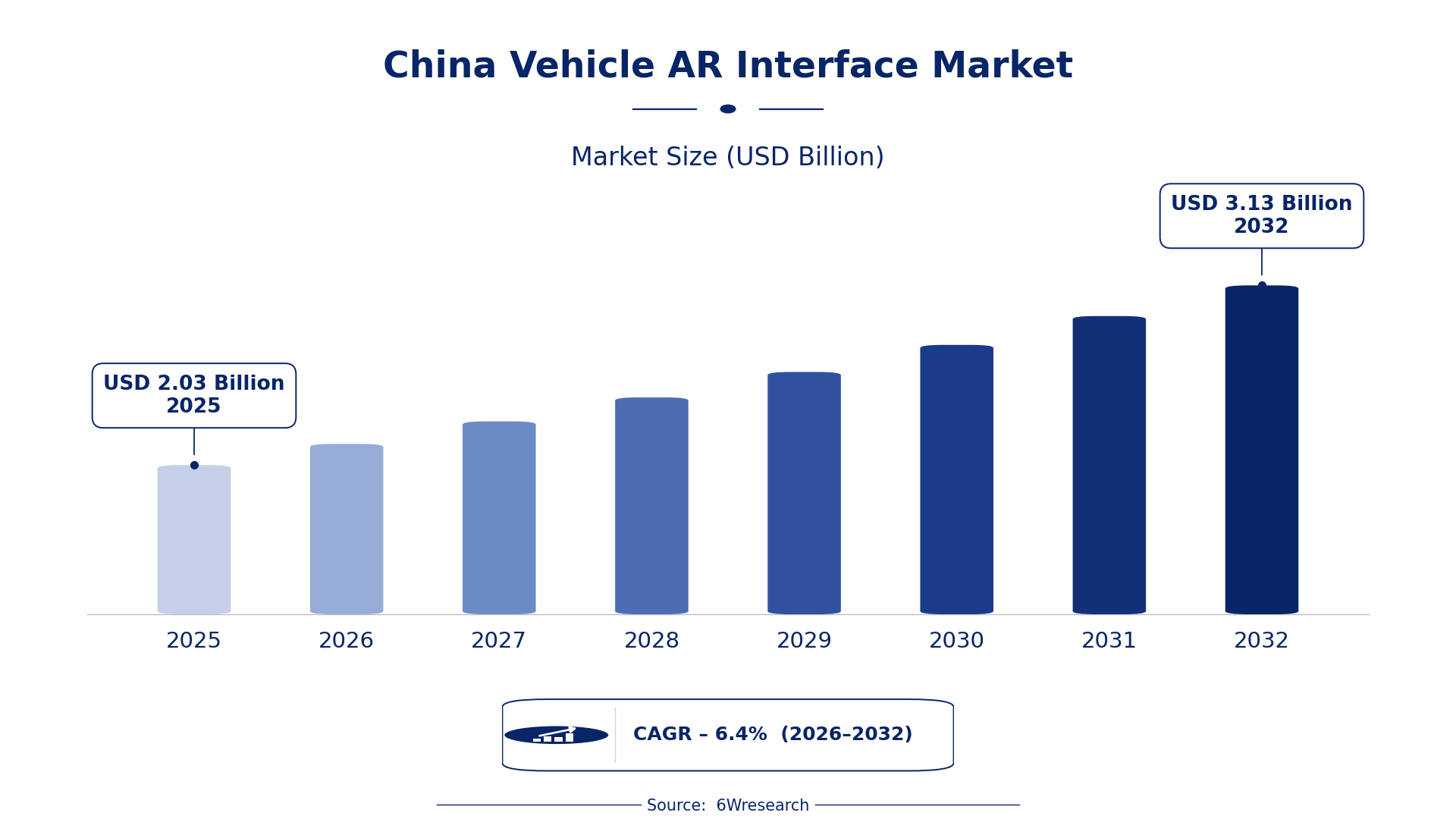
According to 6Wresearch internal database and industry insights, the China Vehicle AR Interface Market was valued at USD 2.03 billion in 2025 and is projected to reach USD 3.13 billion by 2032, growing at a CAGR of approximately 6.4% during 2026–2032.
China Vehicle AR Interface Market Highlights
| Report Metric | Details |
| Report Name | China Vehicle AR Interface Market |
| Market Size 2025 | USD 2.03 billion |
| Market Size 2032 | USD 3.13 billion |
| Absolute Growth 2025–2032 | USD 1.10 billion |
| CAGR 2026–2032 | 6.4% |
| Peak Annual Growth | 8.7% in 2027 |
| Forecast Period | 2026–2032 |
| Historical Data | 2022–2025 |
| Base Year | 2025 |
| Leading Interface Type, 2025 | Head-Up Display (HUD) (48% share) |
| Leading Display Technology, 2025 | Augmented Overlay (51% share) |
| Leading Application, 2025 | Navigation (40% share) |
| Leading End User, 2025 | EV and Premium OEMs (37% share) |
| Fastest-Growing Interface Type | In-Vehicle AR Display (8.6% CAGR) |
| Fastest-Growing Application | Real-Time Driver Info (8.7% CAGR) |
| Fastest-Growing End User | Connected Vehicles (8.8% CAGR) |
| Growing Sector | Electric Vehicles |
| Key End Users | Electric vehicle manufacturers, premium automotive brands, automotive aftermarket providers, technology developers |
China Vehicle AR Interface Market Year-wise Growth Rate and Key Drivers (2022–2032)
This graph illustrates the annual growth rates of the market from 2022 to 2032, highlighting a steady upward trajectory and projected market expansion over the forecast period.
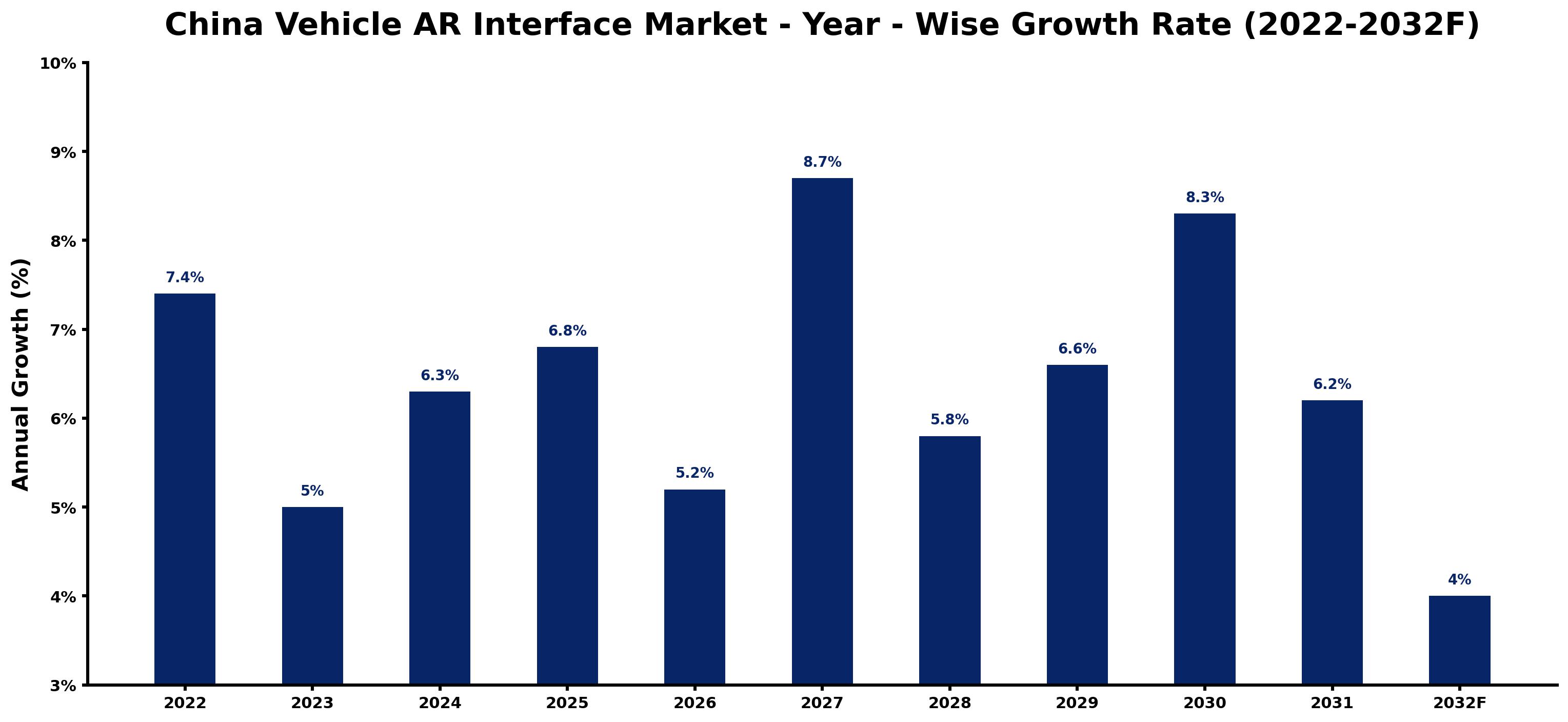
Below, each year's estimated growth is shown next to the factor that most influenced it.
| Year | Estimated Annual Growth (%) | Market Rationale |
| 2022 | 7.4 | The market experienced strong demand from electric vehicle manufacturers and premium automotive brands. |
| 2023 | 5.0 | Growth slowed as the market adjusted to the 'Connected Vehicle Roadmap' and evolving technology standards. |
| 2024 | 6.3 | Demand picked up as the 'Smart Vehicle Development Plan' encouraged more manufacturers to adopt AR technologies in their new models. |
| 2025 | 6.8 | The market continued to grow, driven by the integration of AR in navigation systems. |
| 2026 | 5.2 | Growth slowed again as manufacturers faced challenges in standardising AR interfaces under the National Standard GB/T 34657-2017. |
| 2027 | 8.7 | A surge in demand occurred as new standards for AR technology were implemented, boosting adoption rates. |
| 2028 | 5.8 | The market experienced a slowdown as the focus shifted to improving existing technologies and user experiences. |
| 2029 | 6.6 | Demand increased as more vehicles integrated real-time driver information capabilities, enhancing safety features. |
| 2030 | 8.3 | Growth accelerated with advancements in AR technology and increased consumer interest in smart vehicles. |
| 2031 | 6.2 | The market slowed as manufacturers consolidated their AR offerings and focused on quality improvements. |
| 2032 | 4.0 | Growth slowed further as the market matures and competition intensifies, affecting pricing strategies. |
Note: Market size estimations and growth projections presented in this report are based on 6Wresearch's proprietary forecasting methodology, utilizing the latest available industry data, government publications, and primary research inputs.
China Vehicle AR Interface Market Synopsis
The China Vehicle AR Interface Market encompasses technologies that enhance driving experiences through augmented reality displays. These interfaces utilise advanced optics, sensors, and software integration, primarily for navigation assistance and real-time driver information. Growth in this market stems from increasing demand among electric vehicle manufacturers and premium automotive brands, with an AR adoption rate of about 30% in urban premium vehicles. Government initiatives, such as the 'Smart Vehicle Development Plan', encourage AR integration in vehicles, leading to substantial investments and advancements in this sector.
Market Dynamics Impact Analysis (2026–2032)
| Factor | Type | Impact | Primary Segment Affected |
| Increasing integration of AR technology in navigation systems | Driver | High | Navigation |
| Growing demand for real-time driver information in vehicles | Driver | High | Real-Time Driver Info |
| Rising investments in smart transportation initiatives | Opportunity | High | EV and Premium OEMs |
| Expansion of automotive hubs focusing on AR technology | Opportunity | Medium | Head-Up Display (HUD) |
| Challenges in standardising AR interfaces across manufacturers | Restraint | High | Head-Up Display (HUD) |
| Limited consumer awareness of AR technology benefits | Restraint | Medium | In-Vehicle AR Display |
| High development costs for AR technology integration | Challenge | High | Augmented Overlay |
| Competition from alternative navigation technologies | Challenge | Medium | Embedded Screen |
Evaluation of Drivers in China Vehicle AR Interface Market (2026–2032)
Below mentioned are some major drivers and their influence on market dynamics.
| Drivers | Primary Segment Affected | Why It Matters (Evidence) |
| Increased production of electric vehicles | EV and Premium OEMs | China's automotive industry produced over 25 million vehicles in 2022, boosting demand for advanced AR interfaces. |
| Government support for AR technology | Navigation | The 'Smart Vehicle Development Plan' promotes AR integration, driving investments in navigation systems. |
| Rising urbanisation leading to higher vehicle usage | Real-Time Driver Info | With over 300 million registered vehicles, urban areas are increasingly adopting AR for improved driver information. |
| Technological advancements in AR display technologies | Head-Up Display (HUD) | The National Standard GB/T 34657-2017 regulates AR displays, ensuring quality and safety in vehicles. |
| Growing aftermarket interest in AR solutions | In-Vehicle AR Display | The automotive aftermarket in China is valued at 1 trillion CNY, with increasing demand for AR technologies. |
In 2022, the automotive industry produced over 25 million vehicles, driving demand for advanced AR interfaces. The 'Smart Vehicle Development Plan' encourages AR integration, leading to greater investments in navigation systems. Urban areas, with over 300 million registered vehicles, are increasingly adopting AR for improved driver information. Technological advancements in AR display technologies ensure quality and safety in vehicles, further promoting adoption.
Evaluation of Restraints in China Vehicle AR Interface Market
The table below lists the restraints and the evidence behind each.
| Market Restraint | Primary Segment Affected | Why It Matters (Evidence) |
| High development costs for AR technology integration | Augmented Overlay | Producers face substantial costs in developing AR technologies, impacting pricing strategies for consumers. |
| Challenges in standardising AR interfaces across manufacturers | Head-Up Display (HUD) | Inconsistent standards can lead to compatibility issues, limiting widespread adoption among users. |
| Limited consumer awareness of AR technology benefits | In-Vehicle AR Display | Many consumers remain unaware of the advantages of AR, hindering market growth and adoption. |
| Competition from alternative navigation technologies | Navigation | The availability of traditional navigation systems presents a challenge to AR adoption in vehicles. |
| Regulatory hurdles in AR technology implementation | Real-Time Driver Info | Compliance with various regulations can delay the integration of AR systems in new vehicles. |
China Vehicle AR Interface Market Challenges
The China Vehicle AR Interface market still has to solve a few problems, starting with supply chain disruptions that impact producers. These disruptions arise from the reliance on specific components sourced from a limited number of suppliers, which can delay production timelines and increase costs for manufacturers by up to 15%. Technology integration challenges persist, as many producers struggle to implement AR systems effectively, resulting in user experiences that deter buyers and can lead to a 20% drop in sales. Competition from traditional automotive technologies pressures manufacturers to innovate quickly, risking product quality and reliability. Regulatory hurdles, including compliance with the National Standard GB/T 34657-2017, can delay product launches, affecting market entry for new suppliers and stalling potential revenue growth by as much as 10%.
Trends in the China Vehicle AR Interface Market
Below mentioned are some of the trends shaping the China Vehicle AR Interface Market growth.
- Shift from Traditional to AR Navigation Systems: The automotive industry is increasingly adopting AR navigation systems, enhancing user experience. The 'Connected Vehicle Roadmap' introduced in 2022 promotes AR use in smart transportation systems, with 50% of new vehicle models expected to integrate AR by 2025.
- Transition from Basic Displays to Advanced AR Interfaces: A notable shift towards advanced AR interfaces in vehicles is underway, particularly in premium models. The adoption rate of AR in premium vehicles is around 30% in urban areas, reflecting growing consumer demand for improved driving experiences.
- Emergence of Real-Time Driver Information Systems: Real-time driver information systems are becoming standard in new vehicles, driven by consumer demand for safety and convenience. The 'New Energy Vehicle Industry Development Plan' aims to enhance AR applications in EVs by 2025, supporting this trend.
- Integration of AR in Smart Transportation Initiatives: AR technology is being integrated into smart transportation initiatives across major automotive hubs. In 2023, the government allocated 5 billion CNY for smart transportation, including AR technologies, to improve traffic safety and efficiency.
Investment Opportunities in the China Vehicle AR Interface Market
Investors looking at the China Vehicle AR Interface Market should consider the following areas.
- Timing for Investment in AR Navigation: Now is an ideal time to invest in AR navigation solutions, as the market is expanding rapidly. The 'Smart Vehicle Development Plan' encourages innovation, with an expected 50% integration rate of AR in new vehicle models by 2025.
- Growing Demand from EV Manufacturers: Electric vehicle manufacturers are increasingly seeking advanced AR interfaces, creating substantial investment opportunities. With over 25 million vehicles produced in 2022, suppliers can enter this market by partnering with local OEMs.
- Entry into Automotive Aftermarket for AR Solutions: The automotive aftermarket valued at 1 trillion CNY presents opportunities for AR technology suppliers. Engaging with aftermarket service providers can facilitate the introduction of AR solutions to improve vehicle diagnostics.
- Focus on Automotive Hubs for Collaboration: Major automotive hubs like Guangdong and Jiangsu provinces are focusing on AR technology development. Collaborating with local manufacturers in these regions can provide access to a growing market for AR interfaces.
Government Initiatives in the China Vehicle AR Interface Market
The 'Smart Vehicle Development Plan', issued by the Ministry of Industry and Information Technology in 2021, aims to improve AR technology integration in vehicles by 2025. This measure builds on previous regulations by promoting practical AR solutions, ensuring that manufacturers align with national standards for safety and performance. By supporting research and development, the plan encourages companies to invest in AR technologies, ultimately benefiting consumers with improved driving experiences. In 2023, the government allocated 5 billion CNY for smart transportation initiatives, including AR technologies, to enhance road safety and efficiency.
The National Development and Reform Commission oversees the implementation of the 'New Energy Vehicle Industry Development Plan', which includes initiatives for AR technology in electric vehicles. This agency funds projects that promote smart transportation systems, ensuring that manufacturers receive the necessary support to integrate AR technologies. Additionally, the Ministry of Transport introduced the 'Connected Vehicle Roadmap' in 2022, which facilitates the use of AR in smart transportation systems, improving overall road safety. The China Automotive Technology and Research Center also launched a program to standardise AR interfaces, further supporting manufacturers in compliance and integration.
Future Insight of the China Vehicle AR Interface Market
The China Vehicle AR Interface market is expected to evolve significantly by 2032, driven by several key factors. The government's allocation of 5 billion CNY for smart transportation initiatives will promote AR technology adoption across the automotive sector. By 2025, AR technology is projected to be integrated into 50% of new vehicle models, providing buyers with more advanced options. The 'New Energy Vehicle Industry Development Plan' will further support AR applications in electric vehicles, appealing to environmentally conscious consumers. Standardisation efforts by the China Automotive Technology and Research Center will ensure compatibility and safety, benefiting both suppliers and buyers.
Market Segmentation Analysis
The analysis below covers each segmentation, its leading category in 2025 and its fastest-growing category through 2032.
By Interface Type – Head-Up Display (HUD) Dominated, In-Vehicle AR Display Expected to Grow Fastest
According to Bhawna Singh, Assistant Manager at 6Wresearch, Head-Up Display (HUD) accounted for a 48% market share by interface type in 2025. The Head-Up Display (HUD) holds the largest market share due to its widespread use in navigation and alert systems across various vehicle models. This technology is particularly favoured by premium automotive brands, which integrate HUDs to enhance the driving experience and safety. Over 2026–2032, In-Vehicle AR Display is expected to post the fastest growth, at a CAGR of 8.6%. The In-Vehicle AR Display is experiencing rapid growth as it provides immersive experiences for infotainment and diagnostics, appealing to tech-savvy consumers. With the increasing integration of AR in new vehicle models, this segment is set for swift expansion. Suppliers should prioritise the development of HUD technologies to meet the growing demand from premium automotive manufacturers.
By Display Technology – Augmented Overlay Dominated and Is Expected to Record the Fastest Growth
Augmented Overlay took a 51% share of display technology in 2025, more than any other category. Augmented Overlay leads in market share as it significantly enhances real-time data visibility for drivers, making it a preferred choice among manufacturers. Its ability to seamlessly integrate with existing vehicle systems solidifies its strong market position. Its lead should widen, with a projected CAGR of 8.3% during 2026–2032, the highest in this split. The Augmented Overlay is also the fastest-growing segment, driven by its rising adoption in new vehicle models that emphasise user engagement. As more manufacturers implement this technology, its market share is likely to continue increasing. Buyers will benefit from improved safety and user experience as Augmented Overlay technologies become more prevalent in vehicles.
By Application – Navigation Dominated, Real-Time Driver Info Expected to Grow Fastest
With a 40% revenue share in 2025, Navigation was the largest application category. Navigation commands the largest market share as it is crucial for guiding drivers and enhancing road safety. This application is essential for both urban and rural drivers, leading to widespread acceptance and integration. Real-Time Driver Info is set to record the highest CAGR in this split, 8.7% over 2026–2032. Real-Time Driver Info is the fastest-growing application, enhancing situational awareness for drivers and meeting the increasing demand for connected vehicle features. As vehicles advance, this application is expected to gain momentum rapidly. Suppliers must focus on developing real-time driver information systems to align with the evolving needs of modern drivers.
By End User – EV and Premium OEMs Dominated, Connected Vehicles Expected to Grow Fastest
In 2025, EV and Premium OEMs led the end user split with a 37% share. EV and Premium OEMs dominate the market share as they are the primary users of advanced AR technologies, integrating these systems into their high-end models. Their focus on innovation and premium features drives the demand for AR interfaces. Connected Vehicles are projected to grow fastest, at a CAGR of 8.8% during 2026–2032. Connected Vehicles are the fastest-growing end-user segment, as they support connectivity and data sharing in smart vehicles, aligning with current industry trends. This growth reflects the increasing emphasis on vehicle connectivity and smart technology integration. Suppliers should align their offerings with the needs of connected vehicle manufacturers to capture emerging opportunities in the market.
Key Attractiveness of the Report
- 10 Years of Market Numbers
- Historical Data Starting from 2022 to 2025
- Base Year 2025
- Forecast Data until 2032
- Key Performance Indicators Impacting the Market
- Major Upcoming Developments and Projects
Key Highlights of the Report:
- China Vehicle AR Interface Market Outlook
- Market Size of China Vehicle AR Interface Market, 2025
- Forecast of China Vehicle AR Interface Market, 2032
- Historical Data and Forecast of China Vehicle AR Interface Revenues & Volume for the Period 2022 - 2032F
- China Vehicle AR Interface Market Trend Evolution
- China Vehicle AR Interface Market Drivers and Challenges
- China Vehicle AR Interface Price Trends
- China Vehicle AR Interface Porter's Five Forces
- China Vehicle AR Interface Industry Life Cycle
- Historical Data and Forecast of China Vehicle AR Interface Market Revenues & Volume By Interface Type for the Period 2022 - 2032F
- Historical Data and Forecast of China Vehicle AR Interface Market Revenues & Volume By Head-Up Display (HUD) for the Period 2022 - 2032F
- Historical Data and Forecast of China Vehicle AR Interface Market Revenues & Volume By Windshield Display for the Period 2022 - 2032F
- Historical Data and Forecast of China Vehicle AR Interface Market Revenues & Volume By In-Vehicle AR Display for the Period 2022 - 2032F
- Historical Data and Forecast of China Vehicle AR Interface Market Revenues & Volume By Wearable AR for the Period 2022 - 2032F
- Historical Data and Forecast of China Vehicle AR Interface Market Revenues & Volume By Display Technology for the Period 2022 - 2032F
- Historical Data and Forecast of China Vehicle AR Interface Market Revenues & Volume By Projection/Optical Lens for the Period 2022 - 2032F
- Historical Data and Forecast of China Vehicle AR Interface Market Revenues & Volume By Augmented Overlay for the Period 2022 - 2032F
- Historical Data and Forecast of China Vehicle AR Interface Market Revenues & Volume By Embedded Screen for the Period 2022 - 2032F
- Historical Data and Forecast of China Vehicle AR Interface Market Revenues & Volume By Smart Glasses Integration for the Period 2022 - 2032F
- Historical Data and Forecast of China Vehicle AR Interface Market Revenues & Volume By Application for the Period 2022 - 2032F
- Historical Data and Forecast of China Vehicle AR Interface Market Revenues & Volume By Navigation, Speed, Alerts for the Period 2022 - 2032F
- Historical Data and Forecast of China Vehicle AR Interface Market Revenues & Volume By Real-Time Driver Info for the Period 2022 - 2032F
- Historical Data and Forecast of China Vehicle AR Interface Market Revenues & Volume By Infotainment, Diagnostics for the Period 2022 - 2032F
- Historical Data and Forecast of China Vehicle AR Interface Market Revenues & Volume By Fleet & Training Usage for the Period 2022 - 2032F
- Historical Data and Forecast of China Vehicle AR Interface Market Revenues & Volume By End User for the Period 2022 - 2032F
- Historical Data and Forecast of China Vehicle AR Interface Market Revenues & Volume By EV and Premium OEMs for the Period 2022 - 2032F
- Historical Data and Forecast of China Vehicle AR Interface Market Revenues & Volume By Advanced Driver Assist for the Period 2022 - 2032F
- Historical Data and Forecast of China Vehicle AR Interface Market Revenues & Volume By Connected Vehicles for the Period 2022 - 2032F
- Historical Data and Forecast of China Vehicle AR Interface Market Revenues & Volume By Autonomous Test Fleets for the Period 2022 - 2032F
- China Vehicle AR Interface Import Export Trade Statistics
- Market Opportunity Assessment By Interface Type
- Market Opportunity Assessment By Display Technology
- Market Opportunity Assessment By Application
- Market Opportunity Assessment By End User
- China Vehicle AR Interface Top Companies Market Share
- China Vehicle AR Interface Competitive Benchmarking By Technical and Operational Parameters
- China Vehicle AR Interface Company Profiles
- China Vehicle AR Interface Key Strategic Recommendations
Market Covered
The report offers an extensive study of the following market segments.
By Interface Type
- Head-Up Display (HUD)
- Windshield Display
- In-Vehicle AR Display
- Wearable AR
By Display Technology
- Projection/Optical Lens
- Augmented Overlay
- Embedded Screen
- Smart Glasses Integration
By Application
- Navigation
- Speed
- Alerts
- Real-Time Driver Info
- Infotainment
- Diagnostics
- Fleet & Training Usage
By End User
- EV and Premium OEMs
- Advanced Driver Assist
- Connected Vehicles
- Autonomous Test Fleets































