China Vehicle Crash Safety System Market Size & Growth Rate
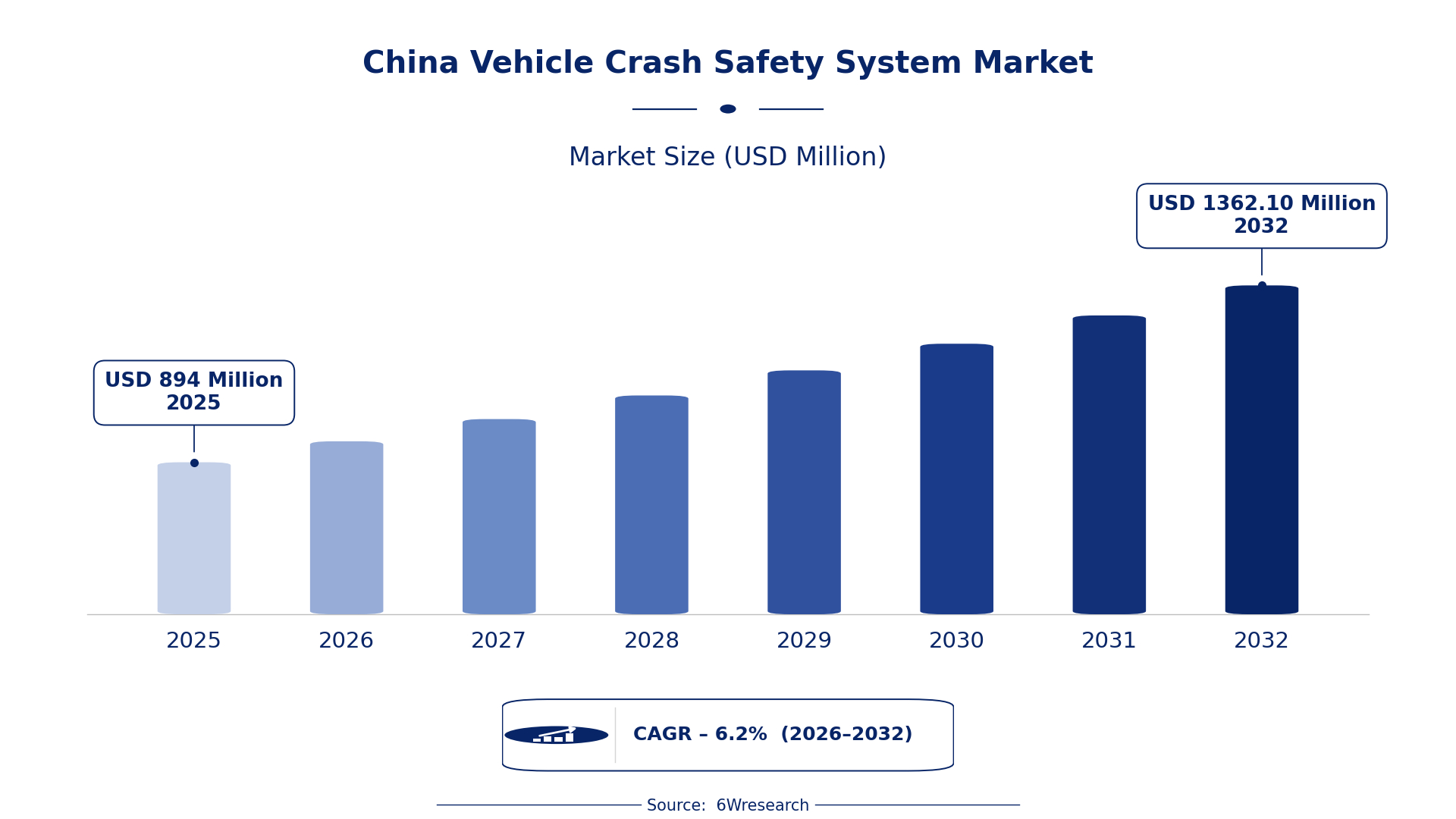
According to 6Wresearch internal database and industry insights, the China Vehicle Crash Safety System Market was valued at USD 894.0 million in 2025 and is projected to reach USD 1,362.10 million by 2032, growing at a CAGR of approximately 6.2% during 2026–2032.
China Vehicle Crash Safety System Market Highlights
| Report Metric | Details |
| Report Name | China Vehicle Crash Safety System Market |
| Market Size 2025 | USD 894.0 million |
| Market Size 2032 | USD 1,362.10 million |
| Absolute Growth 2025–2032 | USD 468.10 million |
| CAGR 2026–2032 | 6.2% |
| Peak Annual Growth | 7.4% in 2028 |
| Forecast Period | 2026–2032 |
| Historical Data | 2022–2025 |
| Base Year | 2025 |
| Leading System Type, 2025 | Airbag Systems (45% share) |
| Leading Activation Mechanism, 2025 | Impact Sensors (41% share) |
| Leading Vehicle Class, 2025 | Passenger Cars (41% share) |
| Leading End User, 2025 | OEMs (43% share) |
| Fastest-Growing System Type | Crash Sensors (8.7% CAGR) |
| Fastest-Growing Activation Mechanism | Accelerometer-Based (8.6% CAGR) |
| Fastest-Growing Vehicle Class | EVs (8.2% CAGR) |
| Fastest-Growing End User | Autonomous Vehicle Makers (8.8% CAGR) |
| Growing Sector | Passenger Cars |
| Key End Users | OEMs, Autonomous Vehicle Makers, Safety Engineering Firms, ADAS Integrators |
China Vehicle Crash Safety System Market Year-wise Growth Rate and Key Drivers (2022–2032)
This graph illustrates the annual growth rates of the market from 2022 to 2032, highlighting a steady upward trajectory and projected market expansion over the forecast period.
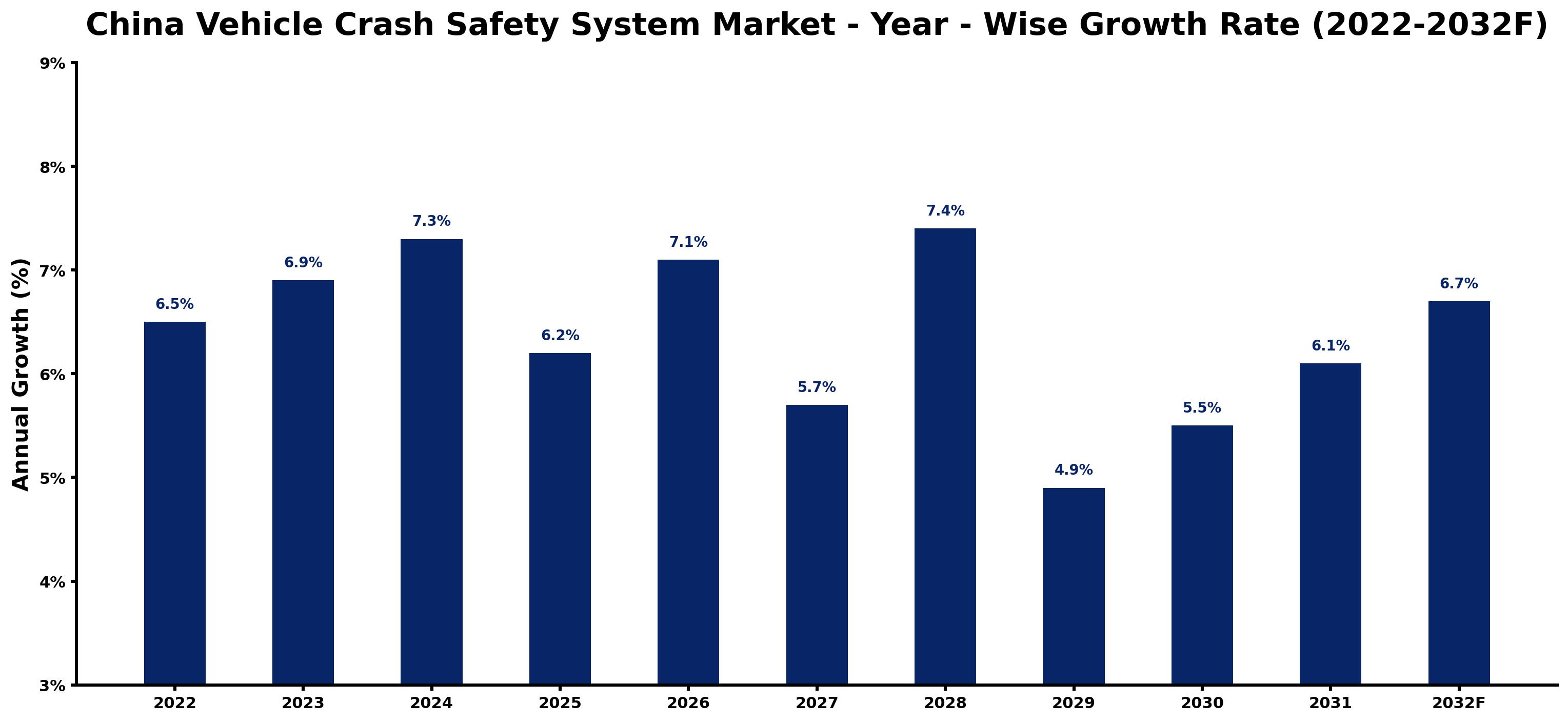
Each row of the following table gives one year's estimated growth and the event or demand shift that explains it.
| Year | Estimated Annual Growth (%) | Market Rationale |
| 2022 | 6.5 | The automotive industry produced 25 million vehicles, indicating strong demand for safety systems. |
| 2023 | 6.9 | The National Road Safety Plan aims to reduce fatalities by 30% by 2030, boosting safety technology needs. |
| 2024 | 7.3 | Airbag systems are mandated in all new passenger vehicles, driving regulatory compliance and demand. |
| 2025 | 6.2 | The market experiences a slowdown as growth stabilises after rapid increases in previous years. |
| 2026 | 7.1 | Investment in electric vehicle safety features is expected to rise, driving overall market demand. |
| 2027 | 5.7 | The market is projected to slow as manufacturers focus on integrating advanced safety technologies in existing models. |
| 2028 | 7.4 | The projected peak growth is driven by the increasing adoption of crash sensors in vehicles. |
| 2029 | 4.9 | Growth is expected to slow as the market matures, with demand stabilising across various vehicle classes. |
| 2030 | 5.5 | A rise in electric vehicle sales continues to push the need for advanced safety systems. |
| 2031 | 6.1 | Demand is expected to increase as autonomous vehicle makers integrate advanced safety features into their designs. |
| 2032 | 6.7 | The market will grow as new safety regulations are introduced, further driving innovation. |
Note: Market size estimations and growth projections presented in this report are based on 6Wresearch's proprietary forecasting methodology, utilizing the latest available industry data, government publications, and primary research inputs.
China Vehicle Crash Safety System Market Synopsis
The Vehicle Crash Safety System in China encompasses advanced technologies designed to protect occupants during collisions. These systems include airbags and sensors, essential for passenger safety and compliance with regulatory standards. Ongoing demand from domestic manufacturers and a growing focus on safety regulations contribute to market growth.
Market Dynamics Impact Analysis (2026–2032)
| Factor | Type | Impact | Primary Segment Affected |
| Increasing production of passenger vehicles drives demand for crash safety systems. | Driver | High | Passenger Cars |
| Rising electric vehicle sales create a need for advanced safety features. | Driver | High | EVs |
| Investment in safety technology integration presents opportunities for suppliers. | Opportunity | High | OEMs |
| The push for compliance with national safety standards opens avenues for innovation. | Opportunity | High | Safety Engineering Firms |
| High costs associated with implementing advanced safety systems can deter manufacturers. | Restraint | Medium | OEMs |
| Supply chain disruptions impact the availability of critical components for safety systems. | Restraint | Medium | Crash Sensors |
| Regulatory approval processes can delay the introduction of new safety technologies. | Challenge | High | ADAS Integrators |
| Competition among safety technology providers can lead to price pressures. | Challenge | Medium | Safety Engineering Firms |
Evaluation of Drivers in China Vehicle Crash Safety System Market (2026–2032)
The main growth drivers and the segments they affect most are set out below.
| Drivers | Primary Segment Affected | Why It Matters (Evidence) |
| Growing production of vehicles increases demand for safety systems. | Passenger Cars | China's automotive industry produced 25 million vehicles in 2022, driving demand for crash safety systems. |
| Investment in electric vehicle technology increases safety features. | EVs | Electric vehicle sales reached 6 million units in 2022, creating a demand for advanced safety technologies. |
| Government regulations mandate safety features in new vehicles. | Airbag Systems | All new passenger vehicles must include airbag systems under national safety regulations, ensuring compliance. |
| The National Road Safety Plan encourages innovation in safety systems. | Crash Sensors | The plan aims to reduce traffic fatalities by 30% by 2030, boosting the need for safety technology. |
| Increased focus on autonomous vehicles drives demand for integrated safety systems. | Autonomous Vehicle Makers | The rise of autonomous vehicle technology necessitates advanced safety systems for compliance. |
The automotive industry produced 25 million vehicles in 2022, driving demand for crash safety systems. Electric vehicle sales reached 6 million units in 2022, creating a need for advanced safety technologies. The National Road Safety Plan aims to reduce traffic fatalities by 30% by 2030, driving demand for safety technology. Focus on autonomous vehicles increases the need for integrated safety systems to meet evolving standards.
Evaluation of Restraints in China Vehicle Crash Safety System Market
The main factors holding the market back are set out below.
| Market Restraint | Primary Segment Affected | Why It Matters (Evidence) |
| High costs of implementing advanced safety systems can deter manufacturers. | OEMs | The investment required for integrating complex safety technologies can be substantial, affecting profitability. |
| Supply chain disruptions impact the availability of critical components for safety systems. | Crash Sensors | Recent global supply chain issues have delayed the production of essential safety components. |
| Regulatory approval processes can delay the introduction of new safety technologies. | ADAS Integrators | Lengthy approval timelines can hinder timely market entry for new safety solutions. |
| Competition among safety technology providers can lead to price pressures. | Safety Engineering Firms | Intense competition may force firms to lower prices, impacting their margins and investment capacity. |
| Limited consumer awareness of advanced safety features can slow adoption rates. | Passenger Cars | Many consumers remain unaware of the benefits of advanced safety systems, affecting purchasing decisions. |
China Vehicle Crash Safety System Market Challenges
Producers in the China Vehicle Crash Safety System market face rising costs due to mandatory airbag integration in new passenger vehicles, which adds approximately $300 to each unit. Buyers encounter challenges from rapidly evolving technology standards, as compliance with the National Standard GB 7258 requires continuous R&D investment, often delaying product launches by six months. Importers experience intense competition from domestic manufacturers, who produced 25 million vehicles in 2022, leading to aggressive pricing strategies that erode profit margins. Suppliers must navigate the increasing operational costs associated with meeting evolving safety regulations, which restrict their ability to invest in new safety innovations.
Trends in the China Vehicle Crash Safety System Market
Four trends stand out in the China Vehicle Crash Safety System Market.
- Shift towards Advanced Safety Features in EVs: China's electric vehicle market is increasingly incorporating advanced safety technologies. In 2022, electric vehicle sales reached 6 million units, prompting manufacturers to enhance safety features, benefiting suppliers of crash safety systems.
- Transition to Smart Safety Systems: Since 2023, a notable shift towards smart safety systems in vehicles has emerged. The 'Smart Vehicle Innovation and Development Strategy' aims to promote investments in new technologies, improving safety features.
- Emergence of New Vehicle Safety Standards: The rise of autonomous vehicles has prompted the development of new safety standards. In 2023, the National Road Safety Plan introduced guidelines for integrating safety systems in self-driving vehicles.
- Growing Demand for Integrated Crash Sensors: The demand for integrated crash sensors has surged, with a projected CAGR of 8.7% from 2026 to 2032. This trend reflects the automotive industry's commitment to enhancing occupant protection during collisions.
Investment Opportunities in the China Vehicle Crash Safety System Market
Below are the investment opportunities with the strongest case in the China Vehicle Crash Safety System Market.
- $10 billion market potential by 2025: The automotive safety market in China is projected to reach $10 billion by 2025, presenting investment opportunities for suppliers of crash safety systems, particularly in passenger vehicles.
- Need for compliance with safety regulations: With the introduction of new safety regulations, OEMs require advanced safety systems to meet compliance. Collaborating with local manufacturers can facilitate market entry.
- Focus on integrating safety features in EVs: The rising sales of electric vehicles create a demand for advanced safety technologies. Suppliers can target OEMs in regions like Shanghai, a hub for automotive innovation.
- Expansion of safety engineering services: Safety Engineering Firms are essential for compliance with national standards. Investing in consulting services can help manufacturers navigate regulatory requirements effectively.
Government Initiatives in the China Vehicle Crash Safety System Market
In 2023, the government launched the 'Smart Vehicle Innovation and Development Strategy' to enhance safety features in vehicles. This initiative builds on the National Standard GB 7258, which governs vehicle safety and crashworthiness. The strategy encourages the integration of advanced safety technologies in new vehicle models, ensuring compliance with safety regulations and improving overall road safety. The initiative aims to reduce traffic fatalities by 30% by 2030, promoting innovation in safety systems.
The Ministry of Industry and Information Technology oversees the implementation of vehicle safety standards. In 2022, the agency approved numerous projects aimed at improving safety features in vehicles, including funding for research and development of crash safety systems. This support ensures that manufacturers meet regulatory requirements while encouraging innovation in safety technologies, benefiting both producers and consumers.
Future Insight of the China Vehicle Crash Safety System Market
The China Vehicle Crash Safety System market will experience notable changes by 2032, driven by the Smart Vehicle Innovation and Development Strategy. This initiative will prioritise the integration of advanced safety technologies across all vehicle types, including collision avoidance systems. As electric vehicle sales continue to rise, suppliers will need to adjust their offerings to meet the growing demand for comprehensive safety solutions.
Market Segmentation Analysis
The analysis below covers each segmentation, its leading category in 2025 and its fastest-growing category through 2032.
By System Type – Airbag Systems Dominated, Crash Sensors Expected to Grow Fastest
According to Bhawna Singh, Assistant Manager at 6Wresearch, Airbag Systems took a 45% share of system type in 2025, more than any other category. Airbag systems are essential for occupant protection during collisions, making them a top choice for manufacturers in China. Their mandated presence in all new passenger vehicles has resulted in a substantial installed base, reflecting their critical role in enhancing safety. Over 2026–2032, Crash Sensors are expected to post the fastest growth, at a CAGR of 8.7%. Crash sensors are experiencing rapid growth driven by an increased emphasis on advanced safety features in vehicles. The government's Smart Vehicle Innovation and Development Strategy is a key factor, significantly boosting demand for these technologies. Suppliers should prioritise the development of crash sensor technologies to align with rising safety standards and consumer demands.
By Activation Mechanism – Impact Sensors Dominated, Accelerometer-Based Expected to Grow Fastest
Impact Sensors held a 41% share of the China Vehicle Crash Safety System Market by activation mechanism in 2025. Impact sensors play a vital role in detecting crash forces, establishing them as the preferred activation mechanism for safety systems. Their proven reliability in real-time crash scenarios contributes to a strong market share among vehicle manufacturers in China. Accelerometer-Based is projected to grow fastest, at a CAGR of 8.6% during 2026–2032. Accelerometer-based systems are rapidly gaining traction as they accurately measure acceleration changes during a crash, enhancing safety response times. This trend is particularly relevant as manufacturers increasingly adopt these technologies in their latest models. Buyers should consider the integration of accelerometer-based systems to significantly improve the effectiveness of their vehicle safety features.
By Vehicle Class – Passenger Cars Dominated, EVs Expected to Grow Fastest
In 2025, Passenger Cars led the vehicle class split with a 41% share. Passenger cars represent the largest segment requiring vehicle crash safety systems due to their high production volume in China. With 25 million vehicles produced in 2022, this class dominates the market share for safety technologies. The quickest growth will come from EVs, forecast to expand at a CAGR of 8.2% between 2026 and 2032. Electric vehicles are rapidly growing in popularity, driven by increased consumer interest and regulatory support for safety features. The surge in EV sales, reaching 6 million units in 2022, propels demand for advanced safety systems tailored for this segment. Suppliers must adapt their offerings to cater to the unique safety requirements of the expanding electric vehicle market.
By End User – OEMs Dominated, Autonomous Vehicle Makers Expected to Grow Fastest
The largest end user category in 2025 was OEMs, with a 43% share of total revenue. OEMs are the primary users of crash safety technologies, as they integrate these systems into their vehicle designs. Their substantial market share reflects the continuous demand for safety compliance within the automotive industry. Autonomous Vehicle Makers are set to record the highest CAGR in this split, 8.8% over 2026–2032. Autonomous vehicle makers are leading the integration of advanced safety systems, which is vital for the evolution of self-driving technologies. This sector's growth is accelerated by an increasing emphasis on safety standards and regulations. Suppliers should prioritise collaborations with autonomous vehicle makers to align with the future of automotive safety advancements.
Key Attractiveness of the Report
- 10 Years of Market Numbers
- Historical Data Starting from 2022 to 2025
- Base Year 2025
- Forecast Data until 2032
- Key Performance Indicators Impacting the Market
- Major Upcoming Developments and Projects
Key Highlights of the Report:
- China Vehicle Crash Safety System Market Outlook
- Market Size of China Vehicle Crash Safety System Market, 2025
- Forecast of China Vehicle Crash Safety System Market, 2032
- Historical Data and Forecast of China Vehicle Crash Safety System Revenues & Volume for the Period 2022 - 2032F
- China Vehicle Crash Safety System Market Trend Evolution
- China Vehicle Crash Safety System Market Drivers and Challenges
- China Vehicle Crash Safety System Price Trends
- China Vehicle Crash Safety System Porter's Five Forces
- China Vehicle Crash Safety System Industry Life Cycle
- Historical Data and Forecast of China Vehicle Crash Safety System Market Revenues & Volume By System Type for the Period 2022 - 2032F
- Historical Data and Forecast of China Vehicle Crash Safety System Market Revenues & Volume By Airbag Systems for the Period 2022 - 2032F
- Historical Data and Forecast of China Vehicle Crash Safety System Market Revenues & Volume By Crash Sensors for the Period 2022 - 2032F
- Historical Data and Forecast of China Vehicle Crash Safety System Market Revenues & Volume By Crumple Zones for the Period 2022 - 2032F
- Historical Data and Forecast of China Vehicle Crash Safety System Market Revenues & Volume By Pre-Crash Systems for the Period 2022 - 2032F
- Historical Data and Forecast of China Vehicle Crash Safety System Market Revenues & Volume By Activation Mechanism for the Period 2022 - 2032F
- Historical Data and Forecast of China Vehicle Crash Safety System Market Revenues & Volume By Impact Sensors for the Period 2022 - 2032F
- Historical Data and Forecast of China Vehicle Crash Safety System Market Revenues & Volume By Accelerometer-Based for the Period 2022 - 2032F
- Historical Data and Forecast of China Vehicle Crash Safety System Market Revenues & Volume By Structural Design for the Period 2022 - 2032F
- Historical Data and Forecast of China Vehicle Crash Safety System Market Revenues & Volume By Radar/Camera Input for the Period 2022 - 2032F
- Historical Data and Forecast of China Vehicle Crash Safety System Market Revenues & Volume By Vehicle Class for the Period 2022 - 2032F
- Historical Data and Forecast of China Vehicle Crash Safety System Market Revenues & Volume By Passenger Cars for the Period 2022 - 2032F
- Historical Data and Forecast of China Vehicle Crash Safety System Market Revenues & Volume By EVs for the Period 2022 - 2032F
- Historical Data and Forecast of China Vehicle Crash Safety System Market Revenues & Volume By SUVs for the Period 2022 - 2032F
- Historical Data and Forecast of China Vehicle Crash Safety System Market Revenues & Volume By High-End Vehicles for the Period 2022 - 2032F
- Historical Data and Forecast of China Vehicle Crash Safety System Market Revenues & Volume By End User for the Period 2022 - 2032F
- Historical Data and Forecast of China Vehicle Crash Safety System Market Revenues & Volume By OEMs for the Period 2022 - 2032F
- Historical Data and Forecast of China Vehicle Crash Safety System Market Revenues & Volume By Autonomous Vehicle Makers for the Period 2022 - 2032F
- Historical Data and Forecast of China Vehicle Crash Safety System Market Revenues & Volume By Safety Engineering Firms for the Period 2022 - 2032F
- Historical Data and Forecast of China Vehicle Crash Safety System Market Revenues & Volume By ADAS Integrators for the Period 2022 - 2032F
- China Vehicle Crash Safety System Import Export Trade Statistics
- Market Opportunity Assessment By System Type
- Market Opportunity Assessment By Activation Mechanism
- Market Opportunity Assessment By Vehicle Class
- Market Opportunity Assessment By End User
- China Vehicle Crash Safety System Top Companies Market Share
- China Vehicle Crash Safety System Competitive Benchmarking By Technical and Operational Parameters
- China Vehicle Crash Safety System Company Profiles
- China Vehicle Crash Safety System Key Strategic Recommendations
Market Covered
This report examines the market across the segments below.
By System Type
- Airbag Systems
- Crash Sensors
- Crumple Zones
- Pre-Crash Systems
By Activation Mechanism
- Impact Sensors
- Accelerometer-Based
- Structural Design
- Radar/Camera Input
By Vehicle Class
- Passenger Cars
- EVs
- SUVs
- High-End Vehicles
By End User
- OEMs
- Autonomous Vehicle Makers
- Safety Engineering Firms
- ADAS Integrators































