France Energy Security Market Size & Growth Rate (2026-2032)
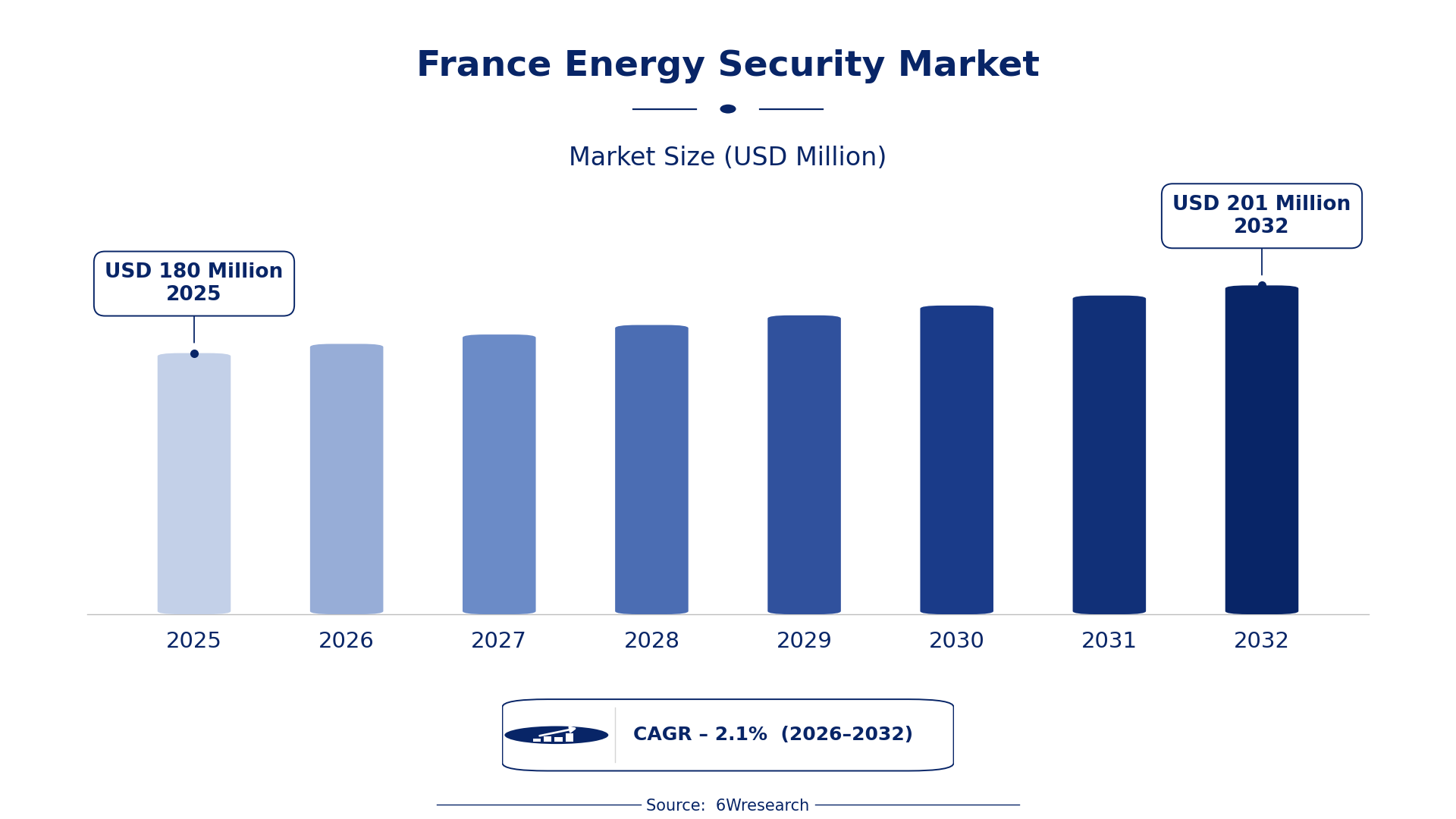
The France Energy Security Market was estimated at USD 180 Million in 2025 and is projected to reach USD 201 Million by 2032, growing at a CAGR of 2.1% from 2026 to 2032.
France Energy Security Market Synopsis
The France Energy Security Market is at a crossroads as the nation emphasizes diversifying its energy sources. With policies focused on enhancing energy independence, the government is committed to reducing reliance on fossil fuels while promoting renewable energy solutions.
Significant investments in solar and wind technologies are crucial to achieving these objectives. The collaboration between various stakeholders, including government entities and private sector players, further strengthens the framework necessary for a resilient energy supply.
France Energy Security Market Year-wise Growth Rate and Key Drivers
This graph illustrates the annual growth rates of the France Energy Security Market from 2021 to 2032, highlighting a steady upward trajectory and projected expansion over the forecast period.
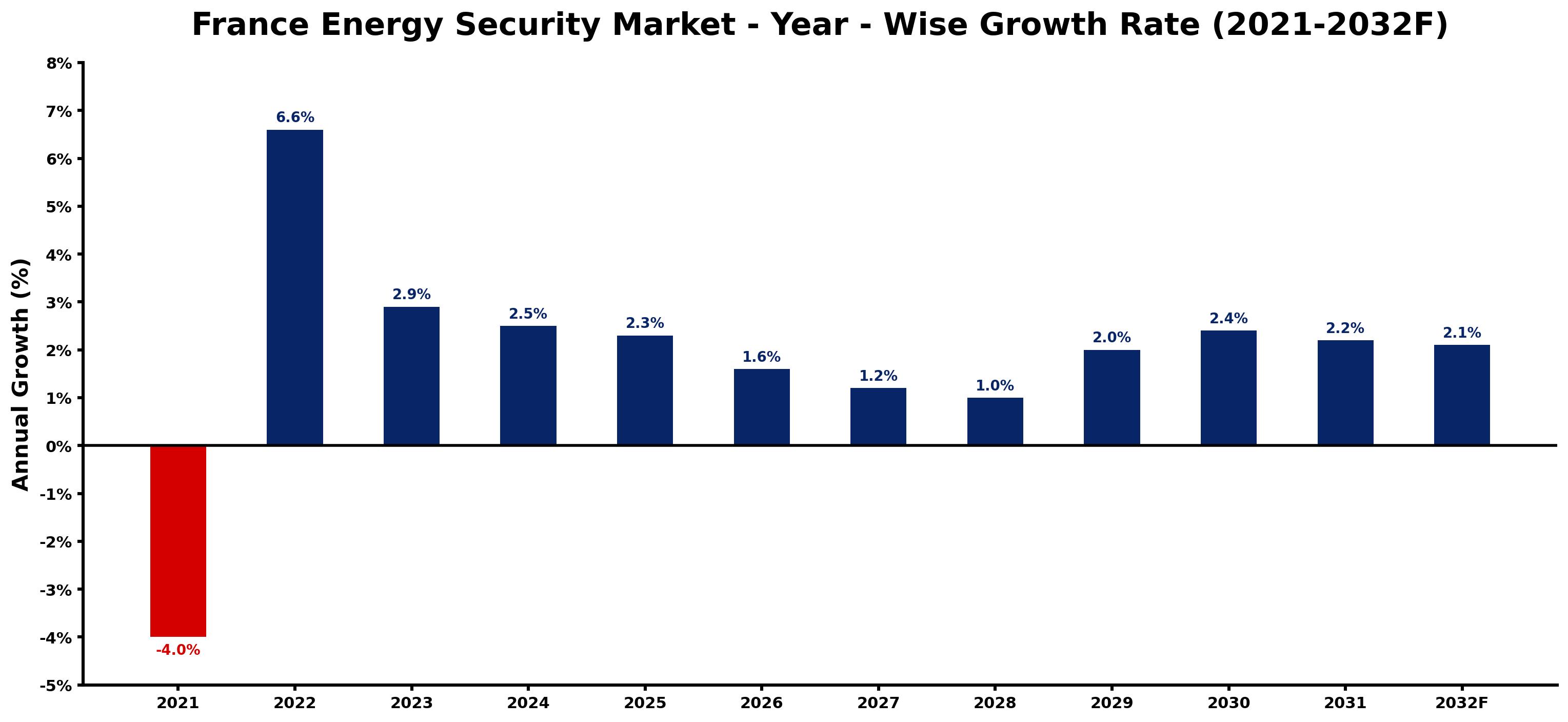
The table below presents the year‑wise growth rates along with the key drivers influencing the market
| Year | Growth Rate | Major Drivers |
| 2021 | -4.0% | Energy transition policies limited fossil fuel investments. |
| 2022 | 6.6% | EU's Fit for 55 package boosting clean energy investments |
| 2023 | 2.9% | Increased public funding for energy resilience projects |
| 2024 | 2.5% | Implementation of France's Energy Multiannual Program incentives |
| 2025 | 2.3% | Rising investments in cyber resilience for energy networks |
| 2026 | 1.6% | Strengthening regulations on energy system security protocols |
| 2027 | 1.2% | Growing public awareness of energy independence initiatives |
| 2028 | 1.0% | Government push for nuclear energy revitalization efforts |
| 2029 | 2.0% | Increased private sector investments in energy efficiency technologies |
| 2030 | 2.4% | Mandatory CO2 reduction targets driving energy transition |
| 2031 | 2.2% | Enhanced framework for smart grid technology deployment |
| 2032 | 2.1% | Local community energy cooperatives gaining government support |
Note: Market size estimations and growth projections presented in this report are based on 6Wresearch's proprietary forecasting methodology, utilizing the latest available industry data, government publications, and primary research inputs.
France Energy Security Market Key Takeaways
Below are some of the specific key takeaways from the market, including:
- The government has set an ambitious target of 33% renewable energy production by 2030.
- Investment in energy storage and smart grid technologies is gaining traction as a means to enhance system reliability.
- Current initiatives aim to modernize energy infrastructure to accommodate cleaner energy sources.
- Investment opportunities are emerging in the renewable energy and energy efficiency sectors.
- The focus on digital technologies is reshaping energy consumption and distribution patterns.
Evaluation of Restraints in France Energy Security Market
Despite positive trends, the France Energy Security Market grapples with notable constraints. A primary concern is the existing dependence on imported fossil fuels, which makes the country vulnerable to geopolitical shifts. The challenge lies in balancing immediate energy needs with long-term sustainability goals. on top of that, securing sufficient funding for necessary infrastructure upgrades remains a pressing issue, complicating the transition to a cleaner energy future.
France Energy Security Market Trends
A marked trend is the increasing integration of renewable energy solutions, particularly wind and solar. The shift towards decentralized energy systems is also notable, with more consumers opting for self-generation options. Technological advancements, especially in energy efficiency and smart grid capabilities, are shaping the operational frameworks of energy distribution. on top of that, as consumers become more environmentally conscious, there’s a growing demand for sustainable energy practices.
France Energy Security Market Opportunities
Genuine growth opportunities lie within the burgeoning renewable sector. Investments in solar parks and wind farms present a pathway for enhanced energy independence. Additionally, energy storage technologies are critical for ensuring supply stability, given the intermittent nature of renewable sources. The implementation of energy efficiency measures and technologies also offers pathways for significant financial and environmental benefits, catering to both businesses and households.
Government Initiatives in the France Energy Security Market
Government policies are increasingly shaping the France Energy Security Market. With a strong focus on sustainability and efficiency, recent initiatives are geared towards reducing energy import reliance and diversifying energy sources. The direction of these policies reflects a commitment to establishing a resilient energy system that meets both current demands and future challenges.
- A recently completed initiative aimed at improving energy efficiency in public buildings has seen widespread implementation of energy-saving measures.
- Currently, the government is executing a national program to enhance the electrical grid, promoting the integration of renewable sources.
- Upcoming regulations are set to mandate stricter energy efficiency standards across all sectors by 2027.
- Ongoing efforts are in place to develop a cybersecurity framework designed to protect critical energy infrastructure.
- A planned public-private partnership aimed at expanding hydrogen production capabilities is expected to launch in late 2026.
Future Insights of the France Energy Security Market
Looking ahead to 2026-2032, the France Energy Security Market is likely to experience dynamic transformations driven by a blend of investment in renewable technologies and infrastructure modernization. The government’s commitment to achieving a more sustainable energy framework will steer growth, especially as digital and decentralized solutions become increasingly prevalent. on top of that, the emphasis on resilience in the face of geopolitical challenges is expected to reinforce long-term growth prospects for the market.
France Energy Security Market Latest Developments
In the last 12 months, the France Energy Security Market has seen a flurry of activity indicative of a sector in transition. Heightened investments in renewable energy and advancements in energy technologies signal a clear commitment to securing the energy supply chain. Collaborative efforts between the public and private sectors are becoming increasingly common as the landscape evolves.
- A major technology vendor launched a pilot project for smart grid integration in mid-2025, aimed at optimizing energy distribution.
- In early 2025, a regional operator completed an upgrade to energy storage facilities, enhancing system reliability.
- An initiative to develop community solar projects is currently underway, expected to increase local energy generation capabilities.
- A public-private partnership focused on cybersecurity measures began its rollout in Q3 2025, enhancing infrastructure security.
- Plans for a new offshore wind farm, anticipated to generate significant energy contributions, are set to begin construction in early 2026.
France Energy Security Market - Key Attractiveness of the Report
- 10 Years of Market Numbers
- Historical Data Starting from 2022 to 2025
- Base Year: 2025
- Forecast Data until 2032
- Key Performance Indicators Impacting the Market
- Major Upcoming Developments and Projects
Key Highlights of the Report:
- France Energy Security Market Outlook
- Market Size of France Energy Security Market, 2025
- Forecast of France Energy Security Market, 2032
- Historical Data and Forecast of France Energy Security Revenues & Volume for the Period 2022-2032F
- France Energy Security Market Trend Evolution
- France Energy Security Market Drivers and Challenges
- France Energy Security Price Trends
- France Energy Security Porter's Five Forces
- France Energy Security Industry Life Cycle
- Historical Data and Forecast of France Energy Security Market Revenues & Volume By Power Plants for the Period 2022-2032F
- Historical Data and Forecast of France Energy Security Market Revenues & Volume By Nuclear for the Period 2022-2032F
- Historical Data and Forecast of France Energy Security Market Revenues & Volume By Thermal for the Period 2022-2032F
- Historical Data and Forecast of France Energy Security Market Revenues & Volume By Hydro for the Period 2022-2032F
- Historical Data and Forecast of France Energy Security Market Revenues & Volume By Oil for the Period 2022-2032F
- Historical Data and Forecast of France Energy Security Market Revenues & Volume By Gas for the Period 2022-2032F
- Historical Data and Forecast of France Energy Security Market Revenues & Volume By Renewable Energy for the Period 2022-2032F
- Historical Data and Forecast of France Energy Security Market Revenues & Volume By Technologies for the Period 2022-2032F
- Historical Data and Forecast of France Energy Security Market Revenues & Volume By Physical for the Period 2022-2032F
- Historical Data and Forecast of France Energy Security Market Revenues & Volume By Network Security for the Period 2022-2032F
- France Energy Security Import Export Trade Statistics
- Market Opportunity Assessment By Power Plants
- Market Opportunity Assessment By Technologies
- France Energy Security Top Companies Market Share
- France Energy Security Competitive Benchmarking By Technical and Operational Parameters
- France Energy Security Company Profiles
- France Energy Security Key Strategic Recommendations






































