India Hydroforming Part Market Size & Growth Rate
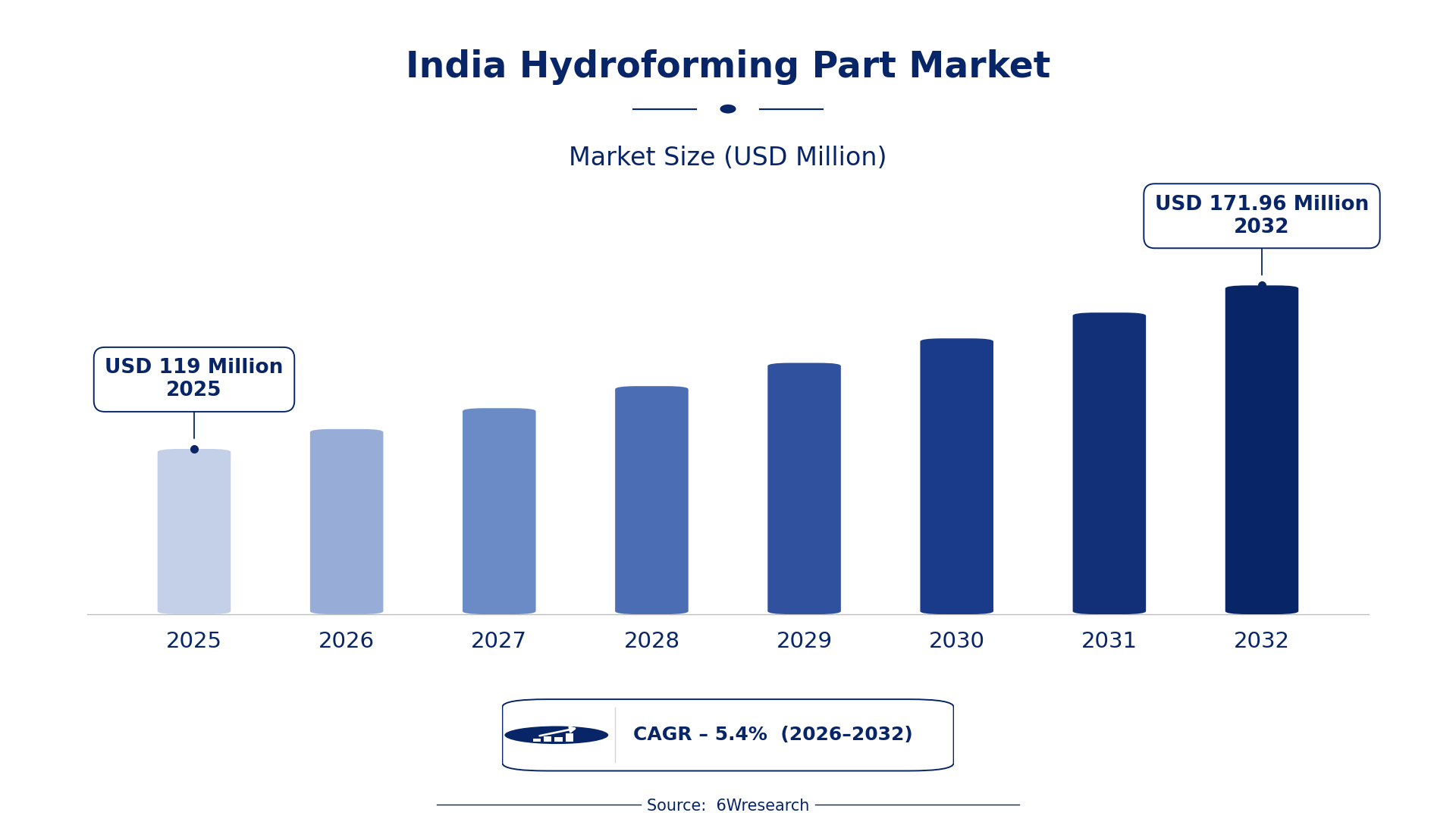
According to 6Wresearch internal database and industry insights, the India Hydroforming Part Market was valued at USD 119.0 million in 2025 and is projected to reach USD 171.96 million by 2032, growing at a CAGR of approximately 5.4% during 2026–2032.
India Hydroforming Part Market Highlights
| Report Metric | Details |
| Report Name | India Hydroforming Part Market |
| Market Size 2025 | USD 119.0 million |
| Market Size 2032 | USD 171.96 million |
| Absolute Growth 2025–2032 | USD 52.96 million |
| CAGR 2026–2032 | 5.4% |
| Peak Annual Growth | 7.8% in 2032 |
| Forecast Period | 2026–2032 |
| Historical Data | 2022–2025 |
| Base Year | 2025 |
| Leading Part Type, 2025 | Chassis Frames (39% share) |
| Leading Material Used, 2025 | High-Strength Steel (50% share) |
| Leading End-Use Sector, 2025 | Automotive (37% share) |
| Leading End User, 2025 | Vehicle OEMs (46% share) |
| Fastest-Growing Part Type | Exhaust Components (6.7% CAGR) |
| Fastest-Growing Material Used | Aluminum Alloy (7.2% CAGR) |
| Fastest-Growing End-Use Sector | Transportation (8.2% CAGR) |
| Fastest-Growing End User | Truck Manufacturers (7.8% CAGR) |
| Growing Sector | Transportation |
| Key End Users | Automotive, Transportation, Construction, Sports Equipment |
India Hydroforming Part Market Year-wise Growth Rate and Key Drivers (2022–2032)
This graph illustrates the annual growth rates of the market from 2022 to 2032, highlighting a steady upward trajectory and projected market expansion over the forecast period.
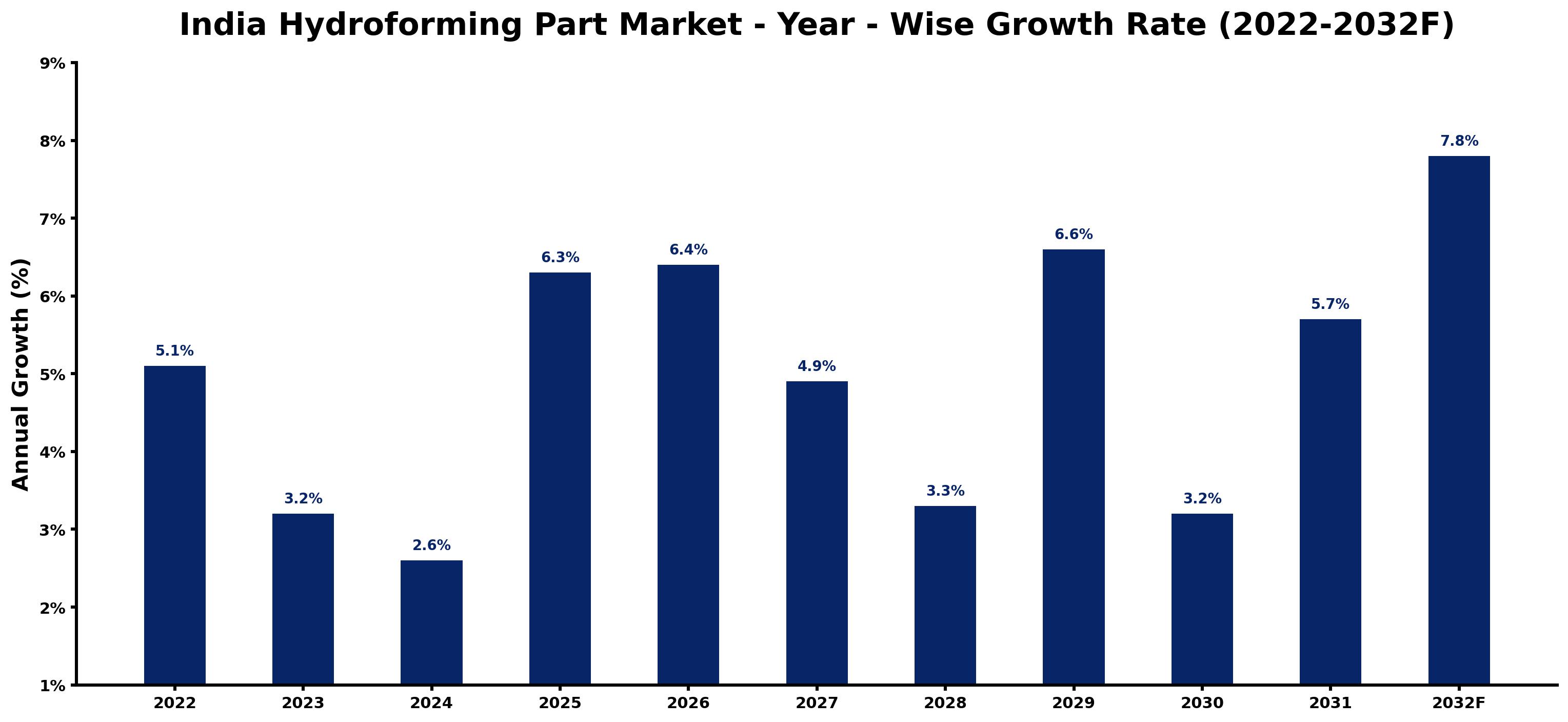
The following table presents the estimated annual growth rate for each year together with the principal factor influencing market performance.
| Year | Estimated Annual Growth (%) | Market Rationale |
| 2022 | 5.1 | The automotive sector showed steady production levels, indicating strong demand for hydroformed parts. |
| 2023 | 3.2 | Automotive production faced challenges due to supply chain disruptions, slowing growth in hydroforming parts demand. |
| 2024 | 2.6 | Continued supply chain issues constrained growth, impacting the hydroforming part market's expansion. |
| 2025 | 6.3 | A surge in automotive production boosted demand for hydroformed components, leading to faster growth. |
| 2026 | 6.4 | Investment in automotive innovation and production capacity is anticipated to stimulate demand for hydroforming parts. |
| 2027 | 4.9 | Growth is projected to moderate as the market adjusts to previous high levels of automotive production. |
| 2028 | 3.3 | Demand is expected to slow as the automotive sector faces challenges from supply chain constraints. |
| 2029 | 6.6 | A rebound in vehicle production will lead to increased demand for hydroformed parts, driving growth. |
| 2030 | 3.2 | Growth is projected to slow again as manufacturers face challenges in sourcing materials for production. |
| 2031 | 5.7 | Increased investments in automotive manufacturing will revitalise demand for hydroforming parts. |
| 2032 | 7.8 | The market is expected to peak as electric vehicle production ramps up, driving demand for lightweight components. |
Note: Market size estimations and growth projections presented in this report are based on 6Wresearch's proprietary forecasting methodology, utilizing the latest available industry data, government publications, and primary research inputs.
India Hydroforming Part Market Synopsis
The India Hydroforming Part Market is projected to grow, driven by the automotive industry's anticipated production of 25 million units by 2025 and the increasing adoption of high-strength materials. Key factors include innovation and sustainability in vehicle manufacturing, supported by government initiatives like the National Automotive Policy 2021 and the Production-Linked Incentive scheme.
Market Dynamics Impact Analysis (2026–2032)
| Factor | Type | Impact | Primary Segment Affected |
| Rising automotive production levels | Driver | High | Chassis Frames |
| Increased adoption of lightweight materials | Driver | High | High-Strength Steel |
| Growing demand for electric vehicles | Opportunity | High | Automotive |
| Expansion of infrastructure projects | Opportunity | Medium | Structural Tubes |
| Supply chain disruptions affecting material availability | Restraint | High | Exhaust Components |
| High initial investment costs for hydroforming technology | Restraint | Medium | Chassis Frames |
| Limited awareness of hydroforming benefits among manufacturers | Challenge | High | Vehicle OEMs |
| Competition from alternative manufacturing processes | Challenge | Medium | Exhaust Components |
Evaluation of Drivers in India Hydroforming Part Market (2026–2032)
The factors lifting demand, and the evidence behind each, are summarised below.
| Drivers | Primary Segment Affected | Why It Matters (Evidence) |
| Increased automotive production | Chassis Frames | The automotive sector in India is expected to reach 25 million units by 2025, driving demand for chassis frames. |
| Preference for high-strength materials | High-Strength Steel | High-strength steel is preferred for chassis frames due to its strength-to-weight ratio, improving vehicle performance. |
| Government initiatives promoting electric vehicles | Automotive | The 'FAME India' scheme allocates $1.4 billion to support electric vehicle adoption, increasing demand for lightweight components. |
| Investment in infrastructure projects | Structural Tubes | Infrastructure firms are increasingly using structural tubes for their strength and flexibility, boosting demand in this segment. |
| Rising need for lightweight components | Exhaust Components | The need for fuel-efficient vehicles drives the demand for lightweight exhaust components, improving performance. |
The Hydroforming Part market in India is expanding due to increasing demand from end-users, a rise in automotive production, and investments in infrastructure projects. The automotive sector is anticipated to reach 25 million units by 2025, which will heighten the need for hydroformed components. High-strength steel is favoured for chassis frames because of its superior strength-to-weight ratio, which enhances vehicle performance.
Evaluation of Restraints in India Hydroforming Part Market
The main factors holding the market back are set out below.
| Market Restraint | Primary Segment Affected | Why It Matters (Evidence) |
| Supply chain disruptions affecting material availability | Exhaust Components | Supply chain issues have led to increased lead times for materials, impacting production schedules for exhaust components. |
| High initial investment costs for hydroforming technology | Chassis Frames | The upfront costs for hydroforming equipment deter some manufacturers from adopting this technology. |
| Limited awareness of hydroforming benefits among manufacturers | Vehicle OEMs | Many vehicle OEMs are unaware of the advantages of hydroforming, limiting market penetration. |
| Competition from alternative manufacturing processes | Exhaust Components | Alternative processes such as stamping and welding are more established, posing a challenge to hydroforming adoption. |
| Regulatory compliance costs for automotive components | Chassis Frames | Compliance with updated BIS standards increases costs for manufacturers, affecting pricing strategies. |
India Hydroforming Part Market Challenges
The India Hydroforming Part Market encounters a technological challenge stemming from the limited adoption of advanced hydroforming techniques, which affects production efficiency for suppliers. Many local manufacturers lack access to modern machinery, resulting in lead times that can be up to 30% longer for automotive and construction buyers in need of components. Increased competition from traditional manufacturing methods makes it challenging for hydroforming producers to compete on price, risking a loss of market share. Additionally, sourcing high-strength steel can pose difficulties, leading to delays in production timelines for automotive manufacturers and impacting their ability to meet order deadlines.
Trends in the India Hydroforming Part Market
Below mentioned are some of the trends shaping the India Hydroforming Part Market growth.
- Shift towards Lightweight Materials: The Indian automotive sector is increasingly embracing lightweight materials, with high-strength steel expected to dominate. By 2025, this material is projected to comprise 50% of chassis frames, thereby improving fuel efficiency.
- Transition to Electric Vehicles: The 'FAME India' scheme, launched in 2021, promotes electric vehicles and boosts demand for lightweight components. This initiative allocates $1.4 billion to support infrastructure, aiding the transition to sustainable automotive solutions.
- Emergence of Advanced Manufacturing Techniques: The automotive sector is adopting advanced manufacturing techniques, with hydroforming gaining popularity. This trend is expected to enhance production efficiency and component performance, aligning with industry standards.
- Growing Demand for Bicycle Frames: India's bicycle market, bolstered by the 'Make in India' initiative, is projected to reach 20 million units by 2025. This growth is driving demand for lightweight bicycle frames produced through hydroforming.
Investment Opportunities in the India Hydroforming Part Market
Below are the investment opportunities with the strongest case in the India Hydroforming Part Market.
- $8 billion investment gap in automotive manufacturing: India's automotive sector is anticipated to attract $8 billion in investments by 2025, presenting an opportunity for hydroforming technology suppliers to partner with local manufacturers.
- Vehicle OEMs seeking lightweight components: Vehicle OEMs are increasingly in search of lightweight components to improve fuel efficiency. Suppliers can enter this market by offering hydroformed parts that adhere to strict quality standards.
- Joint ventures for local manufacturing: Forming joint ventures with local automotive manufacturers can facilitate entry into the hydroforming market, leveraging existing infrastructure and expertise.
- Structural tubes for infrastructure projects: As infrastructure firms expand their projects, the demand for structural tubes is on the rise. Suppliers can target this sector by providing hydroformed solutions that meet specific project needs.
Government Initiatives in the India Hydroforming Part Market
The National Automotive Policy 2021 aims to boost domestic manufacturing and innovation in the automotive sector, promoting sustainable practices and electric vehicles, overseen by the Ministry of Heavy Industries. This policy encourages the adoption of advanced manufacturing techniques, including hydroforming, to improve component quality and performance. The Production-Linked Incentive (PLI) scheme for the automobile sector, launched in 2021, aims to attract investments of $8 billion over five years to enhance local manufacturing and job creation. This funding is vital for companies looking to invest in hydroforming technology and expand their production capabilities.
The Ministry of Heavy Industries oversees the implementation of automotive policies, including the PLI scheme, which funds initiatives aimed at boosting local manufacturing. The Bureau of Indian Standards (BIS) updated automotive standards in 2022 to ensure compliance for all automotive components, including hydroformed parts. This regulatory framework supports manufacturers by establishing clear guidelines for quality assurance and product safety.
Future Insight of the India Hydroforming Part Market
By 2032, buyers and suppliers in the India Hydroforming Part Market can anticipate transformative changes driven by several factors. The National Automotive Testing and R&D Infrastructure Project (NATRiP) will spur innovation, leading to improved product quality. With investments of $8-10 billion in the automotive sector, local manufacturing capabilities will expand considerably. The 'Production-Linked Incentive' scheme will promote the adoption of advanced hydroforming technologies, enabling the production of lighter and stronger components. These advancements will streamline production processes and boost market competitiveness.
Market Segmentation Analysis
The report offers a comprehensive study of the following market segments and their leading categories in the market.
By Part Type – Chassis Frames Dominated, Exhaust Components Expected to Grow Fastest
According to Bhawna Singh, Assistant Manager at 6Wresearch, in 2025, Chassis Frames led the part type split with a 39% share. Chassis frames dominate the market share in India as they are vital for vehicle structures, providing essential strength and weight reduction. The automotive sector's projected growth to 25 million units by 2025 underscores the reliance on these components for vehicle production. Over 2026–2032, Exhaust Components are expected to post the fastest growth, at a CAGR of 6.7%. Exhaust components are rapidly growing in demand, crucial for automotive exhaust systems that comply with stringent emission standards. As the automotive industry expands, the need for efficient exhaust systems is expected to rise significantly, propelling this segment forward. Suppliers should focus on enhancing their chassis frame offerings while also investing in exhaust components to meet increasing market demands.
By Material Used – High-Strength Steel Dominated, Aluminum Alloy Expected to Grow Fastest
High-Strength Steel accounted for a 50% market share by material used in 2025. High-strength steel holds the largest market share due to its widespread use for durability and strength in automotive applications, particularly in chassis frames. Its robust properties are essential for meeting the needs of the expanding automotive sector in India, which is poised for substantial growth. The quickest growth will come from Aluminum Alloy, forecast to expand at a CAGR of 7.2% between 2026 and 2032. Aluminum alloys are experiencing the fastest growth, favoured for their lightweight characteristics that improve fuel efficiency in vehicles. As the automotive industry prioritises weight reduction, the shift towards aluminium alloys will likely accelerate, strengthening their market position. Suppliers should consider diversifying their material offerings to include more aluminium alloys in response to the evolving preferences of vehicle manufacturers.
By End-Use Sector – Automotive Dominated, Transportation Expected to Grow Fastest
Automotive held a 37% share of the India Hydroforming Part Market by end-use sector in 2025. The automotive sector commands the largest market share as it is the primary user of hydroformed parts, integral to vehicle production. With India's automotive industry being the fourth largest globally, the demand for these parts remains strong and consistent. Transportation is set to record the highest CAGR in this split, 8.2% over 2026–2032. Transportation is the fastest-growing sector for hydroformed parts, driven by increasing demand for lightweight components in transport-related applications. As infrastructure projects expand, the need for such components in transportation will continue to rise, further boosting this segment. This trend indicates that suppliers should explore opportunities within the transportation sector to maximise their market reach and growth potential.
By End User – Vehicle OEMs Dominated, Truck Manufacturers Expected to Grow Fastest
Vehicle OEMs took a 46% share of end user in 2025, more than any other category. Vehicle OEMs represent the largest share of the market as they are the primary users of hydroformed parts in vehicle manufacturing. The growth of the automotive industry directly translates into sustained demand from these original equipment manufacturers, solidifying their market position. Truck Manufacturers are projected to grow fastest, at a CAGR of 7.8% during 2026–2032. Truck manufacturers are experiencing the fastest growth due to their significant need for heavy-duty components that can withstand rigorous conditions. As the demand for commercial vehicles increases, so will the need for robust hydroformed parts, driving this segment's expansion. This suggests that suppliers should strengthen their relationships with truck manufacturers to effectively capture the growing demand in this segment.
Key Attractiveness of the Report
- 10 Years of Market Numbers
- Historical Data Starting from 2022 to 2025
- Base Year 2025
- Forecast Data until 2032
- Key Performance Indicators Impacting the Market
- Major Upcoming Developments and Projects
Key Highlights of the Report:
- India Hydroforming Part Market Outlook
- Market Size of India Hydroforming Part Market, 2025
- Forecast of India Hydroforming Part Market, 2032
- Historical Data and Forecast of India Hydroforming Part Revenues & Volume for the Period 2022 - 2032F
- India Hydroforming Part Market Trend Evolution
- India Hydroforming Part Market Drivers and Challenges
- India Hydroforming Part Price Trends
- India Hydroforming Part Porter's Five Forces
- India Hydroforming Part Industry Life Cycle
- Historical Data and Forecast of India Hydroforming Part Market Revenues & Volume By Part Type for the Period 2022 - 2032F
- Historical Data and Forecast of India Hydroforming Part Market Revenues & Volume By Chassis Frames for the Period 2022 - 2032F
- Historical Data and Forecast of India Hydroforming Part Market Revenues & Volume By Exhaust Components for the Period 2022 - 2032F
- Historical Data and Forecast of India Hydroforming Part Market Revenues & Volume By Structural Tubes for the Period 2022 - 2032F
- Historical Data and Forecast of India Hydroforming Part Market Revenues & Volume By Bicycle Frames for the Period 2022 - 2032F
- Historical Data and Forecast of India Hydroforming Part Market Revenues & Volume By Material Used for the Period 2022 - 2032F
- Historical Data and Forecast of India Hydroforming Part Market Revenues & Volume By High-Strength Steel for the Period 2022 - 2032F
- Historical Data and Forecast of India Hydroforming Part Market Revenues & Volume By Aluminum Alloy for the Period 2022 - 2032F
- Historical Data and Forecast of India Hydroforming Part Market Revenues & Volume By Stainless Steel for the Period 2022 - 2032F
- Historical Data and Forecast of India Hydroforming Part Market Revenues & Volume By Lightweight Alloy for the Period 2022 - 2032F
- Historical Data and Forecast of India Hydroforming Part Market Revenues & Volume By End-Use Sector for the Period 2022 - 2032F
- Historical Data and Forecast of India Hydroforming Part Market Revenues & Volume By Automotive for the Period 2022 - 2032F
- Historical Data and Forecast of India Hydroforming Part Market Revenues & Volume By Transportation for the Period 2022 - 2032F
- Historical Data and Forecast of India Hydroforming Part Market Revenues & Volume By Construction for the Period 2022 - 2032F
- Historical Data and Forecast of India Hydroforming Part Market Revenues & Volume By Sports Equipment for the Period 2022 - 2032F
- Historical Data and Forecast of India Hydroforming Part Market Revenues & Volume By End User for the Period 2022 - 2032F
- Historical Data and Forecast of India Hydroforming Part Market Revenues & Volume By Vehicle OEMs for the Period 2022 - 2032F
- Historical Data and Forecast of India Hydroforming Part Market Revenues & Volume By Truck Manufacturers for the Period 2022 - 2032F
- Historical Data and Forecast of India Hydroforming Part Market Revenues & Volume By Infrastructure Firms for the Period 2022 - 2032F
- Historical Data and Forecast of India Hydroforming Part Market Revenues & Volume By Bicycle Manufacturers for the Period 2022 - 2032F
- India Hydroforming Part Import Export Trade Statistics
- Market Opportunity Assessment By Part Type
- Market Opportunity Assessment By Material Used
- Market Opportunity Assessment By End-Use Sector
- Market Opportunity Assessment By End User
- India Hydroforming Part Top Companies Market Share
- India Hydroforming Part Competitive Benchmarking By Technical and Operational Parameters
- India Hydroforming Part Company Profiles
- India Hydroforming Part Key Strategic Recommendations
Market Covered
The report offers an extensive study of the following market segments.
By Part Type
- Chassis Frames
- Exhaust Components
- Structural Tubes
- Bicycle Frames
By Material Used
- High-Strength Steel
- Aluminum Alloy
- Stainless Steel
- Lightweight Alloy
By End-Use Sector
- Automotive
- Transportation
- Construction
- Sports Equipment
By End User
- Vehicle OEMs
- Truck Manufacturers
- Infrastructure Firms
- Bicycle Manufacturers































