China Hydroforming Part Market Size & Growth Rate
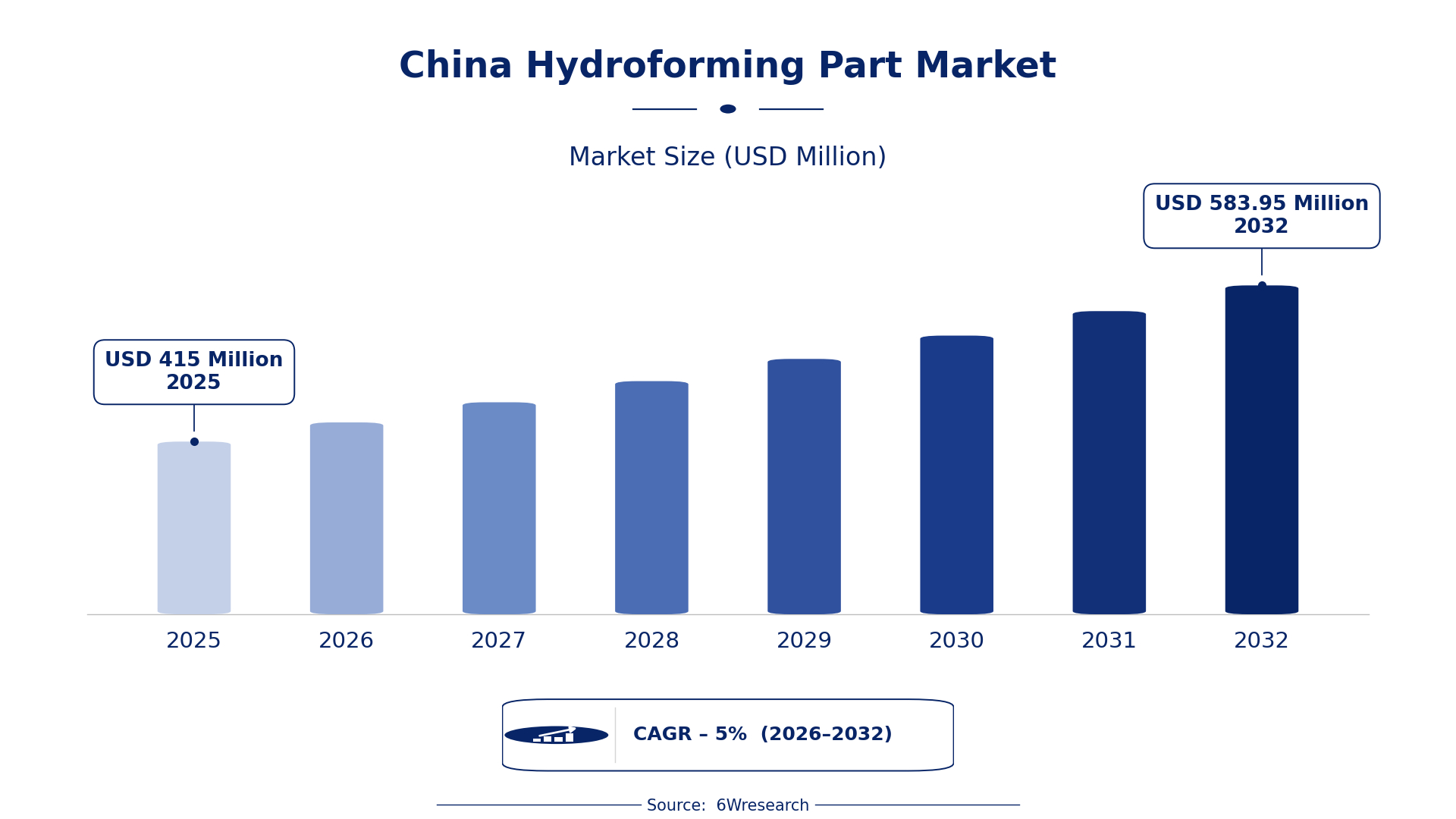
According to 6Wresearch internal database and industry insights, the China Hydroforming Part Market was valued at USD 415.0 million in 2025 and is projected to reach USD 583.95 million by 2032, growing at a CAGR of approximately 5% during 2026–2032.
China Hydroforming Part Market Highlights
| Report Metric | Details |
| Report Name | China Hydroforming Part Market |
| Market Size 2025 | USD 415.0 million |
| Market Size 2032 | USD 583.95 million |
| Absolute Growth 2025–2032 | USD 168.95 million |
| CAGR 2026–2032 | 5% |
| Peak Annual Growth | 7.5% in 2026 |
| Forecast Period | 2026–2032 |
| Historical Data | 2022–2025 |
| Base Year | 2025 |
| Leading Part Type, 2025 | Chassis Frames (47% share) |
| Leading Material Used, 2025 | High-Strength Steel (40% share) |
| Leading End-Use Sector, 2025 | Automotive (35% share) |
| Leading End User, 2025 | Vehicle OEMs (43% share) |
| Fastest-Growing Part Type | Bicycle Frames (7.0% CAGR) |
| Fastest-Growing Material Used | Lightweight Alloy (7.1% CAGR) |
| Fastest-Growing End-Use Sector | Construction (6.8% CAGR) |
| Fastest-Growing End User | Bicycle Manufacturers (6.5% CAGR) |
| Growing Sector | Automotive |
| Key End Users | Vehicle OEMs, Truck Manufacturers, Bicycle Manufacturers, Infrastructure Firms |
China Hydroforming Part Market Year-wise Growth Rate and Key Drivers (2022–2032)
This graph illustrates the annual growth rates of the market from 2022 to 2032, highlighting a steady upward trajectory and projected market expansion over the forecast period.
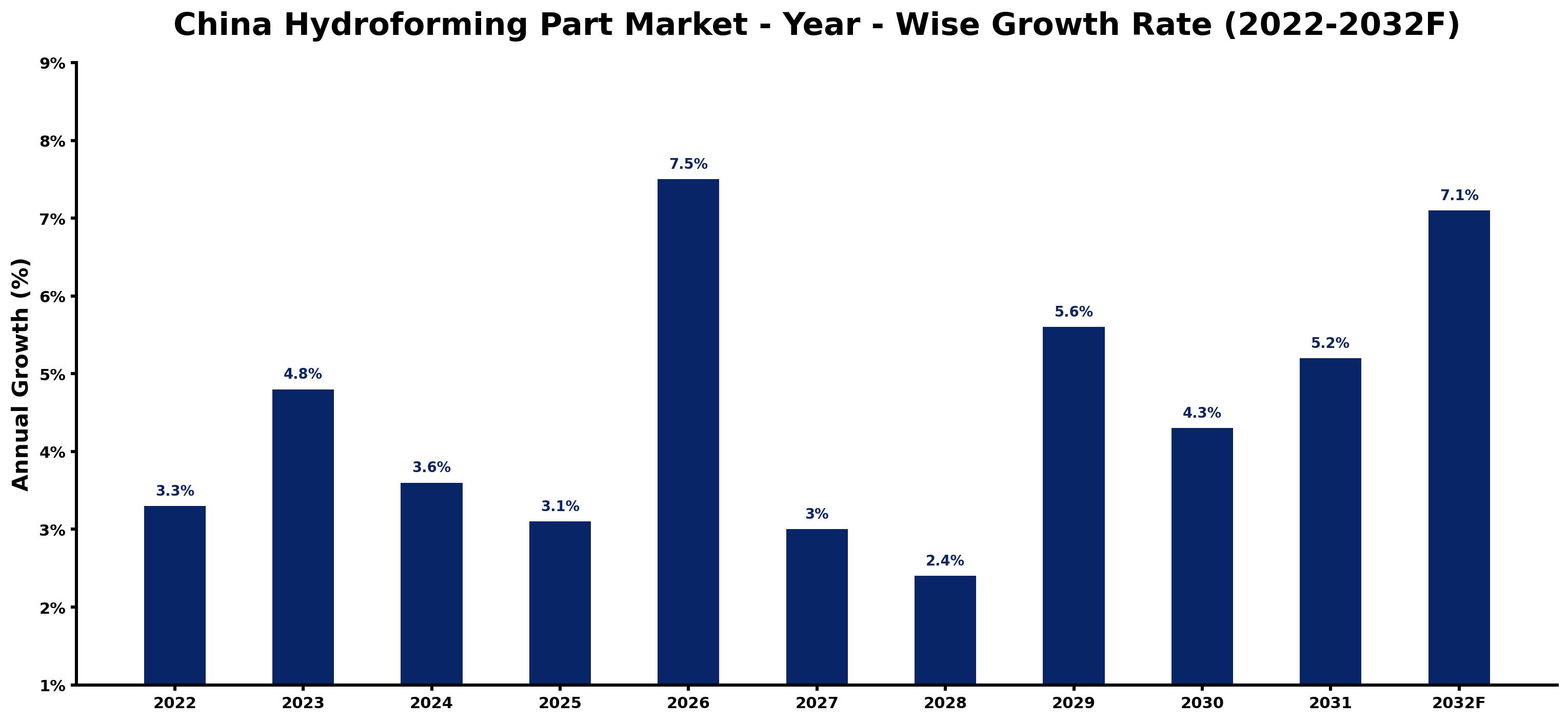
The following table presents the estimated annual growth rate for each year together with the principal factor influencing market performance.
| Year | Estimated Annual Growth (%) | Market Rationale |
| 2022 | 3.3 | The automotive sector showed steady demand for hydroformed parts, reflecting ongoing production needs. |
| 2023 | 4.8 | Increased automotive production led to faster growth in demand for hydroforming technology. |
| 2024 | 3.6 | Demand for hydroformed chassis frames slowed due to reduced automotive output. |
| 2025 | 3.1 | Automotive production continued to grow, but at a slower pace, affecting hydroforming demand. |
| 2026 | 7.5 | Rising investments in advanced manufacturing technologies will boost demand for hydroforming parts. |
| 2027 | 3.0 | The market is expected to slow as the '14th Five-Year Plan for the Automotive Industry' stabilises production. |
| 2028 | 2.4 | Demand for hydroformed parts will slow further due to market saturation in certain segments. |
| 2029 | 5.6 | A resurgence in automotive production is projected to lead to increased demand for hydroformed components. |
| 2030 | 4.3 | Growth is expected to slow as the automotive sector faces challenges in maintaining production levels. |
| 2031 | 5.2 | Demand for hydroformed parts will increase as vehicle OEMs seek lightweight solutions. |
| 2032 | 7.1 | The market is expected to grow as new automotive technologies drive hydroforming adoption. |
Note: Market size estimations and growth projections presented in this report are based on 6Wresearch's proprietary forecasting methodology, utilizing the latest available industry data, government publications, and primary research inputs.
China Hydroforming Part Market Synopsis
This method shapes materials such as steel and aluminium into intricate components, mainly for the automotive and construction industries. The China Hydroforming Part Market is expanding due to an increase in automotive production, which reached 26 million units in 2022, along with substantial investments in advanced manufacturing technologies. The 'Automotive Industry Development Plan' introduced in 2023 further supports this expansion by encouraging manufacturers to adopt new processes that improve efficiency and competitiveness.
Market Dynamics Impact Analysis (2026–2032)
| Factor | Type | Impact | Primary Segment Affected |
| Rising automotive production in provinces like Jiangsu and Guangdong | Driver | High | Chassis Frames |
| Increased focus on lightweight materials for fuel efficiency | Driver | High | High-Strength Steel |
| Growing demand for high-performance bicycles in Zhejiang | Opportunity | High | Bicycle Frames |
| Investment in urban development projects requiring structural tubes | Opportunity | High | Structural Tubes |
| High costs associated with advanced hydroforming technologies | Restraint | Medium | Exhaust Components |
| Limited awareness of hydroforming benefits among smaller manufacturers | Restraint | Medium | Bicycle Frames |
| Supply chain disruptions affecting raw material availability | Challenge | High | Automotive |
| Technological barriers in adopting advanced hydroforming processes | Challenge | Medium | Construction |
Evaluation of Drivers in China Hydroforming Part Market (2026–2032)
The main growth drivers and the segments they affect most are set out below.
| Drivers | Primary Segment Affected | Why It Matters (Evidence) |
| Increased automotive production | Chassis Frames | The demand for chassis frames surged with automotive production reaching 26 million units in 2022, driving purchases by vehicle OEMs. |
| Focus on lightweight materials | High-Strength Steel | The shift towards lightweight materials for fuel efficiency has led to a 40% share of high-strength steel in hydroformed parts. |
| Growth in bicycle manufacturing | Bicycle Frames | The rising demand for high-performance bicycles in regions like Zhejiang has increased the need for hydroformed bicycle frames. |
| Urban development projects | Structural Tubes | The construction sector's expansion in urban areas has boosted the demand for hydroformed structural tubes, with a notable increase in projects. |
| Regulatory pressure on emissions | Exhaust Components | Stringent emission regulations have increased the demand for lightweight exhaust components made through hydroforming. |
Market growth in China for Hydroforming Part rests on rising automotive production, increased focus on lightweight materials, and expanding bicycle manufacturing. The automotive sector produced 26 million units in 2022, driving demand for chassis frames. The demand for high-performance bicycles has surged, increasing the need for hydroformed bicycle frames.
Evaluation of Restraints in China Hydroforming Part Market
The following restraints limit how fast demand can grow.
| Market Restraint | Primary Segment Affected | Why It Matters (Evidence) |
| High costs of advanced hydroforming technologies | Exhaust Components | The investment required for advanced hydroforming technologies can deter smaller manufacturers, limiting their participation in the market. |
| Limited awareness of hydroforming benefits | Bicycle Frames | Many smaller bicycle manufacturers lack awareness of hydroforming advantages, hindering adoption and market growth. |
| Supply chain disruptions | Automotive | Supply chain issues have affected the availability of raw materials, causing delays in production for automotive manufacturers. |
| Technological barriers in adoption | Construction | Smaller construction firms face challenges in adopting advanced hydroforming processes, limiting their competitiveness. |
| Market saturation in certain segments | Chassis Frames | As the market matures, saturation in chassis frames may slow growth rates in the coming years. |
China Hydroforming Part Market Challenges
A skills shortage hampers the China hydroforming part market, particularly in Jiangsu, where advanced manufacturing techniques are essential. This gap arises from rapid technological changes in the automotive sector, causing delays in production and escalating costs for manufacturers. Competition among producers is fierce as the automotive industry expands, with 26 million units produced in 2022, resulting in price wars that erode margins for smaller suppliers. Buyers are facing increased costs for hydroformed components, as the demand for lightweight materials grows; this surge could inflate prices by up to 15% within the next year.
Trends in the China Hydroforming Part Market
Buyers and suppliers in the China Hydroforming Part Market are adjusting to the following trends.
- Shift from Traditional to Advanced Manufacturing: The automotive industry is increasingly adopting advanced manufacturing technologies, including hydroforming, to improve production efficiency. In 2023, the Chinese government launched the 'Automotive Industry Development Plan' to support this transition, with an investment of over 1 trillion RMB by 2025.
- Increase in Lightweight Material Usage: Since 2021, there has been a growing focus on lightweight materials in vehicle production, driven by the 'New Energy Vehicle Industry Development Plan'. This initiative promotes hydroforming for its capability to produce lightweight components, with a projected rise in demand for such materials.
- Expansion of Hydroforming in Construction: The construction sector is increasingly utilising hydroformed structural tubes, particularly following the updated standards in 2023. This shift is apparent in urban development projects, where the demand for these materials is increasing due to their strength and lightweight characteristics.
- Growth in Bicycle Frame Production: The bicycle manufacturing sector is experiencing a surge in hydroformed frame production, especially in Zhejiang. This trend is supported by the rising demand for high-performance bicycles, with a notable increase in production rates.
Investment Opportunities in the China Hydroforming Part Market
Some of the investment opportunities in the China Hydroforming Part Market are mentioned below.
- Urban Development Projects: Urban development in cities like Beijing is creating a demand for hydroformed structural tubes, with a projected rise in construction activities. Investing in these materials can lead to partnerships with infrastructure firms.
- Bicycle Manufacturing in Zhejiang: The expanding bicycle manufacturing sector in Zhejiang offers opportunities for hydroformed bicycle frames. With a 7.0% CAGR anticipated, manufacturers can enter this market through local partnerships or joint ventures.
- Investment in Lightweight Materials: The automotive sector's focus on lightweight materials is driving demand for hydroformed parts. With over 1 trillion RMB expected to be invested by 2025, suppliers can take advantage of this trend by aligning with vehicle OEMs.
- Advanced Manufacturing Technologies: The push for advanced manufacturing technologies in the automotive sector presents opportunities for hydroforming suppliers. Engaging with manufacturers seeking ISO 9001 certification can facilitate market entry.
Government Initiatives in the China Hydroforming Part Market
The '14th Five-Year Plan for the Automotive Industry' launched in 2021 by the Ministry of Industry and Information Technology aims to promote advanced manufacturing technologies, including hydroforming. This plan encourages manufacturers to adopt new processes, improving production efficiency and competitiveness. The 'Green Manufacturing Program' initiated in 2020 focuses on reducing emissions in the automotive sector, promoting lightweight hydroformed parts as a solution. These measures are expected to drive demand for hydroforming technology in the automotive industry.
In 2022, the National Development and Reform Commission approved a subsidy scheme for manufacturers adopting advanced hydroforming technologies. This initiative provides financial support to improve production efficiency and encourage innovation. Additionally, the Ministry of Housing and Urban-Rural Development updated construction standards in 2023 to include advanced materials like hydroformed structural tubes. These updates aim to enhance construction quality and sustainability, benefiting both producers and buyers in the construction sector.
Future Insight of the China Hydroforming Part Market
The China hydroforming part market is set to evolve significantly by 2032, driven by technological advancements and government initiatives. The 'Automotive Industry Development Plan' launched in 2023 will stimulate investment in hydroforming processes, improving production capabilities. The emphasis on lightweight materials under the 'Made in China 2025' initiative will broaden the application of hydroformed components across various sectors. By 2025, the automotive industry is projected to invest over 1 trillion RMB in new technologies, promoting efficiency and innovation throughout the market.
Market Segmentation Analysis
The report offers a comprehensive study of the following market segments and their leading categories in the market.
By Part Type – Chassis Frames Dominated, Bicycle Frames Expected to Grow Fastest
According to Bhawna Singh, Assistant Manager at 6Wresearch, Chassis Frames held a 47% share of the China Hydroforming Part Market by part type in 2025. Chassis frames hold the largest share in the China Hydroforming Part Market due to their critical role in vehicle safety and structure. The automotive industry relies heavily on these components, particularly in provinces like Jiangsu and Guangdong, where production is concentrated. Bicycle Frames are set to record the highest CAGR in this split, 7.0% over 2026–2032. Bicycle frames are witnessing rapid growth as the demand for high-performance bicycles increases, especially in Zhejiang, a notable manufacturing region. This surge is driven by consumers seeking lightweight and durable options for improved cycling experiences. Suppliers should focus on developing bicycle frames to take advantage of this expanding market opportunity.
By Material Used – High-Strength Steel Dominated, Lightweight Alloy Expected to Grow Fastest
In 2025, High-Strength Steel led the material used split with a 40% share. High-strength steel captures the largest market share as it is essential for the durability and safety of automotive parts. Its extensive use in chassis frames highlights its importance in maintaining vehicle integrity and performance. Lightweight Alloy is projected to grow fastest, at a CAGR of 7.1% during 2026–2032. The lightweight alloy segment is poised for significant growth, propelled by the automotive industry's emphasis on fuel efficiency and compliance with regulatory standards. This trend illustrates the increasing importance of weight reduction in vehicle design. Manufacturers must invest in lightweight alloy technologies to meet the automotive sector's changing demands.
By End-Use Sector – Automotive Dominated, Construction Expected to Grow Fastest
Automotive accounted for a 35% market share by end-use sector in 2025. The automotive sector commands the largest market share for hydroformed parts, largely due to its widespread use in vehicle manufacturing. With automotive production reaching 26 million units in 2022, the demand from this sector remains strong and consistent. Over 2026–2032, Construction is expected to post the fastest growth, at a CAGR of 6.8%. The construction sector is rapidly adopting hydroformed structural tubes, particularly in urban development projects. This growth is supported by government initiatives aimed at promoting advanced manufacturing technologies, including hydroforming. Suppliers should explore partnerships within the construction sector to unlock new opportunities for hydroformed products.
By End User – Vehicle OEMs Dominated, Bicycle Manufacturers Expected to Grow Fastest
The largest end user category in 2025 was Vehicle OEMs, with a 43% share of total revenue. Vehicle OEMs account for the largest market share as they are the primary consumers of hydroformed parts in vehicle production. Their demand is driven by the need for high-quality components that ensure optimal vehicle performance and safety. The quickest growth will come from Bicycle Manufacturers, forecast to expand at a CAGR of 6.5% between 2026 and 2032. Bicycle manufacturers are increasingly utilising hydroformed parts to produce high-end bicycles that meet consumer expectations for performance and weight. This trend reflects a broader movement towards premium bicycle offerings in the market. Suppliers should customise their products to cater to the specific needs of bicycle manufacturers to capitalise on this growing segment.
Key Attractiveness of the Report
- 10 Years of Market Numbers
- Historical Data Starting from 2022 to 2025
- Base Year 2025
- Forecast Data until 2032
- Key Performance Indicators Impacting the Market
- Major Upcoming Developments and Projects
Key Highlights of the Report:
- China Hydroforming Part Market Outlook
- Market Size of China Hydroforming Part Market, 2025
- Forecast of China Hydroforming Part Market, 2032
- Historical Data and Forecast of China Hydroforming Part Revenues & Volume for the Period 2022 - 2032F
- China Hydroforming Part Market Trend Evolution
- China Hydroforming Part Market Drivers and Challenges
- China Hydroforming Part Price Trends
- China Hydroforming Part Porter's Five Forces
- China Hydroforming Part Industry Life Cycle
- Historical Data and Forecast of China Hydroforming Part Market Revenues & Volume By Part Type for the Period 2022 - 2032F
- Historical Data and Forecast of China Hydroforming Part Market Revenues & Volume By Chassis Frames for the Period 2022 - 2032F
- Historical Data and Forecast of China Hydroforming Part Market Revenues & Volume By Exhaust Components for the Period 2022 - 2032F
- Historical Data and Forecast of China Hydroforming Part Market Revenues & Volume By Structural Tubes for the Period 2022 - 2032F
- Historical Data and Forecast of China Hydroforming Part Market Revenues & Volume By Bicycle Frames for the Period 2022 - 2032F
- Historical Data and Forecast of China Hydroforming Part Market Revenues & Volume By Material Used for the Period 2022 - 2032F
- Historical Data and Forecast of China Hydroforming Part Market Revenues & Volume By High-Strength Steel for the Period 2022 - 2032F
- Historical Data and Forecast of China Hydroforming Part Market Revenues & Volume By Aluminum Alloy for the Period 2022 - 2032F
- Historical Data and Forecast of China Hydroforming Part Market Revenues & Volume By Stainless Steel for the Period 2022 - 2032F
- Historical Data and Forecast of China Hydroforming Part Market Revenues & Volume By Lightweight Alloy for the Period 2022 - 2032F
- Historical Data and Forecast of China Hydroforming Part Market Revenues & Volume By End-Use Sector for the Period 2022 - 2032F
- Historical Data and Forecast of China Hydroforming Part Market Revenues & Volume By Automotive for the Period 2022 - 2032F
- Historical Data and Forecast of China Hydroforming Part Market Revenues & Volume By Transportation for the Period 2022 - 2032F
- Historical Data and Forecast of China Hydroforming Part Market Revenues & Volume By Construction for the Period 2022 - 2032F
- Historical Data and Forecast of China Hydroforming Part Market Revenues & Volume By Sports Equipment for the Period 2022 - 2032F
- Historical Data and Forecast of China Hydroforming Part Market Revenues & Volume By End User for the Period 2022 - 2032F
- Historical Data and Forecast of China Hydroforming Part Market Revenues & Volume By Vehicle OEMs for the Period 2022 - 2032F
- Historical Data and Forecast of China Hydroforming Part Market Revenues & Volume By Truck Manufacturers for the Period 2022 - 2032F
- Historical Data and Forecast of China Hydroforming Part Market Revenues & Volume By Infrastructure Firms for the Period 2022 - 2032F
- Historical Data and Forecast of China Hydroforming Part Market Revenues & Volume By Bicycle Manufacturers for the Period 2022 - 2032F
- China Hydroforming Part Import Export Trade Statistics
- Market Opportunity Assessment By Part Type
- Market Opportunity Assessment By Material Used
- Market Opportunity Assessment By End-Use Sector
- Market Opportunity Assessment By End User
- China Hydroforming Part Top Companies Market Share
- China Hydroforming Part Competitive Benchmarking By Technical and Operational Parameters
- China Hydroforming Part Company Profiles
- China Hydroforming Part Key Strategic Recommendations
Market Covered
This report examines the market across the segments below.
By Part Type
- Chassis Frames
- Exhaust Components
- Structural Tubes
- Bicycle Frames
By Material Used
- High-Strength Steel
- Aluminum Alloy
- Stainless Steel
- Lightweight Alloy
By End-Use Sector
- Automotive
- Transportation
- Construction
- Sports Equipment
By End User
- Vehicle OEMs
- Truck Manufacturers
- Infrastructure Firms
- Bicycle Manufacturers































