India Hydrogen Fuel Cell Aircraft Market Size & Growth Rate
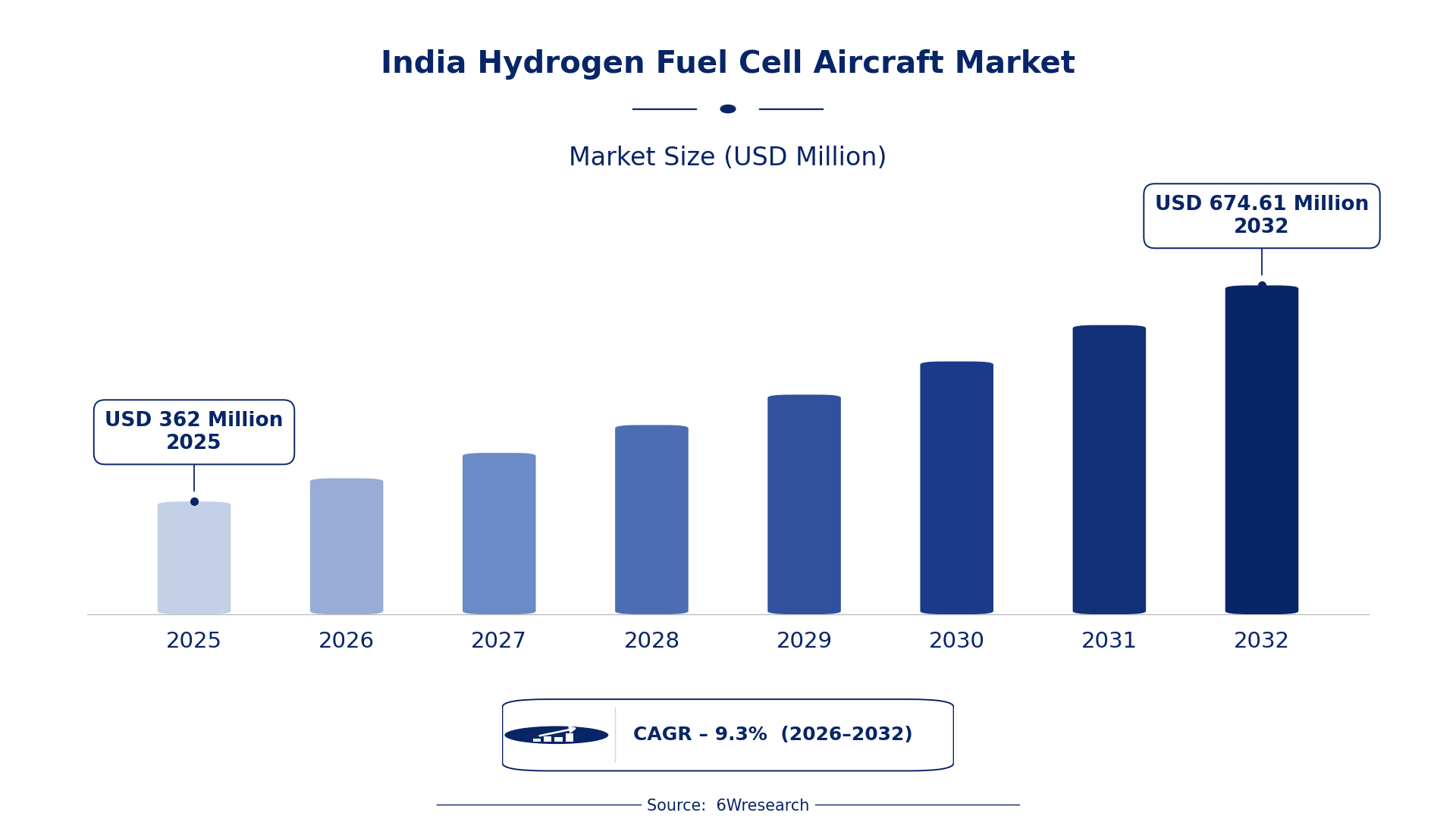
According to 6Wresearch internal database and industry insights, the India Hydrogen Fuel Cell Aircraft Market was valued at USD 362.0 million in 2025 and is projected to reach USD 674.61 million by 2032, growing at a CAGR of approximately 9.3% during 2026–2032.
India Hydrogen Fuel Cell Aircraft Market Highlights
| Report Metric | Details |
| Report Name | India Hydrogen Fuel Cell Aircraft Market |
| Market Size 2025 | USD 362.0 million |
| Market Size 2032 | USD 674.61 million |
| Absolute Growth 2025–2032 | USD 312.61 million |
| CAGR 2026–2032 | 9.3% |
| Peak Annual Growth | 11.2% in 2028 |
| Forecast Period | 2026–2032 |
| Historical Data | 2022–2025 |
| Base Year | 2025 |
| Leading Aircraft Type, 2025 | Regional Aircraft (36% share) |
| Leading Fuel Cell Type, 2025 | PEM Fuel Cell (35% share) |
| Leading Application Use, 2025 | Short-Haul Travel (36% share) |
| Leading End User, 2025 | Regional Airline Operators (48% share) |
| Fastest-Growing Aircraft Type | Drones/UAVs (11.0% CAGR) |
| Fastest-Growing Fuel Cell Type | Solid Oxide Fuel Cell (11.9% CAGR) |
| Fastest-Growing Application Use | Surveillance (10.4% CAGR) |
| Fastest-Growing End User | Defense Sector (11.2% CAGR) |
| Growing Sector | regional airline operators |
| Key End Users | regional airline operators, defense sector, aerospace R&D agencies, air taxi startups |
India Hydrogen Fuel Cell Aircraft Market Year-wise Growth Rate and Key Drivers (2022–2032)
This graph illustrates the annual growth rates of the market from 2022 to 2032, highlighting a steady upward trajectory and projected market expansion over the forecast period.
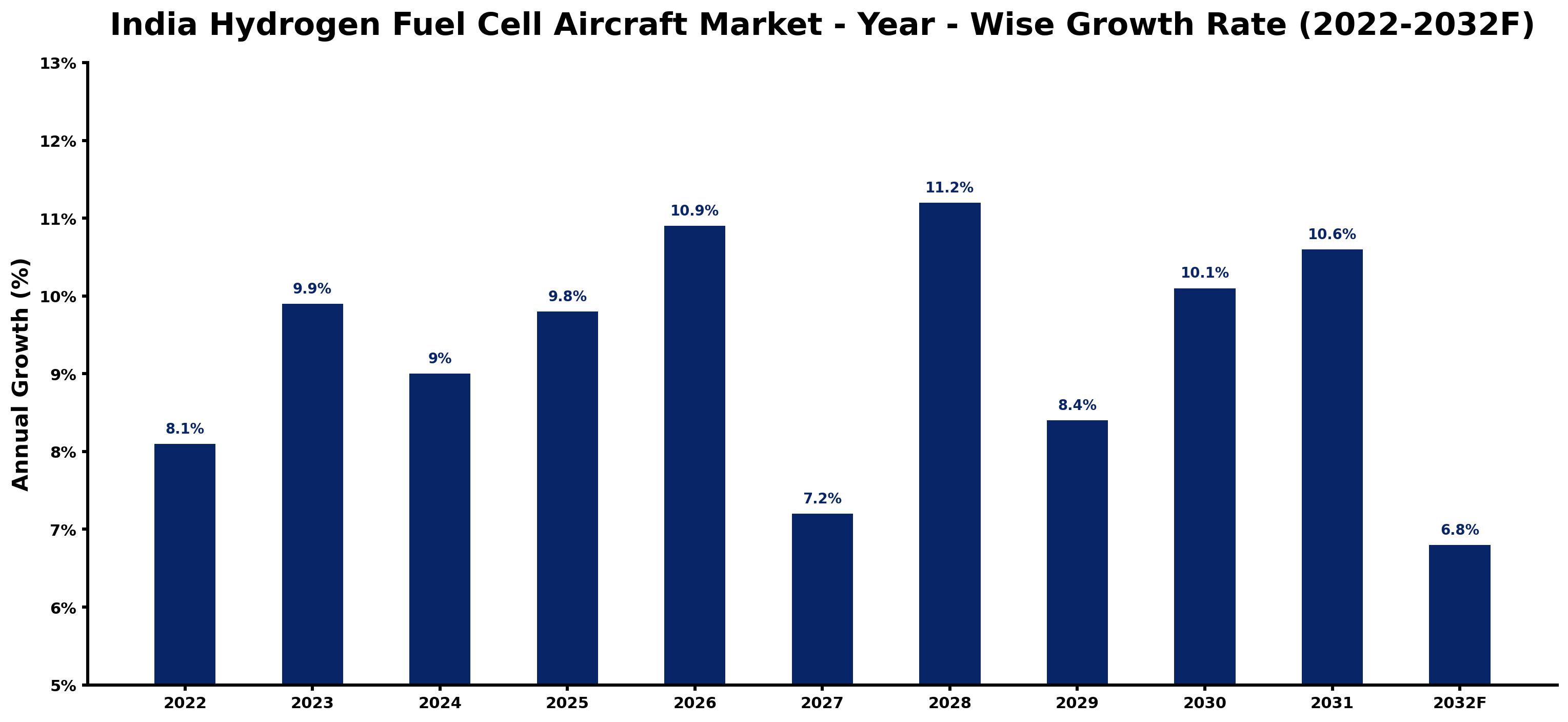
Each row of the following table gives one year's estimated growth and the event or demand shift that explains it.
| Year | Estimated Annual Growth (%) | Market Rationale |
| 2022 | 8.1 | The market experienced steady growth due to initial investments in hydrogen technologies. |
| 2023 | 9.9 | Demand increased as the aerospace sector showed heightened interest in sustainable aviation solutions. |
| 2024 | 9.0 | Growth slowed as companies adjusted to evolving regulatory frameworks and market conditions. |
| 2025 | 9.8 | Investment in hydrogen fuel cell prototypes accelerated, boosting market activity and interest. |
| 2026 | 10.9 | The introduction of new standards for hydrogen systems enhanced market confidence and demand. |
| 2027 | 7.2 | Growth slowed as the industry faced challenges in scaling production capacities effectively. |
| 2028 | 11.2 | A surge in investment for hydrogen technologies led to the peak growth rate for the market. |
| 2029 | 8.4 | Market growth slowed as companies consolidated their positions and refined strategies. |
| 2030 | 10.1 | Increased air travel demand and government initiatives revitalised market growth prospects. |
| 2031 | 10.6 | The market continued to expand as regional airline operators increased their focus on sustainability. |
| 2032 | 6.8 | Growth slowed as the market began to stabilise after rapid expansion in previous years. |
Note: Market size estimations and growth projections presented in this report are based on 6Wresearch's proprietary forecasting methodology, utilizing the latest available industry data, government publications, and primary research inputs.
India Hydrogen Fuel Cell Aircraft Market Synopsis
Hydrogen Fuel Cell Aircraft Market in India includes aircraft powered by hydrogen fuel cells, which generate electricity through chemical reactions. These aircraft cater to short-haul travel, surveillance, and urban air mobility. The market is expanding as investments in sustainable aviation technologies rise, driven by regional airline operators and government initiatives. India's aerospace industry is set to reach $70 billion by 2030, indicating a strong demand for advanced aviation solutions. The National Hydrogen Mission and the National Air Mobility Policy play crucial roles in shaping this growth.
Market Dynamics Impact Analysis (2026–2032)
| Factor | Type | Impact | Primary Segment Affected |
| Increasing investments in hydrogen fuel cell technology | Driver | High | Regional Aircraft |
| Growing demand for sustainable aviation solutions | Driver | High | Short-Haul Travel |
| Emerging opportunities in urban air mobility | Opportunity | High | eVTOL Aircraft |
| Potential for regional connectivity enhancements | Opportunity | High | Regional Airline Operators |
| High development costs for hydrogen infrastructure | Restraint | High | Drones/UAVs |
| Limited awareness and understanding of hydrogen technologies | Restraint | Medium | Commercial Prototypes |
| Challenges in scaling production capacity | Challenge | High | Regional Aircraft |
| Regulatory hurdles in certification and standards | Challenge | Medium | Aerospace R&D Agencies |
Evaluation of Drivers in India Hydrogen Fuel Cell Aircraft Market (2026–2032)
Below mentioned are some major drivers and their influence on market dynamics.
| Drivers | Primary Segment Affected | Why It Matters (Evidence) |
| Rising investments in hydrogen fuel cell prototypes | Regional Aircraft | Investment in hydrogen fuel cell prototypes is expected to reach $200 million, encouraging regional airline operators to adopt these technologies. |
| Increased demand for sustainable aviation solutions | Short-Haul Travel | The aerospace industry is projected to reach $70 billion by 2030, driving airlines to seek sustainable options. |
| Government initiatives promoting hydrogen technology | eVTOL Aircraft | The National Air Mobility Policy supports the integration of eVTOL aircraft, stimulating demand for hydrogen fuel cell systems. |
| Focus on reducing aviation emissions | Drones/UAVs | The program to reduce emissions by promoting alternative fuels boosts interest in hydrogen technologies among producers. |
| Expansion of aerospace R&D funding | Commercial Prototypes | The establishment of a $1 billion fund for aerospace R&D supports research into hydrogen fuel cell applications. |
Market growth for Hydrogen Fuel Cell Aircraft in India is underpinned by rising investments in hydrogen fuel cell prototypes and increased demand for sustainable aviation solutions. The aerospace industry is projected to reach $70 billion by 2030, prompting airlines to explore cleaner technologies. The establishment of a dedicated $1 billion fund for aerospace R&D supports research into hydrogen applications, creating a conducive environment for market expansion.
Evaluation of Restraints in India Hydrogen Fuel Cell Aircraft Market
The table below lists the restraints and the evidence behind each.
| Market Restraint | Primary Segment Affected | Why It Matters (Evidence) |
| High development costs for hydrogen infrastructure | Drones/UAVs | Developing hydrogen infrastructure incurs costs of up to $10 million, limiting investments from regional airline operators. |
| Limited awareness and understanding of hydrogen technologies | Commercial Prototypes | A lack of knowledge about hydrogen fuel cell benefits hinders adoption among aerospace R&D agencies, affecting innovation. |
| Regulatory hurdles in certification and standards | Regional Aircraft | Complex certification processes delay the introduction of hydrogen fuel cell aircraft to the market, affecting timelines for producers. |
| Challenges in scaling production capacity | Regional Aircraft | Production capacity issues create bottlenecks, affecting supply for regional airline operators and delaying projects. |
| Market volatility due to fluctuating investments | eVTOL Aircraft | Investment fluctuations create uncertainty, impacting the development of hydrogen fuel cell technologies and market stability. |
India Hydrogen Fuel Cell Aircraft Market Challenges
Producers in the India hydrogen fuel cell aircraft market face intense competition from emerging players, which can erode profit margins and compel established firms to invest heavily in innovation. Buyers encounter high costs associated with technology adoption; initial investments in hydrogen infrastructure can exceed $10 million, creating a barrier for smaller airlines. Skills shortages hinder the industry's growth, as the lack of trained professionals in hydrogen technology can delay project timelines for manufacturers, affecting their ability to fulfil market demands. Technological challenges persist due to the absence of established standards for hydrogen fuel systems, causing uncertainty that delays product launches and impacts suppliers' readiness.
Trends in the India Hydrogen Fuel Cell Aircraft Market
Buyers and suppliers in the India Hydrogen Fuel Cell Aircraft Market are adjusting to the following trends.
- Shift towards Sustainable Aviation: Regional airline operators are increasingly adopting hydrogen fuel cell technologies to improve sustainability. The National Hydrogen Mission aims for 5 million tons of hydrogen production by 2030, supporting this shift.
- Growth of Urban Air Mobility Solutions: Maharashtra is emerging as a hub for eVTOL aircraft development, with the government targeting 100 prototypes by 2025. This initiative is expected to drive demand for hydrogen-powered solutions.
- Increased Focus on Hydrogen Standards: The Bureau of Indian Standards is developing ISO-compliant standards for hydrogen fuel systems, expected to be finalised by 2024. This standardisation will facilitate market entry for new technologies and promote safety.
- Rising Investment in Aerospace R&D: India's dedicated $1 billion fund for aerospace R&D is promoting advancements in hydrogen fuel cell technologies. This investment is essential for developing new applications in the aviation sector.
Investment Opportunities in the India Hydrogen Fuel Cell Aircraft Market
The following opportunities in the India Hydrogen Fuel Cell Aircraft Market pair current demand with a clear way in.
- Supply of Hydrogen Fuel Cell Systems: The demand for hydrogen fuel cell systems is growing, with the market expected to reach $674.61 million by 2032. Regional airline operators are seeking suppliers to meet this demand for sustainable aviation solutions.
- Investment in R&D for Hydrogen Technologies: With a $1 billion fund for aerospace R&D, there is an opportunity to invest in hydrogen fuel cell technology development. Collaborating with aerospace R&D agencies can drive innovation and improve capabilities.
- Development of Hydrogen Infrastructure: The establishment of hydrogen refuelling stations is vital, with the National Hydrogen Mission targeting 5 million tons of production by 2030. Partnering with local governments can facilitate infrastructure development and support market growth.
- Expansion into Urban Air Mobility: The eVTOL aircraft market is expanding, with a projected growth rate of 11.0%. Investing in hydrogen-powered eVTOL solutions can position suppliers advantageously in this emerging sector.
Government Initiatives in the India Hydrogen Fuel Cell Aircraft Market
The National Hydrogen Mission, launched by the Ministry of Power in 2021, aims to promote hydrogen production and utilisation with a target of 5 million tons by 2030. This initiative encourages investment in hydrogen technologies and supports infrastructure development, benefiting producers and buyers alike. The Ministry of Civil Aviation's National Air Mobility Policy, introduced in 2022, focuses on integrating eVTOL aircraft into urban transport systems by 2025. This policy creates a framework for the development and adoption of hydrogen fuel cell aircraft in urban settings, improving market prospects for producers.
The Defense Research and Development Organization initiated a project in 2023 to develop hydrogen fuel cell technology for UAV applications, with a budget of $200 million. This funding supports research and development efforts, enabling suppliers to create innovative solutions for the defense sector. The Bureau of Indian Standards is also working on ISO-compliant standards for hydrogen fuel systems in aviation, expected to be finalised by 2024. This standardisation will facilitate market entry for new technologies, benefiting both producers and buyers.
Future Insight of the India Hydrogen Fuel Cell Aircraft Market
Several forward-looking factors should support the India hydrogen fuel cell aircraft market in the coming years. The government's initiative to develop 100 prototypes of electric vertical take-off and landing aircraft by 2025 will stimulate innovation and attract investment. By 2030, India's aerospace industry is projected to reach $70 billion, highlighting the growing demand for sustainable aviation solutions. Collaborations between the Civil Aviation Ministry and international agencies will accelerate advancements in hydrogen technology, while the National Hydrogen Mission will promote hydrogen as a clean energy source.
Market Segmentation Analysis
Each segment group is reviewed below, with the leader by share and the fastest grower by CAGR.
By Aircraft Type – Regional Aircraft Dominated, Drones/UAVs Expected to Grow Fastest
According to Bhawna Singh, Assistant Manager at 6Wresearch, in 2025, Regional Aircraft led the aircraft type split with a 36% share. Regional aircraft dominate the market share as they are essential for short-haul travel, catering to the connectivity requirements across India's varied regions. Their efficiency in addressing these needs positions them as a cornerstone of the hydrogen fuel cell aircraft market. Drones/UAVs are set to record the highest CAGR in this split, 11.0% over 2026–2032. Drones and UAVs are experiencing rapid growth, largely due to their critical applications in surveillance and monitoring, which are increasingly vital for national security. The Indian Air Force's exploration of hydrogen fuel cell technology for UAVs underscores the momentum behind this segment's expansion. Suppliers should focus on developing hydrogen fuel cell technologies that cater specifically to the needs of regional aircraft and UAVs to capitalise on these emerging opportunities.
By Fuel Cell Type – PEM Fuel Cell Dominated, Solid Oxide Fuel Cell Expected to Grow Fastest
The largest fuel cell type category in 2025 was PEM Fuel Cell, with a 35% share of total revenue. PEM fuel cells command the largest share of the market owing to their high efficiency and suitability for aviation applications, making them the preferred option for manufacturers. Their established presence ensures a strong installed base that supports their market position in hydrogen fuel cell aircraft. Solid Oxide Fuel Cell is projected to grow fastest, at a CAGR of 11.9% during 2026–2032. Solid oxide fuel cells are experiencing rapid growth, albeit from a smaller base, as advancements in technology may soon enable their use in aviation despite current challenges. This potential for future application creates an appealing growth narrative for suppliers in the hydrogen fuel cell market. Buyers should stay informed about the evolving fuel cell technologies, as suppliers are likely to introduce more efficient and applicable solutions in the near future.
By Application Use – Short-Haul Travel Dominated, Surveillance Expected to Grow Fastest
With a 36% revenue share in 2025, Short-Haul Travel was the largest application use category. Short-haul travel stands out as the primary application for hydrogen fuel cell aircraft, effectively meeting the urgent demand for efficient regional connectivity in India. The increasing population and air travel demand further reinforce its leading market share. Over 2026–2032, Surveillance is expected to post the fastest growth, at a CAGR of 10.4%. Surveillance applications are witnessing the highest growth rate, propelled by the escalating need for defence and monitoring capabilities in a dynamic security environment. The Defence Sector's integration of hydrogen fuel cells into UAVs highlights this trend's significance. Suppliers must prioritise the creation of hydrogen fuel cell solutions that specifically address the requirements of short-haul travel and surveillance applications to remain competitive.
By End User – Regional Airline Operators Dominated, Defense Sector Expected to Grow Fastest
Regional Airline Operators took a 48% share of end user in 2025, more than any other category. Regional airline operators are the key end users of hydrogen fuel cell aircraft, playing a crucial role in enhancing regional connectivity throughout India. Their commitment to sustainable practices and established operational frameworks significantly bolster their market share in this sector. The quickest growth will come from Defense Sector, forecast to expand at a CAGR of 11.2% between 2026 and 2032. The defence sector is rapidly adopting hydrogen fuel cell technology, particularly for UAVs and surveillance, driven by growing national security demands. This urgent need for advanced capabilities positions the defence sector as the fastest-growing end user segment in the market. Suppliers should collaborate with both regional airline operators and the defence sector to develop hydrogen fuel cell solutions that meet their specific operational needs.
Key Attractiveness of the Report
- 10 Years of Market Numbers
- Historical Data Starting from 2022 to 2025
- Base Year 2025
- Forecast Data until 2032
- Key Performance Indicators Impacting the Market
- Major Upcoming Developments and Projects
Key Highlights of the Report:
- India Hydrogen Fuel Cell Aircraft Market Outlook
- Market Size of India Hydrogen Fuel Cell Aircraft Market, 2025
- Forecast of India Hydrogen Fuel Cell Aircraft Market, 2032
- Historical Data and Forecast of India Hydrogen Fuel Cell Aircraft Revenues & Volume for the Period 2022 - 2032F
- India Hydrogen Fuel Cell Aircraft Market Trend Evolution
- India Hydrogen Fuel Cell Aircraft Market Drivers and Challenges
- India Hydrogen Fuel Cell Aircraft Price Trends
- India Hydrogen Fuel Cell Aircraft Porter's Five Forces
- India Hydrogen Fuel Cell Aircraft Industry Life Cycle
- Historical Data and Forecast of India Hydrogen Fuel Cell Aircraft Market Revenues & Volume By Aircraft Type for the Period 2022 - 2032F
- Historical Data and Forecast of India Hydrogen Fuel Cell Aircraft Market Revenues & Volume By Regional Aircraft for the Period 2022 - 2032F
- Historical Data and Forecast of India Hydrogen Fuel Cell Aircraft Market Revenues & Volume By Drones/UAVs for the Period 2022 - 2032F
- Historical Data and Forecast of India Hydrogen Fuel Cell Aircraft Market Revenues & Volume By eVTOL Aircraft for the Period 2022 - 2032F
- Historical Data and Forecast of India Hydrogen Fuel Cell Aircraft Market Revenues & Volume By Commercial Prototypes for the Period 2022 - 2032F
- Historical Data and Forecast of India Hydrogen Fuel Cell Aircraft Market Revenues & Volume By Fuel Cell Type for the Period 2022 - 2032F
- Historical Data and Forecast of India Hydrogen Fuel Cell Aircraft Market Revenues & Volume By PEM Fuel Cell for the Period 2022 - 2032F
- Historical Data and Forecast of India Hydrogen Fuel Cell Aircraft Market Revenues & Volume By Solid Oxide Fuel Cell for the Period 2022 - 2032F
- Historical Data and Forecast of India Hydrogen Fuel Cell Aircraft Market Revenues & Volume By Alkaline Fuel Cell for the Period 2022 - 2032F
- Historical Data and Forecast of India Hydrogen Fuel Cell Aircraft Market Revenues & Volume By Hybrid Systems for the Period 2022 - 2032F
- Historical Data and Forecast of India Hydrogen Fuel Cell Aircraft Market Revenues & Volume By Application Use for the Period 2022 - 2032F
- Historical Data and Forecast of India Hydrogen Fuel Cell Aircraft Market Revenues & Volume By Short-Haul Travel for the Period 2022 - 2032F
- Historical Data and Forecast of India Hydrogen Fuel Cell Aircraft Market Revenues & Volume By Surveillance for the Period 2022 - 2032F
- Historical Data and Forecast of India Hydrogen Fuel Cell Aircraft Market Revenues & Volume By Urban Air Mobility for the Period 2022 - 2032F
- Historical Data and Forecast of India Hydrogen Fuel Cell Aircraft Market Revenues & Volume By Long-Range Planning for the Period 2022 - 2032F
- Historical Data and Forecast of India Hydrogen Fuel Cell Aircraft Market Revenues & Volume By End User for the Period 2022 - 2032F
- Historical Data and Forecast of India Hydrogen Fuel Cell Aircraft Market Revenues & Volume By Regional Airline Operators for the Period 2022 - 2032F
- Historical Data and Forecast of India Hydrogen Fuel Cell Aircraft Market Revenues & Volume By Defense Sector for the Period 2022 - 2032F
- Historical Data and Forecast of India Hydrogen Fuel Cell Aircraft Market Revenues & Volume By Air Taxi Startups for the Period 2022 - 2032F
- Historical Data and Forecast of India Hydrogen Fuel Cell Aircraft Market Revenues & Volume By Aerospace R&D Agencies for the Period 2022 - 2032F
- India Hydrogen Fuel Cell Aircraft Import Export Trade Statistics
- Market Opportunity Assessment By Aircraft Type
- Market Opportunity Assessment By Fuel Cell Type
- Market Opportunity Assessment By Application Use
- Market Opportunity Assessment By End User
- India Hydrogen Fuel Cell Aircraft Top Companies Market Share
- India Hydrogen Fuel Cell Aircraft Competitive Benchmarking By Technical and Operational Parameters
- India Hydrogen Fuel Cell Aircraft Company Profiles
- India Hydrogen Fuel Cell Aircraft Key Strategic Recommendations
Market Covered
Segments analysed in this report are listed below.
By Aircraft Type
- Regional Aircraft
- Drones/UAVs
- eVTOL Aircraft
- Commercial Prototypes
By Fuel Cell Type
- PEM Fuel Cell
- Solid Oxide Fuel Cell
- Alkaline Fuel Cell
- Hybrid Systems
By Application Use
- Short-Haul Travel
- Surveillance
- Urban Air Mobility
- Long-Range Planning
By End User
- Regional Airline Operators
- Defense Sector
- Air Taxi Startups
- Aerospace R&D Agencies































