China Hydrogen Fuel Cell Aircraft Market Size & Growth Rate
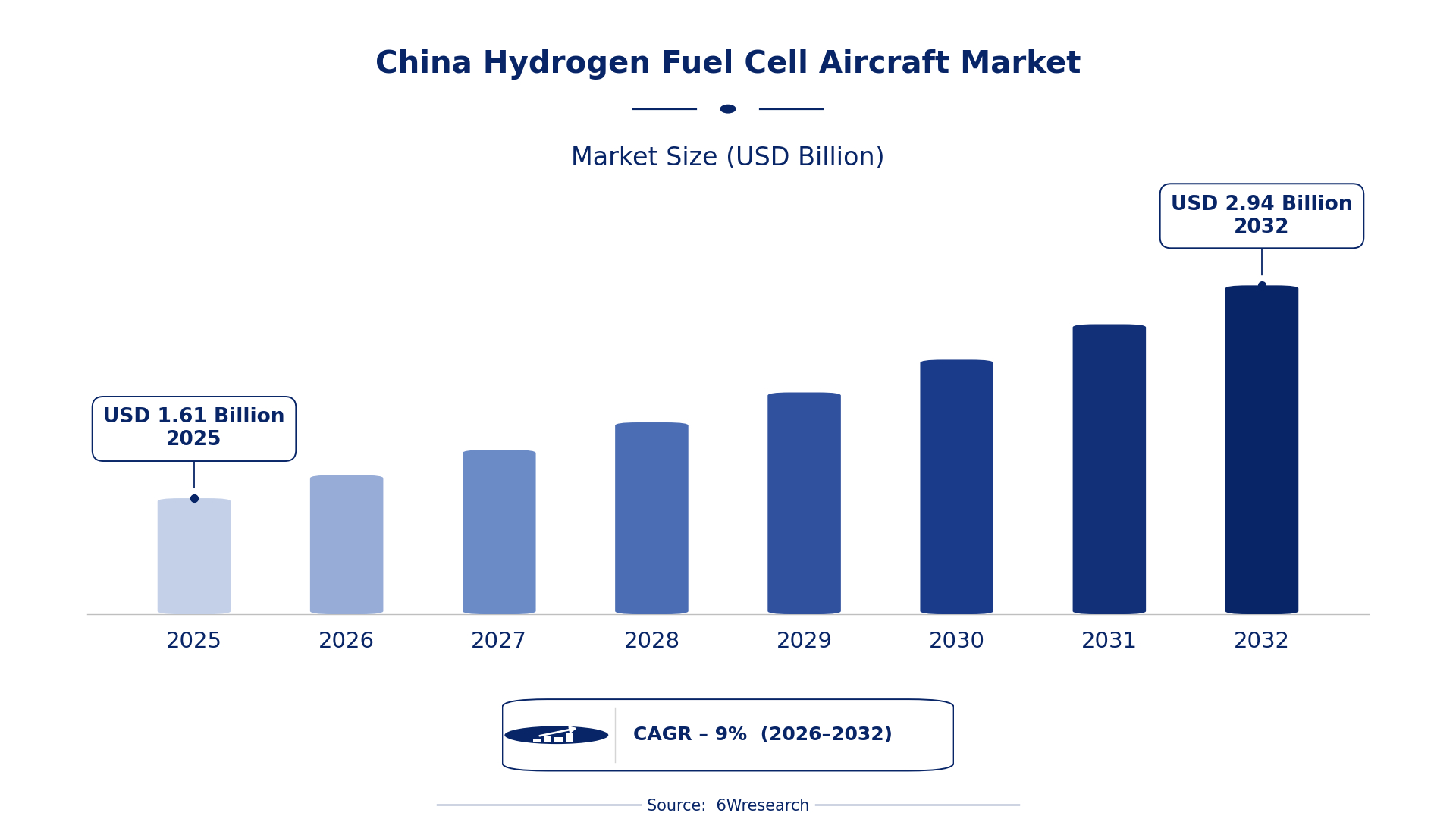
According to 6Wresearch internal database and industry insights, the China Hydrogen Fuel Cell Aircraft Market was valued at USD 1.61 billion in 2025 and is projected to reach USD 2.94 billion by 2032, growing at a CAGR of approximately 9% during 2026–2032.
China Hydrogen Fuel Cell Aircraft Market Highlights
| Report Metric | Details |
| Report Name | China Hydrogen Fuel Cell Aircraft Market |
| Market Size 2025 | USD 1.61 billion |
| Market Size 2032 | USD 2.94 billion |
| Absolute Growth 2025–2032 | USD 1.33 billion |
| CAGR 2026–2032 | 9% |
| Peak Annual Growth | 10.8% in 2028 |
| Forecast Period | 2026–2032 |
| Historical Data | 2022–2025 |
| Base Year | 2025 |
| Leading Aircraft Type, 2025 | Regional Aircraft (49% share) |
| Leading Fuel Cell Type, 2025 | PEM Fuel Cell (44% share) |
| Leading Application Use, 2025 | Short-Haul Travel (41% share) |
| Leading End User, 2025 | Regional Airline Operators (42% share) |
| Fastest-Growing Aircraft Type | Drones/UAVs (11.2% CAGR) |
| Fastest-Growing Application Use | Urban Air Mobility (10.5% CAGR) |
| Fastest-Growing End User | Air Taxi Startups (10.7% CAGR) |
| Growing Sector | Regional Transportation |
| Key End Users | Regional Airline Operators, Aerospace R&D Agencies, Urban Air Mobility Startups |
China Hydrogen Fuel Cell Aircraft Market Year-wise Growth Rate and Key Drivers (2022–2032)
This graph illustrates the annual growth rates of the market from 2022 to 2032, highlighting a steady upward trajectory and projected market expansion over the forecast period.
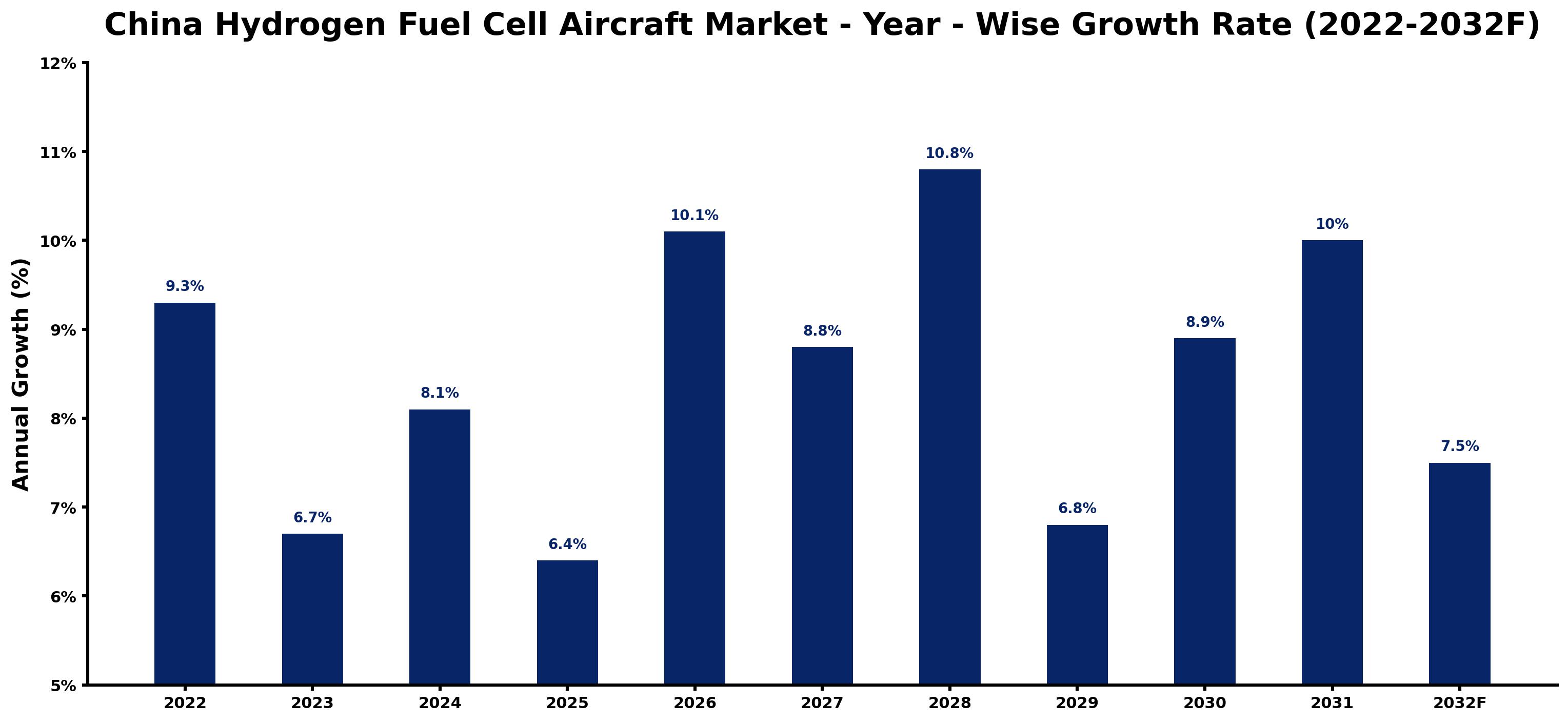
Annual growth estimates for each year appear below with the principal reason behind them, explaining the shifts that set the pace of the market.
| Year | Estimated Annual Growth (%) | Market Rationale |
| 2022 | 9.3 | The market experienced strong interest from regional airline operators exploring hydrogen fuel technologies. |
| 2023 | 6.7 | Growth slowed as some projects faced delays in funding and development timelines. |
| 2024 | 8.1 | Increased R&D initiatives led to a resurgence in market activity and investment through the Hydrogen Fuel Cell Aircraft Innovation Program. |
| 2025 | 6.4 | The market continued to grow, but at a slower pace due to regulatory hurdles from the Ministry of Industry and Information Technology. |
| 2026 | 10.1 | Demand surged as the government launched new support programs for hydrogen technologies, including the National Hydrogen Energy Development Plan. |
| 2027 | 8.8 | Market growth slowed as some regional operators reassessed their investment strategies in hydrogen fuel initiatives. |
| 2028 | 10.8 | A peak in growth occurred as urban air mobility initiatives gained traction, supported by the Civil Aviation Administration of China. |
| 2029 | 6.8 | Growth slowed as the market adjusted to new standards and regulations set by the Ministry of Industry and Information Technology. |
| 2030 | 8.9 | Increased interest in urban air mobility led to a rebound in growth rates, as regional airline operators sought sustainable solutions. |
| 2031 | 10.0 | Demand rose as regional airline operators committed to sustainable aviation solutions under the Green Aviation Development Strategy. |
| 2032 | 7.5 | Growth moderated as the market stabilised following a period of rapid expansion. |
Note: Market size estimations and growth projections presented in this report are based on 6Wresearch's proprietary forecasting methodology, utilizing the latest available industry data, government publications, and primary research inputs.
China Hydrogen Fuel Cell Aircraft Market Synopsis
Hydrogen Fuel Cell Aircraft in China utilise hydrogen as a fuel source, converting it into electricity through fuel cells to power electric motors. These aircraft are primarily designed for regional transportation and urban air mobility. The China Hydrogen Fuel Cell Aircraft Market is growing due to substantial investments in aerospace R&D, with over 1 trillion CNY projected by 2035. Support from the National Development and Reform Commission under the 14th Five-Year Plan drives demand, as regional airline operators seek sustainable solutions to reduce carbon emissions by 2030.
Market Dynamics Impact Analysis (2026–2032)
| Factor | Type | Impact | Primary Segment Affected |
| Significant investments in R&D for hydrogen technologies | Driver | High | Regional Aircraft |
| Growing interest in urban air mobility solutions | Driver | High | Urban Air Mobility |
| Expansion of hydrogen infrastructure in major hubs | Opportunity | High | Drones/UAVs |
| Rising demand for sustainable aviation solutions | Opportunity | High | Regional Airline Operators |
| Regulatory hurdles in technology adoption | Restraint | High | eVTOL Aircraft |
| Limited public awareness of hydrogen technologies | Restraint | Medium | Commercial Prototypes |
| High initial investment costs for hydrogen infrastructure | Challenge | High | Regional Airline Operators |
| Competition from alternative fuel technologies | Challenge | Medium | Drones/UAVs |
Evaluation of Drivers in China Hydrogen Fuel Cell Aircraft Market (2026–2032)
The table below links each growth driver to the segment it affects and the evidence for it.
| Drivers | Primary Segment Affected | Why It Matters (Evidence) |
| Increased investment in hydrogen fuel cell technology | PEM Fuel Cell | The target of 100 hydrogen fuel cell aircraft prototypes by 2025 drives demand for PEM fuel cells. |
| Growing focus on urban air mobility | Urban Air Mobility | Urban air mobility initiatives, endorsed by regulatory bodies, are expected to stimulate further interest in hydrogen fuel cell aircraft. |
| Support from R&D agencies | Aerospace R&D Agencies | Projected investments of over 1 trillion CNY in R&D by 2035 boost hydrogen fuel cell aircraft development. |
| Regional airline operators exploring sustainable options | Regional Airline Operators | Investigations into hydrogen fuel cells aim to reduce carbon emissions by 2030, increasing demand for these aircraft. |
| Technological advancements in hydrogen production | Drones/UAVs | Drones powered by hydrogen fuel cells can achieve flight times exceeding 5 hours, improving operational capabilities. |
The target of 100 hydrogen fuel cell aircraft prototypes by 2025 will drive demand for PEM fuel cells. China's aerospace sector is projected to invest over 1 trillion CNY in R&D by 2035, which will advance the development of hydrogen fuel cell technologies. Regional airline operators are actively exploring hydrogen fuel cells to meet carbon reduction targets by 2030, leading to increased purchases of these aircraft.
Evaluation of Restraints in China Hydrogen Fuel Cell Aircraft Market
Below mentioned are some major restraints and their influence on market dynamics.
| Market Restraint | Primary Segment Affected | Why It Matters (Evidence) |
| Regulatory hurdles in technology adoption | eVTOL Aircraft | Regulatory challenges slow down the adoption of hydrogen fuel cell technologies in eVTOL aircraft, affecting market growth. |
| Limited public awareness of hydrogen technologies | Commercial Prototypes | A lack of awareness among potential buyers limits the market for commercial prototypes using hydrogen fuel cells. |
| High initial investment costs for hydrogen infrastructure | Regional Airline Operators | The high costs associated with establishing hydrogen infrastructure deter some regional airline operators from investing. |
| Competition from alternative fuel technologies | Drones/UAVs | Drones powered by alternative fuels may pose a competitive threat to hydrogen fuel cell UAVs, impacting market share. |
| Technological limitations in fuel cell efficiency | PEM Fuel Cell | Current efficiency limitations of PEM fuel cells may hinder broader adoption in the aviation sector. |
China Hydrogen Fuel Cell Aircraft Market Challenges
Buyers in the China Hydrogen Fuel Cell Aircraft Market encounter several pressing issues, starting with high costs. The substantial initial investments required for hydrogen fuel technologies can lead to delays in the adoption of cleaner aircraft solutions by regional airline operators. Regulatory challenges follow, as evolving standards from the Ministry of Industry and Information Technology create uncertainty, which can slow down procurement processes for buyers. A skills gap in the workforce further complicates matters, as the demand for specialised training in hydrogen technologies exceeds current educational offerings, making it difficult for producers to recruit qualified personnel.
Trends in the China Hydrogen Fuel Cell Aircraft Market
Buyers and suppliers in the China Hydrogen Fuel Cell Aircraft Market are adjusting to the following trends.
- Shift towards Urban Air Mobility Solutions: Regional airline operators are increasingly focusing on urban air mobility solutions, backed by the Civil Aviation Administration of China. This shift is expected to drive demand for hydrogen fuel cell aircraft, with a projected growth rate of 10.5% in this segment.
- Increased R&D Investment in Hydrogen Technologies: China's aerospace industry is set to invest over 1 trillion CNY in R&D by 2035, driving advancements in hydrogen technologies. This investment is vital for developing efficient hydrogen fuel cell aircraft and improving their market viability.
- Growing Adoption of PEM Fuel Cells: PEM fuel cells are becoming the preferred choice for hydrogen fuel cell aircraft due to their efficiency. This trend is clear as they accounted for 44% of the fuel cell market share in 2025, promoting further adoption.
- Expansion of Hydrogen Infrastructure: The establishment of hydrogen infrastructure is gaining momentum, particularly in the Beijing-Tianjin-Hebei region. This development is essential for supporting the growing demand for hydrogen fuel cell aircraft, with significant investments planned.
Investment Opportunities in the China Hydrogen Fuel Cell Aircraft Market
Some of the investment opportunities in the China Hydrogen Fuel Cell Aircraft Market are mentioned below.
- Development of Hydrogen Infrastructure in Major Hubs: The Beijing-Tianjin-Hebei region is becoming a key area for hydrogen infrastructure development, with over 1 trillion CNY projected for R&D by 2035. This presents opportunities for suppliers to enter the market through partnerships with regional developers.
- Investment in Urban Air Mobility Initiatives: With urban air mobility initiatives gaining traction, there is a notable opportunity for investment in hydrogen fuel cell aircraft. The Civil Aviation Administration of China supports these initiatives, providing a pathway for new entrants.
- Collaboration with Aerospace R&D Agencies: Working with aerospace R&D agencies can improve the development of hydrogen fuel cell technologies. This is timely as the National Hydrogen Energy Development Plan aims to increase hydrogen production capacity significantly by 2025.
- Focus on Sustainable Aviation Solutions: As regional airline operators seek to reduce carbon emissions by 2030, there is a growing opportunity for suppliers of hydrogen fuel cell aircraft. Engaging with these operators can lead to fruitful partnerships.
Government Initiatives in the China Hydrogen Fuel Cell Aircraft Market
The Hydrogen Fuel Cell Aircraft Innovation Program launched by the Ministry of Science and Technology in 2022 aims to support R&D with a budget of 500 million CNY. This program strengthens previous efforts under the National Hydrogen Energy Development Plan, which seeks to increase hydrogen production capacity to 1 million tons by 2025. These measures collectively enhance the framework for hydrogen fuel cell aircraft development in China.
The National Energy Administration oversees the National Hydrogen Energy Development Plan, which allocates funding for hydrogen production and infrastructure projects. This plan aims to increase hydrogen production capacity significantly by 2025, facilitating the growth of hydrogen fuel cell technologies in aviation. The Civil Aviation Administration of China also plays a vital role in promoting hydrogen fuel cell technology adoption through its Green Aviation Development Strategy.
Future Insight of the China Hydrogen Fuel Cell Aircraft Market
Several forward-looking factors should support the China Hydrogen Fuel Cell Aircraft Market over the coming years. The government's commitment to invest in aerospace R&D will drive innovation and efficiency in aircraft development. By 2025, the goal of having 100 hydrogen fuel cell aircraft prototypes will stimulate production and attract investment. Initiatives promoting hydrogen fuel cell technology standards will streamline processes, providing buyers with more reliable options for sustainable transportation. Urban air mobility initiatives will also expand, enhancing the market's growth potential.
Market Segmentation Analysis
The report offers a comprehensive study of the following market segments and their leading categories in the market.
By Aircraft Type – Regional Aircraft Dominated, Drones/UAVs Expected to Grow Fastest
According to Bhawna Singh, Assistant Manager at 6Wresearch, with a 49% revenue share in 2025, Regional Aircraft was the largest aircraft type category. Regional aircraft lead the market share as they are specifically tailored for short-haul flights, appealing to regional airline operators focused on sustainability. This segment benefits from substantial R&D investments in key aerospace hubs such as Beijing-Tianjin-Hebei, which are pivotal for innovation. The quickest growth will come from Drones/UAVs, forecast to expand at a CAGR of 11.2% between 2026 and 2032. Drones and UAVs are witnessing rapid growth due to their capability to utilise hydrogen fuel cells for extended flight times, making them increasingly appealing for logistics and urban applications. The rising demand for innovative transport solutions in urban areas will likely accelerate this segment's expansion. Suppliers should focus on developing solutions for regional aircraft and drones to meet the growing demand in China.
By Fuel Cell Type – PEM Fuel Cell Dominated and Is Expected to Record the Fastest Growth
The largest fuel cell type category in 2025 was PEM Fuel Cell, with a 44% share of total revenue. PEM fuel cells dominate the market share as they are the most efficient type used in hydrogen fuel cell aircraft, making them the preferred choice for manufacturers. Their established technology and performance in various applications solidify their leading position. Its lead should widen, with a projected CAGR of 10.4% during 2026–2032, the highest in this split. The PEM fuel cell segment is also the fastest-growing due to continuous advancements in efficiency and cost-effectiveness, ensuring its relevance in both regional aircraft and UAVs. As the market matures, the lead of PEM fuel cells is expected to widen further. Manufacturers should prioritise PEM fuel cell technology to meet the increasing demand for efficient hydrogen fuel solutions.
By Application Use – Short-Haul Travel Dominated, Urban Air Mobility Expected to Grow Fastest
In 2025, Short-Haul Travel led the application use split with a 41% share. Short-haul travel commands the largest market share as hydrogen fuel cell aircraft are specifically designed for this purpose, catering to regional airline operators' needs. The strong emphasis on reducing carbon emissions in aviation further enhances the appeal of this application. Over 2026–2032, Urban Air Mobility is expected to post the fastest growth, at a CAGR of 10.5%. Urban air mobility is emerging as the fastest-growing application, driven by government initiatives and the increasing demand for innovative transport solutions in densely populated areas. This segment's swift growth is expected to attract significant investment and interest, shaping the overall market. Investors should seek opportunities in urban air mobility as a vital growth area within the hydrogen fuel cell aircraft market.
By End User – Regional Airline Operators Dominated, Air Taxi Startups Expected to Grow Fastest
Regional Airline Operators took a 42% share of end user in 2025, more than any other category. Regional airline operators hold the largest market share as they actively pursue hydrogen fuel cell aircraft to achieve sustainable operations. Their commitment to national carbon reduction goals positions them as crucial stakeholders in this segment. Air Taxi Startups are projected to grow fastest, at a CAGR of 10.7% during 2026–2032. Air taxi startups represent the fastest-growing end user, leveraging hydrogen fuel cell technology to develop innovative transport solutions for urban environments. Their focus on sustainability and flexibility enables them to capture a notable share of the market in the near future. Suppliers should engage with air taxi startups to stay competitive in the rapidly evolving hydrogen fuel cell aircraft market.
Key Attractiveness of the Report
- 10 Years of Market Numbers
- Historical Data Starting from 2022 to 2025
- Base Year 2025
- Forecast Data until 2032
- Key Performance Indicators Impacting the Market
- Major Upcoming Developments and Projects
Key Highlights of the Report:
- China Hydrogen Fuel Cell Aircraft Market Outlook
- Market Size of China Hydrogen Fuel Cell Aircraft Market, 2025
- Forecast of China Hydrogen Fuel Cell Aircraft Market, 2032
- Historical Data and Forecast of China Hydrogen Fuel Cell Aircraft Revenues & Volume for the Period 2022 - 2032F
- China Hydrogen Fuel Cell Aircraft Market Trend Evolution
- China Hydrogen Fuel Cell Aircraft Market Drivers and Challenges
- China Hydrogen Fuel Cell Aircraft Price Trends
- China Hydrogen Fuel Cell Aircraft Porter's Five Forces
- China Hydrogen Fuel Cell Aircraft Industry Life Cycle
- Historical Data and Forecast of China Hydrogen Fuel Cell Aircraft Market Revenues & Volume By Aircraft Type for the Period 2022 - 2032F
- Historical Data and Forecast of China Hydrogen Fuel Cell Aircraft Market Revenues & Volume By Regional Aircraft for the Period 2022 - 2032F
- Historical Data and Forecast of China Hydrogen Fuel Cell Aircraft Market Revenues & Volume By Drones/UAVs for the Period 2022 - 2032F
- Historical Data and Forecast of China Hydrogen Fuel Cell Aircraft Market Revenues & Volume By eVTOL Aircraft for the Period 2022 - 2032F
- Historical Data and Forecast of China Hydrogen Fuel Cell Aircraft Market Revenues & Volume By Commercial Prototypes for the Period 2022 - 2032F
- Historical Data and Forecast of China Hydrogen Fuel Cell Aircraft Market Revenues & Volume By Fuel Cell Type for the Period 2022 - 2032F
- Historical Data and Forecast of China Hydrogen Fuel Cell Aircraft Market Revenues & Volume By PEM Fuel Cell for the Period 2022 - 2032F
- Historical Data and Forecast of China Hydrogen Fuel Cell Aircraft Market Revenues & Volume By Solid Oxide Fuel Cell for the Period 2022 - 2032F
- Historical Data and Forecast of China Hydrogen Fuel Cell Aircraft Market Revenues & Volume By Alkaline Fuel Cell for the Period 2022 - 2032F
- Historical Data and Forecast of China Hydrogen Fuel Cell Aircraft Market Revenues & Volume By Hybrid Systems for the Period 2022 - 2032F
- Historical Data and Forecast of China Hydrogen Fuel Cell Aircraft Market Revenues & Volume By Application Use for the Period 2022 - 2032F
- Historical Data and Forecast of China Hydrogen Fuel Cell Aircraft Market Revenues & Volume By Short-Haul Travel for the Period 2022 - 2032F
- Historical Data and Forecast of China Hydrogen Fuel Cell Aircraft Market Revenues & Volume By Surveillance for the Period 2022 - 2032F
- Historical Data and Forecast of China Hydrogen Fuel Cell Aircraft Market Revenues & Volume By Urban Air Mobility for the Period 2022 - 2032F
- Historical Data and Forecast of China Hydrogen Fuel Cell Aircraft Market Revenues & Volume By Long-Range Planning for the Period 2022 - 2032F
- Historical Data and Forecast of China Hydrogen Fuel Cell Aircraft Market Revenues & Volume By End User for the Period 2022 - 2032F
- Historical Data and Forecast of China Hydrogen Fuel Cell Aircraft Market Revenues & Volume By Regional Airline Operators for the Period 2022 - 2032F
- Historical Data and Forecast of China Hydrogen Fuel Cell Aircraft Market Revenues & Volume By Defense Sector for the Period 2022 - 2032F
- Historical Data and Forecast of China Hydrogen Fuel Cell Aircraft Market Revenues & Volume By Air Taxi Startups for the Period 2022 - 2032F
- Historical Data and Forecast of China Hydrogen Fuel Cell Aircraft Market Revenues & Volume By Aerospace R&D Agencies for the Period 2022 - 2032F
- China Hydrogen Fuel Cell Aircraft Import Export Trade Statistics
- Market Opportunity Assessment By Aircraft Type
- Market Opportunity Assessment By Fuel Cell Type
- Market Opportunity Assessment By Application Use
- Market Opportunity Assessment By End User
- China Hydrogen Fuel Cell Aircraft Top Companies Market Share
- China Hydrogen Fuel Cell Aircraft Competitive Benchmarking By Technical and Operational Parameters
- China Hydrogen Fuel Cell Aircraft Company Profiles
- China Hydrogen Fuel Cell Aircraft Key Strategic Recommendations
Market Covered
Segments analysed in this report are listed below.
By Aircraft Type
- Regional Aircraft
- Drones/UAVs
- eVTOL Aircraft
- Commercial Prototypes
By Fuel Cell Type
- PEM Fuel Cell
- Solid Oxide Fuel Cell
- Alkaline Fuel Cell
- Hybrid Systems
By Application Use
- Short-Haul Travel
- Surveillance
- Urban Air Mobility
- Long-Range Planning
By End User
- Regional Airline Operators
- Defense Sector
- Air Taxi Startups
- Aerospace R&D Agencies































