India Hydroponic Nutrition Market Size & Growth Rate
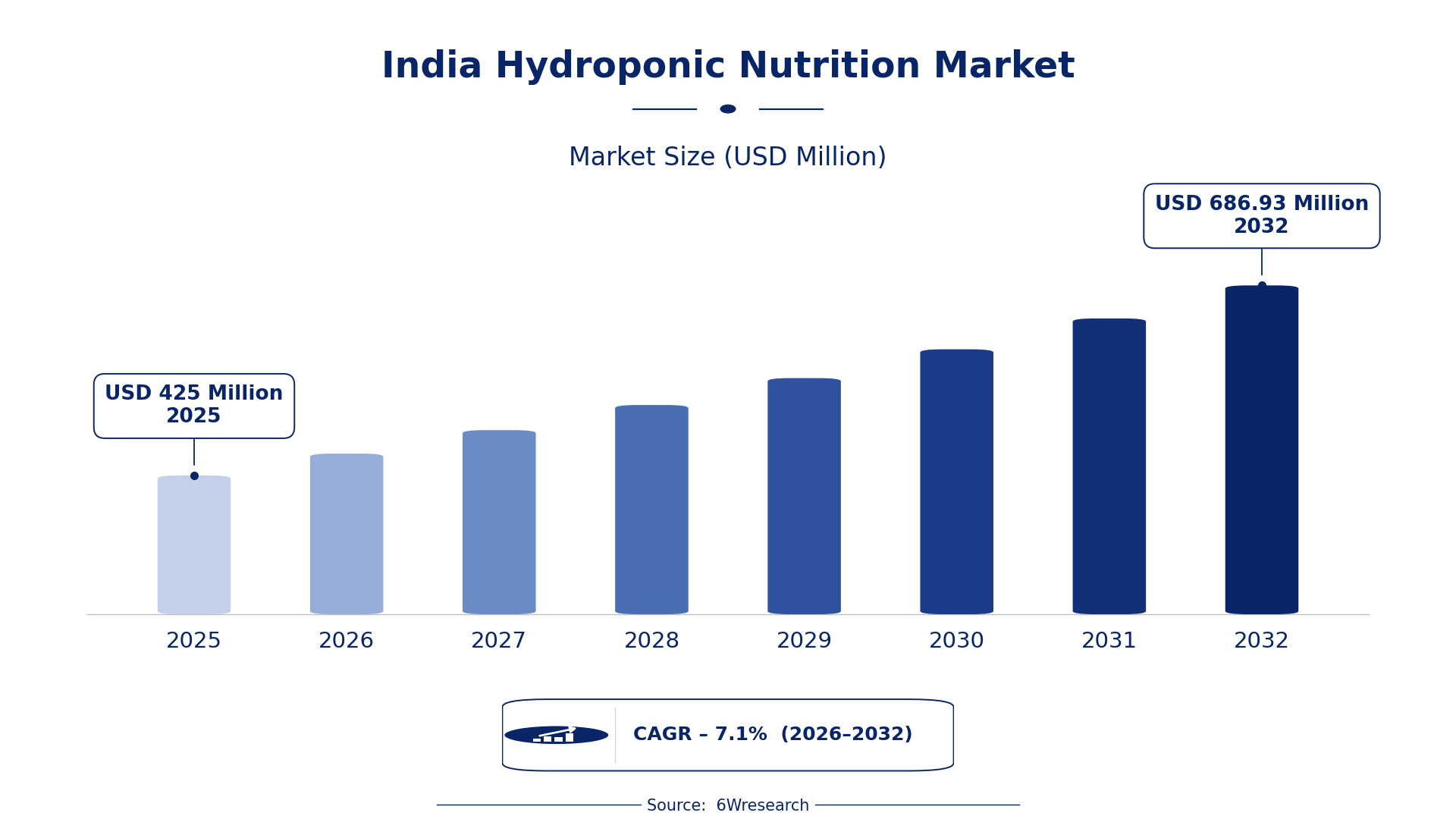
According to 6Wresearch internal database and industry insights, the India Hydroponic Nutrition Market was valued at USD 425.0 million in 2025 and is projected to reach USD 686.93 million by 2032, growing at a CAGR of approximately 7.1% during 2026–2032.
India Hydroponic Nutrition Market Highlights
| Report Metric | Details |
| Report Name | India Hydroponic Nutrition Market |
| Market Size 2025 | USD 425.0 million |
| Market Size 2032 | USD 686.93 million |
| Absolute Growth 2025–2032 | USD 261.93 million |
| CAGR 2026–2032 | 7.1% |
| Peak Annual Growth | 9.9% in 2032 |
| Forecast Period | 2026–2032 |
| Historical Data | 2022–2025 |
| Base Year | 2025 |
| Leading Nutrient Type, 2025 | Macronutrients (42% share) |
| Leading Crop Type, 2025 | Leafy Greens (36% share) |
| Leading Solution Delivery Method, 2025 | NFT (Nutrient Film) (40% share) |
| Leading End User, 2025 | Vertical Farmers (36% share) |
| Fastest-Growing Nutrient Type | Micronutrients (9.7% CAGR) |
| Fastest-Growing Crop Type | Tomatoes/Peppers (9.7% CAGR) |
| Fastest-Growing Solution Delivery Method | Drip Irrigation (9.7% CAGR) |
| Fastest-Growing End User | Hydroponic Greenhouses (8.4% CAGR) |
| Growing Sector | Hydroponic Greenhouses |
| Key End Users | Vertical Farmers, Hydroponic Greenhouses, Urban Agri Startups, Indoor Growers |
India Hydroponic Nutrition Market Year-wise Growth Rate and Key Drivers (2022–2032)
This graph illustrates the annual growth rates of the market from 2022 to 2032, highlighting a steady upward trajectory and projected market expansion over the forecast period.
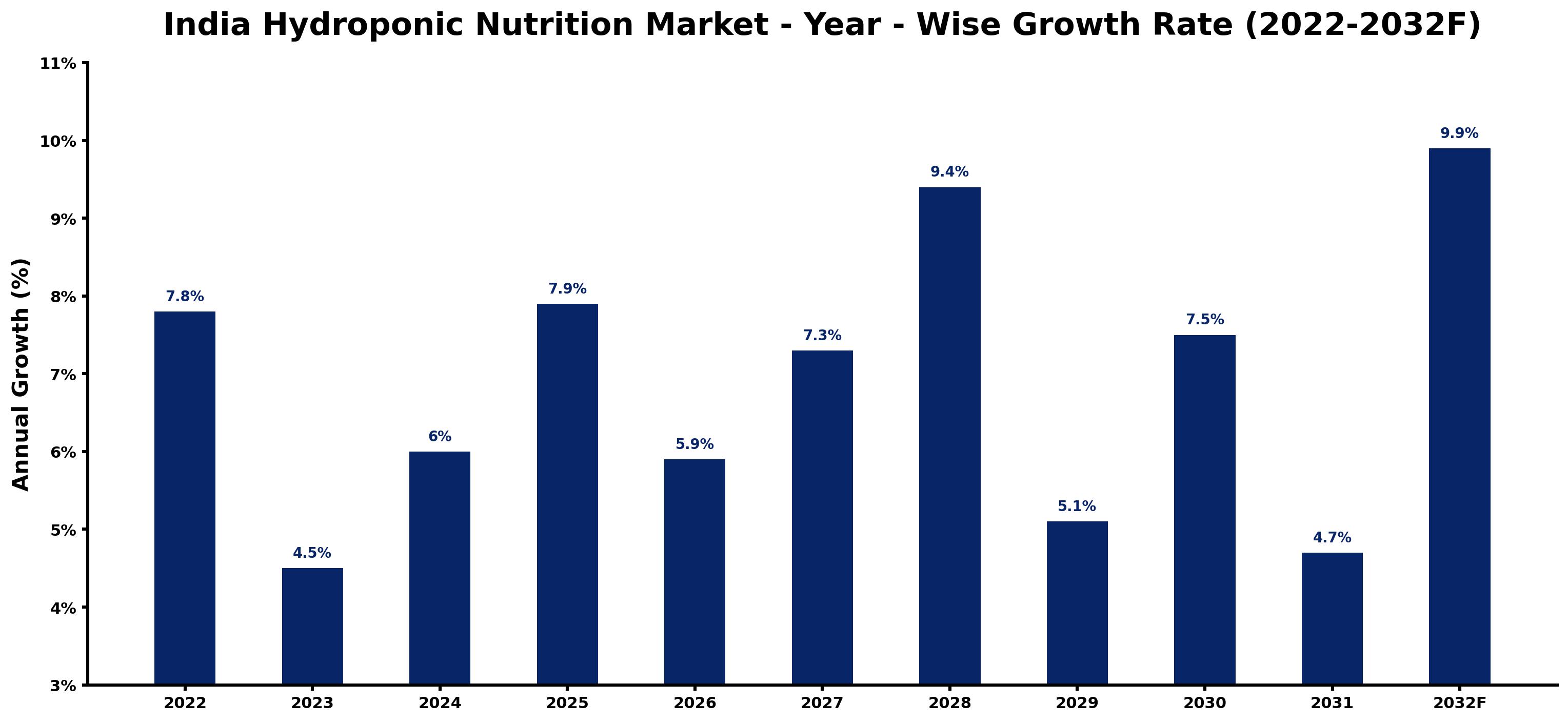
Year by year, the estimates below pair each growth rate with the development that shaped it.
| Year | Estimated Annual Growth (%) | Market Rationale |
| 2022 | 7.8 | The market showed strong activity with a growth rate reflecting increasing interest in hydroponics. |
| 2023 | 4.5 | Growth slowed as some urban agriculture initiatives faced implementation challenges in various states. |
| 2024 | 6.0 | The market rebounded with renewed interest in hydroponic systems due to rising health consciousness. |
| 2025 | 7.9 | Demand surged as more hydroponic farms were established, particularly in Maharashtra and Karnataka. |
| 2026 | 5.9 | Growth slowed again due to supply chain issues affecting nutrient delivery systems. |
| 2027 | 7.3 | Increased investment in hydroponic technology spurred faster growth as urban agriculture expanded. |
| 2028 | 9.4 | The market accelerated as more startups entered the hydroponic sector, boosting production capacity. |
| 2029 | 5.1 | Growth slowed as competition intensified among existing hydroponic farms and new entrants. |
| 2030 | 7.5 | The market rebounded with renewed focus on sustainable farming practices and government support. |
| 2031 | 4.7 | Growth slowed as the market began to stabilise after rapid expansion in previous years. |
| 2032 | 9.9 | The market peaked as urban agriculture initiatives gained momentum, driving demand for hydroponic solutions. |
Note: Market size estimations and growth projections presented in this report are based on 6Wresearch's proprietary forecasting methodology, utilizing the latest available industry data, government publications, and primary research inputs.
India Hydroponic Nutrition Market Synopsis
Hydroponic Nutrition in India includes nutrient solutions tailored for soilless agriculture, aimed at promoting plant growth and improving yields. This approach enables year-round cultivation, particularly for leafy greens and herbs. The Hydroponic Nutrition Market is growing due to urban agriculture initiatives in states like Maharashtra and Karnataka, coupled with a heightened awareness of health among consumers. With more than 1,000 hydroponic farms documented in 2022, demand is on an upward trend.
Market Dynamics Impact Analysis (2026–2032)
| Factor | Type | Impact | Primary Segment Affected |
| Urban agriculture initiatives are expanding, driving demand for hydroponic nutrition solutions. | Driver | High | Macronutrients |
| The increasing health consciousness among consumers is boosting the demand for fresh produce. | Driver | High | Macronutrients |
| Investment in hydroponic systems is rising, particularly in urban areas. | Opportunity | High | Macronutrients |
| The growing number of urban agri startups is creating new market opportunities. | Opportunity | High | Urban Agri Startups |
| Supply chain disruptions are causing delays in nutrient delivery to hydroponic farms. | Restraint | High | Macronutrients |
| High initial investment costs for hydroponic systems can deter new entrants. | Restraint | Medium | Macronutrients |
| Limited awareness of hydroponic benefits among traditional farmers hampers market growth. | Challenge | Medium | Macronutrients |
| Regulatory hurdles in nutrient certification can slow down market entry for new products. | Challenge | Medium | Macronutrients |
Evaluation of Drivers in India Hydroponic Nutrition Market (2026–2032)
The factors lifting demand, and the evidence behind each, are summarised below.
| Drivers | Primary Segment Affected | Why It Matters (Evidence) |
| Urban agriculture initiatives are expanding, particularly in Maharashtra and Karnataka, increasing demand for hydroponic solutions. | Macronutrients | In 2022, over 1,000 hydroponic farms were reported in India, indicating strong market activity. |
| Health-conscious consumers are seeking fresh produce, driving demand for hydroponically grown vegetables. | Macronutrients | The Indian population is increasingly prioritising health and nutrition, with 70% seeking organic options. |
| Investment in hydroponic technology is rising, improving production capabilities for growers. | Macronutrients | The 'Atmanirbhar Bharat' initiative supports local production of hydroponic systems, with ₹1,000 crores allocated. |
| Emerging urban agriculture startups are creating new market opportunities for hydroponic solutions. | Urban Agri Startups | Over 200 startups were registered in urban areas by 2023, indicating a growing entrepreneurial landscape. |
| Government subsidies for hydroponic farming are encouraging more farmers to adopt these methods. | Macronutrients | The Ministry of Food Processing Industries introduced a subsidy scheme in 2022, funding up to 50% of costs. |
Growth across the Hydroponic Nutrition market in India is anchored in urban agriculture expansion, rising health consciousness, and increased investment in technology. In 2022, over 1,000 hydroponic farms were reported, indicating strong market activity. Health-conscious consumers are increasingly seeking fresh produce, driving demand for hydroponically grown vegetables. As urban agriculture expands, the number of startups entering the hydroponic sector is also increasing, creating new opportunities for growth.
Evaluation of Restraints in India Hydroponic Nutrition Market
The table below lists the restraints and the evidence behind each.
| Market Restraint | Primary Segment Affected | Why It Matters (Evidence) |
| Supply chain disruptions are affecting the timely delivery of nutrients to hydroponic farms. | Macronutrients | These disruptions have delayed operations for many growers, impacting their productivity by up to 30%. |
| High initial investment costs for hydroponic systems deter some potential growers from entering the market. | Macronutrients | This financial barrier limits the expansion of new hydroponic farms, with costs reaching ₹5 lakhs. |
| Limited awareness of hydroponic benefits among traditional farmers hampers market growth. | Macronutrients | Many farmers are hesitant to switch from conventional methods to hydroponics, affecting adoption rates. |
| Regulatory hurdles in nutrient certification can slow down market entry for new products. | Macronutrients | Producers face delays in getting their products approved, affecting supply and market readiness. |
| Competition among existing hydroponic farms is intensifying, affecting profit margins. | Macronutrients | As more farms enter the market, price pressures are increasing, reducing profitability by approximately 20%. |
India Hydroponic Nutrition Market Challenges
The India Hydroponic Nutrition Market faces regulatory hurdles that prolong product approval processes, potentially delaying market entry for producers by up to six months. These challenges arise from stringent guidelines set by the Bureau of Indian Standards, complicating the launch of new nutrient solutions. Technological limitations also impede growth; many hydroponic farms lack access to advanced systems, leading to reduced yields and higher operational costs. Furthermore, traditional agriculture remains a competitor, as conventional farming methods often provide cheaper alternatives, compelling hydroponic farmers to invest heavily in marketing to attract health-conscious consumers.
Trends in the India Hydroponic Nutrition Market
Below mentioned are some of the trends shaping the India Hydroponic Nutrition Market growth.
- Shift towards Sustainable Urban Agriculture: Since 2021, urban agriculture initiatives have gained momentum, particularly in Maharashtra. The 'Pradhan Mantri Krishi Sinchai Yojana' encourages efficient irrigation methods, including hydroponics, resulting in greater adoption among urban farmers.
- Growth of Hydroponic Startups: The popularity of NFT (Nutrient Film Technique) systems is increasing among hydroponic farmers. With a projected 40% market share in 2025, this method is favoured for its efficiency and effectiveness in nutrient delivery.
- Expansion of Hydroponic Greenhouses: In 2023, the number of hydroponic greenhouses has risen, reflecting a change in farming practices. This segment is expected to grow at an 8.4% CAGR, driven by urban demand for fresh produce.
- Increased Adoption of Organic Nutrients: As health awareness rises, there is a growing demand for organic nutrient solutions in hydroponics. The Bureau of Indian Standards has set guidelines for organic hydroponic nutrients, broadening market opportunities.
Investment Opportunities in the India Hydroponic Nutrition Market
Investors looking at the India Hydroponic Nutrition Market should consider the following areas.
- Investment in Hydroponic Farms in Maharashtra: With Maharashtra leading in hydroponic vegetable production, there is a significant opportunity to invest in new farms. The state reported over 1,000 hydroponic farms in 2022, indicating a growing market.
- Support for Urban Agri Startups: Urban agri startups focusing on hydroponics are emerging as a key opportunity. With over 200 startups registered in 2023, investors can enter this market through partnerships and local collaborations.
- Demand for Innovative Hydroponic Nutrient Solutions: The demand for innovative nutrient solutions is growing, particularly for organic options. The Bureau of Indian Standards has established guidelines, creating a market for certified organic hydroponic nutrients.
- Growth in Vertical Farming Facilities: As vertical farming becomes more popular, there is a need for hydroponic solutions. With a projected market size of USD 686.93 million by 2032, suppliers can target this expanding segment.
Government Initiatives in the India Hydroponic Nutrition Market
In 2021, the Ministry of Agriculture launched the 'National Hydroponics Promotion Scheme' to support hydroponic farming across India. This scheme focuses on technology transfer and training, building upon earlier initiatives like the 'National Agriculture Policy 2020', which promotes modern farming techniques. These measures aim to improve food security and encourage the adoption of hydroponic methods among farmers, facilitating their access to essential resources and knowledge.
The 'Pradhan Mantri Kisan Samman Nidhi' scheme provides financial support to farmers adopting hydroponic methods. With a budget of ₹75,000 crores, this initiative helps farmers invest in modern farming technologies, including hydroponics. The Ministry of Agriculture and Farmers' Welfare also supports hydroponic farming through various subsidies and training programs, facilitating the growth of this sector and enabling farmers to improve their production capabilities.
Future Insight of the India Hydroponic Nutrition Market
Several forward-looking factors should support the India Hydroponic Nutrition Market by 2032. Urban agriculture initiatives in Maharashtra and Karnataka are expected to drive demand for hydroponic systems and nutrient solutions. The 'Pradhan Mantri Krishi Sinchai Yojana' will improve irrigation efficiency, facilitating hydroponic farming practices. Adoption of ISO 22000 standards for food safety will strengthen consumer confidence in hydroponically grown produce. By 2025, more than 1,000 hydroponic farms are anticipated to be operational, indicating a notable shift towards sustainable agricultural practices.
Market Segmentation Analysis
The report offers a comprehensive study of the following market segments and their leading categories in the market.
By Nutrient Type – Macronutrients Dominated, Micronutrients Expected to Grow Fastest
According to Bhawna Singh, Assistant Manager at 6Wresearch, with a 42% revenue share in 2025, Macronutrients was the largest nutrient type category. Macronutrients hold the largest share in the India hydroponic nutrition market as they are essential for plant growth, with strong demand from over 1,000 hydroponic farms across the country. Their widespread use in urban agriculture initiatives, particularly in Maharashtra and Karnataka, underscores their importance in nutrient solutions. Micronutrients are set to record the highest CAGR in this split, 9.7% over 2026–2032. Micronutrients are experiencing rapid growth due to the increasing awareness of their role in plant health, particularly as urban agriculture expands. The government's initiatives, such as the 'Pradhan Mantri Krishi Sinchai Yojana', promote the adoption of comprehensive nutrient solutions, driving this segment's growth. Suppliers should focus on developing micronutrient solutions to capitalise on the growing interest in holistic plant health.
By Crop Type – Leafy Greens Dominated, Tomatoes/Peppers Expected to Grow Fastest
Leafy Greens held a 36% share of the India Hydroponic Nutrition Market by crop type in 2025. Leafy greens dominate the market share as they are the primary crop cultivated in hydroponics, appealing to health-conscious consumers seeking fresh produce. Their prevalence in hydroponic farms, especially in states like Maharashtra, highlights their significance in the sector. Tomatoes/Peppers are projected to grow fastest, at a CAGR of 9.7% during 2026–2032. Tomatoes and peppers are witnessing the fastest growth, driven by their popularity among consumers and adaptability in hydroponic systems. The increasing number of hydroponic farms is expanding the cultivation of these crops, reflecting changing consumer preferences. Producers should prioritise investments in tomato and pepper cultivation to meet the rising demand in the hydroponic sector.
By Solution Delivery Method – NFT (Nutrient Film) Dominated, Drip Irrigation Expected to Grow Fastest
In 2025, NFT (Nutrient Film) led the solution delivery method split with a 40% share. NFT (Nutrient Film Technique) leads in market share due to its efficiency in delivering nutrients to plants, making it a preferred choice among hydroponic farmers. This method's popularity is evident in the operational practices of many hydroponic farms across India. Over 2026–2032, Drip Irrigation is expected to post the fastest growth, at a CAGR of 9.7%. Drip irrigation is growing rapidly as it offers a water-efficient solution for nutrient delivery, aligning with the government's push for sustainable agricultural practices. The increasing adoption of this method among hydroponic greenhouses indicates a shift towards more efficient farming techniques. Suppliers should consider enhancing drip irrigation technologies to cater to the increasing demand for efficient nutrient delivery systems.
By End User – Vertical Farmers Dominated, Hydroponic Greenhouses Expected to Grow Fastest
Vertical Farmers accounted for a 36% market share by end user in 2025. Vertical farmers represent the largest share of the market as key end users of hydroponic nutrition, utilising advanced techniques to maximise space and yield. Their prominence is highlighted by the establishment of numerous hydroponic farms focused on urban agriculture. The quickest growth will come from Hydroponic Greenhouses, forecast to expand at a CAGR of 8.4% between 2026 and 2032. Hydroponic greenhouses are the fastest-growing segment, driven by the need for controlled environments that enhance crop production. The rise in urban agriculture initiatives is encouraging more investments in greenhouse facilities, further propelling this segment's growth. Investors should explore opportunities in hydroponic greenhouse development to leverage the growing interest in efficient farming practices.
Key Attractiveness of the Report
- 10 Years of Market Numbers
- Historical Data Starting from 2022 to 2025
- Base Year 2025
- Forecast Data until 2032
- Key Performance Indicators Impacting the Market
- Major Upcoming Developments and Projects
Key Highlights of the Report:
- India Hydroponic Nutrition Market Outlook
- Market Size of India Hydroponic Nutrition Market, 2025
- Forecast of India Hydroponic Nutrition Market, 2032
- Historical Data and Forecast of India Hydroponic Nutrition Revenues & Volume for the Period 2022 - 2032F
- India Hydroponic Nutrition Market Trend Evolution
- India Hydroponic Nutrition Market Drivers and Challenges
- India Hydroponic Nutrition Price Trends
- India Hydroponic Nutrition Porter's Five Forces
- India Hydroponic Nutrition Industry Life Cycle
- Historical Data and Forecast of India Hydroponic Nutrition Market Revenues & Volume By Nutrient Type for the Period 2022 - 2032F
- Historical Data and Forecast of India Hydroponic Nutrition Market Revenues & Volume By Macronutrients for the Period 2022 - 2032F
- Historical Data and Forecast of India Hydroponic Nutrition Market Revenues & Volume By Micronutrients for the Period 2022 - 2032F
- Historical Data and Forecast of India Hydroponic Nutrition Market Revenues & Volume By Organic Nutrients for the Period 2022 - 2032F
- Historical Data and Forecast of India Hydroponic Nutrition Market Revenues & Volume By Chelated Minerals for the Period 2022 - 2032F
- Historical Data and Forecast of India Hydroponic Nutrition Market Revenues & Volume By Crop Type for the Period 2022 - 2032F
- Historical Data and Forecast of India Hydroponic Nutrition Market Revenues & Volume By Leafy Greens for the Period 2022 - 2032F
- Historical Data and Forecast of India Hydroponic Nutrition Market Revenues & Volume By Tomatoes/Peppers for the Period 2022 - 2032F
- Historical Data and Forecast of India Hydroponic Nutrition Market Revenues & Volume By Strawberries for the Period 2022 - 2032F
- Historical Data and Forecast of India Hydroponic Nutrition Market Revenues & Volume By Herbs for the Period 2022 - 2032F
- Historical Data and Forecast of India Hydroponic Nutrition Market Revenues & Volume By Solution Delivery Method for the Period 2022 - 2032F
- Historical Data and Forecast of India Hydroponic Nutrition Market Revenues & Volume By NFT (Nutrient Film) for the Period 2022 - 2032F
- Historical Data and Forecast of India Hydroponic Nutrition Market Revenues & Volume By Drip Irrigation for the Period 2022 - 2032F
- Historical Data and Forecast of India Hydroponic Nutrition Market Revenues & Volume By Deep Water Culture for the Period 2022 - 2032F
- Historical Data and Forecast of India Hydroponic Nutrition Market Revenues & Volume By Aeroponic Misting for the Period 2022 - 2032F
- Historical Data and Forecast of India Hydroponic Nutrition Market Revenues & Volume By End User for the Period 2022 - 2032F
- Historical Data and Forecast of India Hydroponic Nutrition Market Revenues & Volume By Vertical Farmers for the Period 2022 - 2032F
- Historical Data and Forecast of India Hydroponic Nutrition Market Revenues & Volume By Hydroponic Greenhouses for the Period 2022 - 2032F
- Historical Data and Forecast of India Hydroponic Nutrition Market Revenues & Volume By Urban Agri Startups for the Period 2022 - 2032F
- Historical Data and Forecast of India Hydroponic Nutrition Market Revenues & Volume By Indoor Growers for the Period 2022 - 2032F
- India Hydroponic Nutrition Import Export Trade Statistics
- Market Opportunity Assessment By Nutrient Type
- Market Opportunity Assessment By Crop Type
- Market Opportunity Assessment By Solution Delivery Method
- Market Opportunity Assessment By End User
- India Hydroponic Nutrition Top Companies Market Share
- India Hydroponic Nutrition Competitive Benchmarking By Technical and Operational Parameters
- India Hydroponic Nutrition Company Profiles
- India Hydroponic Nutrition Key Strategic Recommendations
Market Covered
The report offers an extensive study of the following market segments.
By Nutrient Type
- Macronutrients
- Micronutrients
- Organic Nutrients
- Chelated Minerals
By Crop Type
- Leafy Greens
- Tomatoes/Peppers
- Strawberries
- Herbs
By Solution Delivery Method
- NFT (Nutrient Film)
- Drip Irrigation
- Deep Water Culture
- Aeroponic Misting
By End User
- Vertical Farmers
- Hydroponic Greenhouses
- Urban Agri Startups
- Indoor Growers































