India Hygiene Product Material Market Size & Growth Rate
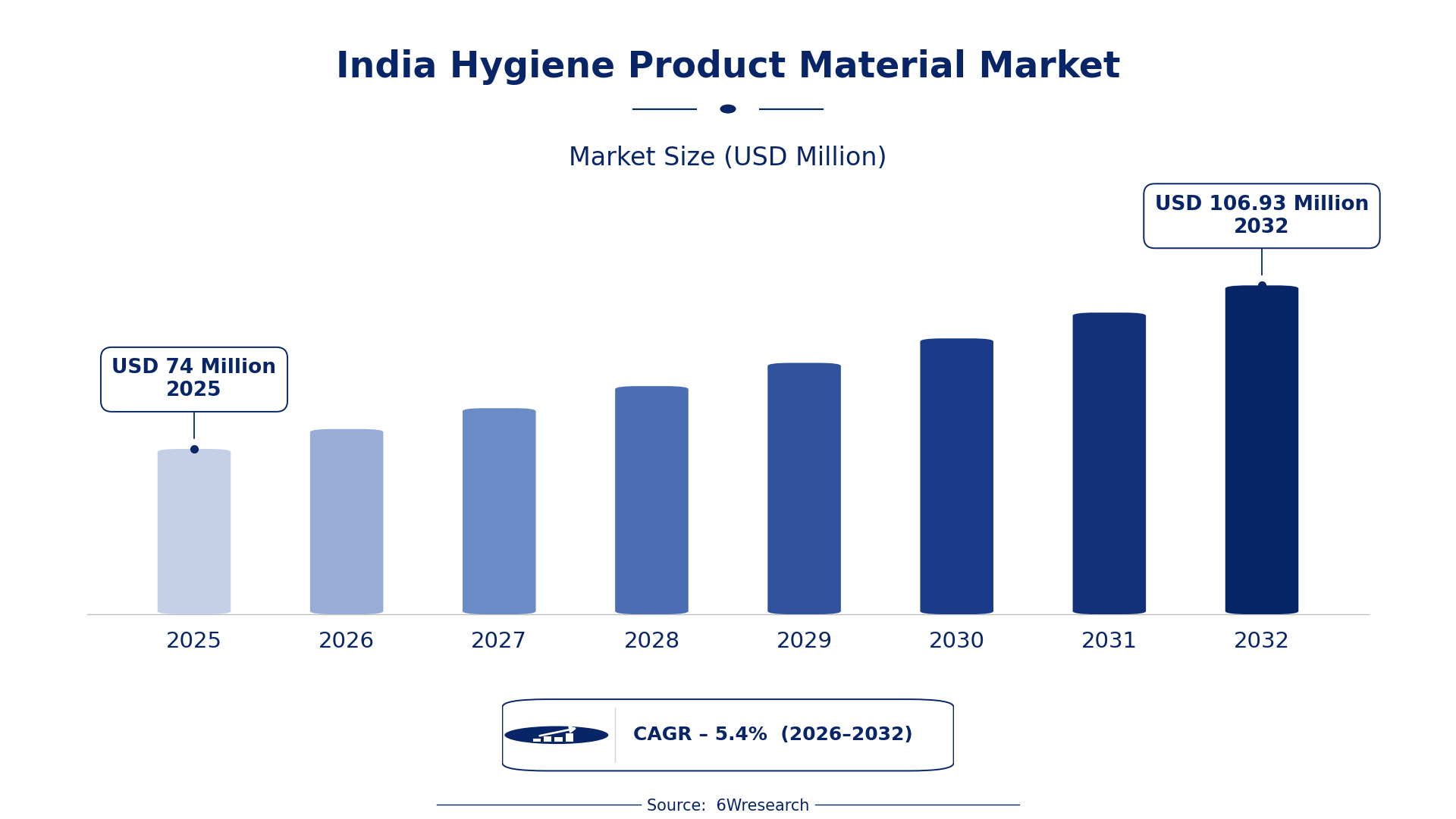
According to 6Wresearch internal database and industry insights, the India Hygiene Product Material Market was valued at USD 74.0 million in 2025 and is projected to reach USD 106.93 million by 2032, growing at a CAGR of approximately 5.4% during 2026–2032.
India Hygiene Product Material Market Highlights
| Report Metric | Details |
| Report Name | India Hygiene Product Material Market |
| Market Size 2025 | USD 74.0 million |
| Market Size 2032 | USD 106.93 million |
| Absolute Growth 2025–2032 | USD 32.93 million |
| CAGR 2026–2032 | 5.4% |
| Peak Annual Growth | 7.6% in 2032 |
| Forecast Period | 2026–2032 |
| Historical Data | 2022–2025 |
| Base Year | 2025 |
| Leading Material Type, 2025 | Super Absorbent Polymers (46% share) |
| Leading Product Application, 2025 | Diapers & Pads (38% share) |
| Leading Biodegradability Factor, 2025 | Low (40% share) |
| Leading End User, 2025 | Mass Production Companies (42% share) |
| Fastest-Growing Material Type | Nonwoven Fabrics (7.5% CAGR) |
| Fastest-Growing Product Application | Sanitary Napkins/Wipes (7.3% CAGR) |
| Fastest-Growing Biodegradability Factor | Medium (6.5% CAGR) |
| Fastest-Growing End User | Hygiene OEMs (8.1% CAGR) |
| Growing Sector | Hygiene Products |
| Key End Users | Mass Production Companies, Hygiene OEMs, Eco-Friendly Brands |
India Hygiene Product Material Market Year-wise Growth Rate and Key Drivers (2022–2032)
This graph illustrates the annual growth rates of the market from 2022 to 2032, highlighting a steady upward trajectory and projected market expansion over the forecast period.
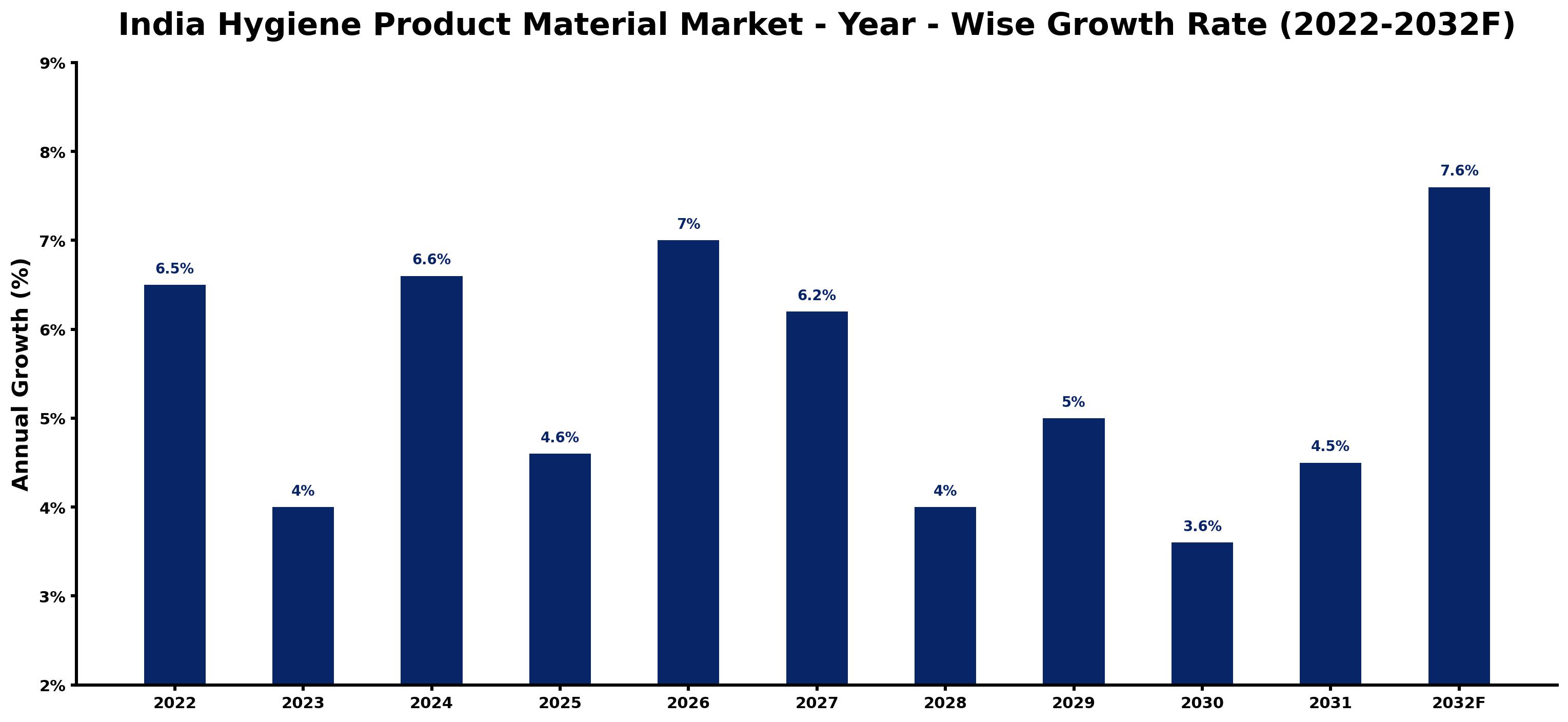
The table below sets out the estimated growth rate for each year and the main factor behind it.
| Year | Estimated Annual Growth (%) | Market Rationale |
| 2022 | 6.5 | The market experienced solid growth due to heightened consumer awareness of hygiene standards. |
| 2023 | 4.0 | Growth slowed as the market adjusted to increasing production costs and supply chain challenges. |
| 2024 | 6.6 | Demand surged as the diaper market expanded, reaching 1.5 billion units by 2025. |
| 2025 | 4.6 | Growth decelerated due to market saturation in certain hygiene product segments. |
| 2026 | 7.0 | The market rebounded with increased demand for eco-friendly products and biodegradable options. |
| 2027 | 6.2 | Growth slowed as manufacturers faced challenges in sourcing sustainable materials. |
| 2028 | 4.0 | Demand stabilised as consumers continued to prioritise hygiene and sustainability. |
| 2029 | 5.0 | The market saw renewed growth driven by rising awareness of menstrual hygiene management. |
| 2030 | 3.6 | Growth slowed as competition intensified among hygiene product manufacturers. |
| 2031 | 4.5 | Demand increased as the market adapted to evolving consumer preferences for eco-friendly products. |
| 2032 | 7.6 | The market peaked with significant growth driven by the demand for biodegradable materials. |
Note: Market size estimations and growth projections presented in this report are based on 6Wresearch's proprietary forecasting methodology, utilizing the latest available industry data, government publications, and primary research inputs.
India Hygiene Product Material Market Synopsis
Hygiene Product Material in India includes various materials used in personal care items, primarily for absorbent products like diapers and sanitary items. These materials are created through chemical processes and manufacturing techniques. The India Hygiene Product Material Market is expanding due to heightened consumer awareness of hygiene standards and a growing demand for eco-friendly alternatives. With a population exceeding 1.4 billion, the necessity for hygiene products is considerable. Initiatives such as the Swachh Bharat Mission further propel this market, promoting sanitation and hygiene throughout the country.
Market Dynamics Impact Analysis (2026–2032)
| Factor | Type | Impact | Primary Segment Affected |
| Increasing demand for eco-friendly hygiene products driven by rising environmental awareness | Driver | High | Fully Biodegradable |
| Growth in the diaper market as it is projected to reach 1.5 billion units by 2025 | Driver | High | Diapers & Pads |
| Expansion of production facilities for biodegradable materials to meet growing demand | Opportunity | Medium | SAP-Free Natural Materials |
| Investment in menstrual hygiene awareness programs targeting rural women | Opportunity | Medium | Sanitary Napkins/Wipes |
| Challenges in sourcing sustainable materials impacting production timelines | Restraint | High | Nonwoven Fabrics |
| Regulatory compliance costs associated with biodegradable materials | Restraint | Medium | Super Absorbent Polymers |
| Supply chain disruptions affecting timely delivery of raw materials | Challenge | High | Fluff Pulp |
| Intense competition among manufacturers leading to pricing pressures | Challenge | Medium | Hygiene OEMs |
Evaluation of Drivers in India Hygiene Product Material Market (2026–2032)
Key forces behind demand, with the segment each one moves most, are listed below.
| Drivers | Primary Segment Affected | Why It Matters (Evidence) |
| Rising consumer demand for eco-friendly hygiene products | Fully Biodegradable | This demand is driven by increasing environmental awareness, leading to higher purchases of biodegradable materials, with the market for organic diapers growing at 15% annually. |
| Expansion of the diaper market | Diapers & Pads | The diaper market is expected to reach 1.5 billion units by 2025, prompting manufacturers to increase production of absorbent materials to meet demand. |
| Government initiatives promoting sanitation and hygiene | Mass Production Companies | Programs like the Swachh Bharat Mission enhance hygiene awareness, encouraging mass production companies to invest in hygiene product materials. |
| Technological advancements in production processes | Nonwoven Fabrics | Improvements in manufacturing techniques are enabling the production of softer, more absorbent nonwoven fabrics, which are crucial for various hygiene applications. |
| Increased healthcare infrastructure investment | Hygiene OEMs | The Pradhan Mantri Swasthya Suraksha Yojana focuses on improving healthcare access, resulting in higher demand for hygiene products among OEMs. |
The Hygiene Product Material market in India is expanding as rising consumer awareness of hygiene standards, growth in the diaper market, and increased focus on sustainable materials drive demand. Approximately 2 million tons of hygiene products were produced in India in 2022, reflecting strong market activity. The Swachh Bharat Mission promotes sanitation, further supporting market growth. The diaper market is expected to reach 1.5 billion units by 2025, necessitating more absorbent materials. Investments in production facilities for eco-friendly materials are responding to the demand for sustainable options, ensuring continued growth in this sector.
Evaluation of Restraints in India Hygiene Product Material Market
The following restraints limit how fast demand can grow.
| Market Restraint | Primary Segment Affected | Why It Matters (Evidence) |
| Supply chain disruptions affecting timely delivery of raw materials | Fluff Pulp | These disruptions can delay production schedules, impacting manufacturers' ability to meet market demand. |
| Regulatory compliance costs associated with biodegradable materials | Super Absorbent Polymers | Compliance with new regulations increases operational costs for producers, affecting pricing strategies. |
| Challenges in sourcing sustainable materials impacting production timelines | Nonwoven Fabrics | Sourcing difficulties can create delays, reducing the availability of finished products in the market. |
| Intense competition among manufacturers leading to pricing pressures | Hygiene OEMs | Competitive pricing strategies can reduce profit margins for manufacturers, impacting overall market health. |
| Market saturation in certain hygiene product segments | Diapers & Pads | Saturation limits growth potential, as demand stabilises in well-established product categories. |
India Hygiene Product Material Market Challenges
Buyers in the India Hygiene Product Material Market face escalating costs due to reliance on imported raw materials, which can increase prices by up to 20%. Competition among domestic manufacturers intensifies as they strive to meet the growing demand, potentially delaying product availability for retailers. Supply chain disruptions frequently hinder the transportation of nonwoven fabrics, extending lead times by several weeks for producers. Technological advancements in biodegradable materials are slow to be adopted, limiting options for eco-conscious consumers and constraining market growth for suppliers.
Trends in the India Hygiene Product Material Market
Below mentioned are some of the trends shaping the India Hygiene Product Material Market growth.
- Shift Towards Eco-Friendly Hygiene Products: Mass Production Companies are increasingly adopting biodegradable materials in their products, reflecting a trend towards sustainability. In 2023, the market for organic diapers is growing at a rate of 15% annually, indicating a shift in consumer preferences.
- Transition to Improved Menstrual Hygiene Management: The National Health Mission's campaign initiated in 2022 targets 10 million women to promote menstrual hygiene management. This initiative highlights the increasing focus on women's health and hygiene, driving demand for sanitary products.
- Emergence of Biodegradable Materials in Hygiene Products: The Bureau of Indian Standards has set guidelines for hygiene product materials under IS 14612:2018, promoting the use of biodegradable options. This standard is influencing manufacturers to innovate and develop eco-friendly products.
- Growing Demand for Nonwoven Fabrics: The demand for nonwoven fabrics is rising, particularly in sanitary napkins and wipes. Over 60% of sanitary napkins used in India are made from nonwoven fabrics, showcasing their critical role in the hygiene market.
Investment Opportunities in the India Hygiene Product Material Market
The following opportunities in the India Hygiene Product Material Market pair current demand with a clear way in.
- Investment in Biodegradable Hygiene Materials: The market gap for eco-friendly hygiene products is considerable, with a growing consumer base. Mass Production Companies can invest in biodegradable materials to meet this demand, especially in urban areas.
- Expansion of Sanitary Product Accessibility: With the Indian government allocating funds for enhancing sanitation facilities in schools, there is a clear opportunity for suppliers of sanitary products. This initiative aims to improve hygiene awareness among students.
- Development of Organic Diapers: The organic diaper segment is expanding rapidly, growing at a rate of 15% annually. Manufacturers can enter this market by partnering with eco-friendly brands focused on sustainability.
- Improving Menstrual Hygiene Awareness Programs: The initiative by the Ministry of Health to enhance menstrual hygiene awareness presents an opportunity for suppliers of sanitary products. Collaborating with local NGOs can facilitate market entry.
Government Initiatives in the India Hygiene Product Material Market
The Plastic Waste Management Rules, revised in 2021, promote the use of biodegradable hygiene products, impacting manufacturers by requiring compliance with new standards. This regulation encourages producers to innovate and shift towards sustainable materials, improving market appeal. Additionally, the National Cleanliness Programme, launched by the Ministry of Housing and Urban Affairs in 2021, aims to enhance sanitation across urban areas with a budget of ₹1,000 crores, directly benefiting hygiene product manufacturers by increasing demand for their products.
The National Health Mission has initiated a campaign in 2022 to promote menstrual hygiene management, targeting 10 million women. This program, administered by the Ministry of Health, supports the distribution of sanitary products and raises awareness about menstrual hygiene. Furthermore, the Pradhan Mantri Swasthya Suraksha Yojana, updated in 2020, focuses on improving healthcare infrastructure, including hygiene product accessibility in rural regions, facilitating better access for consumers.
Future Insight of the India Hygiene Product Material Market
The India Hygiene Product Material Market will undergo a notable shift towards biodegradable options by 2032, driven by increasing consumer demand for sustainable products. Government initiatives, such as the Swachh Bharat Mission, will further encourage the use of eco-friendly hygiene materials. By 2025, the diaper market is projected to reach 1.5 billion units, reflecting a strong trend towards sustainability. Advances in production technologies will empower suppliers to develop new products that meet the evolving preferences of environmentally aware consumers.
Market Segmentation Analysis
The analysis below covers each segmentation, its leading category in 2025 and its fastest-growing category through 2032.
By Material Type – Super Absorbent Polymers Dominated, Nonwoven Fabrics Expected to Grow Fastest
According to Bhawna Singh, Assistant Manager at 6Wresearch, the largest material type category in 2025 was Super Absorbent Polymers, with a 46% share of total revenue. Super Absorbent Polymers hold the largest share in the India Hygiene Product Material Market due to their critical role in providing absorbency for products like diapers and sanitary items. With the diaper market projected to reach 1.5 billion units by 2025, demand for these materials is expected to rise significantly. The quickest growth will come from Nonwoven Fabrics, forecast to expand at a CAGR of 7.5% between 2026 and 2032. Nonwoven Fabrics are experiencing rapid growth as they are increasingly used in various hygiene applications, particularly in sanitary napkins and wipes. The rising awareness of hygiene standards is driving demand for these materials, ensuring a strong growth trajectory. Suppliers should focus on expanding their product offerings to include nonwoven fabrics to meet the increasing demand in the hygiene sector.
By Product Application – Diapers & Pads Dominated, Sanitary Napkins/Wipes Expected to Grow Fastest
With a 38% revenue share in 2025, Diapers & Pads was the largest product application category. Diapers & Pads capture the largest market share as the primary application for hygiene materials, driven by substantial production across India. Their widespread use in households underscores their essential role in personal care and hygiene. Sanitary Napkins/Wipes are projected to grow fastest, at a CAGR of 7.3% during 2026–2032. Sanitary Napkins/Wipes are witnessing the fastest growth due to heightened awareness surrounding menstrual hygiene, particularly in rural areas. Government initiatives aimed at improving menstrual hygiene awareness are further boosting this demand, indicating strong growth potential. Buyers should consider investing in sanitary napkin and wipe production to align with the increasing consumer focus on menstrual hygiene.
By Biodegradability Factor – Low Dominated, Medium Expected to Grow Fastest
In 2025, Low led the biodegradability factor split with a 40% share. Low biodegradability materials currently command the largest share, primarily due to their widespread use in traditional hygiene products. The limited demand for alternatives has kept this segment at the forefront of the market. Medium is set to record the highest CAGR in this split, 6.5% over 2026–2032. Medium biodegradability materials are growing rapidly as consumers increasingly seek eco-friendly options in hygiene products. The rising environmental awareness among consumers is propelling this segment's growth, suggesting a shift in market preferences. Suppliers must innovate towards medium biodegradability options to meet changing consumer preferences and regulatory standards.
By End User – Mass Production Companies Dominated, Hygiene OEMs Expected to Grow Fastest
Mass Production Companies held a 42% share of the India Hygiene Product Material Market by end user in 2025. Mass Production Companies represent the largest consumer group in the hygiene product material market, requiring substantial quantities of materials for their manufacturing processes. Their extensive operations significantly influence the demand dynamics within the market. Over 2026–2032, Hygiene OEMs are expected to post the fastest growth, at a CAGR of 8.1%. Hygiene OEMs are experiencing the fastest growth as they respond to the rising demand for customised hygiene products. Their focus on innovation and addressing specific consumer needs positions them well for future expansion. Suppliers should tailor their offerings to meet the specific requirements of hygiene OEMs to capitalise on emerging opportunities in the market.
Key Attractiveness of the Report
- 10 Years of Market Numbers
- Historical Data Starting from 2022 to 2025
- Base Year 2025
- Forecast Data until 2032
- Key Performance Indicators Impacting the Market
- Major Upcoming Developments and Projects
Key Highlights of the Report:
- India Hygiene Product Material Market Outlook
- Market Size of India Hygiene Product Material Market, 2025
- Forecast of India Hygiene Product Material Market, 2032
- Historical Data and Forecast of India Hygiene Product Material Revenues & Volume for the Period 2022 - 2032F
- India Hygiene Product Material Market Trend Evolution
- India Hygiene Product Material Market Drivers and Challenges
- India Hygiene Product Material Price Trends
- India Hygiene Product Material Porter's Five Forces
- India Hygiene Product Material Industry Life Cycle
- Historical Data and Forecast of India Hygiene Product Material Market Revenues & Volume By Material Type for the Period 2022 - 2032F
- Historical Data and Forecast of India Hygiene Product Material Market Revenues & Volume By Super Absorbent Polymers for the Period 2022 - 2032F
- Historical Data and Forecast of India Hygiene Product Material Market Revenues & Volume By Nonwoven Fabrics for the Period 2022 - 2032F
- Historical Data and Forecast of India Hygiene Product Material Market Revenues & Volume By Fluff Pulp for the Period 2022 - 2032F
- Historical Data and Forecast of India Hygiene Product Material Market Revenues & Volume By SAP-Free Natural Materials for the Period 2022 - 2032F
- Historical Data and Forecast of India Hygiene Product Material Market Revenues & Volume By Product Application for the Period 2022 - 2032F
- Historical Data and Forecast of India Hygiene Product Material Market Revenues & Volume By Diapers & Pads for the Period 2022 - 2032F
- Historical Data and Forecast of India Hygiene Product Material Market Revenues & Volume By Sanitary Napkins/Wipes for the Period 2022 - 2032F
- Historical Data and Forecast of India Hygiene Product Material Market Revenues & Volume By Paper-Based Products for the Period 2022 - 2032F
- Historical Data and Forecast of India Hygiene Product Material Market Revenues & Volume By Organic Diapers for the Period 2022 - 2032F
- Historical Data and Forecast of India Hygiene Product Material Market Revenues & Volume By Biodegradability Factor for the Period 2022 - 2032F
- Historical Data and Forecast of India Hygiene Product Material Market Revenues & Volume By Low for the Period 2022 - 2032F
- Historical Data and Forecast of India Hygiene Product Material Market Revenues & Volume By Medium for the Period 2022 - 2032F
- Historical Data and Forecast of India Hygiene Product Material Market Revenues & Volume By High for the Period 2022 - 2032F
- Historical Data and Forecast of India Hygiene Product Material Market Revenues & Volume By Fully Biodegradable for the Period 2022 - 2032F
- Historical Data and Forecast of India Hygiene Product Material Market Revenues & Volume By End User for the Period 2022 - 2032F
- Historical Data and Forecast of India Hygiene Product Material Market Revenues & Volume By Mass Production Companies for the Period 2022 - 2032F
- Historical Data and Forecast of India Hygiene Product Material Market Revenues & Volume By Hygiene OEMs for the Period 2022 - 2032F
- Historical Data and Forecast of India Hygiene Product Material Market Revenues & Volume By Eco-Friendly Brands for the Period 2022 - 2032F
- Historical Data and Forecast of India Hygiene Product Material Market Revenues & Volume By Sustainable Product Makers for the Period 2022 - 2032F
- India Hygiene Product Material Import Export Trade Statistics
- Market Opportunity Assessment By Material Type
- Market Opportunity Assessment By Product Application
- Market Opportunity Assessment By Biodegradability Factor
- Market Opportunity Assessment By End User
- India Hygiene Product Material Top Companies Market Share
- India Hygiene Product Material Competitive Benchmarking By Technical and Operational Parameters
- India Hygiene Product Material Company Profiles
- India Hygiene Product Material Key Strategic Recommendations
Market Covered
Segments analysed in this report are listed below.
By Material Type
- Super Absorbent Polymers
- Nonwoven Fabrics
- Fluff Pulp
- SAP-Free Natural Materials
By Product Application
- Diapers & Pads
- Sanitary Napkins/Wipes
- Paper-Based Products
- Organic Diapers
By Biodegradability Factor
- Low
- Medium
- High
- Fully Biodegradable
By End User
- Mass Production Companies
- Hygiene OEMs
- Eco-Friendly Brands
- Sustainable Product Makers































