China Hygiene Product Material Market Size & Growth Rate
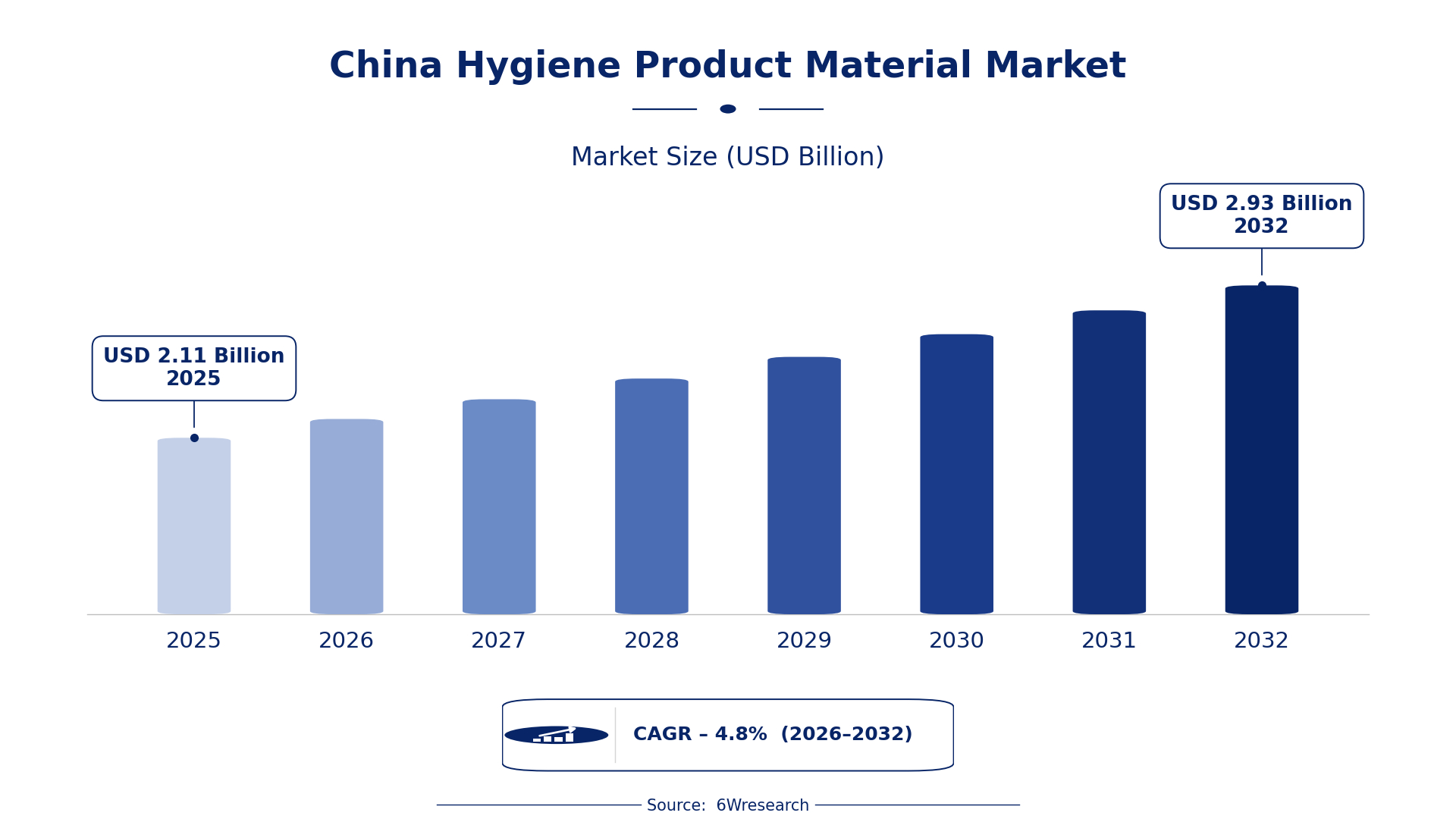
According to 6Wresearch internal database and industry insights, the China Hygiene Product Material Market was valued at USD 2.11 billion in 2025 and is projected to reach USD 2.93 billion by 2032, growing at a CAGR of approximately 4.8% during 2026–2032.
China Hygiene Product Material Market Highlights
| Report Metric | Details |
| Report Name | China Hygiene Product Material Market |
| Market Size 2025 | USD 2.11 billion |
| Market Size 2032 | USD 2.93 billion |
| Absolute Growth 2025–2032 | USD 0.82 billion |
| CAGR 2026–2032 | 4.8% |
| Peak Annual Growth | 7.2% in 2031 |
| Forecast Period | 2026–2032 |
| Historical Data | 2022–2025 |
| Base Year | 2025 |
| Leading Material Type, 2025 | Super Absorbent Polymers (39% share) |
| Leading Product Application, 2025 | Diapers & Pads (41% share) |
| Leading Biodegradability Factor, 2025 | Low (48% share) |
| Leading End User, 2025 | Mass Production Companies (35% share) |
| Fastest-Growing Material Type | Nonwoven Fabrics (6.2% CAGR) |
| Fastest-Growing Product Application | Sanitary Napkins/Wipes (7.4% CAGR) |
| Fastest-Growing Biodegradability Factor | Medium (6.5% CAGR) |
| Fastest-Growing End User | Hygiene OEMs (6.6% CAGR) |
| Growing Sector | Eco-Friendly Hygiene Products |
| Key End Users | Mass Production Companies, Hygiene OEMs, Sustainable Product Makers, Eco-Friendly Brands |
China Hygiene Product Material Market Year-wise Growth Rate and Key Drivers (2022–2032)
This graph illustrates the annual growth rates of the market from 2022 to 2032, highlighting a steady upward trajectory and projected market expansion over the forecast period.
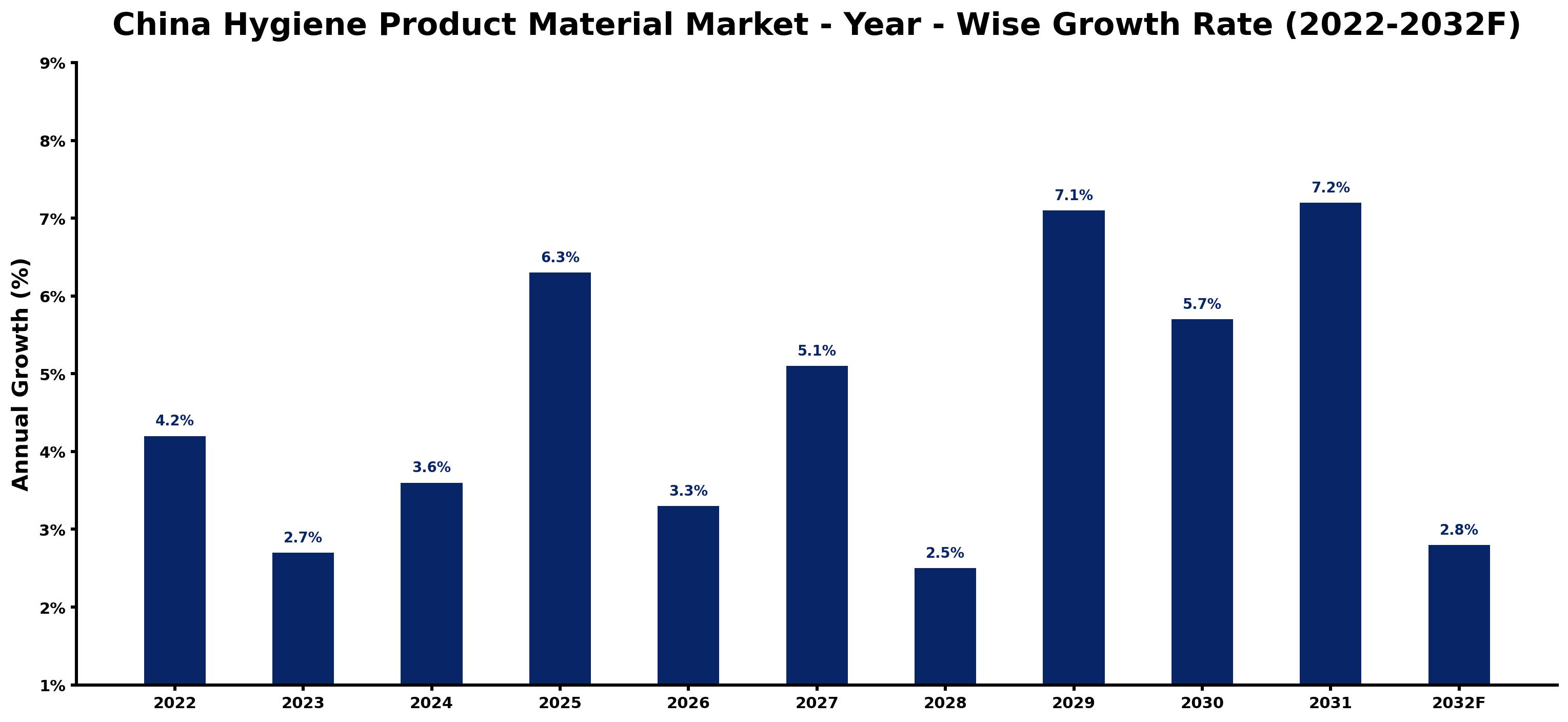
The following table presents the estimated annual growth rate for each year together with the principal factor influencing market performance.
| Year | Estimated Annual Growth (%) | Market Rationale |
| 2022 | 4.2 | The market experienced steady growth due to ongoing demand from mass production companies. |
| 2023 | 2.7 | Growth slowed as manufacturers faced challenges in sourcing eco-friendly materials. |
| 2024 | 3.6 | Demand increased as consumers showed a preference for sustainable hygiene products. |
| 2025 | 6.3 | The market saw a surge in investment, driven by rising consumer awareness of eco-friendly options. |
| 2026 | 3.3 | Growth decelerated as competition intensified among local manufacturers in the eco-friendly segment. |
| 2027 | 5.1 | A recovery in growth occurred as hygiene OEMs expanded their production capacity for sustainable materials. |
| 2028 | 2.5 | Market growth slowed again due to fluctuating raw material prices affecting production costs. |
| 2029 | 7.1 | Demand accelerated as urban households increased their usage of hygiene products, particularly diapers. |
| 2030 | 5.7 | Growth moderated as manufacturers adjusted to new consumer preferences for biodegradable options. |
| 2031 | 7.2 | The market peaked with heightened investment in eco-friendly materials and technologies. |
| 2032 | 2.8 | Growth slowed as market saturation began to affect new product introductions in the hygiene sector. |
Note: Market size estimations and growth projections presented in this report are based on 6Wresearch's proprietary forecasting methodology, utilizing the latest available industry data, government publications, and primary research inputs.
China Hygiene Product Material Market Synopsis
Hygiene Product Material in China includes super absorbent polymers and nonwoven fabrics, crucial for the production of hygiene items such as diapers and sanitary napkins. Domestic demand from mass production companies and a rising emphasis on eco-friendly materials are key drivers of this market. With over 20 million tons of hygiene products manufactured each year, investment in sustainable solutions is on the rise. The 'Green Product Promotion Plan' is boosting demand for biodegradable options, further supporting market expansion.
Market Dynamics Impact Analysis (2026–2032)
| Factor | Type | Impact | Primary Segment Affected |
| Rising consumer preference for eco-friendly products is driving demand for sustainable materials. | Driver | High | SAP-Free Natural Materials |
| The increasing birth rate in urban areas boosts demand for diapers and pads. | Driver | High | Diapers & Pads |
| Government subsidies for biodegradable materials create opportunities for manufacturers. | Opportunity | High | Sustainable Product Makers |
| The demand for organic diapers is rising, indicating a shift towards sustainable hygiene solutions. | Opportunity | High | Organic Diapers |
| High production costs for eco-friendly materials may limit market growth. | Restraint | Medium | SAP-Free Natural Materials |
| Limited consumer awareness of biodegradable options can hinder adoption rates. | Restraint | Medium | Fully Biodegradable |
| Manufacturers face challenges in sourcing quality raw materials for production. | Challenge | High | Nonwoven Fabrics |
| Competition among local manufacturers is intensifying, affecting pricing strategies. | Challenge | Medium | Fluff Pulp |
Evaluation of Drivers in China Hygiene Product Material Market (2026–2032)
The table below links each growth driver to the segment it affects and the evidence for it.
| Drivers | Primary Segment Affected | Why It Matters (Evidence) |
| Increased urbanisation leads to higher consumption of hygiene products. | Diapers & Pads | China's population exceeds 1.4 billion, driving demand for hygiene products. |
| Investment in eco-friendly materials is on the rise. | SAP-Free Natural Materials | In 2023, investment in eco-friendly materials increased by 10%. |
| Growing awareness of hygiene and sanitation is boosting product demand. | Nonwoven Fabrics | The average urban household uses 8-10 diapers per month per child. |
| Government initiatives support sustainable product development. | Organic Diapers | The 'Green Product Promotion Plan' encourages the use of biodegradable materials. |
| Rising disposable incomes allow consumers to opt for premium hygiene products. | Sanitary Napkins/Wipes | Research indicates that 40% of consumers prefer fully biodegradable products. |
The Hygiene Product Material market in China is growing on the back of rising urbanisation, increasing disposable incomes, and heightened awareness of hygiene. With over 1.4 billion people, demand for hygiene products is substantial, particularly in the diaper segment. The average urban household consumes 8-10 diapers monthly, propelling demand further. Investment in eco-friendly materials surged by 10% in 2023, reflecting a shift towards sustainability.
Evaluation of Restraints in China Hygiene Product Material Market
Below mentioned are some major restraints and their influence on market dynamics.
| Market Restraint | Primary Segment Affected | Why It Matters (Evidence) |
| High production costs for eco-friendly materials limit market expansion. | SAP-Free Natural Materials | Manufacturers face increased costs in sourcing sustainable materials, impacting pricing. |
| Limited consumer awareness of biodegradable options hinders market adoption. | Fully Biodegradable | Many consumers remain unaware of the benefits of biodegradable hygiene products. |
| Fluctuating raw material prices create uncertainty for manufacturers. | Fluff Pulp | Price volatility affects production planning and profitability for manufacturers. |
| Regulatory compliance can be challenging for new entrants. | Nonwoven Fabrics | Manufacturers must navigate complex regulations to ensure product safety. |
| Competition from low-cost imports may pressure local manufacturers. | Diapers & Pads | Imported products can offer lower prices, affecting local market share. |
China Hygiene Product Material Market Challenges
The China Hygiene Product Material Market encounters various practical issues, starting with a shortage of skilled workers among producers. Many manufacturers find it challenging to recruit personnel trained in polymerisation techniques, resulting in production delays that affect product quality. Rising production costs pose another hurdle, as raw material prices have increased by 12% over the past year, squeezing profit margins for producers. Technology adoption remains limited, with only 30% of manufacturers utilising modern equipment, leading to inefficiencies that undermine competitiveness. Supply chain disruptions are common, as fluctuations in fluff pulp availability can halt production for weeks, affecting distributors' ability to fulfil demand.
Trends in the China Hygiene Product Material Market
Below mentioned are some of the trends shaping the China Hygiene Product Material Market growth.
- Shift Towards Eco-Friendly Materials: In 2021, the 'Green Product Promotion Plan' was introduced to promote sustainable materials in hygiene products. This initiative has resulted in a 10% increase in investment in eco-friendly materials in 2023, encouraging manufacturers to adjust their offerings.
- Growing Demand for Organic Diapers: The demand for organic diapers increased by 15% in urban areas in 2022. This trend highlights a shift towards sustainability, as consumers increasingly favour environmentally friendly products.
- Increased Focus on Biodegradable Products: Research shows that 40% of consumers now prefer fully biodegradable hygiene products. This growing preference is influencing product development strategies among manufacturers nationwide.
- Expansion of Sanitary Napkins/Wipes Market: The sanitary napkins and wipes segment is anticipated to grow at a CAGR of 7.4% from 2026 to 2032. This growth is driven by rising awareness of women's hygiene and the demand for convenient products.
Investment Opportunities in the China Hygiene Product Material Market
Some of the investment opportunities in the China Hygiene Product Material Market are mentioned below.
- Market Gap for Biodegradable Materials: With 40% of consumers preferring fully biodegradable products, there is a notable market gap. Manufacturers can invest in developing biodegradable hygiene materials to meet this demand.
- Partnerships for Sustainable Production: Government subsidies are available for manufacturers adopting biodegradable materials. Collaborating with local partners can facilitate access to these subsidies and improve production capabilities.
- Rising Demand from Eco-Friendly Brands: Eco-Friendly Brands are increasingly seeking sustainable materials for their products. Suppliers can target this growing segment by offering innovative, eco-friendly hygiene materials.
- Investment in Sanitary Napkins/Wipes Production: The sanitary napkins and wipes market is expected to grow significantly. Investing in advanced production facilities can help capture this expanding demand from manufacturers.
Government Initiatives in the China Hygiene Product Material Market
The national standard GB/T 28004-2011 regulates hygiene product materials in China, ensuring safety and quality. Compliance with this standard is essential for manufacturers to maintain market access. Additionally, government subsidies are available for manufacturers adopting biodegradable materials, incentivising the transition to eco-friendly options. These measures collectively support the growth of sustainable hygiene product materials in the country.
In 2021, the Ministry of Ecology and Environment launched the 'Green Product Promotion Plan', which aims to promote sustainable materials in various industries. This initiative has allocated funding to support manufacturers transitioning to eco-friendly production methods. The National Development and Reform Commission also backs the 'Circular Economy Development Strategy', which encourages the use of biodegradable materials in hygiene products. These agencies facilitate the adoption of sustainable practices among manufacturers.
Future Insight of the China Hygiene Product Material Market
Several forward-looking factors should support the China Hygiene Product Material Market in the coming years. The government's 'Green Product Promotion Plan' will motivate manufacturers to adopt sustainable materials, driving innovation in product development. By 2025, the market for biodegradable hygiene products is projected to grow by 20%, reflecting a clear shift in consumer preferences. Advances in manufacturing technology will improve operational efficiency, enabling suppliers to better meet the needs of urban households, which typically use 8-10 diapers per month per child.
Market Segmentation Analysis
The analysis below covers each segmentation, its leading category in 2025 and its fastest-growing category through 2032.
By Material Type – Super Absorbent Polymers Dominated, Nonwoven Fabrics Expected to Grow Fastest
According to Bhawna Singh, Assistant Manager at 6Wresearch, the largest material type category in 2025 was Super Absorbent Polymers, with a 39% share of total revenue. Super absorbent polymers dominate the market due to their critical role in producing high-absorbency diapers and pads, which are essential for consumer satisfaction. With a market value of around 4 billion USD, they are integral to the hygiene product supply chain. Nonwoven Fabrics are projected to grow fastest, at a CAGR of 6.2% during 2026–2032. Nonwoven fabrics are rapidly growing as they are increasingly used in the production of sanitary napkins and wipes, driven by heightened awareness of hygiene. The demand for convenience and quality in women's hygiene products is significantly boosting this segment's expansion. Suppliers should focus on enhancing the production of nonwoven fabrics to capture the increasing market share in hygiene applications.
By Product Application – Diapers & Pads Dominated, Sanitary Napkins/Wipes Expected to Grow Fastest
With a 41% revenue share in 2025, Diapers & Pads was the largest product application category. Diapers and pads represent the largest application of hygiene materials, constituting 70% of the total market. This substantial share is driven by high usage rates in urban households, where families typically use 8-10 diapers monthly per child. Sanitary Napkins/Wipes are set to record the highest CAGR in this split, 7.4% over 2026–2032. Sanitary napkins and wipes are witnessing the fastest growth, spurred by rising awareness of women's hygiene needs and the introduction of innovative products. Targeted marketing strategies and product diversification are further propelling this segment's expansion. Manufacturers should concentrate on developing products specifically for the sanitary napkin and wipe market to leverage this growth opportunity.
By Biodegradability Factor – Low Dominated, Medium Expected to Grow Fastest
In 2025, Low led the biodegradability factor split with a 48% share. Low biodegradability materials currently hold the largest share, primarily due to their widespread use in traditional hygiene products where cost and performance are prioritised. This segment's dominance reflects the existing manufacturing practices that favour these materials despite environmental concerns. The quickest growth will come from Medium, forecast to expand at a CAGR of 6.5% between 2026 and 2032. Medium biodegradability materials are gaining traction as consumers increasingly prefer products that balance performance with environmental responsibility. The push for sustainable alternatives is driving this segment's growth as manufacturers respond to changing consumer preferences. Suppliers must adapt to the rising demand for medium biodegradability materials to remain competitive in the evolving hygiene market.
By End User – Mass Production Companies Dominated, Hygiene OEMs Expected to Grow Fastest
Mass Production Companies accounted for a 35% market share by end user in 2025. Mass production companies are the largest user group in the hygiene manufacturing sector, effectively utilising economies of scale to meet the high demand for hygiene products. Their established infrastructure and extensive distribution networks allow them to maintain a strong market share. Over 2026–2032, Hygiene OEMs are expected to post the fastest growth, at a CAGR of 6.6%. Hygiene OEMs are experiencing the fastest growth as they adapt to market trends with specialised products. Their ability to innovate and respond to consumer needs positions them favourably for future expansion in the hygiene sector. Suppliers should explore partnerships with hygiene OEMs to leverage their innovative capabilities and enhance market share.
Key Attractiveness of the Report
- 10 Years of Market Numbers
- Historical Data Starting from 2022 to 2025
- Base Year 2025
- Forecast Data until 2032
- Key Performance Indicators Impacting the Market
- Major Upcoming Developments and Projects
Key Highlights of the Report:
- China Hygiene Product Material Market Outlook
- Market Size of China Hygiene Product Material Market, 2025
- Forecast of China Hygiene Product Material Market, 2032
- Historical Data and Forecast of China Hygiene Product Material Revenues & Volume for the Period 2022 - 2032F
- China Hygiene Product Material Market Trend Evolution
- China Hygiene Product Material Market Drivers and Challenges
- China Hygiene Product Material Price Trends
- China Hygiene Product Material Porter's Five Forces
- China Hygiene Product Material Industry Life Cycle
- Historical Data and Forecast of China Hygiene Product Material Market Revenues & Volume By Material Type for the Period 2022 - 2032F
- Historical Data and Forecast of China Hygiene Product Material Market Revenues & Volume By Super Absorbent Polymers for the Period 2022 - 2032F
- Historical Data and Forecast of China Hygiene Product Material Market Revenues & Volume By Nonwoven Fabrics for the Period 2022 - 2032F
- Historical Data and Forecast of China Hygiene Product Material Market Revenues & Volume By Fluff Pulp for the Period 2022 - 2032F
- Historical Data and Forecast of China Hygiene Product Material Market Revenues & Volume By SAP-Free Natural Materials for the Period 2022 - 2032F
- Historical Data and Forecast of China Hygiene Product Material Market Revenues & Volume By Product Application for the Period 2022 - 2032F
- Historical Data and Forecast of China Hygiene Product Material Market Revenues & Volume By Diapers & Pads for the Period 2022 - 2032F
- Historical Data and Forecast of China Hygiene Product Material Market Revenues & Volume By Sanitary Napkins/Wipes for the Period 2022 - 2032F
- Historical Data and Forecast of China Hygiene Product Material Market Revenues & Volume By Paper-Based Products for the Period 2022 - 2032F
- Historical Data and Forecast of China Hygiene Product Material Market Revenues & Volume By Organic Diapers for the Period 2022 - 2032F
- Historical Data and Forecast of China Hygiene Product Material Market Revenues & Volume By Biodegradability Factor for the Period 2022 - 2032F
- Historical Data and Forecast of China Hygiene Product Material Market Revenues & Volume By Low for the Period 2022 - 2032F
- Historical Data and Forecast of China Hygiene Product Material Market Revenues & Volume By Medium for the Period 2022 - 2032F
- Historical Data and Forecast of China Hygiene Product Material Market Revenues & Volume By High for the Period 2022 - 2032F
- Historical Data and Forecast of China Hygiene Product Material Market Revenues & Volume By Fully Biodegradable for the Period 2022 - 2032F
- Historical Data and Forecast of China Hygiene Product Material Market Revenues & Volume By End User for the Period 2022 - 2032F
- Historical Data and Forecast of China Hygiene Product Material Market Revenues & Volume By Mass Production Companies for the Period 2022 - 2032F
- Historical Data and Forecast of China Hygiene Product Material Market Revenues & Volume By Hygiene OEMs for the Period 2022 - 2032F
- Historical Data and Forecast of China Hygiene Product Material Market Revenues & Volume By Eco-Friendly Brands for the Period 2022 - 2032F
- Historical Data and Forecast of China Hygiene Product Material Market Revenues & Volume By Sustainable Product Makers for the Period 2022 - 2032F
- China Hygiene Product Material Import Export Trade Statistics
- Market Opportunity Assessment By Material Type
- Market Opportunity Assessment By Product Application
- Market Opportunity Assessment By Biodegradability Factor
- Market Opportunity Assessment By End User
- China Hygiene Product Material Top Companies Market Share
- China Hygiene Product Material Competitive Benchmarking By Technical and Operational Parameters
- China Hygiene Product Material Company Profiles
- China Hygiene Product Material Key Strategic Recommendations
Market Covered
The report offers an extensive study of the following market segments.
By Material Type
- Super Absorbent Polymers
- Nonwoven Fabrics
- Fluff Pulp
- SAP-Free Natural Materials
By Product Application
- Diapers & Pads
- Sanitary Napkins/Wipes
- Paper-Based Products
- Organic Diapers
By Biodegradability Factor
- Low
- Medium
- High
- Fully Biodegradable
By End User
- Mass Production Companies
- Hygiene OEMs
- Eco-Friendly Brands
- Sustainable Product Makers































