India Identity Verification AI Market Size & Growth Rate
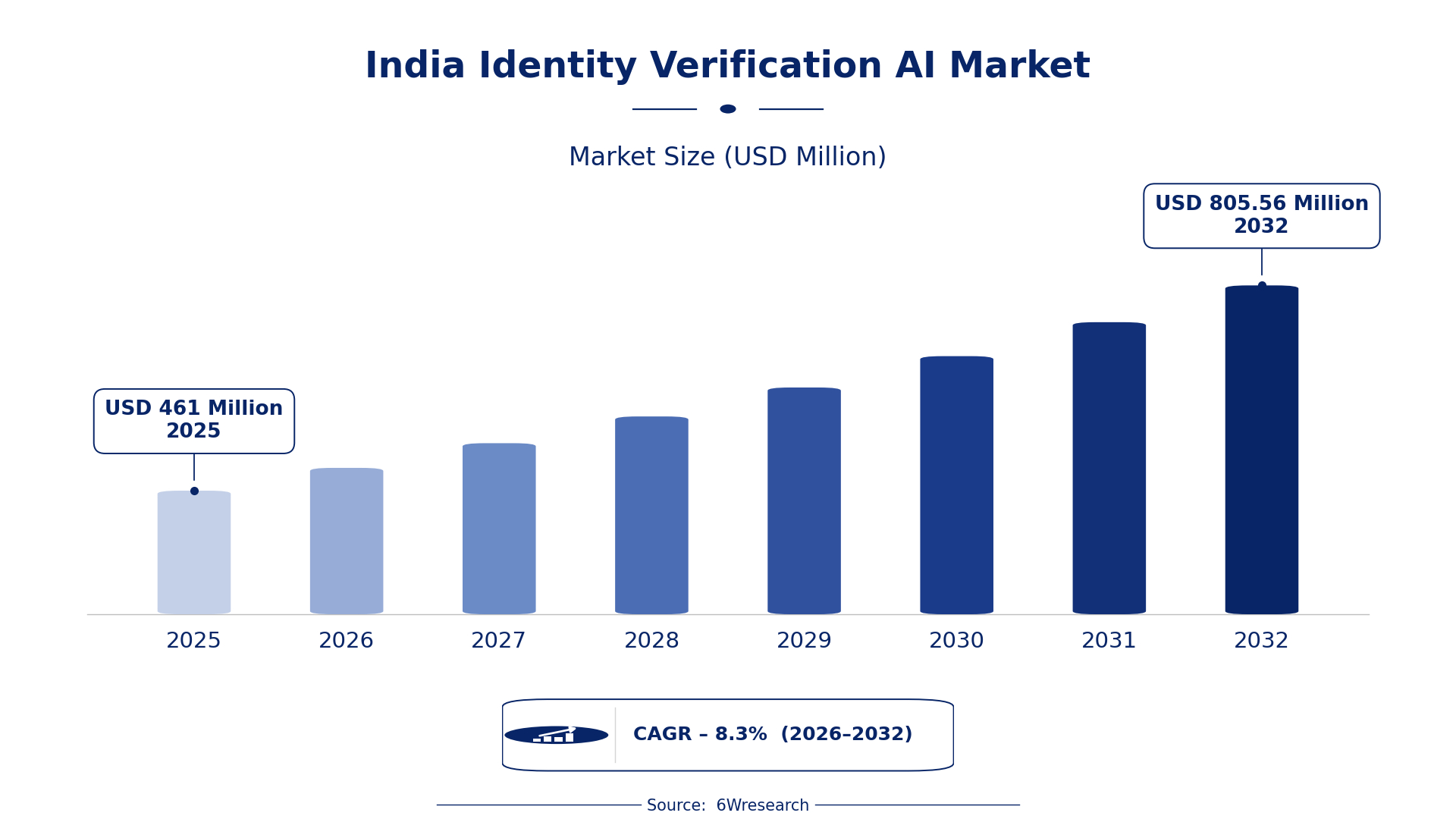
According to 6Wresearch internal database and industry insights, the India Identity Verification AI Market was valued at USD 461.0 million in 2025 and is projected to reach USD 805.56 million by 2032, growing at a CAGR of approximately 8.3% during 2026–2032.
India Identity Verification AI Market Highlights
| Report Metric | Details |
| Report Name | India Identity Verification AI Market |
| Market Size 2025 | USD 461.0 million |
| Market Size 2032 | USD 805.56 million |
| Absolute Growth 2025–2032 | USD 344.56 million |
| CAGR 2026–2032 | 8.3% |
| Peak Annual Growth | 10.7% in 2032 |
| Forecast Period | 2026–2032 |
| Historical Data | 2022–2025 |
| Base Year | 2025 |
| Leading Verification Mode, 2025 | Facial Recognition (47% share) |
| Leading AI Technology Used, 2025 | Deep Learning/CNNs (37% share) |
| Leading Use Case, 2025 | eKYC (39% share) |
| Leading End User, 2025 | Fintech & Banking (39% share) |
| Fastest-Growing Verification Mode | Behavioral Biometrics (11.1% CAGR) |
| Fastest-Growing AI Technology Used | OCR + NLP (9.4% CAGR) |
| Fastest-Growing Use Case | Fraud Prevention (10.0% CAGR) |
| Fastest-Growing End User | E-commerce & e-Gov Platforms (9.8% CAGR) |
| Growing Sector | E-commerce & e-Gov Platforms |
| Key End Users | Fintech & Banking, E-commerce & e-Gov Platforms, Online Platforms, Telecom Providers |
India Identity Verification AI Market Year-wise Growth Rate and Key Drivers (2022–2032)
This graph illustrates the annual growth rates of the market from 2022 to 2032, highlighting a steady upward trajectory and projected market expansion over the forecast period.
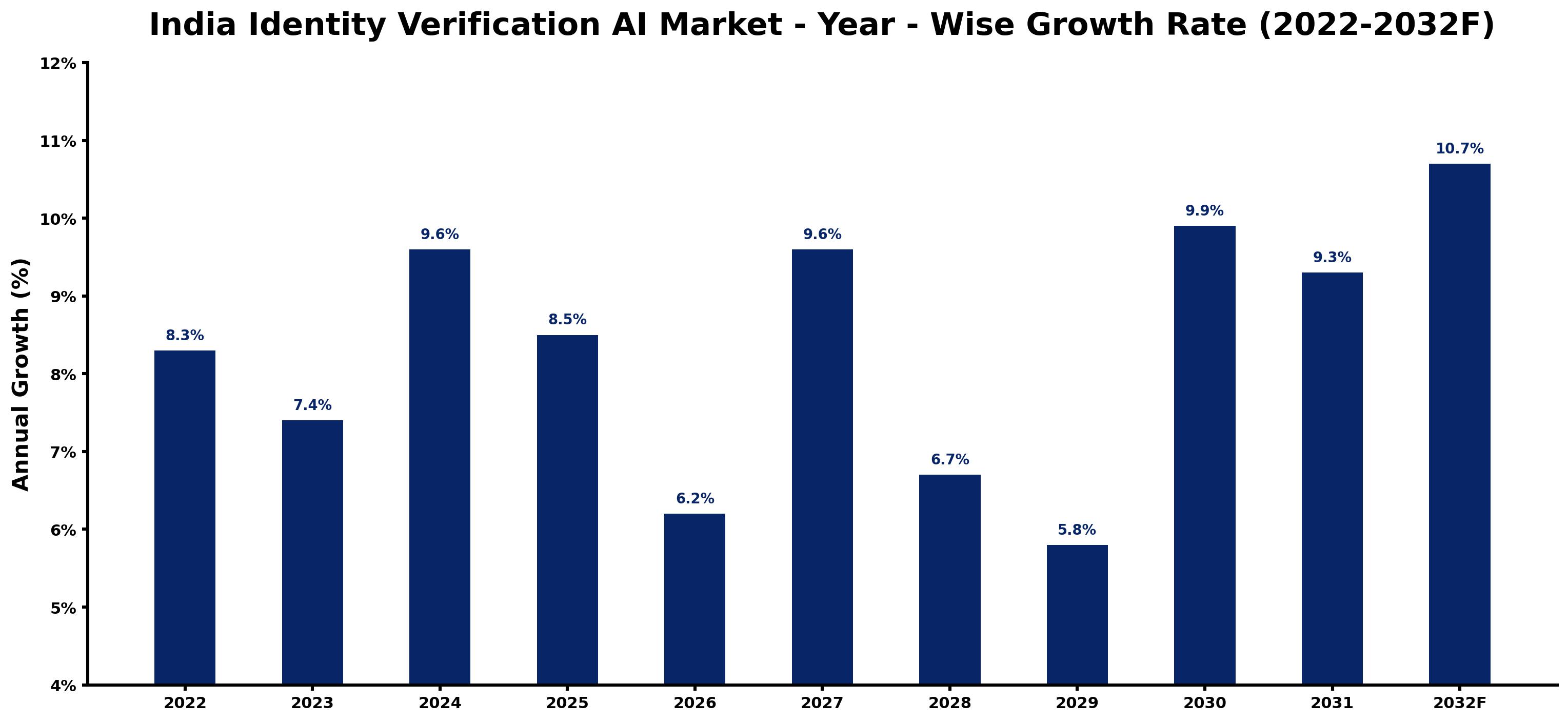
Each row of the following table gives one year's estimated growth and the event or demand shift that explains it.
| Year | Estimated Annual Growth (%) | Market Rationale |
| 2022 | 8.3 | The market experienced steady growth, supported by the Reserve Bank of India's eKYC mandate for financial institutions. |
| 2023 | 7.4 | Growth slowed due to evolving regulatory frameworks and adjustments in technology adoption. |
| 2024 | 9.6 | Demand surged as financial institutions expanded their eKYC processes to accommodate over 300 million users. |
| 2025 | 8.5 | Market growth slowed again as competition intensified among identity verification service providers. |
| 2026 | 6.2 | Growth slowed further as the sector faced challenges in scaling AI technology solutions effectively. |
| 2027 | 9.6 | A resurgence in demand occurred with improved technological adoption in the fintech sector. |
| 2028 | 6.7 | Growth decelerated as market maturation began to take effect in various industries. |
| 2029 | 5.8 | The market continued to slow as companies adjusted to new operational standards and regulations. |
| 2030 | 9.9 | Demand picked up again, driven by advancements in AI technologies and applications across sectors. |
| 2031 | 9.3 | Growth slowed slightly as the market stabilised with established players and regulatory compliance. |
| 2032 | 10.7 | A peak in growth is expected as the market matures and the National Digital Identity Program is implemented. |
Note: Market size estimations and growth projections presented in this report are based on 6Wresearch's proprietary forecasting methodology, utilizing the latest available industry data, government publications, and primary research inputs.
India Identity Verification AI Market Synopsis
Identity Verification AI in India includes technologies that confirm individual identities through methods like facial recognition and document verification. This technology is essential for security in financial transactions and fraud prevention. The India Identity Verification AI Market is expanding due to strong demand from sectors such as fintech and e-commerce. The Reserve Bank of India's eKYC mandate has accelerated this growth, with over 300 million users requiring verification services in 2022. The National Digital Identity Program aims to integrate these solutions across government services by 2025.
Market Dynamics Impact Analysis (2026–2032)
| Factor | Type | Impact | Primary Segment Affected |
| Growing demand from the fintech sector for secure transactions | Driver | High | Fintech & Banking |
| Increased adoption of eKYC processes across financial institutions | Driver | High | eKYC |
| Rising need for secure identity verification solutions | Opportunity | High | E-commerce & e-Gov Platforms |
| Expansion of digital identity verification in public services | Opportunity | Medium | Telecom Providers |
| Challenges in integrating AI technologies with existing systems | Restraint | High | Document Verification |
| High costs associated with implementing advanced verification systems | Restraint | Medium | Facial Recognition |
| Limited awareness among smaller enterprises about AI solutions | Challenge | Medium | Online Platforms |
| Regulatory compliance requirements can delay implementation | Challenge | High | Fintech & Banking |
Evaluation of Drivers in India Identity Verification AI Market (2026–2032)
Below mentioned are some major drivers and their influence on market dynamics.
| Drivers | Primary Segment Affected | Why It Matters (Evidence) |
| Increased investment in AI technologies by financial institutions | Fintech & Banking | This investment drives transaction security, with over 60% of Indian banks adopting AI-driven solutions by 2025. |
| Growing user base in the fintech sector | eKYC | With over 300 million users in 2022, the demand for efficient identity verification processes has surged, driving AI adoption. |
| Government initiatives promoting digital identity verification | E-commerce & e-Gov Platforms | The National Digital Identity Program aims to integrate verification across services, increasing demand for AI technologies by 2025. |
| Rising cyber security concerns among consumers | Document Verification | As cyber threats increase, businesses are investing in secure identity verification, prompting higher demand for AI solutions. |
| Expansion of online services requiring identity verification | Online Platforms | The growing number of online transactions necessitates effective verification systems, leading to increased purchases of AI technologies. |
The Identity Verification AI market in India is growing on the back of increased investment in AI technologies and a rapidly expanding user base in the fintech sector. In 2022, over 300 million users required identity verification, prompting financial institutions to adopt advanced solutions. Cyber security concerns are pushing businesses to invest in secure identity verification, creating a strong market for AI technologies. The expansion of online services necessitates effective verification systems, resulting in increased purchases of AI solutions by various sectors.
Evaluation of Restraints in India Identity Verification AI Market
The table below lists the restraints and the evidence behind each.
| Market Restraint | Primary Segment Affected | Why It Matters (Evidence) |
| Dependence on legacy systems that are hard to upgrade | eKYC | Existing systems may not support new technologies, complicating the transition to AI-driven solutions and delaying implementation. |
| High development costs for advanced technologies | Document Verification | Developing sophisticated AI solutions can exceed 20% of budgets, limiting investment in new projects. |
| Regulatory compliance challenges | Fintech & Banking | Strict regulations can delay product rollout, extending timelines by up to three months for compliance checks. |
| Skills shortages in AI technologies | Online Platforms | Only 30% of professionals possess the necessary expertise, hindering effective implementation of identity verification solutions. |
| Outdated infrastructure in many sectors | E-commerce & e-Gov Platforms | Slow technology adoption can lead to a 15% increase in operational costs for businesses reliant on timely verification. |
India Identity Verification AI Market Challenges
Producers of Identity Verification AI in India face high development costs, as sophisticated machine learning algorithms and biometric data integration can consume over 20% of their budgets. Distributors encounter regulatory challenges, with the Reserve Bank of India mandating eKYC for financial institutions, leading to product rollout delays that can extend timelines by three months. Buyers in the fintech sector struggle with skills shortages, as only 30% of professionals possess the necessary expertise in AI technologies, hindering effective implementation. Many businesses experience technology adoption issues due to outdated infrastructure, which can increase operational costs by 15% for those reliant on timely identity verification.
Trends in the India Identity Verification AI Market
Below mentioned are some of the trends shaping the India Identity Verification AI Market growth.
- Shift towards AI-driven Identity Verification Solutions: India is increasingly adopting AI-driven identity verification solutions, particularly in the fintech sector. In 2022, over 60% of Indian banks began implementing AI technologies to improve security, reflecting a notable shift in operational practices.
- Transition from Manual to Automated Verification Processes: The move towards automated verification processes began in 2021, driven by the Reserve Bank of India's eKYC mandate. This transition is expected to streamline operations and improve efficiency in financial institutions, with a projected 30% growth in AI technologies through 2025.
- Growing Adoption of eKYC in Government Services: The government is promoting eKYC as part of its Digital India initiative, launched in 2015. By 2025, this initiative aims to integrate identity verification across various public services, enhancing security and accessibility for citizens.
- Increased Focus on Cybersecurity in Identity Verification: As cyber threats rise, the emphasis on secure identity verification has intensified among telecom providers. In 2023, the Telecom Regulatory Authority of India highlighted the need for secure customer verification, pushing for enhanced AI solutions.
Investment Opportunities in the India Identity Verification AI Market
Several openings in the India Identity Verification AI Market merit attention from investors.
- Fintech Sector's Demand for Secure Solutions: The fintech sector is currently expanding rapidly, with over 300 million users requiring identity verification. Investing in AI technologies tailored for this sector can yield substantial returns as demand continues to grow over the coming years.
- Government Initiatives Supporting Digital Identity Verification: With a budget of ₹1 trillion for the Digital India Programme, there is substantial funding available for tech startups focusing on identity verification solutions. Collaborating with local partners can facilitate market entry and growth in this sector.
- Telecom Providers Expanding Digital Verification Needs: Telecom providers are increasingly adopting AI-driven identity verification solutions, driven by regulatory requirements. This presents an opportunity for suppliers to offer tailored solutions, especially with the emphasis on secure verification in 2023.
- E-Governance Initiatives Promoting Digital Identity: The e-Governance initiative encourages the use of digital identity verification across public services. Suppliers can enter this market by obtaining necessary certifications and aligning with government standards.
Government Initiatives in the India Identity Verification AI Market
The Digital India Programme, launched in 2015, aims to improve digital infrastructure, including identity verification systems, with a budget of ₹1 trillion. This initiative has led to increased investments in technology and infrastructure, benefiting producers in the identity verification sector. The National Strategy on Artificial Intelligence, introduced in 2018, promotes the use of AI in identity verification, encouraging innovation and development in this field. The Reserve Bank of India mandates eKYC processes for all financial institutions, ensuring secure identity verification and increasing demand for AI solutions among banks and fintech companies. Furthermore, the Startup India initiative launched in 2022 supports tech startups in identity verification, providing funding and resources to enhance their capabilities and market reach.
The Telecom Regulatory Authority of India oversees compliance with secure customer verification standards in telecom services. This agency ensures that service providers implement necessary measures to protect consumer data, promoting the adoption of AI-driven identity verification solutions. The Ministry of Electronics and Information Technology also supports initiatives that facilitate the integration of digital identity verification across various sectors, enhancing the overall security framework for users. By funding projects that promote secure verification practices, these agencies are instrumental in shaping the identity verification landscape in India.
Future Insight of the India Identity Verification AI Market
The Identity Verification AI market in India is poised for notable changes by 2032, as several key factors will support its growth. The National Digital Identity Program aims to integrate verification across government services by 2025, enhancing accessibility for users. By 2025, over 60% of Indian banks are projected to adopt AI-driven solutions, which will improve security and efficiency in transactions. Initiatives from the Ministry of Electronics and Information Technology will advance secure digital identity verification, fostering greater trust and encouraging wider adoption across various sectors.
Market Segmentation Analysis
The analysis below covers each segmentation, its leading category in 2025 and its fastest-growing category through 2032.
By Verification Mode – Facial Recognition Dominated, Behavioral Biometrics Expected to Grow Fastest
According to Bhawna Singh, Assistant Manager at 6Wresearch, Facial Recognition accounted for a 47% market share by verification mode in 2025. Facial recognition holds the largest share in India's identity verification market due to its extensive use in various applications, particularly in financial transactions. This method is crucial for user identification, especially in the fintech sector, which has over 300 million users requiring these services. The quickest growth will come from Behavioral Biometrics, forecast to expand at a CAGR of 11.1% between 2026 and 2032. Behavioral biometrics is experiencing rapid growth as it enhances security through the analysis of user behaviour, particularly in sectors like e-commerce. The increasing emphasis on secure transactions is propelling this segment's swift expansion. Suppliers should focus on developing advanced behavioural biometrics solutions to align with the rising demand for enhanced security measures.
By AI Technology Used – Deep Learning/CNNs Dominated, OCR + NLP Expected to Grow Fastest
With a 37% revenue share in 2025, Deep Learning/CNNs was the largest ai technology used category. Deep learning and convolutional neural networks (CNNs) dominate the market as they are essential for processing and analysing visual data in identity verification applications. Their effectiveness in handling complex data sets makes them a preferred choice among developers. Over 2026–2032, OCR + NLP is expected to post the fastest growth, at a CAGR of 9.4%. OCR combined with natural language processing is swiftly gaining traction, particularly for its role in accurately reading and interpreting text from documents, which is vital for eKYC processes. The increasing volume of digital transactions is driving this segment's growth. Buyers should seek solutions that integrate OCR and NLP capabilities to streamline their identity verification processes.
By Use Case – eKYC Dominated, Fraud Prevention Expected to Grow Fastest
The largest use case category in 2025 was eKYC, with a 39% share of total revenue. eKYC dominates the use case segment in the identity verification market, primarily due to its essential role in customer onboarding processes within the financial sector. The Reserve Bank of India's mandate for eKYC has significantly accelerated its adoption among financial institutions, solidifying its leading position. Fraud Prevention is set to record the highest CAGR in this split, 10.0% over 2026–2032. Fraud prevention is the fastest-growing use case as businesses increasingly focus on identifying and mitigating fraudulent activities in real-time. The surge in digital transactions is intensifying the need for effective fraud prevention strategies. Suppliers must prioritise developing solutions that enhance fraud detection capabilities to capitalise on this expanding market opportunity.
By End User – Fintech & Banking Dominated, E-commerce & e-Gov Platforms Expected to Grow Fastest
Fintech & Banking took a 39% share of end user in 2025, more than any other category. The fintech and banking sectors represent the largest share of the identity verification market, driven by the necessity for secure transactions and compliance with regulatory requirements. With over 60% of banks adopting these solutions, this segment is pivotal for market growth. E-commerce & e-Gov Platforms are projected to grow fastest, at a CAGR of 9.8% during 2026–2032. E-commerce and e-government platforms are rapidly growing as they increasingly rely on identity verification for secure online transactions and services. The push for digital identity verification in public services is further accelerating this segment's development. Suppliers should tailor their offerings to meet the specific needs of e-commerce and e-government platforms to leverage this growth potential.
Key Attractiveness of the Report
- 10 Years of Market Numbers
- Historical Data Starting from 2022 to 2025
- Base Year 2025
- Forecast Data until 2032
- Key Performance Indicators Impacting the Market
- Major Upcoming Developments and Projects
Key Highlights of the Report:
- India Identity Verification AI Market Outlook
- Market Size of India Identity Verification AI Market, 2025
- Forecast of India Identity Verification AI Market, 2032
- Historical Data and Forecast of India Identity Verification AI Revenues & Volume for the Period 2022 - 2032F
- India Identity Verification AI Market Trend Evolution
- India Identity Verification AI Market Drivers and Challenges
- India Identity Verification AI Price Trends
- India Identity Verification AI Porter's Five Forces
- India Identity Verification AI Industry Life Cycle
- Historical Data and Forecast of India Identity Verification AI Market Revenues & Volume By Verification Mode for the Period 2022 - 2032F
- Historical Data and Forecast of India Identity Verification AI Market Revenues & Volume By Facial Recognition for the Period 2022 - 2032F
- Historical Data and Forecast of India Identity Verification AI Market Revenues & Volume By Document Verification for the Period 2022 - 2032F
- Historical Data and Forecast of India Identity Verification AI Market Revenues & Volume By Behavioral Biometrics for the Period 2022 - 2032F
- Historical Data and Forecast of India Identity Verification AI Market Revenues & Volume By Voice Authentication for the Period 2022 - 2032F
- Historical Data and Forecast of India Identity Verification AI Market Revenues & Volume By AI Technology Used for the Period 2022 - 2032F
- Historical Data and Forecast of India Identity Verification AI Market Revenues & Volume By Deep Learning/CNNs for the Period 2022 - 2032F
- Historical Data and Forecast of India Identity Verification AI Market Revenues & Volume By OCR + NLP for the Period 2022 - 2032F
- Historical Data and Forecast of India Identity Verification AI Market Revenues & Volume By ML Pattern Recognition for the Period 2022 - 2032F
- Historical Data and Forecast of India Identity Verification AI Market Revenues & Volume By Voiceprint AI for the Period 2022 - 2032F
- Historical Data and Forecast of India Identity Verification AI Market Revenues & Volume By Use Case for the Period 2022 - 2032F
- Historical Data and Forecast of India Identity Verification AI Market Revenues & Volume By eKYC, Secure Login for the Period 2022 - 2032F
- Historical Data and Forecast of India Identity Verification AI Market Revenues & Volume By ID Card Matching for the Period 2022 - 2032F
- Historical Data and Forecast of India Identity Verification AI Market Revenues & Volume By Fraud Prevention for the Period 2022 - 2032F
- Historical Data and Forecast of India Identity Verification AI Market Revenues & Volume By Call Center Access for the Period 2022 - 2032F
- Historical Data and Forecast of India Identity Verification AI Market Revenues & Volume By End User for the Period 2022 - 2032F
- Historical Data and Forecast of India Identity Verification AI Market Revenues & Volume By Fintech & Banking for the Period 2022 - 2032F
- Historical Data and Forecast of India Identity Verification AI Market Revenues & Volume By E-commerce & e-Gov Platforms for the Period 2022 - 2032F
- Historical Data and Forecast of India Identity Verification AI Market Revenues & Volume By Online Platforms for the Period 2022 - 2032F
- Historical Data and Forecast of India Identity Verification AI Market Revenues & Volume By Telecom Providers for the Period 2022 - 2032F
- India Identity Verification AI Import Export Trade Statistics
- Market Opportunity Assessment By Verification Mode
- Market Opportunity Assessment By AI Technology Used
- Market Opportunity Assessment By Use Case
- Market Opportunity Assessment By End User
- India Identity Verification AI Top Companies Market Share
- India Identity Verification AI Competitive Benchmarking By Technical and Operational Parameters
- India Identity Verification AI Company Profiles
- India Identity Verification AI Key Strategic Recommendations
Market Covered
This report examines the market across the segments below.
By Verification Mode
- Facial Recognition
- Document Verification
- Behavioral Biometrics
- Voice Authentication
By AI Technology Used
- Deep Learning/CNNs
- OCR + NLP
- ML Pattern Recognition
- Voiceprint AI
By Use Case
- eKYC
- Secure Login
- ID Card Matching
- Fraud Prevention
- Call Center Access
By End User
- Fintech & Banking
- E-commerce & e-Gov Platforms
- Online Platforms
- Telecom Providers































