China Identity Verification AI Market Size & Growth Rate
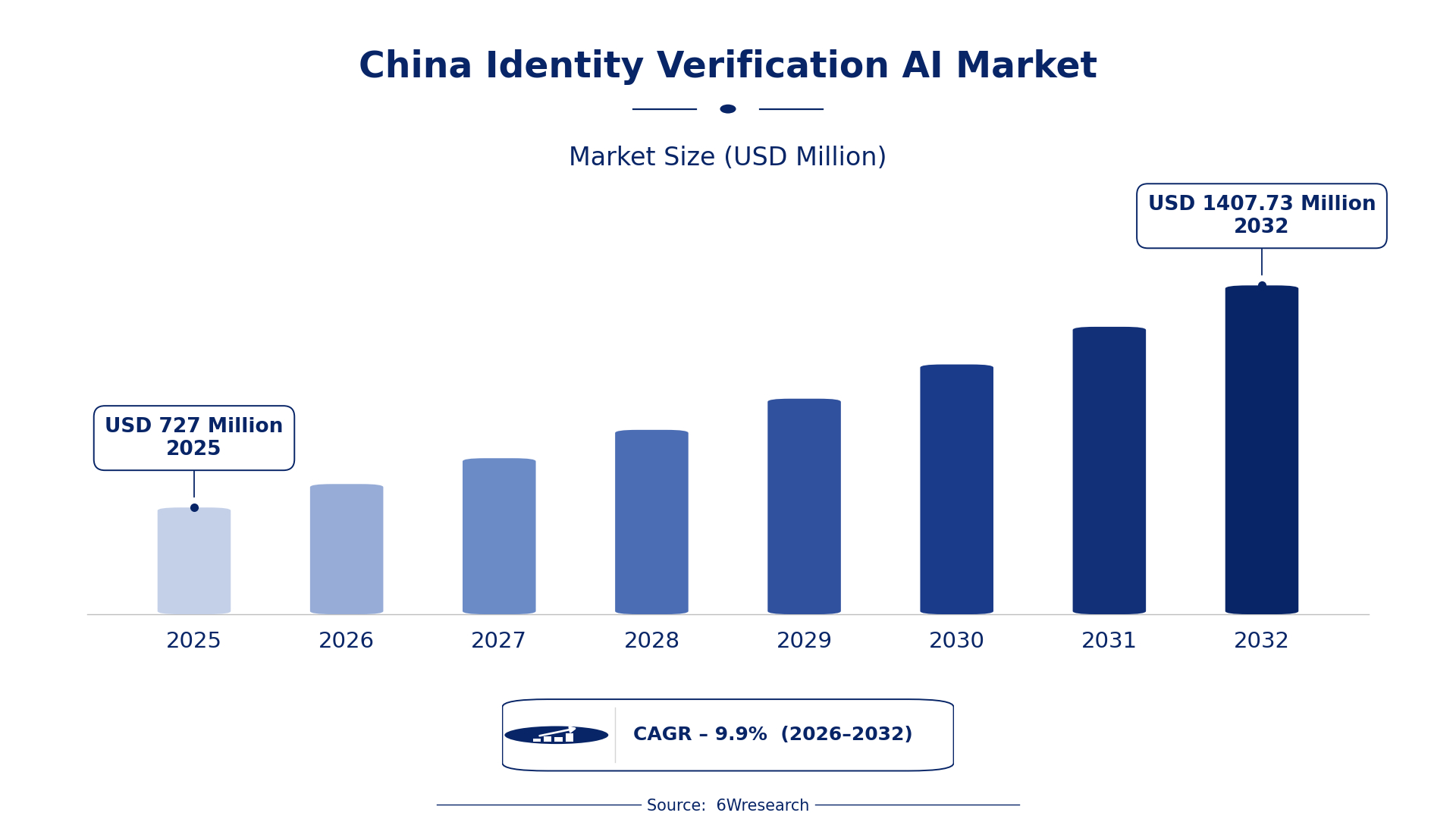
According to 6Wresearch internal database and industry insights, the China Identity Verification AI Market was valued at USD 727.0 million in 2025 and is projected to reach USD 1,407.73 million by 2032, growing at a CAGR of approximately 9.9% during 2026–2032.
China Identity Verification AI Market Highlights
| Report Metric | Details |
| Report Name | China Identity Verification AI Market |
| Market Size 2025 | USD 727.0 million |
| Market Size 2032 | USD 1,407.73 million |
| Absolute Growth 2025–2032 | USD 680.73 million |
| CAGR 2026–2032 | 9.9% |
| Peak Annual Growth | 11.7% in 2026 |
| Forecast Period | 2026–2032 |
| Historical Data | 2022–2025 |
| Base Year | 2025 |
| Leading Verification Mode, 2025 | Facial Recognition (37% share) |
| Leading AI Technology Used, 2025 | Deep Learning/CNNs (40% share) |
| Leading Use Case, 2025 | eKYC (41% share) |
| Leading End User, 2025 | Fintech & Banking (40% share) |
| Fastest-Growing Verification Mode | Behavioral Biometrics (11.7% CAGR) |
| Fastest-Growing AI Technology Used | OCR + NLP (11.5% CAGR) |
| Fastest-Growing Use Case | Fraud Prevention (11.5% CAGR) |
| Fastest-Growing End User | E-commerce & e-Gov Platforms (11.4% CAGR) |
| Growing Sector | Fintech & Banking |
| Key End Users | Fintech & Banking, E-commerce & e-Gov Platforms, Telecom Providers |
China Identity Verification AI Market Year-wise Growth Rate and Key Drivers (2022–2032)
This graph illustrates the annual growth rates of the market from 2022 to 2032, highlighting a steady upward trajectory and projected market expansion over the forecast period.
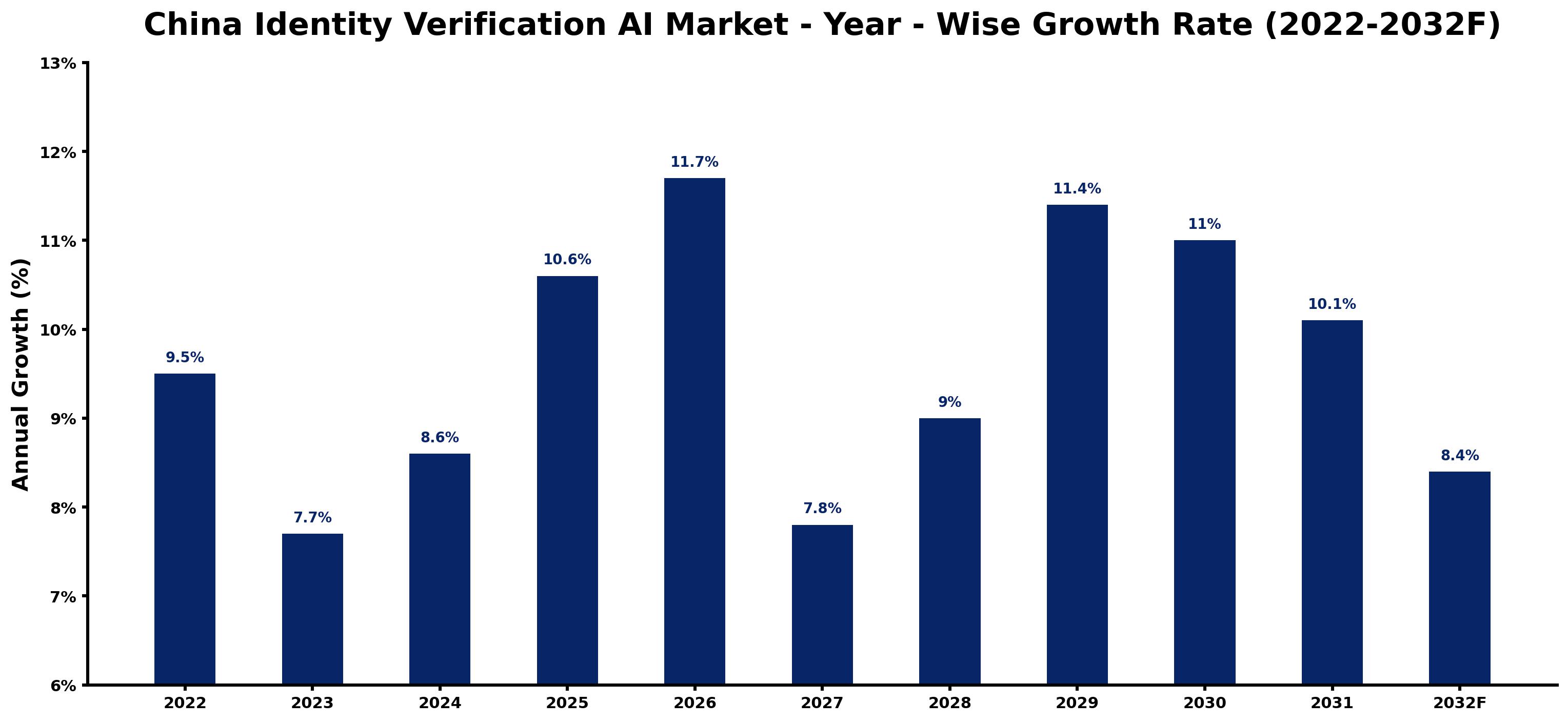
The table below sets out the estimated growth rate for each year and the main factor behind it.
| Year | Estimated Annual Growth (%) | Market Rationale |
| 2022 | 9.5 | The market experienced strong growth due to rising demand for secure online transactions. |
| 2023 | 7.7 | Growth slowed as the market adjusted to new cybersecurity regulations and standards. |
| 2024 | 8.6 | Demand increased as the fintech sector expanded, requiring more eKYC solutions. |
| 2025 | 10.6 | Growth accelerated with the surge in online platforms adopting identity verification technologies. |
| 2026 | 11.7 | The peak growth year is expected to be driven by heightened investment in AI technologies for identity verification. |
| 2027 | 7.8 | Growth is projected to slow as the market matures and competition intensifies among service providers. |
| 2028 | 9.0 | Demand is expected to pick up again as consumers seek improved security measures in digital transactions. |
| 2029 | 11.4 | Growth will continue as e-commerce platforms increasingly integrate identity verification solutions. |
| 2030 | 11.0 | Growth is projected to slow slightly as regulatory compliance becomes more stringent across sectors. |
| 2031 | 10.1 | The market is expected to experience a slowdown as existing solutions become standardised and competition increases. |
| 2032 | 8.4 | Growth will continue to decelerate as the market reaches a more stable phase of development. |
Note: Market size estimations and growth projections presented in this report are based on 6Wresearch's proprietary forecasting methodology, utilizing the latest available industry data, government publications, and primary research inputs.
China Identity Verification AI Market Synopsis
The China Identity Verification AI Market encompasses technologies that authenticate individuals using biometric and behavioural data. This technology is essential for secure online transactions, fraud prevention, and regulatory compliance. The market is expanding due to the rapid growth of the fintech sector and the increasing demand for eKYC solutions. In 2022, over 70% of online platforms in China utilised some form of identity verification technology. The government's investment in AI technologies is driving innovation and adoption across various sectors.
Market Dynamics Impact Analysis (2026–2032)
| Factor | Type | Impact | Primary Segment Affected |
| Growing demand for secure online transactions and fraud prevention solutions. | Driver | High | Document Verification |
| Increasing regulatory compliance requirements in financial sectors. | Driver | High | eKYC |
| Expansion of e-commerce platforms requiring effective identity verification. | Opportunity | High | Facial Recognition |
| Rising adoption of AI technologies in customer verification processes. | Opportunity | High | Deep Learning/CNNs |
| Concerns over data privacy and security in identity verification processes. | Restraint | High | Behavioral Biometrics |
| High costs associated with implementing advanced identity verification technologies. | Restraint | Medium | Voice Authentication |
| The need for continuous updates to comply with evolving regulations. | Challenge | High | Document Verification |
| Competition among service providers leading to price wars. | Challenge | Medium | Facial Recognition |
Evaluation of Drivers in China Identity Verification AI Market (2026–2032)
Key forces behind demand, with the segment each one moves most, are listed below.
| Drivers | Primary Segment Affected | Why It Matters (Evidence) |
| Increased investment in AI technologies for identity verification. | Deep Learning/CNNs | The AI technology sector in China received a government investment of $10 billion in 2021, driving innovation. |
| Rising demand for eKYC solutions in the fintech sector. | eKYC | The fintech sector in China is projected to grow, driving the need for eKYC solutions. |
| Widespread adoption of identity verification in online platforms. | Document Verification | Over 70% of online platforms in China utilise some form of identity verification technology. |
| Growing consumer awareness of identity security. | Facial Recognition | In 2023, a public awareness campaign on identity security was initiated by the government. |
| Regulatory compliance requirements necessitating advanced verification solutions. | Fraud Prevention | The demand for Document Verification services has surged due to regulatory compliance requirements. |
Growth in the Identity Verification AI market in China stems from increased investment in AI technologies, a surge in demand for eKYC solutions, and the widespread use of identity verification across online platforms. In 2021, the AI technology sector attracted $10 billion in funding, spurring innovation. The fintech sector's expansion fuels the need for eKYC solutions, with over 70% of online platforms integrating verification technologies. A public awareness campaign initiated in 2023 highlights the importance of identity security, driving market growth. Compliance requirements also create a demand for advanced verification solutions, particularly within financial sectors.
Evaluation of Restraints in China Identity Verification AI Market
The main factors holding the market back are set out below.
| Market Restraint | Primary Segment Affected | Why It Matters (Evidence) |
| Concerns over data privacy and security in identity verification processes. | Behavioral Biometrics | The implementation of stringent data protection measures has raised concerns about privacy. |
| High costs associated with implementing advanced identity verification technologies. | Voice Authentication | The investment required for advanced technologies can be a barrier for smaller businesses. |
| Limited consumer trust in biometric data usage. | Facial Recognition | Concerns about misuse of biometric data can hinder widespread adoption. |
| Integration challenges with existing systems. | eKYC | Businesses face difficulties when integrating new verification technologies with legacy systems. |
| The need for continuous updates to comply with evolving regulations. | Document Verification | Regulatory changes require constant adaptation, increasing operational costs. |
China Identity Verification AI Market Challenges
The China Identity Verification AI market still faces several pressing issues, with the first being competition from alternative security solutions. This stems from the rapid emergence of various technologies, forcing buyers to seek cost-effective identity authentication methods. Regulatory hurdles follow, as compliance with updated cybersecurity laws can delay implementation for producers, potentially costing them up to 20% of their market share. Buyers also struggle with the need for secure identity verification; in the e-commerce sector, over 70% of platforms necessitate effective solutions. Technology integration issues persist, as many firms find it challenging to adopt advanced AI technologies, resulting in service delivery delays.
Trends in the China Identity Verification AI Market
Several trends are reshaping the China Identity Verification AI Market; the most important are set out below.
- Shift towards Stricter Regulatory Compliance: The 'Cybersecurity and Data Protection Initiative' launched in 2021 has heightened regulatory compliance standards for identity verification. This initiative has led to an increase in demand for compliance-focused identity verification solutions.
- Transition to AI-Driven Verification Solutions: Since 2020, the adoption of AI-driven identity verification technologies has surged. By 2023, the installed base of biometric systems in China is estimated to exceed 500 million devices, indicating a shift in verification methods.
- Emergence of Multi-Factor Authentication: In 2022, the Ministry of Industry and Information Technology published guidelines promoting multi-factor authentication. This has resulted in an increase in the implementation of secure login solutions across various sectors.
- Growing Demand for eKYC Solutions: The fintech sector's expansion has driven the demand for eKYC solutions since 2021. The market for eKYC solutions is expected to grow by 11.5% annually, reflecting the increasing need for secure digital onboarding.
Investment Opportunities in the China Identity Verification AI Market
Investors looking at the China Identity Verification AI Market should consider the following areas.
- Fintech & Banking Sector Expansion: The fintech and banking sectors are rapidly expanding, with a projected growth rate of 11.5%. Investing in eKYC solutions will cater to this demand, particularly in urban areas.
- Partnerships for Technology Integration: Establishing joint ventures with local tech firms can facilitate entry into the Chinese identity verification market. Collaborating with fintech companies will improve service offerings and market reach.
- Supply of Advanced Verification Technologies: There is a growing need for advanced document verification technologies in the financial sector. Supplying AI-driven solutions can meet the demand for regulatory compliance and security.
- Investment in Urban Verification Solutions: Urban areas in China are increasingly adopting identity verification technologies. Focusing on solutions for transportation hubs can tap into this market, especially with the installed base of biometric systems exceeding 500 million.
Government Initiatives in the China Identity Verification AI Market
In 2023, the Ministry of Industry and Information Technology established the 'Digital Identity Framework' to standardise identity verification processes. This framework builds on the 'National Standards for Identity Verification' updated in 2021, improving security measures and aligning with international best practices. The new framework aims to streamline compliance for businesses and improve consumer trust in identity verification technologies.
The Cybersecurity and Data Protection Initiative launched by the Ministry of Public Security in 2021 promotes secure online transactions. This initiative encourages businesses to adopt advanced identity verification technologies, providing funding for projects that strengthen security protocols. The initiative has resulted in increased approvals for identity verification solutions, ensuring compliance with the latest regulations.
Future Insight of the China Identity Verification AI Market
By 2032, the China Identity Verification AI market will undergo substantial transformation, primarily driven by advancements in machine learning and biometric systems. The integration of these technologies will improve secure online transactions, providing clear benefits for both buyers and suppliers. In 2022, China's e-commerce market was valued at over $2 trillion, highlighting the critical need for robust identity verification solutions. Government initiatives aimed at promoting AI across various sectors will further underscore the importance of these solutions for security and regulatory compliance.
Market Segmentation Analysis
The report offers a comprehensive study of the following market segments and their leading categories in the market.
By Verification Mode – Facial Recognition Dominated, Behavioral Biometrics Expected to Grow Fastest
According to Bhawna Singh, Assistant Manager at 6Wresearch, Facial Recognition took a 37% share of verification mode in 2025, more than any other category. Facial recognition technology holds the largest share in the China Identity Verification AI Market due to its widespread application in sectors such as finance and transportation. For instance, over 70% of online platforms in China utilise this technology for real-time identity verification, showcasing its reliability across diverse applications. Over 2026–2032, Behavioral Biometrics are expected to post the fastest growth, at a CAGR of 11.7%. The rapid growth of behavioural biometrics is driven by its increasing integration into online banking systems, where it significantly enhances security measures. As financial institutions prioritise fraud prevention, this sub-segment is poised to gain further importance in the identity verification market. Suppliers should focus on advancing facial recognition technologies while also investing in behavioural biometrics to align with market demands.
By AI Technology Used – Deep Learning/CNNs Dominated, OCR + NLP Expected to Grow Fastest
In 2025, Deep Learning/CNNs led the ai technology used split with a 40% share. Deep Learning and Convolutional Neural Networks (CNNs) lead the market due to their critical role in processing biometric data effectively. These technologies are integral to many identity verification systems, ensuring accurate authentication across various applications. The quickest growth will come from OCR + NLP, forecast to expand at a CAGR of 11.5% between 2026 and 2032. The rapid integration of Optical Character Recognition (OCR) and Natural Language Processing (NLP) is transforming document verification, particularly in response to regulatory compliance needs. This surge reflects the growing demand for efficient data extraction methods across multiple sectors. Investing in OCR and NLP technologies will enable suppliers to stay competitive by meeting the increasing demand for effective identity verification solutions.
By Use Case – eKYC Dominated, Fraud Prevention Expected to Grow Fastest
The largest use case category in 2025 was eKYC, with a 41% share of total revenue. eKYC is the leading use case, essential for digital onboarding in the rapidly expanding fintech sector. This method streamlines customer verification, making it crucial for financial institutions aiming to improve user experience and comply with regulations. Fraud Prevention is projected to grow fastest, at a CAGR of 11.5% during 2026–2032. Fraud prevention is the fastest-growing use case, spurred by the urgent need to combat increasing fraudulent activities in digital transactions. Financial institutions are placing greater emphasis on this area to safeguard their operations and maintain customer trust. Suppliers should enhance fraud prevention capabilities while ensuring eKYC processes remain efficient to meet the evolving needs of the financial sector.
By End User – Fintech & Banking Dominated, E-commerce & e-Gov Platforms Expected to Grow Fastest
With a 40% revenue share in 2025, Fintech & Banking was the largest end user category. The fintech and banking sectors capture the largest share in the China Identity Verification AI Market, primarily due to their reliance on secure identity verification for transactions and regulatory compliance. With the e-commerce market surpassing $2 trillion, these sectors are increasingly adopting verification technologies to protect their operations. E-commerce & e-Gov Platforms are set to record the highest CAGR in this split, 11.4% over 2026–2032. E-commerce and e-Government platforms are experiencing the fastest growth as they implement identity verification solutions to secure online transactions and safeguard user data. The swift expansion of these platforms is driving demand for effective verification technologies. Suppliers should tailor their solutions to meet the specific requirements of e-commerce and e-Government platforms, ensuring they provide secure and efficient identity verification.
Key Attractiveness of the Report
- 10 Years of Market Numbers
- Historical Data Starting from 2022 to 2025
- Base Year 2025
- Forecast Data until 2032
- Key Performance Indicators Impacting the Market
- Major Upcoming Developments and Projects
Key Highlights of the Report:
- China Identity Verification AI Market Outlook
- Market Size of China Identity Verification AI Market, 2025
- Forecast of China Identity Verification AI Market, 2032
- Historical Data and Forecast of China Identity Verification AI Revenues & Volume for the Period 2022 - 2032F
- China Identity Verification AI Market Trend Evolution
- China Identity Verification AI Market Drivers and Challenges
- China Identity Verification AI Price Trends
- China Identity Verification AI Porter's Five Forces
- China Identity Verification AI Industry Life Cycle
- Historical Data and Forecast of China Identity Verification AI Market Revenues & Volume By Verification Mode for the Period 2022 - 2032F
- Historical Data and Forecast of China Identity Verification AI Market Revenues & Volume By Facial Recognition for the Period 2022 - 2032F
- Historical Data and Forecast of China Identity Verification AI Market Revenues & Volume By Document Verification for the Period 2022 - 2032F
- Historical Data and Forecast of China Identity Verification AI Market Revenues & Volume By Behavioral Biometrics for the Period 2022 - 2032F
- Historical Data and Forecast of China Identity Verification AI Market Revenues & Volume By Voice Authentication for the Period 2022 - 2032F
- Historical Data and Forecast of China Identity Verification AI Market Revenues & Volume By AI Technology Used for the Period 2022 - 2032F
- Historical Data and Forecast of China Identity Verification AI Market Revenues & Volume By Deep Learning/CNNs for the Period 2022 - 2032F
- Historical Data and Forecast of China Identity Verification AI Market Revenues & Volume By OCR + NLP for the Period 2022 - 2032F
- Historical Data and Forecast of China Identity Verification AI Market Revenues & Volume By ML Pattern Recognition for the Period 2022 - 2032F
- Historical Data and Forecast of China Identity Verification AI Market Revenues & Volume By Voiceprint AI for the Period 2022 - 2032F
- Historical Data and Forecast of China Identity Verification AI Market Revenues & Volume By Use Case for the Period 2022 - 2032F
- Historical Data and Forecast of China Identity Verification AI Market Revenues & Volume By eKYC, Secure Login for the Period 2022 - 2032F
- Historical Data and Forecast of China Identity Verification AI Market Revenues & Volume By ID Card Matching for the Period 2022 - 2032F
- Historical Data and Forecast of China Identity Verification AI Market Revenues & Volume By Fraud Prevention for the Period 2022 - 2032F
- Historical Data and Forecast of China Identity Verification AI Market Revenues & Volume By Call Center Access for the Period 2022 - 2032F
- Historical Data and Forecast of China Identity Verification AI Market Revenues & Volume By End User for the Period 2022 - 2032F
- Historical Data and Forecast of China Identity Verification AI Market Revenues & Volume By Fintech & Banking for the Period 2022 - 2032F
- Historical Data and Forecast of China Identity Verification AI Market Revenues & Volume By E-commerce & e-Gov Platforms for the Period 2022 - 2032F
- Historical Data and Forecast of China Identity Verification AI Market Revenues & Volume By Online Platforms for the Period 2022 - 2032F
- Historical Data and Forecast of China Identity Verification AI Market Revenues & Volume By Telecom Providers for the Period 2022 - 2032F
- China Identity Verification AI Import Export Trade Statistics
- Market Opportunity Assessment By Verification Mode
- Market Opportunity Assessment By AI Technology Used
- Market Opportunity Assessment By Use Case
- Market Opportunity Assessment By End User
- China Identity Verification AI Top Companies Market Share
- China Identity Verification AI Competitive Benchmarking By Technical and Operational Parameters
- China Identity Verification AI Company Profiles
- China Identity Verification AI Key Strategic Recommendations
Market Covered
This report examines the market across the segments below.
By Verification Mode
- Facial Recognition
- Document Verification
- Behavioral Biometrics
- Voice Authentication
By AI Technology Used
- Deep Learning/CNNs
- OCR + NLP
- ML Pattern Recognition
- Voiceprint AI
By Use Case
- eKYC
- Secure Login
- ID Card Matching
- Fraud Prevention
- Call Center Access
By End User
- Fintech & Banking
- E-commerce & e-Gov Platforms
- Online Platforms
- Telecom Providers































