India Solid-State LiDAR Market Size & Growth Rate
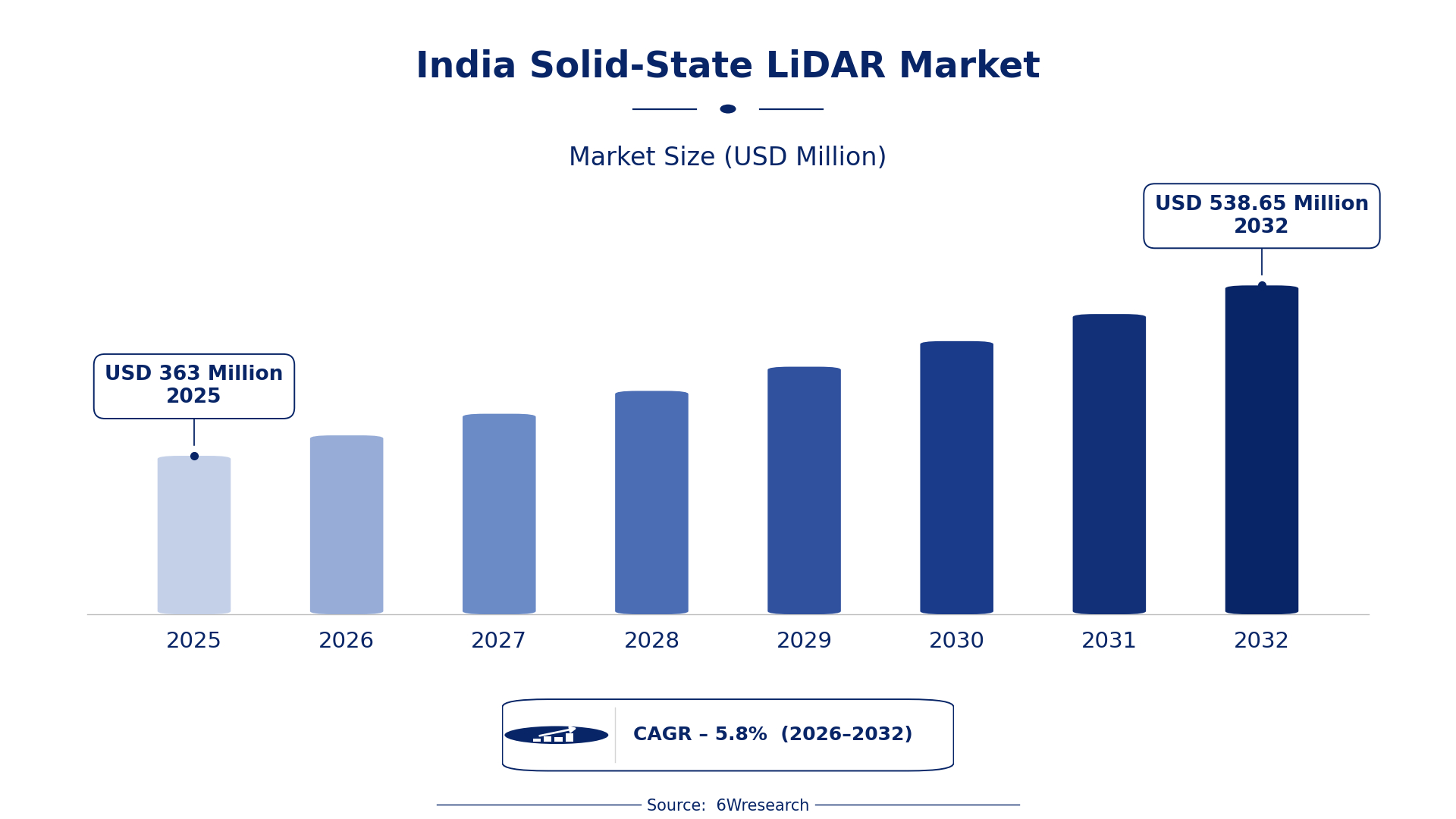
According to 6Wresearch internal database and industry insights, the India Solid-State LiDAR Market was valued at USD 363.0 million in 2025 and is projected to reach USD 538.65 million by 2032, growing at a CAGR of approximately 5.8% during 2026–2032.
India Solid-State LiDAR Market Highlights
| Report Metric | Details |
| Report Name | India Solid-State LiDAR Market |
| Market Size 2025 | USD 363.0 million |
| Market Size 2032 | USD 538.65 million |
| Absolute Growth 2025–2032 | USD 175.65 million |
| CAGR 2026–2032 | 5.8% |
| Peak Annual Growth | 8.0% in 2029 |
| Forecast Period | 2026–2032 |
| Historical Data | 2022–2025 |
| Base Year | 2025 |
| Leading Technology Type, 2025 | MEMS-Based (39% share) |
| Leading Beam Steering Method, 2025 | Mirrorless (45% share) |
| Leading Range Capability, 2025 | Medium-Range (40% share) |
| Leading End User, 2025 | Autonomous Vehicle Makers (44% share) |
| Fastest-Growing Technology Type | Flash LiDAR (7.4% CAGR) |
| Fastest-Growing Beam Steering Method | No Moving Parts (7.6% CAGR) |
| Fastest-Growing Range Capability | Short-Range (7.1% CAGR) |
| Fastest-Growing End User | Robotics Startups (7.6% CAGR) |
| Growing Sector | autonomous vehicles |
| Key End Users | Autonomous Vehicle Makers, Robotics Startups, ADAS Developers |
India Solid-State LiDAR Market Year-wise Growth Rate and Key Drivers (2022–2032)
This graph illustrates the annual growth rates of the market from 2022 to 2032, highlighting a steady upward trajectory and projected market expansion over the forecast period.
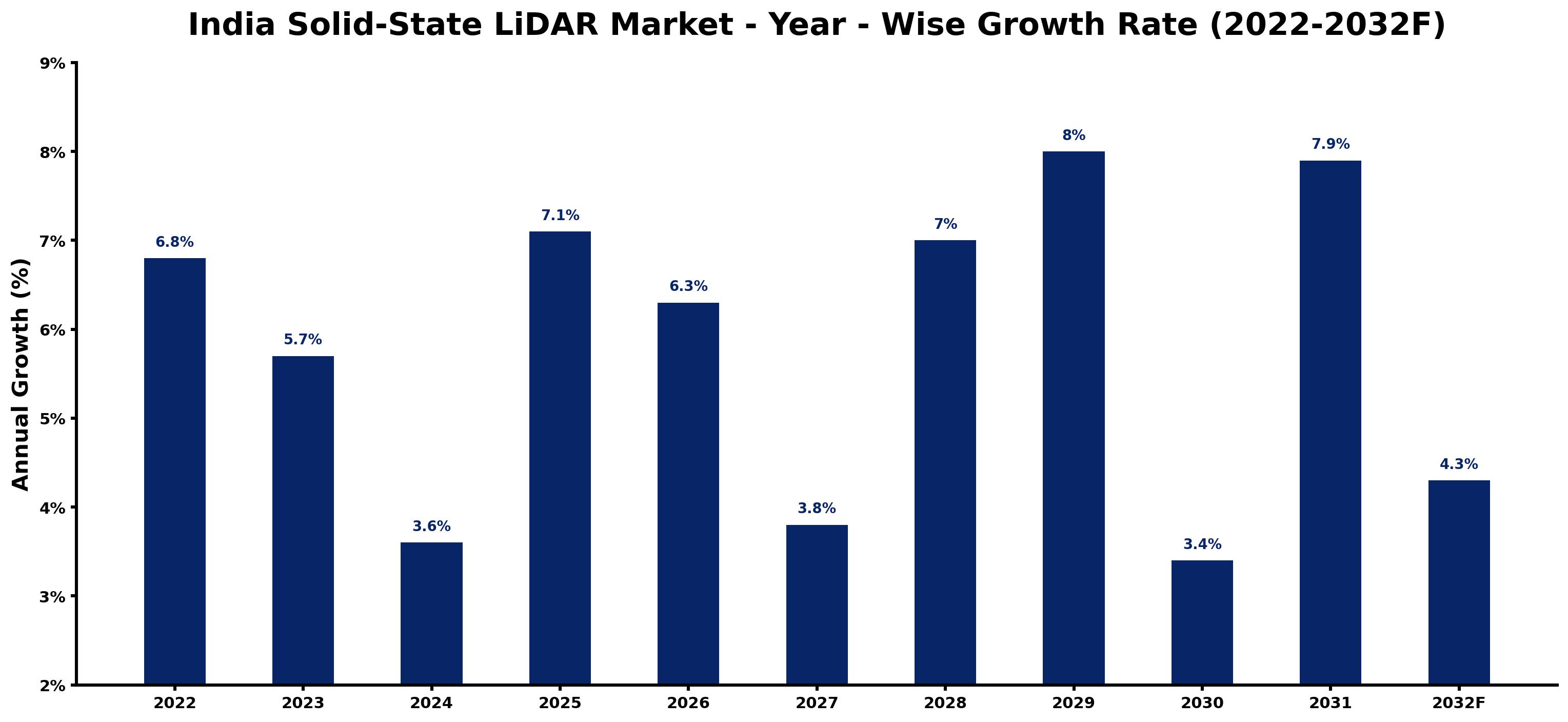
Below, each year's estimated growth is shown next to the factor that most influenced it.
| Year | Estimated Annual Growth (%) | Market Rationale |
| 2022 | 6.8 | The market experienced solid growth due to rising interest in autonomous vehicles. |
| 2023 | 5.7 | Demand growth slowed as manufacturers adjusted to supply chain challenges. |
| 2024 | 3.6 | Market growth continued to slow, reflecting broader economic conditions affecting investment. |
| 2025 | 7.1 | A surge in production targets for vehicles boosted demand for advanced technologies. |
| 2026 | 6.3 | Growth moderated as manufacturers faced increasing competition in the LiDAR space. |
| 2027 | 3.8 | The market saw a slowdown as companies focused on refining existing technologies. |
| 2028 | 7.0 | Demand rebounded with renewed interest in robotics and automation applications. |
| 2029 | 8.0 | A peak in growth was driven by advancements in automotive safety features, supported by the National Automotive Mission Plan. |
| 2030 | 3.4 | Growth slowed again as the market adjusted to new technological standards. |
| 2031 | 7.9 | Increased production in the automotive sector led to a resurgence in demand for safety technologies. |
| 2032 | 4.3 | The market is projected to grow at a slower rate as maturity sets in. |
Note: Market size estimations and growth projections presented in this report are based on 6Wresearch's proprietary forecasting methodology, utilizing the latest available industry data, government publications, and primary research inputs.
India Solid-State LiDAR Market Synopsis
The India Solid-State LiDAR Market features advanced light detection and ranging technology primarily employed in autonomous vehicles and robotics. This technology uses solid-state components to achieve precise distance measurements, enhancing safety and efficiency. The market is expanding due to increasing demand from the automotive sector, which is projected to produce 30 million vehicles by 2026. Government initiatives such as the National Automotive Mission Plan are encouraging innovation and investment in advanced technologies, further propelling market growth. The growing integration of LiDAR in robotics is broadening its applications, creating fresh opportunities for suppliers.
Market Dynamics Impact Analysis (2026–2032)
| Factor | Type | Impact | Primary Segment Affected |
| Rising production targets for vehicles drive demand for advanced safety features. | Driver | High | Autonomous Vehicle Makers |
| Increased integration of LiDAR in robotics enhances navigation capabilities. | Driver | High | Robotics Startups |
| Growing demand for safety technologies creates opportunities for LiDAR suppliers. | Opportunity | High | ADAS Developers |
| The push for local manufacturing presents a chance for investment in production facilities. | Opportunity | High | MEMS-Based |
| Supply chain disruptions can delay the availability of key components. | Restraint | High | Flash LiDAR |
| High initial investment costs can deter smaller companies from entering the market. | Restraint | Medium | MEMS-Based |
| Regulatory hurdles can slow down the approval process for new technologies. | Challenge | High | Optical Phased Array |
| Limited awareness of Solid-State LiDAR benefits can restrict market growth. | Challenge | Medium | High Precision |
Evaluation of Drivers in India Solid-State LiDAR Market (2026–2032)
The table below links each growth driver to the segment it affects and the evidence for it.
| Drivers | Primary Segment Affected | Why It Matters (Evidence) |
| Increased production of vehicles with advanced safety features drives demand for Solid-State LiDAR. | Autonomous Vehicle Makers | The automotive sector in India is projected to reach a production of 30 million vehicles by 2026. |
| Growing integration of LiDAR in robotics improves navigation capabilities. | Robotics Startups | The demand for robotics in India is expected to grow, with LiDAR being a key component. |
| Government initiatives promote innovation in automotive technologies, boosting demand. | ADAS Developers | The National Automotive Mission Plan aims to enhance safety technologies in vehicles. |
| The Make in India initiative encourages local manufacturing of LiDAR systems. | MEMS-Based | This initiative supports domestic production and reduces dependency on imports. |
| Rising investments in research and development accelerate technology adoption. | Flash LiDAR | The Indian Institute of Technology is developing prototypes utilising Solid-State LiDAR. |
Expansion of the Solid-State LiDAR market in India is supported by the rising production of vehicles equipped with advanced safety features, driven by a projected automotive output of 30 million vehicles by 2026. The integration of LiDAR in robotics is enhancing navigation capabilities, as demand for robotics is anticipated to increase. Investments in research and development are further advancing technology adoption, as seen in prototypes developed at leading research institutes.
Evaluation of Restraints in India Solid-State LiDAR Market
The main factors holding the market back are set out below.
| Market Restraint | Primary Segment Affected | Why It Matters (Evidence) |
| Supply chain disruptions can delay the availability of key components. | Flash LiDAR | These disruptions impact the timely production and delivery of LiDAR systems, affecting overall market growth. |
| High initial investment costs can deter smaller companies from entering the market. | MEMS-Based | Smaller firms may struggle to secure funding for advanced technology development, limiting competition. |
| Regulatory hurdles can slow down the approval process for new technologies. | Optical Phased Array | Approval delays can hinder market entry for new products, affecting overall adoption rates. |
| Limited awareness of Solid-State LiDAR benefits can restrict market growth. | High Precision | A lack of understanding among potential users can affect adoption rates, slowing market expansion. |
| Competition from alternative technologies may limit market share. | Medium-Range | Alternative distance measuring technologies pose a threat to Solid-State LiDAR, affecting its market penetration. |
India Solid-State LiDAR Market Challenges
India's Solid-State LiDAR market faces technological limitations, as local producers often lack the advanced manufacturing capabilities necessary for efficient production. This shortfall leads to increased costs, with some manufacturers reporting a 20% rise in expenses due to reliance on imported components. Buyers in the automotive sector encounter longer lead times, delaying the integration of safety technologies in vehicles, which could hinder the projected production of 30 million vehicles by 2026. Regulatory challenges also create obstacles, as the ongoing development of standards by the Bureau of Indian Standards introduces uncertainty for suppliers, complicating market growth.
Trends in the India Solid-State LiDAR Market
Four trends stand out in the India Solid-State LiDAR Market.
- Shift Towards Improved Safety in Autonomous Vehicles: Autonomous Vehicle Makers are increasingly adopting Solid-State LiDAR to enhance safety features, with the automotive sector projected to produce 30 million vehicles by 2026. This shift is driving demand for advanced technologies.
- Growing Integration of LiDAR in Robotics: Robotics Startups are integrating Solid-State LiDAR for improved navigation capabilities, reflecting a broader trend in automation. The demand for robotics is projected to grow, creating new opportunities for suppliers.
- Increased Focus on Local Manufacturing: The Make in India initiative is fostering local production of Solid-State LiDAR systems, with government support encouraging investments in manufacturing. This trend is expected to strengthen domestic supply chains.
- Rise of Advanced Driver-Assistance Systems: ADAS Developers are increasingly incorporating Solid-State LiDAR into their systems, driven by the need for improved vehicle safety. The market for these technologies is expanding as safety regulations become more stringent.
Investment Opportunities in the India Solid-State LiDAR Market
Investors looking at the India Solid-State LiDAR Market should consider the following areas.
- Autonomous Vehicle Makers Seeking Advanced Safety Solutions: With the automotive sector projected to produce 30 million vehicles by 2026, there is a strong opportunity to supply Solid-State LiDAR systems. Collaborating with automotive manufacturers can facilitate market entry.
- Manufacturers Focusing on Local Production: The Make in India initiative presents an opportunity to invest in local manufacturing of Solid-State LiDAR systems, reducing reliance on imports. Establishing partnerships with local firms can enhance market presence.
- Robotics Startups Integrating LiDAR Technology: The growing demand for robotics, with a projected increase in applications, provides a chance to supply Solid-State LiDAR systems. Targeting robotics startups in technology hubs like Maharashtra can yield benefits.
- ADAS Developers Expanding Safety Features: As the market for advanced driver-assistance systems grows, there is a need for reliable Solid-State LiDAR solutions. Engaging with ADAS developers can open new avenues for growth.
Government Initiatives in the India Solid-State LiDAR Market
The National Policy on Electronics 2019 aims to develop a domestic framework for electronics manufacturing, including Solid-State LiDAR components. This policy encourages investments in local production and supports innovation in advanced technologies. Additionally, the FAME India Scheme Phase II promotes electric vehicles and includes funding for advanced technologies like Solid-State LiDAR, which enhances market growth potential. By fostering a conducive environment for manufacturers, these policies help drive demand for Solid-State LiDAR in India.
The Digital India Initiative promotes the use of advanced technologies across various sectors, including automotive and robotics, boosting demand for Solid-State LiDAR. The Ministry of Electronics and Information Technology oversees this initiative, ensuring that funding and support are directed towards innovative technologies. Furthermore, the Atal Innovation Mission supports startups focusing on robotics and automation, providing funding and resources for developing LiDAR applications. This support is vital for advancing the integration of Solid-State LiDAR in various sectors.
Future Insight of the India Solid-State LiDAR Market
By 2032, the India Solid-State LiDAR market will undergo significant changes driven by the National Automotive Mission Plan and the Digital India Programme. These initiatives will stimulate innovation and strengthen local manufacturing, resulting in more competitive pricing for buyers. The expected growth in robotics will be propelled by the Atal Innovation Mission, which supports startups in exploring LiDAR applications. As the automotive sector expands, the focus on safety technologies will foster new partnerships between producers and buyers.
Market Segmentation Analysis
Each segment group is reviewed below, with the leader by share and the fastest grower by CAGR.
By Technology Type – MEMS-Based Dominated, Flash LiDAR Expected to Grow Fastest
According to Summon Dutta, Assistant Manager at 6Wresearch, the largest technology type category in 2025 was MEMS-Based, with a 39% share of total revenue. MEMS-Based technology leads the market share in India due to its widespread application in automotive safety systems, which are essential for the advancement of autonomous vehicles. Its precision in distance measurements makes it a preferred choice among manufacturers in the automotive sector. Flash LiDAR is projected to grow fastest, at a CAGR of 7.4% during 2026–2032. Flash LiDAR is witnessing rapid growth as it is crucial for high-speed imaging in autonomous vehicles, a sector that is gaining significant momentum in India. The projected production of 30 million vehicles by 2026 is fuelling the demand for advanced imaging capabilities. Suppliers should enhance their MEMS-Based offerings while investing in Flash LiDAR technology to cater to the automotive sector's increasing demands.
By Beam Steering Method – Mirrorless Dominated, No Moving Parts Expected to Grow Fastest
Mirrorless took a 45% share of beam steering method in 2025, more than any other category. Mirrorless beam steering technology commands a substantial market share due to its capacity to support compact designs, which are vital for modern LiDAR systems. This technology is favoured by manufacturers aiming to optimise space and efficiency in devices for the automotive and robotics industries. The quickest growth will come from No Moving Parts, forecast to expand at a CAGR of 7.6% between 2026 and 2032. No Moving Parts technology is rapidly gaining popularity because of its reliability and reduced maintenance needs, making it suitable for long-term applications. As the automotive and robotics sectors continue to expand, the benefits of this method will further accelerate its growth. Manufacturers should focus on developing Mirrorless systems while integrating No Moving Parts technology to meet the evolving market requirements.
By Range Capability – Medium-Range Dominated, Short-Range Expected to Grow Fastest
Medium-Range accounted for a 40% market share by range capability in 2025. Medium-Range capability holds a significant market share as it is extensively used in automotive applications, delivering balanced performance across various driving conditions. This range is particularly well-suited to meet the growing demand in the autonomous vehicle sector. Short-Range is set to record the highest CAGR in this split, 7.1% over 2026–2032. Short-Range capability is experiencing the fastest growth due to its increasing applications in robotics and industrial automation, where quick and precise measurements are critical. The rise of robotics startups in India is significantly contributing to the expansion of this segment. Suppliers should enhance their Medium-Range offerings while exploring opportunities in the Short-Range segment to align with the growth of the robotics industry.
By End User – Autonomous Vehicle Makers Dominated, Robotics Startups Expected to Grow Fastest
With a 44% revenue share in 2025, Autonomous Vehicle Makers was the largest end user category. Autonomous Vehicle Makers represent the largest share of the market as they are the primary users of Solid-State LiDAR technology, essential for ensuring safety and navigation in self-driving cars. Their substantial investment in advanced technologies drives the demand for reliable LiDAR systems. Over 2026–2032, Robotics Startups are expected to post the fastest growth, at a CAGR of 7.6%. Robotics Startups are the fastest-growing segment, increasingly integrating LiDAR for navigation and operational efficiency in their products. The support from initiatives like the Atal Innovation Mission is propelling this growth, making it a key area for suppliers. Suppliers should focus on building strong relationships with Autonomous Vehicle Makers while also targeting Robotics Startups to capture emerging opportunities in the market.
Key Attractiveness of the Report
- 10 Years of Market Numbers
- Historical Data Starting from 2022 to 2025
- Base Year 2025
- Forecast Data until 2032
- Key Performance Indicators Impacting the Market
- Major Upcoming Developments and Projects
Key Highlights of the Report:
- India Solid-State LiDAR Market Outlook
- Market Size of India Solid-State LiDAR Market, 2025
- Forecast of India Solid-State LiDAR Market, 2032
- Historical Data and Forecast of India Solid-State LiDAR Revenues & Volume for the Period 2022 - 2032F
- India Solid-State LiDAR Market Trend Evolution
- India Solid-State LiDAR Market Drivers and Challenges
- India Solid-State LiDAR Price Trends
- India Solid-State LiDAR Porter's Five Forces
- India Solid-State LiDAR Industry Life Cycle
- Historical Data and Forecast of India Solid-State LiDAR Market Revenues & Volume By Technology Type for the Period 2022 - 2032F
- Historical Data and Forecast of India Solid-State LiDAR Market Revenues & Volume By MEMS-Based for the Period 2022 - 2032F
- Historical Data and Forecast of India Solid-State LiDAR Market Revenues & Volume By Flash LiDAR for the Period 2022 - 2032F
- Historical Data and Forecast of India Solid-State LiDAR Market Revenues & Volume By Optical Phased Array for the Period 2022 - 2032F
- Historical Data and Forecast of India Solid-State LiDAR Market Revenues & Volume By Frequency-Modulated for the Period 2022 - 2032F
- Historical Data and Forecast of India Solid-State LiDAR Market Revenues & Volume By Beam Steering Method for the Period 2022 - 2032F
- Historical Data and Forecast of India Solid-State LiDAR Market Revenues & Volume By Mirrorless for the Period 2022 - 2032F
- Historical Data and Forecast of India Solid-State LiDAR Market Revenues & Volume By No Moving Parts for the Period 2022 - 2032F
- Historical Data and Forecast of India Solid-State LiDAR Market Revenues & Volume By Electronically Tuned for the Period 2022 - 2032F
- Historical Data and Forecast of India Solid-State LiDAR Market Revenues & Volume By Continuous Wave for the Period 2022 - 2032F
- Historical Data and Forecast of India Solid-State LiDAR Market Revenues & Volume By Range Capability for the Period 2022 - 2032F
- Historical Data and Forecast of India Solid-State LiDAR Market Revenues & Volume By Medium-Range for the Period 2022 - 2032F
- Historical Data and Forecast of India Solid-State LiDAR Market Revenues & Volume By Short-Range for the Period 2022 - 2032F
- Historical Data and Forecast of India Solid-State LiDAR Market Revenues & Volume By Long-Range for the Period 2022 - 2032F
- Historical Data and Forecast of India Solid-State LiDAR Market Revenues & Volume By High Precision for the Period 2022 - 2032F
- Historical Data and Forecast of India Solid-State LiDAR Market Revenues & Volume By End User for the Period 2022 - 2032F
- Historical Data and Forecast of India Solid-State LiDAR Market Revenues & Volume By Autonomous Vehicle Makers for the Period 2022 - 2032F
- Historical Data and Forecast of India Solid-State LiDAR Market Revenues & Volume By Robotics Startups for the Period 2022 - 2032F
- Historical Data and Forecast of India Solid-State LiDAR Market Revenues & Volume By ADAS Developers for the Period 2022 - 2032F
- Historical Data and Forecast of India Solid-State LiDAR Market Revenues & Volume By Aerospace R&D for the Period 2022 - 2032F
- India Solid-State LiDAR Import Export Trade Statistics
- Market Opportunity Assessment By Technology Type
- Market Opportunity Assessment By Beam Steering Method
- Market Opportunity Assessment By Range Capability
- Market Opportunity Assessment By End User
- India Solid-State LiDAR Top Companies Market Share
- India Solid-State LiDAR Competitive Benchmarking By Technical and Operational Parameters
- India Solid-State LiDAR Company Profiles
- India Solid-State LiDAR Key Strategic Recommendations
Market Covered
The report offers an extensive study of the following market segments.
By Technology Type
- MEMS-Based
- Flash LiDAR
- Optical Phased Array
- Frequency-Modulated
By Beam Steering Method
- Mirrorless
- No Moving Parts
- Electronically Tuned
- Continuous Wave
By Range Capability
- Medium-Range
- Short-Range
- Long-Range
- High Precision
By End User
- Autonomous Vehicle Makers
- Robotics Startups
- ADAS Developers
- Aerospace R&D































