China Solid-State LiDAR Market Size & Growth Rate
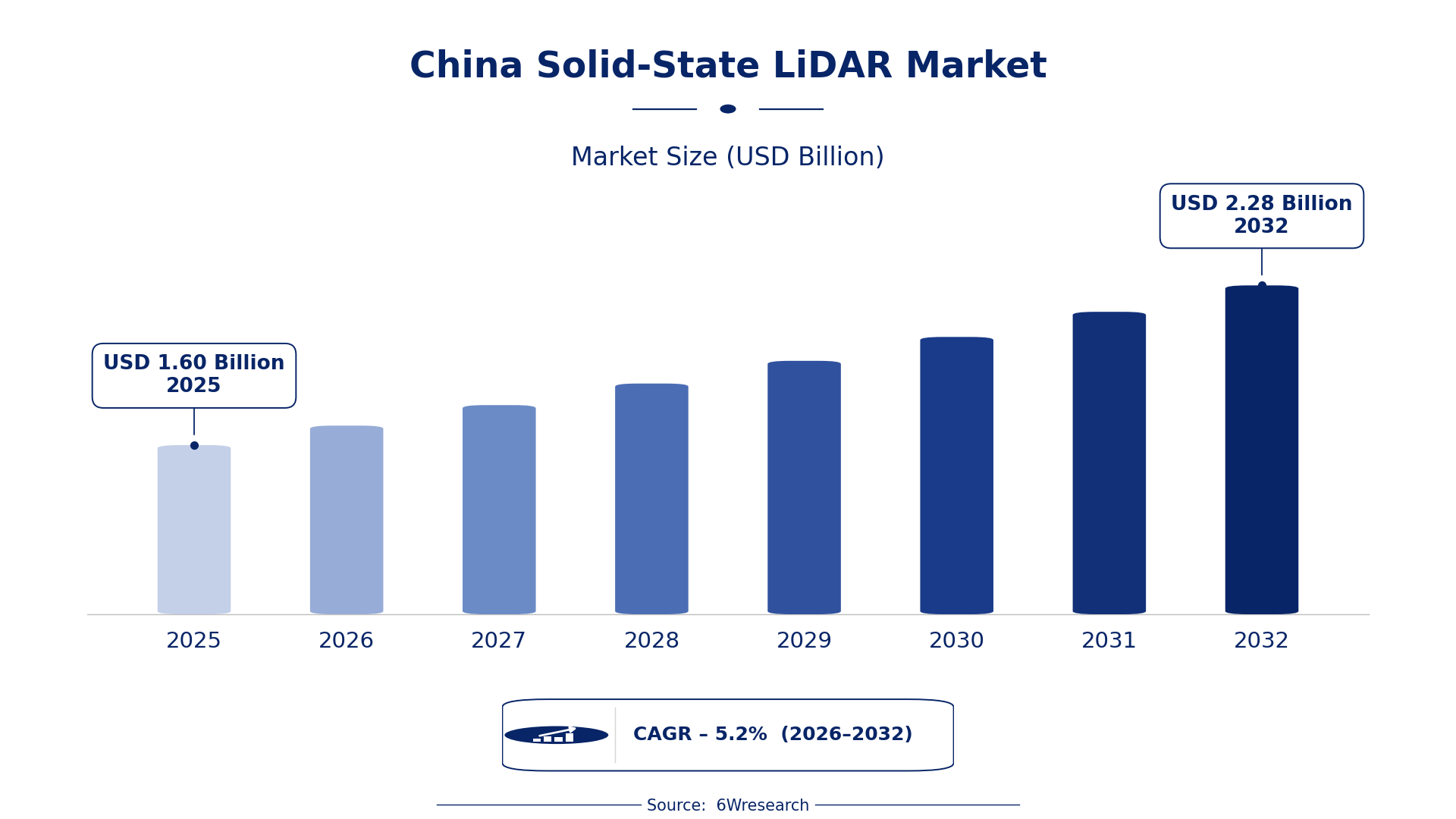
According to 6Wresearch internal database and industry insights, the China Solid-State LiDAR Market was valued at USD 1.60 billion in 2025 and is projected to reach USD 2.28 billion by 2032, growing at a CAGR of approximately 5.2% during 2026–2032.
China Solid-State LiDAR Market Highlights
| Report Metric | Details |
| Report Name | China Solid-State LiDAR Market |
| Market Size 2025 | USD 1.60 billion |
| Market Size 2032 | USD 2.28 billion |
| Absolute Growth 2025–2032 | USD 0.68 billion |
| CAGR 2026–2032 | 5.2% |
| Peak Annual Growth | 7.7% in 2032 |
| Forecast Period | 2026–2032 |
| Historical Data | 2022–2025 |
| Base Year | 2025 |
| Leading Technology Type, 2025 | MEMS-Based (43% share) |
| Leading Beam Steering Method, 2025 | Mirrorless (39% share) |
| Leading Range Capability, 2025 | Long-Range (47% share) |
| Leading End User, 2025 | Autonomous Vehicle Makers (45% share) |
| Fastest-Growing Technology Type | Optical Phased Array (7.5% CAGR) |
| Fastest-Growing Beam Steering Method | Electronically Tuned (7.8% CAGR) |
| Fastest-Growing Range Capability | High Precision (6.6% CAGR) |
| Fastest-Growing End User | Robotics Startups (7.5% CAGR) |
| Growing Sector | autonomous vehicles |
| Key End Users | ADAS Developers, Autonomous Vehicle Makers, Robotics Startups |
China Solid-State LiDAR Market Year-wise Growth Rate and Key Drivers (2022–2032)
This graph illustrates the annual growth rates of the market from 2022 to 2032, highlighting a steady upward trajectory and projected market expansion over the forecast period.
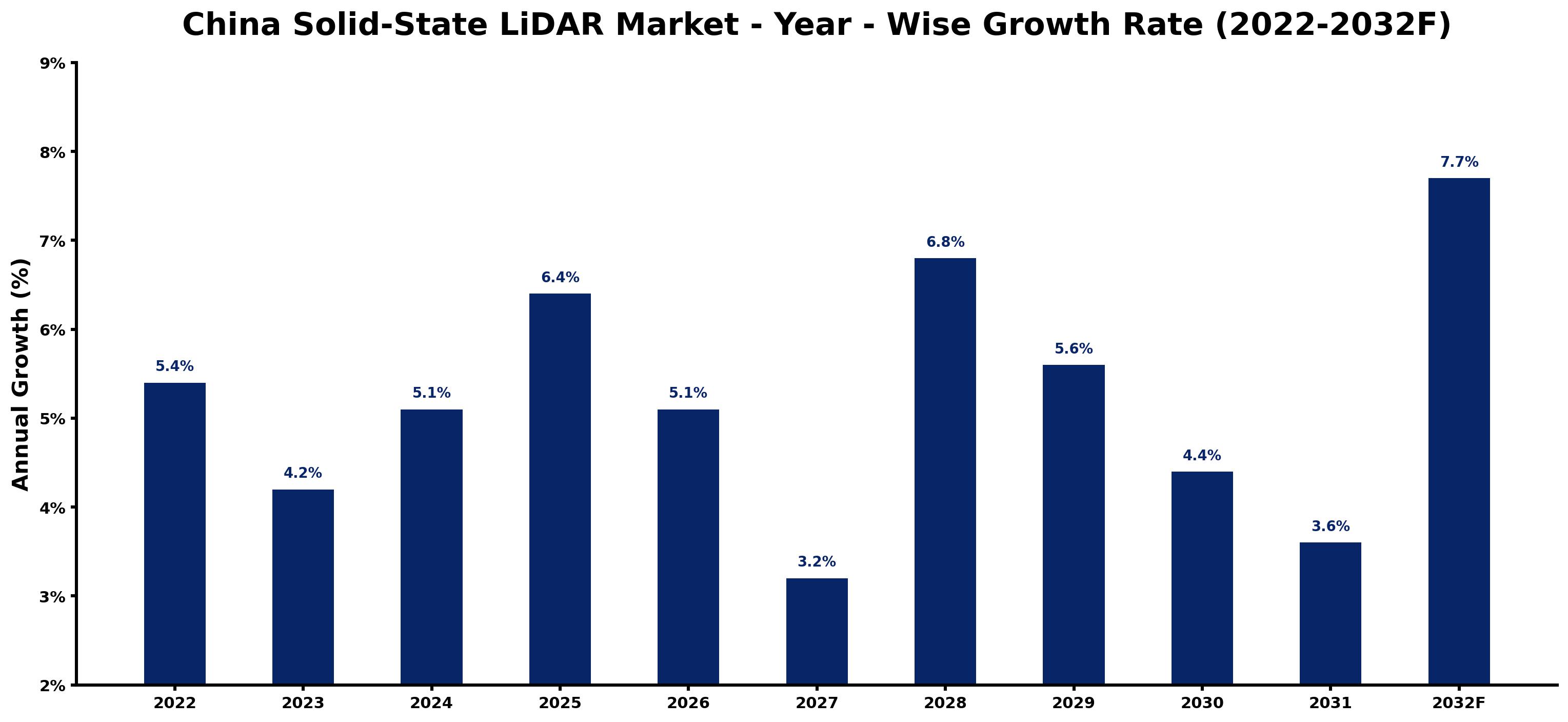
The following table presents the estimated annual growth rate for each year together with the principal factor influencing market performance.
| Year | Estimated Annual Growth (%) | Market Rationale |
| 2022 | 5.4 | The market showed steady growth with increasing adoption of advanced driver-assistance systems. |
| 2023 | 4.2 | Growth slowed due to supply chain challenges affecting production timelines. |
| 2024 | 5.1 | Demand increased as automotive manufacturers ramped up production of smart vehicles. |
| 2025 | 6.4 | Growth accelerated with the introduction of new national standards for automotive LiDAR systems. |
| 2026 | 5.1 | A slowdown occurred as manufacturers faced challenges in scaling production capacity. |
| 2027 | 3.2 | Growth continued to slow as the market adjusted to new technological advancements. |
| 2028 | 6.8 | Demand surged as robotics startups increased their adoption of LiDAR technologies. |
| 2029 | 5.6 | Growth slowed as competition intensified among manufacturers in the sector. |
| 2030 | 4.4 | A further slowdown was noted as market consolidation began to take shape. |
| 2031 | 3.6 | Growth continued to decelerate as the market stabilised amid evolving technology. |
| 2032 | 7.7 | Growth peaked as the government set ambitious targets for smart transportation solutions. |
Note: Market size estimations and growth projections presented in this report are based on 6Wresearch's proprietary forecasting methodology, utilizing the latest available industry data, government publications, and primary research inputs.
China Solid-State LiDAR Market Synopsis
Solid-State LiDAR in China encompasses advanced technologies that measure distances and create 3D maps, primarily used in autonomous vehicles and robotics. The market is thriving, driven by domestic demand and a growing export market. Key applications include automotive safety systems and advanced driver-assistance systems. The increasing focus on smart transportation solutions and the government's push for advanced sensor technologies are key growth factors. By 2025, 50% of new vehicles are expected to be equipped with ADAS, further boosting market expansion.
Market Dynamics Impact Analysis (2026–2032)
| Factor | Type | Impact | Primary Segment Affected |
| Growing demand for autonomous vehicles | Driver | High | Autonomous Vehicle Makers |
| Expansion of robotics applications | Driver | High | Robotics Startups |
| Increased investment in smart transportation | Opportunity | High | ADAS Developers |
| Rising demand for high-precision applications | Opportunity | Medium | High Precision |
| Supply chain disruptions affecting production | Restraint | High | MEMS-Based |
| High production costs for advanced sensors | Restraint | Medium | Flash LiDAR |
| Technological challenges in scaling production | Challenge | High | Optical Phased Array |
| Intense competition among manufacturers | Challenge | Medium | Mirrorless |
Evaluation of Drivers in China Solid-State LiDAR Market (2026–2032)
The factors lifting demand, and the evidence behind each, are summarised below.
| Drivers | Primary Segment Affected | Why It Matters (Evidence) |
| Increased production of autonomous vehicles | Autonomous Vehicle Makers | This growth is supported by the target for 50% of new vehicles to have ADAS by 2025. |
| Rising applications in robotics | Robotics Startups | The demand for LiDAR technologies is increasing as industries seek better automation solutions. |
| Government initiatives promoting smart transportation | ADAS Developers | The 'New Generation Artificial Intelligence Development Plan' aims to advance sensor technologies, boosting demand. |
| Growing need for high-precision measurement | High Precision | The automotive industry increasingly requires high-precision LiDAR for safety and navigation. |
| Technological advancements in semiconductor fabrication | MEMS-Based | These advancements improve the efficiency and compactness of LiDAR systems for automotive applications. |
In 2022, the installed base of LiDAR systems was over 300,000 units, reflecting strong market demand. The automotive industry increasingly requires high-precision LiDAR for safety and navigation, driving further purchases. The push for 50% of new vehicles to feature advanced driver-assistance systems by 2025 will create strong demand for high-quality solutions.
Evaluation of Restraints in China Solid-State LiDAR Market
Below mentioned are some major restraints and their influence on market dynamics.
| Market Restraint | Primary Segment Affected | Why It Matters (Evidence) |
| Supply chain disruptions affecting production timelines | MEMS-Based | In 2022, supply chain issues delayed the rollout of new LiDAR systems, impacting availability. |
| High production costs for advanced sensors | Flash LiDAR | Rising material costs have made it challenging for manufacturers to maintain competitive pricing. |
| Technological challenges in scaling production | Optical Phased Array | Manufacturers face difficulties in achieving economies of scale for new technologies. |
| Regulatory compliance costs for new standards | ADAS Developers | Compliance with the National Standard for Automotive LiDAR increases operational costs for developers. |
| Market entry barriers due to strict regulations | Mirrorless | The increasing number of players in the market faces challenges from stringent compliance requirements. |
China Solid-State LiDAR Market Challenges
The China Solid-State LiDAR market still has to solve a few problems, with high costs being a primary concern for buyers. Advanced LiDAR systems can exceed 100,000 CNY, making it challenging for smaller automotive companies to invest. Many producers struggle with outdated technology, as over 300,000 installed units include older models that fail to meet current performance standards. Regulatory hurdles complicate market entry, with the national standard GB/T 34500-2017 imposing strict compliance requirements that can delay product launches for manufacturers. A shortage of skilled workers in advanced manufacturing limits suppliers' capacity to scale production effectively, impacting delivery timelines for buyers.
Trends in the China Solid-State LiDAR Market
The trends below show where the China Solid-State LiDAR Market is heading.
- Integration of LiDAR in Smart Transportation: The 'National Intelligent Transportation System Plan' updated in 2022 promotes LiDAR integration in traffic management. This shift is expected to improve road safety and efficiency, with an estimated 2 billion CNY budgeted for smart transportation projects.
- Shift Towards High-Precision Applications: The demand for high-precision LiDAR technologies is increasing as industries seek better measurement accuracy. This trend is clear in the automotive sector, where high-precision LiDAR is becoming critical for safety features.
- Emergence of Robotics Startups: Robotics startups in the Guangdong province are increasingly adopting Solid-State LiDAR for automation. This trend is supported by a growing market, with significant investments flowing into the sector.
- Advancements in Semiconductor Technologies: Recent advancements in semiconductor fabrication techniques are improving the performance of Solid-State LiDAR. This change is important for achieving compact designs, particularly in automotive applications.
Investment Opportunities in the China Solid-State LiDAR Market
The following opportunities in the China Solid-State LiDAR Market pair current demand with a clear way in.
- Budget Allocation for Smart Transportation: With a budget of 2 billion CNY for smart transportation projects, there is a significant opportunity to supply advanced LiDAR technologies. ADAS developers can benefit from this funding by partnering with local manufacturers.
- Growing Demand for High-Precision LiDAR: The need for high-precision LiDAR is increasing, particularly in automotive safety applications. Suppliers can target this demand by developing advanced sensor technologies that meet industry standards.
- Partnerships in Robotics Sector: The rise of robotics startups presents an opportunity to supply Solid-State LiDAR solutions. Collaborating with these startups can facilitate market entry and enhance product visibility.
- Expansion in Autonomous Vehicle Market: As the autonomous vehicle market expands, there is a growing need for reliable LiDAR systems. Entering this market through joint ventures with local firms can provide a competitive edge.
Government Initiatives in the China Solid-State LiDAR Market
The '14th Five-Year Plan for the Development of the Automotive Industry' released by the Ministry of Industry and Information Technology in 2021 focuses on smart vehicle technologies, including the integration of Solid-State LiDAR. This plan sets clear objectives for enhancing the automotive sector through advanced sensor technologies. The government aims to increase the adoption of smart vehicles, which will drive demand for LiDAR systems. Furthermore, the 'National Standard for Automotive LiDAR' approved in 2021 establishes performance benchmarks that manufacturers must meet, ensuring quality and reliability in the market.
In 2023, the Chinese government announced a budget of 2 billion CNY for smart transportation projects, including LiDAR applications. The Ministry of Industry and Information Technology oversees this funding, which supports the development and integration of advanced sensor technologies. Additionally, the 'National Intelligent Transportation System Plan' updated in 2022 emphasises the role of LiDAR in traffic management, promoting its adoption across various sectors. These initiatives aim to enhance road safety and efficiency, benefiting both producers and buyers in the market.
Future Insight of the China Solid-State LiDAR Market
The China Solid-State LiDAR market will experience significant shifts by 2032, driven by various forward-looking factors. The government's 2 billion CNY budget for smart transportation projects will accelerate the integration of LiDAR in new vehicles. Advances in semiconductor fabrication techniques will improve performance and lower costs. The push for 50% of new vehicles to feature advanced driver-assistance systems by 2025 will create strong demand for high-quality solutions. Support for AI technologies through initiatives like the 'New Generation Artificial Intelligence Development Plan' will further stimulate innovation in this sector.
Market Segmentation Analysis
The analysis below covers each segmentation, its leading category in 2025 and its fastest-growing category through 2032.
By Technology Type – MEMS-Based Dominated, Optical Phased Array Expected to Grow Fastest
According to Summon Dutta, Assistant Manager at 6Wresearch, MEMS-Based took a 43% share of technology type in 2025, more than any other category. MEMS-Based technology holds the largest share in the China Solid-State LiDAR market due to its extensive application in automotive systems where compactness and efficiency are crucial. The technology's integration into over 300,000 installed units in 2022 highlights its significance in advanced driver-assistance systems. Optical Phased Array is set to record the highest CAGR in this split, 7.5% over 2026–2032. Optical Phased Array is experiencing rapid growth driven by its potential in advanced applications, particularly in autonomous vehicles and robotics. The increasing demand for sophisticated sensing capabilities is expected to propel this technology forward significantly, ensuring that MEMS-Based technology maintains its lead. This trend suggests that suppliers should focus on enhancing their MEMS-Based offerings while also investing in Optical Phased Array technologies to meet future demands.
By Beam Steering Method – Mirrorless Dominated, Electronically Tuned Expected to Grow Fastest
With a 39% revenue share in 2025, Mirrorless was the largest beam steering method category. Mirrorless beam steering technology captures the largest market share as it is crucial for compact designs in vehicles, aligning with the automotive industry's push for smaller, more efficient systems. Its widespread integration into various vehicle models underscores its importance in the market. Electronically Tuned is projected to grow fastest, at a CAGR of 7.8% during 2026–2032. Electronically Tuned beam steering is witnessing the fastest growth due to its application in specialized areas that require high precision, such as advanced robotics. As industries increasingly seek precision in automation, demand for this technology is set to rise sharply, allowing Mirrorless technology to retain its leading position. Suppliers should prioritise the development of Mirrorless solutions while also exploring Electronically Tuned technologies to cater to niche markets.
By Range Capability – Long-Range Dominated, High Precision Expected to Grow Fastest
The largest range capability category in 2025 was Long-Range, with a 47% share of total revenue. Long-Range capability dominates the market share as it is essential for autonomous navigation, enabling vehicles to detect obstacles from greater distances. This capability is particularly vital in urban environments, where safety is paramount for autonomous vehicles. Over 2026–2032, High Precision is expected to post the fastest growth, at a CAGR of 6.6%. High Precision range capability is growing rapidly, driven by its necessity in applications that demand exact measurements, such as robotics and smart transportation. The push for accuracy in these fields is likely to accelerate its adoption, while Long-Range technology will continue to lead the market. This indicates that suppliers must enhance their Long-Range offerings while also investing in High Precision technologies to stay competitive.
By End User – Autonomous Vehicle Makers Dominated, Robotics Startups Expected to Grow Fastest
Autonomous Vehicle Makers accounted for a 45% market share by end user in 2025. Autonomous Vehicle Makers represent the largest share of the market as they are the primary users of Solid-State LiDAR for safety and navigation purposes. Their commitment to integrating advanced sensor technologies into new vehicle models solidifies their leading position in the market. The quickest growth will come from Robotics Startups, forecast to expand at a CAGR of 7.5% between 2026 and 2032. Robotics Startups are the fastest-growing segment, increasingly adopting Solid-State LiDAR for automation and sensing in various applications. The surge in robotics innovation is expected to drive demand significantly in this sector, while Autonomous Vehicle Makers will maintain their dominant share. This means suppliers should focus on meeting the needs of Autonomous Vehicle Makers while also targeting Robotics Startups to capture emerging opportunities.
Key Attractiveness of the Report
- 10 Years of Market Numbers
- Historical Data Starting from 2022 to 2025
- Base Year 2025
- Forecast Data until 2032
- Key Performance Indicators Impacting the Market
- Major Upcoming Developments and Projects
Key Highlights of the Report:
- China Solid-State LiDAR Market Outlook
- Market Size of China Solid-State LiDAR Market, 2025
- Forecast of China Solid-State LiDAR Market, 2032
- Historical Data and Forecast of China Solid-State LiDAR Revenues & Volume for the Period 2022 - 2032F
- China Solid-State LiDAR Market Trend Evolution
- China Solid-State LiDAR Market Drivers and Challenges
- China Solid-State LiDAR Price Trends
- China Solid-State LiDAR Porter's Five Forces
- China Solid-State LiDAR Industry Life Cycle
- Historical Data and Forecast of China Solid-State LiDAR Market Revenues & Volume By Technology Type for the Period 2022 - 2032F
- Historical Data and Forecast of China Solid-State LiDAR Market Revenues & Volume By MEMS-Based for the Period 2022 - 2032F
- Historical Data and Forecast of China Solid-State LiDAR Market Revenues & Volume By Flash LiDAR for the Period 2022 - 2032F
- Historical Data and Forecast of China Solid-State LiDAR Market Revenues & Volume By Optical Phased Array for the Period 2022 - 2032F
- Historical Data and Forecast of China Solid-State LiDAR Market Revenues & Volume By Frequency-Modulated for the Period 2022 - 2032F
- Historical Data and Forecast of China Solid-State LiDAR Market Revenues & Volume By Beam Steering Method for the Period 2022 - 2032F
- Historical Data and Forecast of China Solid-State LiDAR Market Revenues & Volume By Mirrorless for the Period 2022 - 2032F
- Historical Data and Forecast of China Solid-State LiDAR Market Revenues & Volume By No Moving Parts for the Period 2022 - 2032F
- Historical Data and Forecast of China Solid-State LiDAR Market Revenues & Volume By Electronically Tuned for the Period 2022 - 2032F
- Historical Data and Forecast of China Solid-State LiDAR Market Revenues & Volume By Continuous Wave for the Period 2022 - 2032F
- Historical Data and Forecast of China Solid-State LiDAR Market Revenues & Volume By Range Capability for the Period 2022 - 2032F
- Historical Data and Forecast of China Solid-State LiDAR Market Revenues & Volume By Medium-Range for the Period 2022 - 2032F
- Historical Data and Forecast of China Solid-State LiDAR Market Revenues & Volume By Short-Range for the Period 2022 - 2032F
- Historical Data and Forecast of China Solid-State LiDAR Market Revenues & Volume By Long-Range for the Period 2022 - 2032F
- Historical Data and Forecast of China Solid-State LiDAR Market Revenues & Volume By High Precision for the Period 2022 - 2032F
- Historical Data and Forecast of China Solid-State LiDAR Market Revenues & Volume By End User for the Period 2022 - 2032F
- Historical Data and Forecast of China Solid-State LiDAR Market Revenues & Volume By Autonomous Vehicle Makers for the Period 2022 - 2032F
- Historical Data and Forecast of China Solid-State LiDAR Market Revenues & Volume By Robotics Startups for the Period 2022 - 2032F
- Historical Data and Forecast of China Solid-State LiDAR Market Revenues & Volume By ADAS Developers for the Period 2022 - 2032F
- Historical Data and Forecast of China Solid-State LiDAR Market Revenues & Volume By Aerospace R&D for the Period 2022 - 2032F
- China Solid-State LiDAR Import Export Trade Statistics
- Market Opportunity Assessment By Technology Type
- Market Opportunity Assessment By Beam Steering Method
- Market Opportunity Assessment By Range Capability
- Market Opportunity Assessment By End User
- China Solid-State LiDAR Top Companies Market Share
- China Solid-State LiDAR Competitive Benchmarking By Technical and Operational Parameters
- China Solid-State LiDAR Company Profiles
- China Solid-State LiDAR Key Strategic Recommendations
Market Covered
This report examines the market across the segments below.
By Technology Type
- MEMS-Based
- Flash LiDAR
- Optical Phased Array
- Frequency-Modulated
By Beam Steering Method
- Mirrorless
- No Moving Parts
- Electronically Tuned
- Continuous Wave
By Range Capability
- Medium-Range
- Short-Range
- Long-Range
- High Precision
By End User
- Autonomous Vehicle Makers
- Robotics Startups
- ADAS Developers
- Aerospace R&D































