India Vehicle Control Systems Market Size & Growth Rate
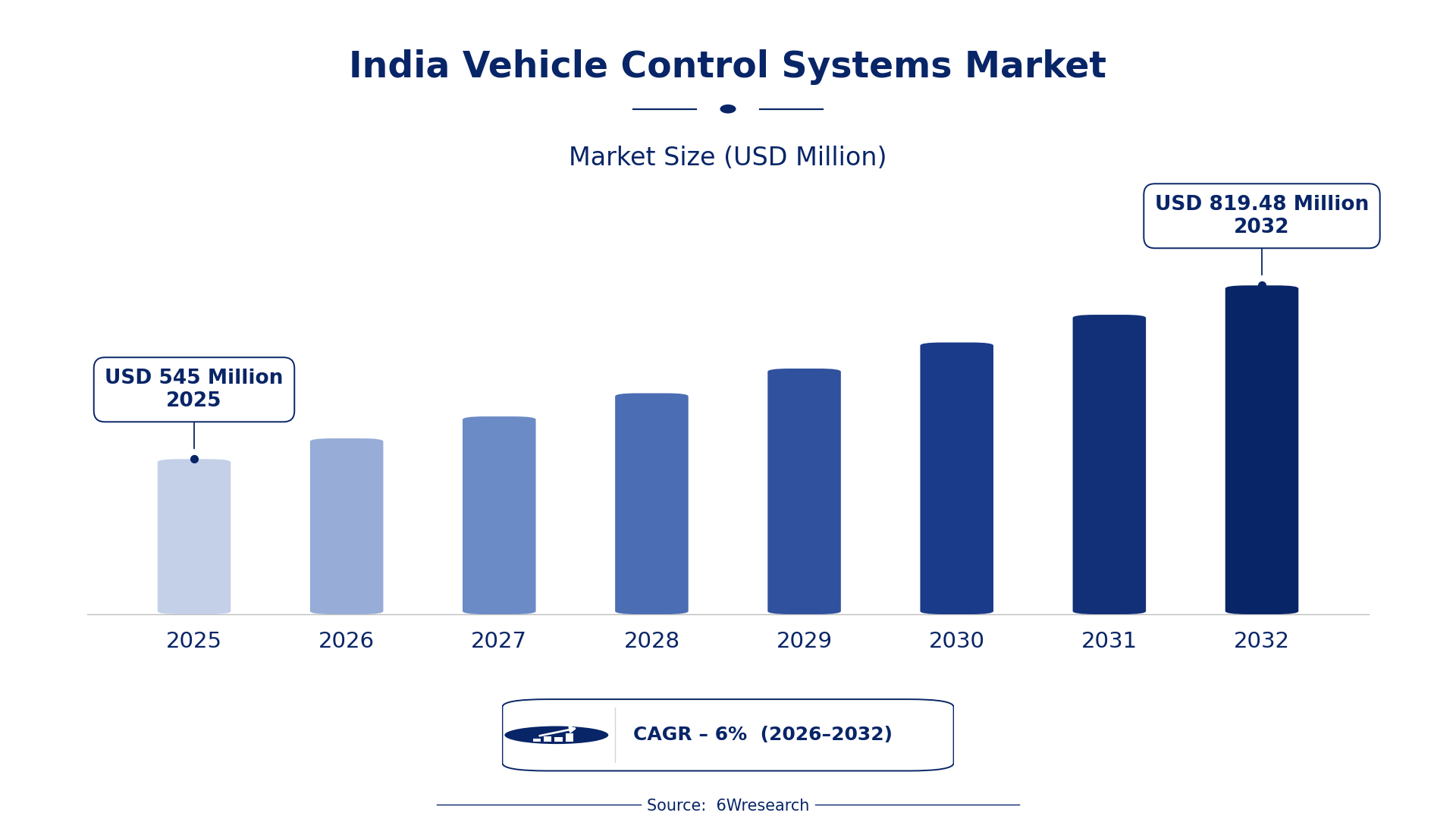
According to 6Wresearch internal database and industry insights, the India Vehicle Control Systems Market was valued at USD 545.0 million in 2025 and is projected to reach USD 819.48 million by 2032, growing at a CAGR of approximately 6% during 2026–2032.
India Vehicle Control Systems Market Highlights
| Report Metric | Details |
| Report Name | India Vehicle Control Systems Market |
| Market Size 2025 | USD 545.0 million |
| Market Size 2032 | USD 819.48 million |
| Absolute Growth 2025–2032 | USD 274.48 million |
| CAGR 2026–2032 | 6% |
| Peak Annual Growth | 8.7% in 2032 |
| Forecast Period | 2026–2032 |
| Historical Data | 2022–2025 |
| Base Year | 2025 |
| Leading System Type, 2025 | Powertrain Control Systems (36% share) |
| Leading Control Domain, 2025 | Engine & Transmission (52% share) |
| Leading Automation Level, 2025 | Level 2–3 (44% share) |
| Leading End User, 2025 | Passenger Car OEMs (37% share) |
| Fastest-Growing System Type | Chassis Control Systems (8.5% CAGR) |
| Fastest-Growing Control Domain | Suspension/Steering (8.0% CAGR) |
| Fastest-Growing End User | EV and SUV OEMs (7.1% CAGR) |
| Growing Sector | EV and SUV OEMs |
| Key End Users | Passenger Car OEMs, EV and SUV OEMs, Hybrid Vehicle OEMs, Smart Vehicle Integrators |
India Vehicle Control Systems Market Year-wise Growth Rate and Key Drivers (2022–2032)
This graph illustrates the annual growth rates of the market from 2022 to 2032, highlighting a steady upward trajectory and projected market expansion over the forecast period.
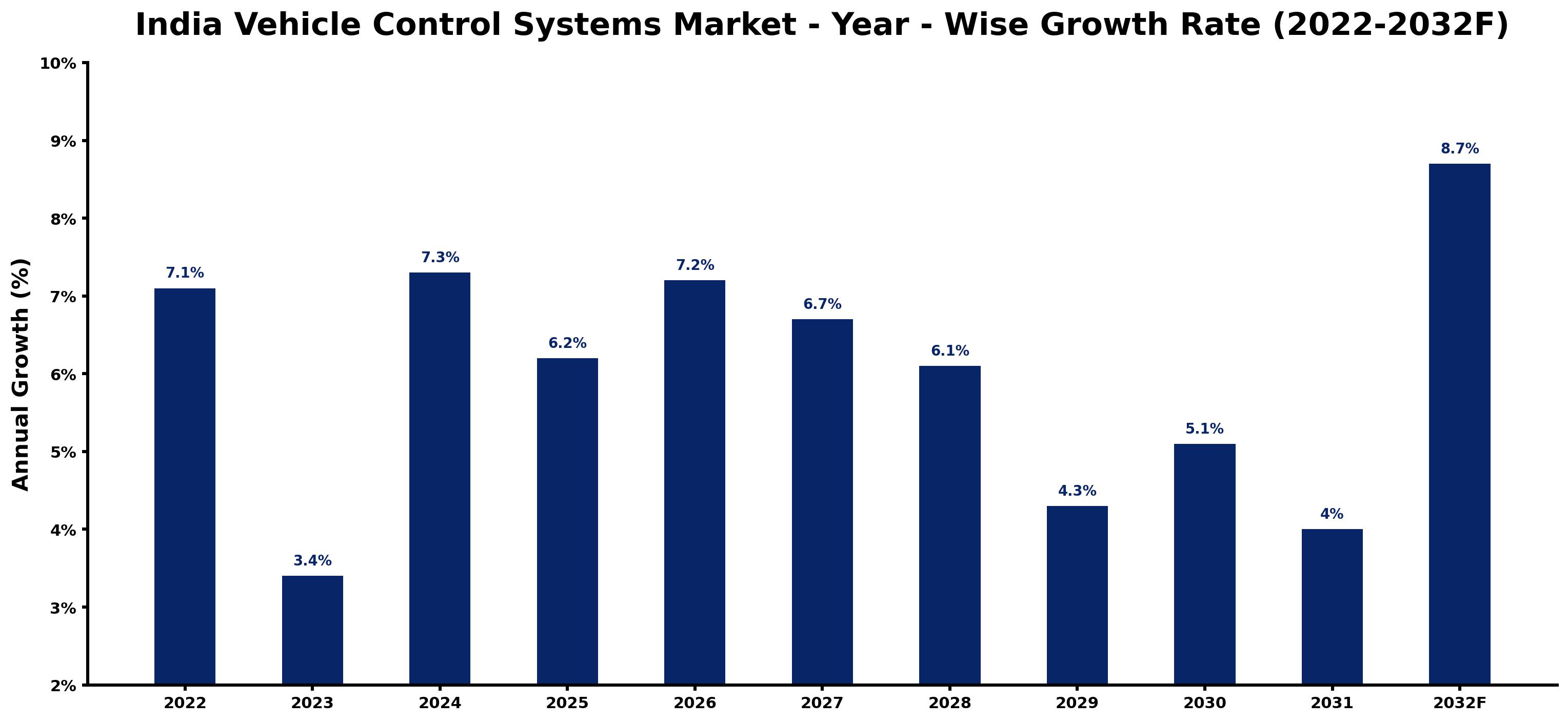
The following table presents the estimated annual growth rate for each year together with the principal factor influencing market performance.
| Year | Estimated Annual Growth (%) | Market Rationale |
| 2022 | 7.1 | The market experienced strong demand, driven by a recovery in vehicle production. |
| 2023 | 3.4 | Growth slowed due to supply chain issues affecting component availability. |
| 2024 | 7.3 | Demand increased as manufacturers ramped up production to meet consumer needs. |
| 2025 | 6.2 | Rising competition among vehicle control system providers impacted growth rates. |
| 2026 | 7.2 | The market is expected to rebound with increased electric vehicle adoption. |
| 2027 | 6.7 | Demand will continue to grow, supported by advancements in vehicle technology. |
| 2028 | 6.1 | Growth is projected to slow as market maturity begins to set in. |
| 2029 | 4.3 | The market will see reduced growth rates due to heightened competition. |
| 2030 | 5.1 | Demand will rise again as new regulations promote electric vehicle integration. |
| 2031 | 4.0 | The market will stabilise as it matures, impacting growth rates. |
| 2032 | 8.7 | The market is expected to peak due to a surge in electric vehicle production. |
Note: Market size estimations and growth projections presented in this report are based on 6Wresearch's proprietary forecasting methodology, utilizing the latest available industry data, government publications, and primary research inputs.
India Vehicle Control Systems Market Synopsis
Vehicle Control Systems in India encompass advanced technologies that manage various vehicle functions, including powertrain and braking systems. These systems are manufactured using electronic components and software algorithms to optimise performance and safety. The India Vehicle Control Systems Market is growing due to strong demand from domestic manufacturers and the expanding electric vehicle market. In 2023, India produced over 4 million passenger vehicles, reflecting robust automotive activity. The FAME India Scheme promotes electric vehicle adoption, driving further investment in vehicle control technologies.
Market Dynamics Impact Analysis (2026–2032)
| Factor | Type | Impact | Primary Segment Affected |
| Rising electric vehicle adoption is driving demand for advanced control systems. | Driver | High | Powertrain Control Systems |
| Increased production of passenger vehicles enhances the need for vehicle control systems. | Driver | High | Chassis Control Systems |
| The growing electric vehicle market presents opportunities for innovative control systems. | Opportunity | High | Brake Control Systems |
| Investment in R&D for vehicle technologies is expanding market potential. | Opportunity | Medium | Engine & Transmission |
| Supply chain disruptions are impacting the availability of essential components. | Restraint | High | Body Control Systems |
| Regulatory compliance costs can hinder smaller manufacturers from entering the market. | Restraint | Medium | Suspension/Steering |
| Competition among manufacturers is intensifying, affecting pricing strategies. | Challenge | High | Regenerative/Conventional |
| Technological integration challenges can delay product development timelines. | Challenge | Medium | Interior Electronics |
Evaluation of Drivers in India Vehicle Control Systems Market (2026–2032)
Below mentioned are some major drivers and their influence on market dynamics.
| Drivers | Primary Segment Affected | Why It Matters (Evidence) |
| Increased production of passenger vehicles drives demand for control systems. | Powertrain Control Systems | In 2023, India produced over 4 million passenger vehicles, increasing the need for efficient powertrain management. |
| Growing electric vehicle adoption necessitates advanced control systems. | Brake Control Systems | India's electric vehicle market is projected to grow at a CAGR of 44% from 2021 to 2026, driving demand for braking technologies. |
| Rising investments in automotive R&D support technology development. | Chassis Control Systems | The National Automotive Testing and R&D Infrastructure Project aims to improve R&D capabilities in the automotive sector, fostering innovation. |
| The expansion of the automotive workforce supports market growth. | Engine & Transmission | The automotive sector employs over 37 million people across India, creating a strong demand for control systems. |
| Government incentives for electric vehicles boost market activity. | Suspension/Steering | The FAME India Scheme promotes electric vehicle adoption with subsidies, increasing the need for advanced steering technologies. |
Market growth for Vehicle Control Systems in India is underpinned by increasing production of passenger vehicles, rising electric vehicle adoption, and substantial investments in automotive research and development. In 2023, India produced over 4 million passenger vehicles, which drives demand for efficient powertrain management systems. The electric vehicle market is projected to grow at a CAGR of 44%, necessitating advanced braking technologies. The automotive sector employs over 37 million people, further supporting demand for control systems.
Evaluation of Restraints in India Vehicle Control Systems Market
The following restraints limit how fast demand can grow.
| Market Restraint | Primary Segment Affected | Why It Matters (Evidence) |
| Supply chain disruptions hinder the availability of essential components. | Body Control Systems | In 2023, global supply chain issues affected the timely delivery of critical vehicle components, impacting production schedules. |
| Regulatory compliance costs can hinder market entry for smaller manufacturers. | Suspension/Steering | Smaller manufacturers often struggle to meet the stringent standards set by the Bureau of Indian Standards, limiting their competitiveness. |
| Intense competition among manufacturers affects pricing strategies. | Regenerative/Conventional | The increasing number of players in the vehicle control systems market has led to price wars, squeezing margins for manufacturers. |
| Technological integration challenges can delay product development timelines. | Interior Electronics | Complexities in integrating new technologies into existing vehicle platforms can lead to increased development times and costs. |
| Market maturity may slow growth rates in the coming years. | Engine & Transmission | As the market reaches saturation, growth rates are expected to stabilise, impacting new investments. |
India Vehicle Control Systems Market Challenges
The India Vehicle Control Systems market faces rising costs as buyers rely on imported electronic components, which can increase production expenses by up to 20%. Regulatory challenges arise as the Bureau of Indian Standards enforces stringent safety and performance guidelines, potentially delaying product launches for manufacturers by an average of six months. Suppliers encounter outdated technology due to inadequate investment in research and development, compelling them to offer systems that do not meet modern consumer expectations. Intense competition emerges as domestic producers vie with international firms, leading to price wars that can diminish profit margins by as much as 15%.
Trends in the India Vehicle Control Systems Market
Several trends are reshaping the India Vehicle Control Systems Market; the most important are set out below.
- Shift towards Electric Vehicle Integration: The FAME India Scheme has expedited the integration of electric vehicle technologies, with the electric vehicle market expected to reach 6-7 million units by 2025. This transition is prompting manufacturers to invest in advanced vehicle control systems.
- Increased Focus on Safety Features: Passenger Car OEMs are prioritising advanced safety features, with a growing emphasis on control systems that enhance vehicle stability. In 2023, over 4 million passenger vehicles were produced, underscoring the demand for safety technologies.
- Adoption of Advanced Driver Assistance Systems: In 2022, the National Electric Mobility Mission Plan was revised to promote advanced driver assistance systems in vehicles. This initiative is driving demand for Level 2–3 automation technologies, improving vehicle safety and performance.
- Growing Investment in R&D for Vehicle Technologies: In 2021, the Automotive Mission Plan 2026 was introduced to enhance R&D capabilities in the automotive sector. This ₹10,000 crores investment is expected to stimulate innovation in vehicle control systems.
Investment Opportunities in the India Vehicle Control Systems Market
Several openings in the India Vehicle Control Systems Market merit attention from investors.
- Timing for Electric Vehicle Adoption: With the electric vehicle market projected to reach 6-7 million units by 2025, there is an opportunity for investment in control systems. EV and SUV OEMs are swiftly adopting these technologies to boost performance.
- Demand from Passenger Car OEMs: Passenger Car OEMs represent a growing buyer group, holding a 37% market share in 2025. Investing in advanced control systems can help satisfy their increasing demand for safety and efficiency.
- Gap in Advanced Control Systems: The market gap for innovative control systems is clear, presenting opportunities for substantial returns. Collaborating with local manufacturers can facilitate entry into this expanding market.
- Entry through Joint Ventures: Forming joint ventures with local automotive firms can provide access to the growing market. This strategy allows for shared resources and expertise, improving competitiveness.
Government Initiatives in the India Vehicle Control Systems Market
In 2021, the FAME II scheme was extended by the Ministry of Heavy Industries, allocating ₹10,000 crores to promote electric vehicles and charging infrastructure. This funding assists manufacturers in developing advanced vehicle control systems to meet the rising demand for electric vehicles. The National Electric Mobility Mission Plan aims for 30% electric vehicle penetration by 2030, encouraging investment in related technologies and boosting the market for control systems.
The Ministry of Heavy Industries oversees the implementation of various automotive policies, including the Automotive Mission Plan 2026. This plan focuses on increasing the automotive sector's contribution to GDP and employment, providing funding for research and development projects. The Automotive Skill Development Council also plays a role in enhancing workforce skills, ensuring a skilled labour force for the automotive industry. These initiatives improve the capabilities of producers and support the growth of vehicle control systems.
Future Insight of the India Vehicle Control Systems Market
Several forward-looking factors are expected to support growth in the India Vehicle Control Systems market in the coming years. The FAME India Scheme will drive electric vehicle adoption, with subsidies projected to significantly boost sales. The National Electric Mobility Mission Plan aims for 6-7 million electric vehicles by 2025, creating strong demand for advanced vehicle control technologies. The National Automotive Testing and R&D Infrastructure Project will enhance research capabilities, enabling suppliers to meet the evolving technological needs of the automotive sector.
Market Segmentation Analysis
The analysis below covers each segmentation, its leading category in 2025 and its fastest-growing category through 2032.
By System Type – Powertrain Control Systems Dominated, Chassis Control Systems Expected to Grow Fastest
According to Bhawna Singh, Assistant Manager at 6Wresearch, Powertrain Control Systems accounted for a 36% market share by system type in 2025. Powertrain Control Systems dominate the market as they are crucial for optimising engine performance and efficiency, vital for India's production of over 4 million passenger vehicles. Their extensive adoption by manufacturers underscores the necessity of advanced powertrain technologies in enhancing vehicle capabilities. Chassis Control Systems are projected to grow fastest, at a CAGR of 8.5% during 2026–2032. Chassis Control Systems are experiencing rapid growth due to manufacturers' increasing emphasis on vehicle dynamics and stability, which are essential for safety and handling. This segment's expansion is further propelled by the industry's focus on improving overall driving comfort and performance. Suppliers should prioritise the development of innovative chassis control technologies to meet the heightened expectations of vehicle manufacturers.
By Control Domain – Engine & Transmission Dominated, Suspension/Steering Expected to Grow Fastest
With a 52% revenue share in 2025, Engine & Transmission was the largest control domain category. Engine & Transmission systems lead the market as they are essential for managing engine output and transmission behaviour, critical for the performance of millions of vehicles produced in India. Their importance is reinforced by the need for optimal vehicle operation, making them indispensable for manufacturers. Over 2026–2032, Suspension/Steering is expected to post the fastest growth, at a CAGR of 8.0%. Suspension/Steering systems are rapidly growing as manufacturers strive to enhance ride comfort and handling, aligning with consumer preferences for superior driving experiences. This increasing focus on comfort and stability is driving the swift expansion of this segment. Buyers should invest in advanced suspension and steering technologies to improve vehicle performance and consumer appeal.
By Automation Level – Level 2–3 Dominated and Is Expected to Record the Fastest Growth
Level 2–3 held a 44% share of the India Vehicle Control Systems Market by automation level in 2025. Level 2–3 systems hold the largest market share as they provide essential advanced driver assistance features, which are becoming standard in modern vehicles. Their role in enhancing safety and convenience makes them a focal point for manufacturers aiming to meet consumer expectations. The same category is also set to grow fastest, at a CAGR of 7.0% during 2026–2032. Level 2–3 systems are also the fastest-growing segment, as their dual role in improving safety and convenience aligns with modern consumer demands. The increasing adoption of these systems by manufacturers will likely further widen their market share. Suppliers must focus on advancing automation technologies to remain competitive in this rapidly evolving market.
By End User – Passenger Car OEMs Dominated, EV and SUV OEMs Expected to Grow Fastest
The largest end user category in 2025 was Passenger Car OEMs, with a 37% share of total revenue. Passenger Car OEMs represent the largest segment, as they heavily rely on control systems to ensure safety and comfort in their vehicles, crucial for meeting consumer demands. The substantial production volume of passenger vehicles in India directly supports this dominant market share. EV and SUV OEMs are set to record the highest CAGR in this split, 7.1% over 2026–2032. EV and SUV OEMs are the fastest-growing segment, rapidly adopting advanced control systems to enhance performance and meet the rising demand for electric vehicles. This shift towards electric and sport utility vehicles is significantly reshaping market dynamics. Suppliers should align their product strategies with the evolving requirements of EV and SUV manufacturers to capitalise on growth opportunities.
Key Attractiveness of the Report
- 10 Years of Market Numbers
- Historical Data Starting from 2022 to 2025
- Base Year 2025
- Forecast Data until 2032
- Key Performance Indicators Impacting the Market
- Major Upcoming Developments and Projects
Key Highlights of the Report:
- India Vehicle Control Systems Market Outlook
- Market Size of India Vehicle Control Systems Market, 2025
- Forecast of India Vehicle Control Systems Market, 2032
- Historical Data and Forecast of India Vehicle Control Systems Revenues & Volume for the Period 2022 - 2032F
- India Vehicle Control Systems Market Trend Evolution
- India Vehicle Control Systems Market Drivers and Challenges
- India Vehicle Control Systems Price Trends
- India Vehicle Control Systems Porter's Five Forces
- India Vehicle Control Systems Industry Life Cycle
- Historical Data and Forecast of India Vehicle Control Systems Market Revenues & Volume By System Type for the Period 2022 - 2032F
- Historical Data and Forecast of India Vehicle Control Systems Market Revenues & Volume By Powertrain Control Systems for the Period 2022 - 2032F
- Historical Data and Forecast of India Vehicle Control Systems Market Revenues & Volume By Chassis Control Systems for the Period 2022 - 2032F
- Historical Data and Forecast of India Vehicle Control Systems Market Revenues & Volume By Brake Control Systems for the Period 2022 - 2032F
- Historical Data and Forecast of India Vehicle Control Systems Market Revenues & Volume By Body Control Systems for the Period 2022 - 2032F
- Historical Data and Forecast of India Vehicle Control Systems Market Revenues & Volume By Control Domain for the Period 2022 - 2032F
- Historical Data and Forecast of India Vehicle Control Systems Market Revenues & Volume By Engine & Transmission for the Period 2022 - 2032F
- Historical Data and Forecast of India Vehicle Control Systems Market Revenues & Volume By Suspension/Steering for the Period 2022 - 2032F
- Historical Data and Forecast of India Vehicle Control Systems Market Revenues & Volume By Regenerative/Conventional for the Period 2022 - 2032F
- Historical Data and Forecast of India Vehicle Control Systems Market Revenues & Volume By Interior Electronics for the Period 2022 - 2032F
- Historical Data and Forecast of India Vehicle Control Systems Market Revenues & Volume By Automation Level for the Period 2022 - 2032F
- Historical Data and Forecast of India Vehicle Control Systems Market Revenues & Volume By Partial Automation for the Period 2022 - 2032F
- Historical Data and Forecast of India Vehicle Control Systems Market Revenues & Volume By Level 2 3 for the Period 2022 - 2032F
- Historical Data and Forecast of India Vehicle Control Systems Market Revenues & Volume By Level 1 2 for the Period 2022 - 2032F
- Historical Data and Forecast of India Vehicle Control Systems Market Revenues & Volume By Fully Automatic for the Period 2022 - 2032F
- Historical Data and Forecast of India Vehicle Control Systems Market Revenues & Volume By End User for the Period 2022 - 2032F
- Historical Data and Forecast of India Vehicle Control Systems Market Revenues & Volume By Hybrid Vehicle OEMs for the Period 2022 - 2032F
- Historical Data and Forecast of India Vehicle Control Systems Market Revenues & Volume By EV and SUV OEMs for the Period 2022 - 2032F
- Historical Data and Forecast of India Vehicle Control Systems Market Revenues & Volume By Passenger Car OEMs for the Period 2022 - 2032F
- Historical Data and Forecast of India Vehicle Control Systems Market Revenues & Volume By Smart Vehicle Integrators for the Period 2022 - 2032F
- India Vehicle Control Systems Import Export Trade Statistics
- Market Opportunity Assessment By System Type
- Market Opportunity Assessment By Control Domain
- Market Opportunity Assessment By Automation Level
- Market Opportunity Assessment By End User
- India Vehicle Control Systems Top Companies Market Share
- India Vehicle Control Systems Competitive Benchmarking By Technical and Operational Parameters
- India Vehicle Control Systems Company Profiles
- India Vehicle Control Systems Key Strategic Recommendations
Market Covered
The report offers an extensive study of the following market segments.
By System Type
- Powertrain Control Systems
- Chassis Control Systems
- Brake Control Systems
- Body Control Systems
By Control Domain
- Engine & Transmission
- Suspension/Steering
- Regenerative/Conventional
- Interior Electronics
By Automation Level
- Partial Automation
- Level 2–3
- Level 1–2
- Fully Automatic
By End User
- Hybrid Vehicle OEMs
- EV and SUV OEMs
- Passenger Car OEMs
- Smart Vehicle Integrators































