Iraq Anti Reflective Glass Market Size, Share & Growth Rate
The Iraq Anti Reflective Glass Market was estimated at USD 283 Million in 2025 and is projected to reach USD 388 Million by 2032, growing at a CAGR of 4.6% from 2026 to 2032. This growth is primarily fueled by the increasing demand for anti reflective glass across key sectors, particularly construction and automotive. The shift towards modern architectural designs that prioritize both aesthetics and energy efficiency is further propelling the need for these specialized glass solutions.
Iraq Anti Reflective Glass Market Year-wise Growth Rate and Key Drivers
This graph highlights how the Iraq Anti Reflective Glass Market has steadily grown over the years, supported by major growth factors.
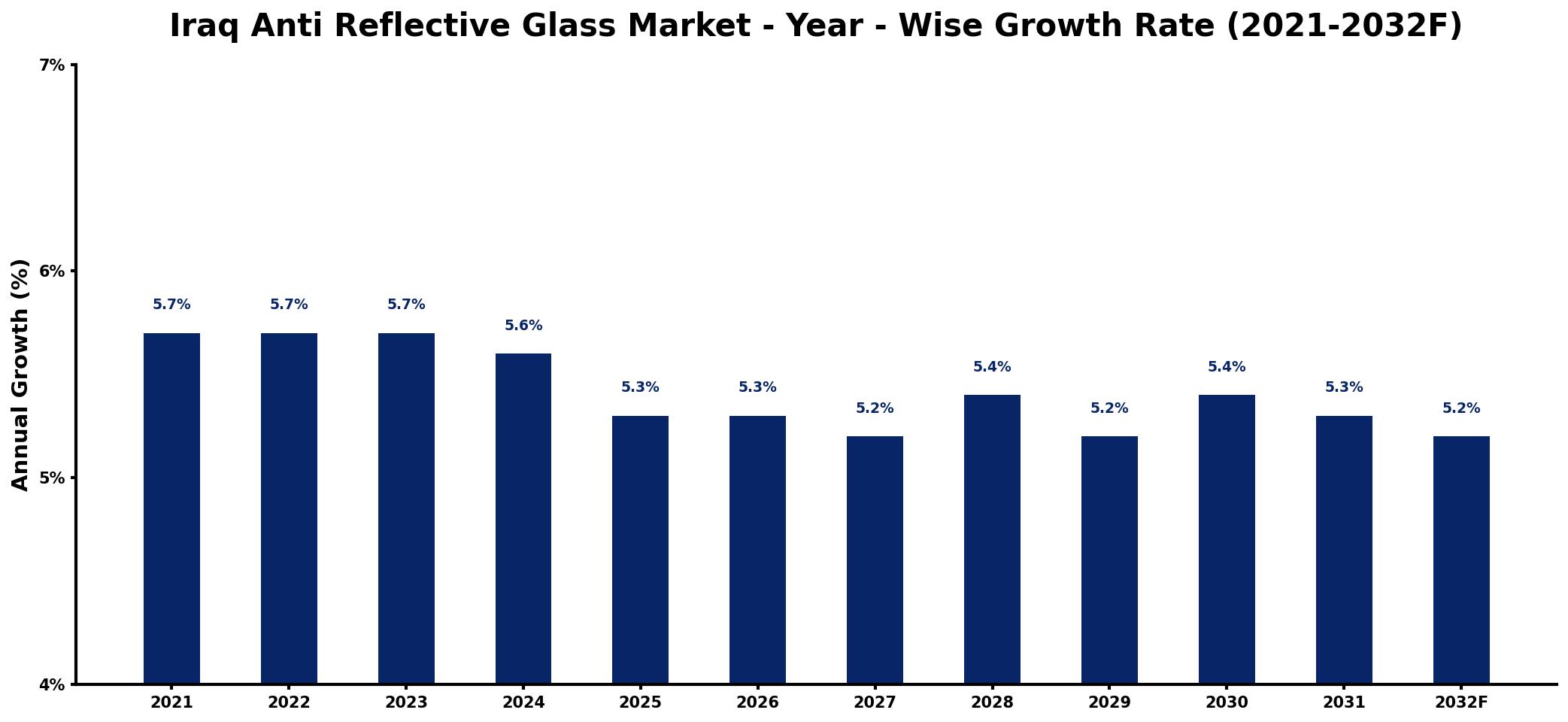
The table below presents the year‑wise growth rates along with the key drivers influencing the market
| Year | Growth Rate | Major Drivers |
| 2021 | 5.7% | Rising construction sector investments |
| 2022 | 5.7% | Increasing demand for energy efficiency |
| 2023 | 5.7% | Growing automotive industry requirements |
| 2024 | 5.6% | Expansion of renewable energy projects |
| 2025 | 5.3% | Surge in architectural design trends |
| 2026 | 5.3% | Technological advancements in coatings |
| 2027 | 5.2% | Heightened focus on safety standards |
| 2028 | 5.4% | Emergence of smart building technologies |
| 2029 | 5.2% | Boost in commercial real estate |
| 2030 | 5.4% | Increased consumer awareness sustainability |
| 2031 | 5.3% | Development of urban infrastructure projects |
| 2032 | 5.2% | Rising preferences for premium materials |
Note: Market size estimations and growth projections presented in this report are based on 6Wresearch's proprietary forecasting methodology, utilizing the latest available industry data, government publications, and primary research inputs.
Iraq Anti Reflective Glass Market Synopsis
In recent years, the Iraq Anti Reflective Glass Market has gained momentum as sectors like construction and automotive ramp up their use of high-quality glass products. This trend is anticipated to continue, with a noticeable shift toward sustainable and energy-efficient solutions becoming a priority for many businesses.
As urbanization accelerates and infrastructure projects multiply, the demand for anti reflective glass is expected to surge. This is particularly evident in residential and commercial buildings, where the need for enhanced visibility and reduced glare is becoming increasingly recognized as crucial for both safety and design.
Iraq Anti Reflective Glass Market Key Takeaways
- The market is driven by growing demand in construction, automotive, and electronics sectors.
- Technological advancements are leading to innovative glass coatings that improve product functionality.
- Increased awareness of energy efficiency and aesthetic appeal fuels adoption in residential projects.
- Government initiatives support local manufacturing, aiming to reduce import dependency.
- The focus on sustainability in building practices positions the market for long-term growth.
Evaluation of Restraints in Iraq Anti Reflective Glass Market
Despite its growth potential, the Iraq Anti Reflective Glass Market faces several challenges. Limited consumer awareness of the advantages of anti reflective glass hinders market penetration, as does the high initial cost associated with these specialized products. Additionally, the absence of standardized regulations for quality and installation poses a risk, potentially affecting consumer confidence. Political instability and security concerns further complicate market dynamics, making businesses hesitant to invest in new technologies and innovations.
Iraq Anti Reflective Glass Market Trends
A significant trend shaping the Iraq Anti Reflective Glass Market is the increasing emphasis on green building practices. As both private and public sectors become more committed to sustainability, the demand for anti reflective glass is expected to grow. Innovations in coating technologies are also emerging, enhancing the performance characteristics of glass and making it more appealing to builders and architects. Furthermore, the integration of energy-efficient solutions is driving manufacturers to develop products that not only reduce glare but also contribute to overall energy conservation in buildings.
Iraq Anti Reflective Glass Market Opportunities
The prospects for investment in the Iraq Anti Reflective Glass Market are promising. With the ongoing expansion of infrastructure development and a clear consumer preference for energy-efficient products, there are ample opportunities for businesses to position themselves strategically in this evolving landscape. Collaborating with local distributors, investing in research and development, and leveraging emerging technologies will be key to capturing market share as demand for high-quality glass products continues to rise.
Government Initiatives in the Iraq Anti Reflective Glass Market
The Iraqi government is actively promoting domestic production of anti reflective glass as part of a broader strategy to enhance local manufacturing capabilities. Measures such as tariffs and import restrictions are designed to encourage local industry development. Additionally, the government supports research and development initiatives within the glass sector to boost innovation and product quality, while streamlining regulations to facilitate smoother business operations. These initiatives aim to create a competitive environment for domestic manufacturers while aligning with international standards.
Future Insights of the Iraq Anti Reflective Glass Market
Looking ahead to 2026-2032, the Iraq Anti Reflective Glass Market is positioned for steady growth. The growing trend towards sustainable construction practices and the increasing adoption of energy-efficient building materials will likely drive demand. The anticipated developments in glass technologies and coatings will further augment the market's growth trajectory. As urbanization continues to transform the landscape of Iraqi cities, anti reflective glass will play a pivotal role in enhancing the safety, aesthetic appeal, and energy efficiency of both commercial and residential projects.
Iraq Anti Reflective Glass Market Latest Developments (2025 - 2026)
In the past year, the Iraq Anti Reflective Glass Market has seen a surge in activity, particularly in infrastructure projects that incorporate modern architectural elements. Industry stakeholders are increasingly focusing on collaborations aimed at enhancing product quality and addressing the technical challenges associated with glass installation. Additionally, advancements in anti reflective technologies are being introduced, aimed at improving durability and performance while aligning with sustainable practices.
Iraq Anti Reflective Glass Market - Key Attractiveness of the Report
- 10 Years of Market Numbers
- Historical Data Starting from 2022 to 2025
- Base Year: 2025
- Forecast Data until 2032
- Key Performance Indicators Impacting the Market
- Major Upcoming Developments and Projects
Key Highlights of the Report:
- Iraq Anti Reflective Glass Market Outlook
- Market Size of Iraq Anti Reflective Glass Market, 2025
- Forecast of Iraq Anti Reflective Glass Market, 2032
- Historical Data and Forecast of Iraq Anti Reflective Glass Revenues & Volume for the Period 2022-2032F
- Iraq Anti Reflective Glass Market Trend Evolution
- Iraq Anti Reflective Glass Market Drivers and Challenges
- Iraq Anti Reflective Glass Price Trends
- Iraq Anti Reflective Glass Porter's Five Forces
- Iraq Anti Reflective Glass Industry Life Cycle
- Historical Data and Forecast of Iraq Anti Reflective Glass Market Revenues & Volume By Type for the Period 2022-2032F
- Historical Data and Forecast of Iraq Anti Reflective Glass Market Revenues & Volume By Double Layers for the Period 2022-2032F
- Historical Data and Forecast of Iraq Anti Reflective Glass Market Revenues & Volume By Four Layers for the Period 2022-2032F
- Historical Data and Forecast of Iraq Anti Reflective Glass Market Revenues & Volume By Others for the Period 2022-2032F
- Historical Data and Forecast of Iraq Anti Reflective Glass Market Revenues & Volume By Application for the Period 2022-2032F
- Historical Data and Forecast of Iraq Anti Reflective Glass Market Revenues & Volume By Architectural Windows for the Period 2022-2032F
- Historical Data and Forecast of Iraq Anti Reflective Glass Market Revenues & Volume By Instrumentation Windows for the Period 2022-2032F
- Historical Data and Forecast of Iraq Anti Reflective Glass Market Revenues & Volume By Electronic Displays for the Period 2022-2032F
- Historical Data and Forecast of Iraq Anti Reflective Glass Market Revenues & Volume By Picture Framing Glass for the Period 2022-2032F
- Historical Data and Forecast of Iraq Anti Reflective Glass Market Revenues & Volume By Showcase Glass for the Period 2022-2032F
- Historical Data and Forecast of Iraq Anti Reflective Glass Market Revenues & Volume By Cold Storage Displays for the Period 2022-2032F
- Historical Data and Forecast of Iraq Anti Reflective Glass Market Revenues & Volume By Lamps Glass for the Period 2022-2032F
- Historical Data and Forecast of Iraq Anti Reflective Glass Market Revenues & Volume By Others for the Period 2022-2032F
- Iraq Anti Reflective Glass Import Export Trade Statistics
- Market Opportunity Assessment By Type
- Market Opportunity Assessment By Application
- Iraq Anti Reflective Glass Top Companies Market Share
- Iraq Anti Reflective Glass Competitive Benchmarking By Technical and Operational Parameters
- Iraq Anti Reflective Glass Company Profiles
- Iraq Anti Reflective Glass Key Strategic Recommendations






































