Italy Apiculture Market Size, Share & Growth Rate
The Italy Apiculture Market was estimated at USD 249 Million in 2025 and is projected to reach USD 274 Million by 2032, growing at a CAGR of 1.4% from 2026 to 2032. This growth is largely driven by the increasing consumer preference for organic and natural products, which continues to elevate the demand for high-quality Italian honey and bee-derived goods. Furthermore, government initiatives to bolster sustainable beekeeping practices are set to enhance market dynamics over the coming years.
Italy Apiculture Market Year-wise Growth Rate and Key Drivers
This graph highlights how the Italy Apiculture Market has steadily grown over the years, supported by major growth factors.
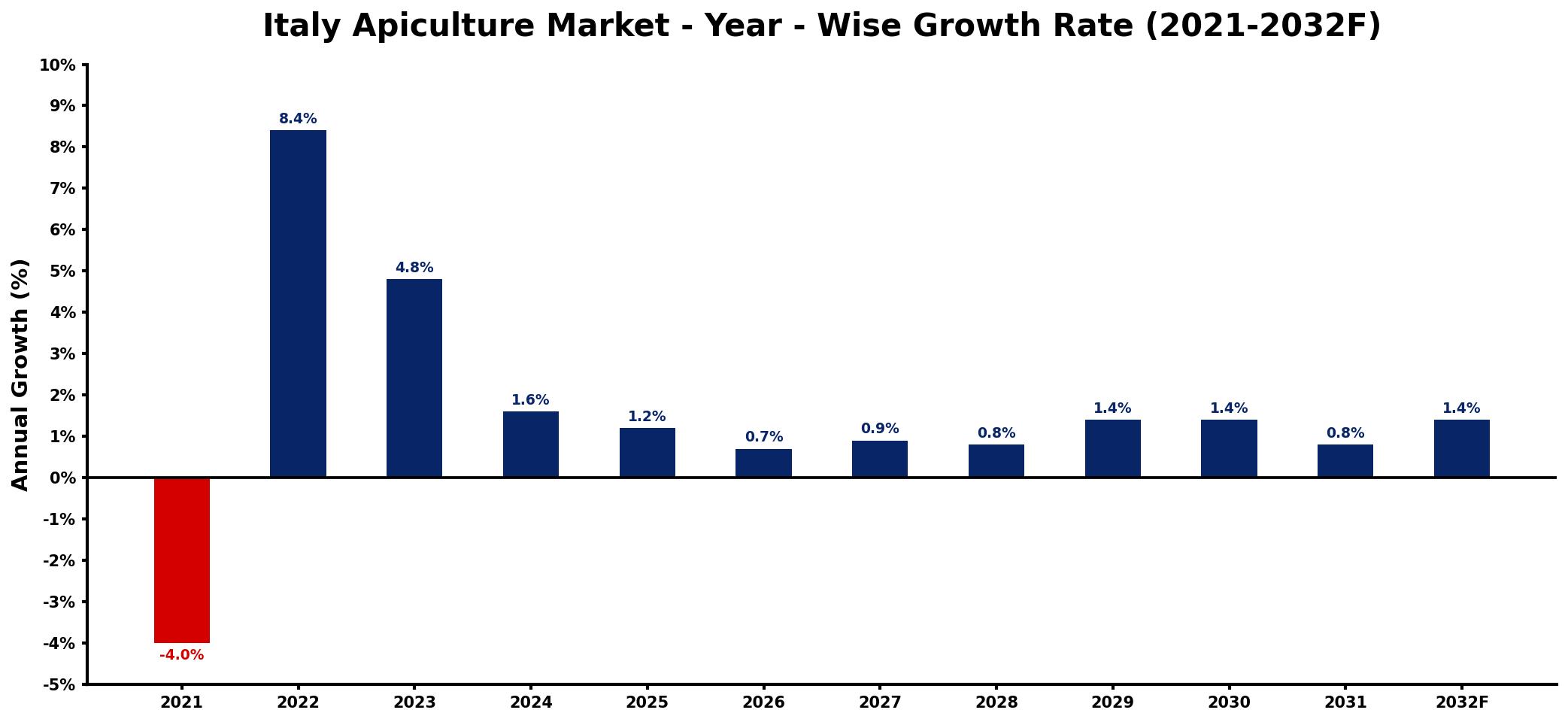
The table below presents the year‑wise growth rates along with the key drivers influencing the market
| Year | Growth Rate | Major Drivers |
| 2021 | -4.0% | decreased consumer interest in honey |
| 2022 | 8.4% | rising health awareness among consumers |
| 2023 | 4.8% | increased organic product demand |
| 2024 | 1.6% | growing popularity of local sourcing |
| 2025 | 1.2% | expansion of urban farming initiatives |
| 2026 | 0.7% | increased investment in sustainable practices |
| 2027 | 0.9% | rising export opportunities for products |
| 2028 | 0.8% | enhanced digital marketing strategies |
| 2029 | 1.4% | growing consumer preference for natural |
| 2030 | 1.4% | increased collaboration among producers |
| 2031 | 0.8% | increased production capacity utilization |
| 2032 | 1.4% | growing interest in biodiversity initiatives |
Note: Market size estimations and growth projections presented in this report are based on 6Wresearch's proprietary forecasting methodology, utilizing the latest available industry data, government publications, and primary research inputs.
Italy Apiculture Market Synopsis
The apiculture sector in Italy is a mosaic of small and large-scale operations, reflecting a rich cultural heritage of beekeeping. Renowned for producing an impressive variety of honey, including acacia and chestnut, Italian beekeepers blend tradition with innovation, continually adapting to market demands.
Sustainability is becoming a cornerstone of the Italy Apiculture Market. The increasing consumer awareness regarding health and the environment is propelling the shift towards natural and organic products, driving beekeepers to adopt practices that safeguard bee populations while maintaining high standards of production.
Italy Apiculture Market Key Takeaways
- The market is experiencing growth fueled by rising demand for organic and sustainably sourced honey.
- Technological innovations in hive management are enhancing productivity and efficiency for beekeepers.
- Government support initiatives aim to protect bee populations and promote beekeeping practices.
- Regional climatic variations play a crucial role in the diversity of honey types produced across Italy.
- Investment opportunities exist in organic honey production and advanced beekeeping equipment.
Evaluation of Restraints in Italy Apiculture Market
Despite the promising landscape, the Italy Apiculture Market faces several significant challenges. Climate change continues to impact honey production, introducing unpredictability in weather patterns and floral availability. This, combined with the adverse effects of pesticide use in agriculture, threatens the health of bee populations and hinders pollination efficiency. Additionally, local producers contend with competition from lower-cost imported honey, which complicates pricing strategies while maintaining quality. Moreover, the aging demographic of beekeepers poses a concern regarding succession and the future of the industry, necessitating efforts to engage and attract younger generations.
Italy Apiculture Market Trends
Several trends are currently shaping the Italy Apiculture Market. A notable movement is the increasing consumer appetite for organic and sustainably sourced honey, reinforcing the markets shift toward environmentally responsible production methods. Additionally, advancements in beekeeping technology, such as monitoring systems that analyze hive conditions, are becoming commonplace, allowing for better management practices. Awareness around bee health is also rising, leading to initiatives focused on biodiversity and habitat conservation, further enhancing the industry's commitment to sustainability.
Italy Apiculture Market Opportunities
The landscape of the Italy Apiculture Market is ripe with investment opportunities. With the growing demand for organic honey, there is a clear pathway for producers to invest in organic beekeeping practices. Additionally, innovative research into new beekeeping technologies and practices can create competitive advantages for businesses. Collaborations with local beekeepers or forming alliances with distributors can expand market reach and facilitate entry into new segments, thus driving profitability in a competitive environment.
Government Initiatives in the Italy Apiculture Market
The Italian government plays an active role in promoting the sustainability of the apiculture market through various policies and initiatives. The Ministry of Agriculture, Food, and Forestry Policies (MiPAAF) implements regulations focused on quality assurance and traceability in honey production. Support programs offer subsidies to beekeepers for disease control and hive management, while strict regulations aim to limit harmful pesticide use. Collaborative efforts between government bodies, industry associations, and research institutions are fostering advancements in bee health and the preservation of biodiversity within agricultural landscapes.
Future Insights of the Italy Apiculture Market
Looking ahead, the Italy Apiculture Market is poised for steady growth through 2026-2032. This growth is underpinned by an enduring consumer inclination for high-quality, natural honey products, supplemented by ongoing government support for sustainable beekeeping practices. As awareness about the health benefits associated with honey consumption rises, market demand is expected to expand. Furthermore, the integration of advanced technologies within beekeeping operations will likely enhance productivity, ensuring the sector remains competitive and relevant in an evolving marketplace.
Italy Apiculture Market Latest Developments (2025 - 2026)
Recent developments within the Italy Apiculture Market indicate a significant push toward sustainability. Many beekeepers are adopting eco-friendly practices to improve hive health and product quality. Additionally, various research initiatives have emerged, aiming to study the impact of climate change on pollinator health and productivity. There are also growing collaborations between local producers and technology providers to enhance beekeeping practices, ensuring the industry is well-equipped to face future challenges.
Italy Apiculture Market - Key Attractiveness of the Report
- 10 Years of Market Numbers
- Historical Data Starting from 2022 to 2025
- Base Year: 2025
- Forecast Data until 2032
- Key Performance Indicators Impacting the Market
- Major Upcoming Developments and Projects
Key Highlights of the Report:
- Italy Apiculture Market Outlook
- Market Size of Italy Apiculture Market, 2025
- Forecast of Italy Apiculture Market, 2032
- Historical Data and Forecast of Italy Apiculture Revenues & Volume for the Period 2022-2032F
- Italy Apiculture Market Trend Evolution
- Italy Apiculture Market Drivers and Challenges
- Italy Apiculture Price Trends
- Italy Apiculture Porter's Five Forces
- Italy Apiculture Industry Life Cycle
- Historical Data and Forecast of Italy Apiculture Market Revenues & Volume By Product Type for the Period 2022-2032F
- Historical Data and Forecast of Italy Apiculture Market Revenues & Volume By Honey for the Period 2022-2032F
- Historical Data and Forecast of Italy Apiculture Market Revenues & Volume By Beeswax for the Period 2022-2032F
- Historical Data and Forecast of Italy Apiculture Market Revenues & Volume By Live-bees for the Period 2022-2032F
- Historical Data and Forecast of Italy Apiculture Market Revenues & Volume By Others for the Period 2022-2032F
- Historical Data and Forecast of Italy Apiculture Market Revenues & Volume By Application for the Period 2022-2032F
- Historical Data and Forecast of Italy Apiculture Market Revenues & Volume By Medical for the Period 2022-2032F
- Historical Data and Forecast of Italy Apiculture Market Revenues & Volume By Food Beverages for the Period 2022-2032F
- Historical Data and Forecast of Italy Apiculture Market Revenues & Volume By Cosmetics for the Period 2022-2032F
- Historical Data and Forecast of Italy Apiculture Market Revenues & Volume By Others for the Period 2022-2032F
- Italy Apiculture Import Export Trade Statistics
- Market Opportunity Assessment By Product Type
- Market Opportunity Assessment By Application
- Italy Apiculture Top Companies Market Share
- Italy Apiculture Competitive Benchmarking By Technical and Operational Parameters
- Italy Apiculture Company Profiles
- Italy Apiculture Key Strategic Recommendations






































